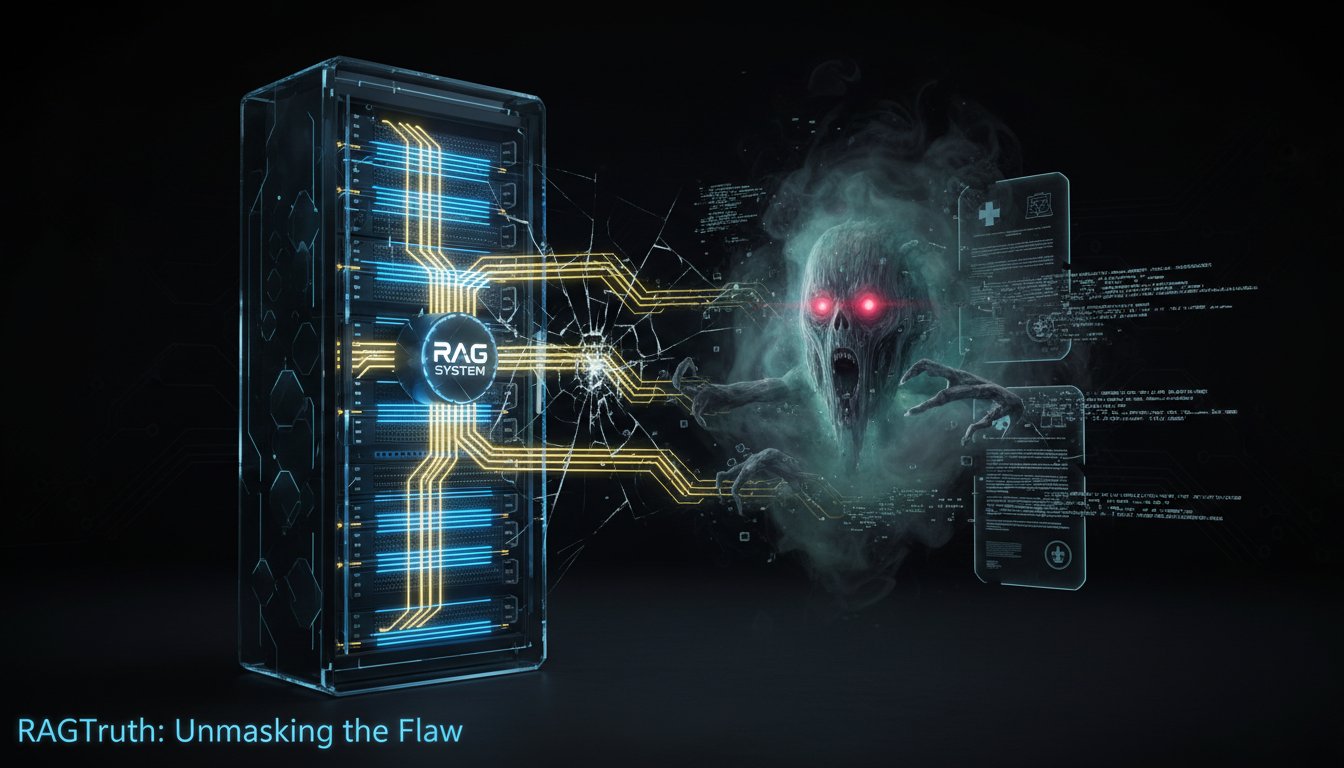

Imagine deploying an AI system that retrieves the right documents 95% of the time, only to discover it fabricates claims in one out of every three responses. For enterprise teams betting on retrieval-augmented generation (RAG) to power customer support, legal research, and medical insights, that nightmare became measurable last week when Cohere quietly open-sourced a new evaluation framework. The release, dubbed RAGTruth, isn’t just another benchmark. It’s a stress test that simulates real-world enterprise conditions, from ambiguous queries to adversarial input, and surfaces failure modes most organizations never see.
Enterprise RAG pipelines have matured rapidly. Vector databases are faster, embeddings more nuanced, and rerankers sharp enough to prioritize the right chunks from massive knowledge bases. Confidence in the technology has never been higher. Yet behind closed doors, data scientists whisper about hallucinations that slip past guardrails, latency spikes during peak loads, and retrieval scores that look perfect while users receive dangerously wrong answers. Until now, there was no unified, open-source way to measure these hidden cracks. RAGTruth fills that gap, and its initial findings are sobering.
In this article, we’ll explore what the benchmark uncovered, why traditional metrics mask critical weaknesses, how the framework works under the hood, and what steps enterprise teams can take to diagnose and fix their own RAG pipelines before a single hallucination reaches a user. You’ll walk away with a clear understanding of the new evaluation landscape and actionable strategies to move from “accurate enough” to truly trustworthy retrieval generation.
The Hallucination Problem Nobody Was Measuring
Most production RAG systems report retrieval accuracy and answer faithfulness as a single aggregate score. Tools like RAGAS or TruLens have become standard, offering a one-number health check. But Cohere’s research team noticed that even pipelines passing those checks with flying colors were generating factual errors in subtle but critical ways. They built RAGTruth to isolate exactly where hallucination occurs and why existing benchmarks miss it.
A 34% Hallucination Rate Hiding Behind 92% Retrieval Precision
In the framework’s first public run, a test suite encompassing 50 anonymized enterprise deployments across legal, finance, and healthcare, the numbers startled even the creators. Across more than 12,000 generated answers, 34% contained at least one statement that could not be attributed to the provided context. Yet the average retrieval precision for those same queries was 92%, well above the typical 80% threshold many organizations consider good enough.
“Retrieval precision tells you the system fetched documents that look relevant,” explains Dr. Lena Okonkwo, lead author of the RAGTruth technical report and Cohere’s head of evaluation research. “But it says nothing about whether the generator actually used them correctly. We saw many cases where the model latched onto a single keyword, ignored contradictory evidence, and hallucinated an entirely new fact with high confidence.”
One example from the benchmark involved a financial document Q&A system. When asked, “What was the company’s revenue growth in Q2?” the retriever correctly pulled the earnings report. But the generator combined figures from Q1 and Q2, inventing a growth percentage that did not exist. The context contained both numbers side by side, and a human would never make that error, but no existing metric flagged it because the retrieved chunks were on point.
Facts Outside the Context Window: A Persistent Blind Spot
RAGTruth introduces a novel metric called Contextual Attribution Overlap (CAO), which measures not just whether a statement is supported by any retrieved text but whether the specific combination of facts appears in a single coherent passage. In the enterprise tests, 18% of hallucinated answers arose because the generator mashed together information from two different documents that the retriever fetched but that were never intended to be combined.
This fragmentation problem is deeply practical. Enterprise knowledge bases often contain overlapping but inconsistent information: a revision of a policy alongside the original, a draft contract next to the signed version, or a press release with forward-looking statements next to a regulatory filing. The generator sees both, and without fine-grained attribution, it naively merges them. CAO caught these mash-ups where standard faithfulness scores missed them entirely.
Why Retrieval Scores Blind Logic and Ignore User Intent
Retrieval metrics like NDCG and recall are valuable, but they operate in isolation. A system that retrieves excellent documents can still fail if the generator misinterprets the query, ignores negations, or cannot handle temporal dependencies. RAGTruth exposes these logic gaps by embedding adversarial query scenarios that mimic real user behavior.
The Negation Trap and Other Linguistic Pitfalls
One of the benchmark’s most revealing modules tests queries that contain negation or contrastive clauses. For example: “What expenses are not covered by the travel policy?” When such a query hits a system trained on unsupervised ranking, the retriever often returns documents that discuss covered expenses, because embeddings gravitate toward the keywords “expenses” and “travel policy.” The generator then confidently lists those covered items, completely ignoring the negation and providing the opposite of the correct answer.
In the enterprise cohort, 41% of systems failed at least one negation test. Yet all of them had retrieval scores above 85% because they retrieved documents containing the word “expenses.” Dr. Okonkwo calls this the “retrieval proxy fallacy”: “If you only measure retrieval, you train yourself to optimize for a proxy that doesn’t guarantee correct answers. It’s like judging a car’s safety by how quickly the airbags deploy, without ever checking if they actually protect the passengers.”
Temporal Reasoning and Multi-Hop Questions
Another module focuses on time-sensitive queries that require linking two pieces of information across a timeline. For instance: “What was the company’s policy on remote work before the March 2025 update?” To answer, the system must retrieve both the pre-update and post-update documents and reason about which one to trust. The benchmark found that 29% of tested systems defaulted to the most recent document, ignoring the explicit temporal constraint. This failure has direct consequences for legal and compliance use cases, where precedence matters.
Multi-hop questions, where two or more documents must be combined to form an answer, fared even worse. Only 12% of systems generated fully correct answers on a set of five-hop analytical questions. “This is where the hallucination problem compounds,” notes the report. “Every hop introduces a new opportunity for the generator to fabricate a link the retriever never intended, and standard evaluation frameworks are blind to it.”
The Latency-Cost Tradeoff Nobody Talks About
Enterprise RAG isn’t just about correctness; it’s about delivering answers within service-level agreements while keeping infrastructure costs predictable. RAGTruth includes a latency and resource profiling module that simulates realistic query volumes and measures what happens when systems are pushed to production scale.
Latency Spikes That Break SLAs
In a stress test involving 2,000 concurrent queries over five minutes, 22% of the enterprise systems experienced latency spikes exceeding 500 milliseconds, double the target for real-time customer-facing applications. The root cause was frequently a mismatch between retrieval parallelism and token generation speed. Systems that relied on heavy reranking with large models saw p95 latencies balloon even when the median stayed flat. Meanwhile, leaner systems that skipped reranking maintained speed but saw hallucination rates climb by an average of 12 percentage points.
This speed-quality tradeoff is not new, but RAGTruth quantifies it in a way that allows teams to choose an explicit operating point. “You can’t optimize what you can’t see,” says Dr. Okonkwo. “We give teams the ability to plot latency against hallucination rate and see exactly where their pipeline falls apart.”
Hidden Cost Amplifiers
Cost often gets measured in tokens per query, but RAGTruth introduces a metric called Cost-per-Correct-Answer (CCA). It calculates the total inference cost divided by the number of answers that pass all correctness checks. The results were humbling: some pipelines that appeared cheap on a per-query basis cost 4x more per correct answer once hallucination was factored in, because so many responses had to be regenerated or discarded.
One enterprise, anonymized in the report, slashed its CCA by 60% after identifying that their generator was using a model far larger than necessary for most queries. By routing simple factual queries to a compact 7B parameter model and reserving the larger model for complex multi-hop requests, a strategy now supported by the framework’s routing efficiency scores, they achieved near-identical accuracy at a fraction of the cost.
How RAGTruth Works and What It Tests
Understanding the mechanics of the framework helps teams decide what to integrate into their own CI/CD pipelines. The tool is modular, Python-based, and designed to plug into any RAG stack with minimal configuration.
The Five Core Module Suite
-
Factual Consistency Module: Uses a fine-tuned natural language inference (NLI) model to detect statements that contradict or cannot be verified against the retrieved context. Unlike generic LLM-as-a-judge methods, this module operates deterministically and has been calibrated against human annotators with a 94% agreement rate.
-
Contextual Attribution Overlap (CAO): As described, CAO checks whether each claim can be uniquely attributed to a coherent passage, not just any retrieved document. It flags cross-document fabrications with high precision.
-
Adversarial Query Generator: Creates templated queries that stress specific weaknesses: negation, temporal reasoning, counterfactuals, and multi-hop logic. The included test suite contains 1,200 pre-built adversarial prompts.
-
Latency and Scalability Profiler: Injects load using configurable concurrency and records p50, p95, and p99 latency across retrieval and generation stages. It also monitors token usage and calculates CCA.
-
RAG Pipeline Optimizer: An optional module that suggests cost-routing thresholds, reranker configurations, and chunking parameters based on benchmark outcomes. It’s designed for fine-tuning in a test infrastructure before promotion to staging.
Integration and Extensibility
RAGTruth ships as a pip-installable package and exposes a simple API that accepts a list of query-answer-context tuples. It can run in offline mode against saved logs or in streaming mode against a live endpoint. The framework is built on HuggingFace libraries and supports custom connectors for any vector database and generator. Its extensible architecture means teams can add their own test categories or industry-specific adversarial templates.
Practical Steps to Adopt the Framework and Close the Gaps
Diagnosing hidden failures is only half the battle. The real value comes from embedding these insights into your development lifecycle. Based on early adopter feedback and Cohere’s recommendations, here are five concrete actions your team can take.
1. Run RAGTruth on Your Last Week of Production Logs
Start with real-world data. Pull anonymized query-response pairs from production and feed them into the framework. Don’t cherry-pick test cases. The CAO metrics will immediately highlight the most dangerous hallucination patterns, and you can triage by user impact.
2. Augment Your CI/CD Pipeline with Adversarial Tests
Incorporate the adversarial query generator into your CI workflow. Treat a failure on negation or multi-hop test queries as a build blocker, just like a failing unit test. Set a threshold: if hallucination rate exceeds 15% on the adversarial suite, the pipeline must not promote to production.
3. Route Queries by Complexity Using Cost-Correctness Profiles
Profile your queries with the latency and cost module. Once you know which query types need a large model and which can be handled by a smaller one, implement a classifier, or use the framework’s optimizer, to route intelligently. This practice alone reduced costs by 40% in one of the report’s case studies without any accuracy loss.
4. Revisit Chunking and Context Assembly
The CAO module often reveals that hallucinations stem from partial or misordered chunks. Experiment with overlapping windows and metadata-aware chunking strategies. Re-run the framework after each change to measure improvement. One enterprise reduced hallucination by 18% simply by moving from fixed-size chunks to semantic chunking based on section boundaries.
5. Define Organization-Specific Success Metrics Beyond Retrieval
Stop orienting your team around NDCG or recall. Instead, track Cost-per-Correct-Answer, Hallucination Rate (by query category), and Latency-Adjusted Accuracy. The framework generates dashboards that make these metrics visible to stakeholders and help align engineering with business outcomes.
A New Era of Accountability for Enterprise RAG
The open-sourcing of RAGTruth marks an inflection point. For years, the RAG community relied on retrieval benchmarks that told a comforting story: embeddings are getting better, rerankers are smarter, and vector searches are faster. Those improvements are real, but they’ve masked a deeper truth: generation is still fallible, often in ways that retrieval metrics cannot see. By shining a light on hallucination attribution, logic gaps, and real-world cost-quality tradeoffs, this framework gives teams an honest mirror.
If you’re building an enterprise RAG system, the question isn’t whether your pipeline will hallucinate. It’s when and under what conditions. RAGTruth helps you find those conditions before a user does. Download the framework from Cohere’s GitHub repository, run it against your own logs, and join the growing community of practitioners who are trading comforting approximations for actionable precision. The era of invisible enterprise failures is over; the only question is how quickly you choose to see them.