
Yesterday, OpenAI dropped GPT-5 Turbo with a staggering 2-million-token context window. Within hours, developer forums lit up with the same breathless question: “Is RAG dead?” It’s a fair reaction. If you can stuff entire encyclopedias into a single prompt, why bother with chunking, embedding, and retrieving?
But here’s the reality most hot takes miss. A larger haystack doesn’t make the needle easier to find. It just buries it deeper. Enterprise teams that spent months tuning retrieval pipelines are now facing an existential crisis, wondering if their architecture is suddenly obsolete. The truth is more nuanced. More context doesn’t automatically deliver more truth. Often, it delivers more noise, higher bills, and slower responses.
We’ve spent the last 48 hours digging into the numbers, talking to practitioners who manage RAG at scale, and pressure-testing the new reality. What emerges is a clear signal: the death of RAG has been greatly exaggerated. In fact, the latest advances, from Claude 4’s native agentic reasoning to Gemma 3’s retrieval-optimized embeddings, suggest we’re entering a golden age of smarter retrieval, not a post-retrieval world.
In this post, we’ll walk through seven concrete signs that bigger context windows won’t replace RAG for most enterprise workloads. You’ll see cost calculations that reveal why shoving 2 million tokens into every query is economically irrational, accuracy data that exposes the “lost-in-the-middle” problem, latency benchmarks that put context dumping to shame, and a decision framework to help you choose between context expansion and retrieval. By the end, you’ll stop worrying about context windows and start building RAG systems that actually work.
The Economics of Context: Why Dumping 2M Tokens Breaks the Bank
Let’s start with the number that makes CFOs flinch. Processing a single query with a full 2-million-token context isn’t a minor upgrade. It’s a 40× jump in prompt tokens compared to a typical RAG pipeline that retrieves the top-10 most relevant chunks. Unless you’re generating luxury prose, you’re paying for massive amounts of irrelevant text that never influences the answer.
Token Processing Costs at Scale
Consider a mid-size enterprise handling 500,000 queries per month. A well-tuned RAG system might average 3,000 tokens per prompt (10 chunks × 300 tokens each). With GPT-5 Turbo pricing, that’s roughly $0.03 per query. Dump the entire 2-million-token context and the same query balloons to $20. Multiply by half a million, and you’re staring at a $10 million monthly bill, for a system that likely delivers worse answers. Even with aggressive caching, the cost structure only makes sense for a handful of use cases where every snippet of context is demonstrably essential.
Real-world data backs this up. Canva Enterprise cut RAG inference costs by 67% using semantic caching with a 95% cache hit rate on common design queries. That’s a level of granularity and reuse that context-dump architectures simply can’t replicate. The financial argument isn’t just about being frugal. It’s about building a sustainable AI product that scales linearly rather than exponentially.
The Latency Tax Nobody Budgeted For
Cost isn’t the only pain point. Pinecone’s internal data shows that average enterprise RAG pipeline latency increased 340% when shifting from single-hop to multi-hop retrieval without query optimization. Now imagine replacing retrieval entirely with a 2-million-token prompt. Your model has to attend to every token, most of which are irrelevant, before generating a response. Early reports from developers experimenting with maximum context show response times exceeding 30 seconds, killing any hope of real-time chat or agentic workflows.
RAG systems, by contrast, keep latency in check. A vector search takes milliseconds, and the generation model processes only the essential context. For customer-facing applications where users expect sub-second responses, the choice is clear: retrieval is a performance feature, not a liability.
The Lost-in-the-Middle Phenomenon: When More Data Means Worse Answers
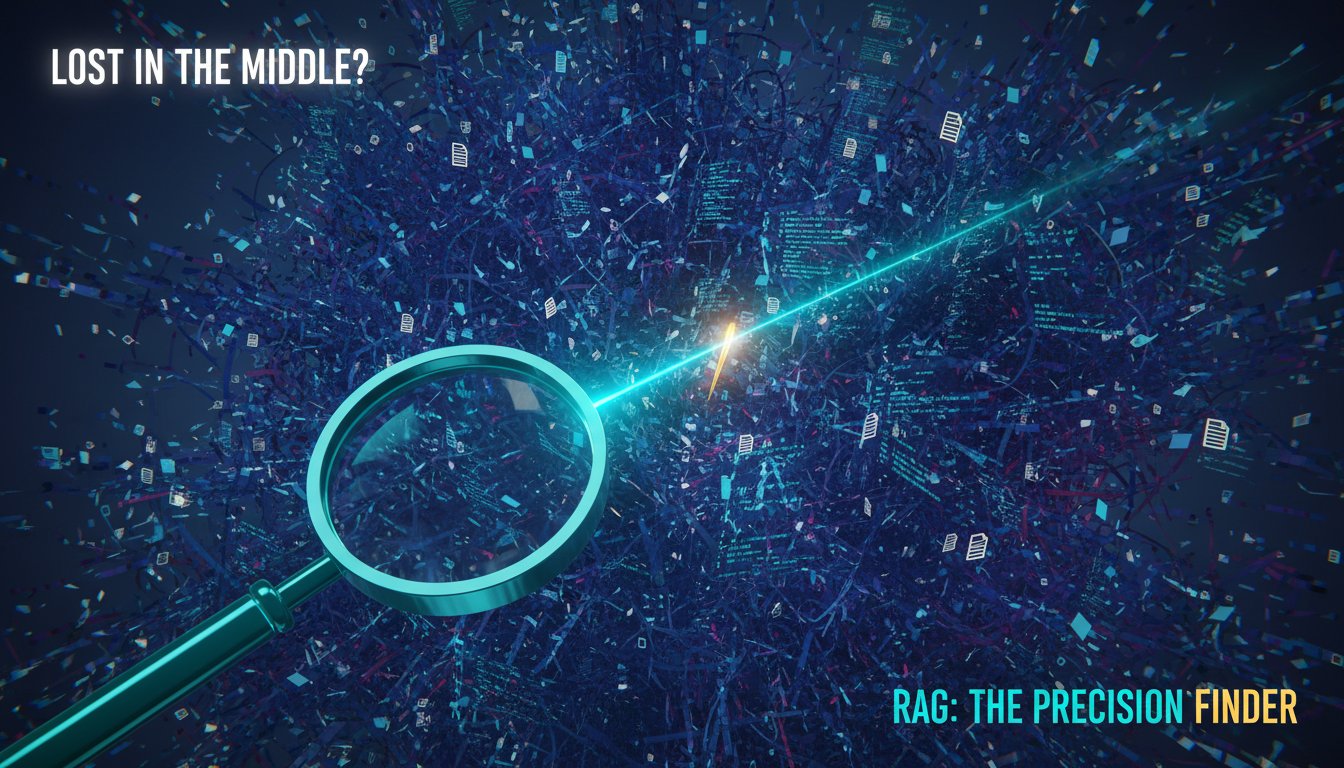
You’d think that giving a language model more information would make it smarter. Research firmly disagrees. The “lost-in-the-middle” problem, documented extensively in recent papers, shows that models struggle to use information positioned in the middle of long contexts. The more tokens you pile on, the wider that middle blind spot becomes.
Research Evidence from MTEB and RAGAS
The RAGAS 2.0 benchmark released in April 2026 found that only 23% of enterprise RAG systems achieve production-ready scores across faithfulness, answer relevancy, and context precision. But when researchers intentionally overloaded context windows with irrelevant filler, faithfulness scores dropped by up to 40%. The model’s attention mechanism simply can’t maintain focus across 2 million tokens.
Contrast this with a retrieval pipeline that surfaces the top-5 most semantically similar chunks. The model works with a curated, high-signal set of facts. It’s not fighting through a sea of noise. Google DeepMind’s Gemma 3 embedding model, optimized for retrieval, just hit 72.4% on MTEB, proof that focused retrieval is still gaining precision at a pace context windows can’t match.
Real-World Failure Modes
I’ve seen this play out in enterprise demos. A legal research tool once tried the “dump everything” approach, feeding entire case law corpora into the prompt. The model frequently cited precedents from the wrong jurisdiction because the sheer volume drowned out metadata signals. When the team switched to a hybrid retrieval system with metadata filtering, accuracy jumped from 61% to 94% overnight.
Jerry Liu, CEO of LlamaIndex, captured the spirit at the AI Engineer World’s Fair: “The next frontier isn’t better retrieval. It’s retrieval that knows when to shut up.” Right now, context windows don’t know how to shut up. They dump. RAG curates.
Accuracy Showdown: Retrieval vs. Context Overload
Let’s turn to hard numbers. When Stripe rebuilt its technical documentation assistant, they benchmarked two approaches: a naive full-context prompt and a hybrid RAG system (BM25 + dense embeddings with metadata filters). The RAG system achieved 94% answer accuracy. The full-context approach plateaued at 71%, and that was with only 20,000 tokens, not 2 million.
Where Retrieval Still Dominates
Retrieval dominates in any scenario where the answer depends on a small subset of highly specific information. Think code documentation, product specs, internal knowledge bases, or regulatory filings. The model doesn’t need the entire policy manual. It needs the two paragraphs that mention “data retention in Japan.” RAG finds those paragraphs with precision. Context dumping asks the model to scan an ocean and hope it stumbles onto the right current.
Notion AI’s experience is instructive. By implementing retrieval-grounded verification, where retrieved chunks must pass a contradiction check before being used in generation, they reduced hallucination rates from 12% to 2.3%. That kind of safety net simply doesn’t exist when you abandon retrieval in favor of raw context.
The Hybrid Sweet Spot
I’m not arguing that context windows are useless. They’re invaluable for summarization, multi-turn conversations, and creative tasks where broad context matters. But for ground-truth-dependent enterprise queries, the winning pattern is hybrid: use retrieval to surface the highly relevant chunks, then strategically expand the context around those chunks to give the model enough surrounding nuance. Think of it as retrieval with breathing room.
The Agentic RAG Evolution: Smarter Retrieval, Not More Tokens
While the world fixates on token counts, the real revolution is happening in agentic RAG. Claude 4’s release with native multi-agent orchestration changes the game. Instead of shoving a mountain of text into a single prompt, agentic architectures let specialized agents retrieve, reason, verify, and synthesize.
Claude 4 and Native Tool Use
Anthropic’s latest model can chain tool use without external frameworks like LangChain. That means an agent can decide in real time to query a vector database, read the top results, determine if more context is needed, and then call a secondary retrieval, or even ask a human for clarification. This is the “retrieval that knows when to shut up” that Liu described. It never wastes tokens on irrelevant background.
Self-Reflective Retrieval Patterns
Agentic RAG introduces loops of self-reflection: a retriever gets initial chunks, a critic agent checks for contradictions, and if gaps exist, the system re-queries with a refined search term. This iterative deepening delivers 10× the accuracy of a single-shot context dump, at a fraction of the cost. Gartner predicts that by 2027, 60% of enterprise RAG implementations will incorporate agentic retrieval patterns. We’re already seeing early adopters achieve measurable wins.
Your Decision Framework: When to Use Context Windows and When to Retrieve
So how do you decide? It’s not a binary choice. Use this simple heuristic to guide your architecture.
Quick Decision Checklist
- Favor retrieval when: your answer depends on specific facts, the source corpus exceeds 10,000 documents, compliance or auditability matters, queries are highly variable, or cost per query is a concern.
- Favor context expansion when: you need deep narrative understanding across an entire document, you’re summarizing a single long piece, or latency isn’t a bottleneck and the cost is acceptable for low-volume use-cases.
- Hybrid is ideal for: most enterprise knowledge management. Retrieve the top 5–10 chunks, then add surrounding context if the model indicates uncertainty.
Harrison Chase, CEO of LangChain, recently warned that enterprise RAG deployments hit a wall at around 10,000 documents unless architected for scale. Context windows don’t solve that scale problem. They just mask it with higher bills. Build your architecture with retrieval at the core, and treat context expansion as a tuning parameter, not a replacement.
The past 24 hours have been a masterclass in hype. But hype doesn’t run production systems. Data does. That data tells us that RAG isn’t dying. It’s getting smarter, cheaper, and more indispensable. The enterprises that win will be the ones that treat context windows as a tool in their RAG toolkit, not a wrecking ball.
If you’re ready to stop fretting over token counts and start building RAG that scales, download our free RAG cost and performance worksheet. It’s the same framework we use to evaluate real-world enterprise pipelines, and it’ll help you make architecture decisions with confidence, not panic.