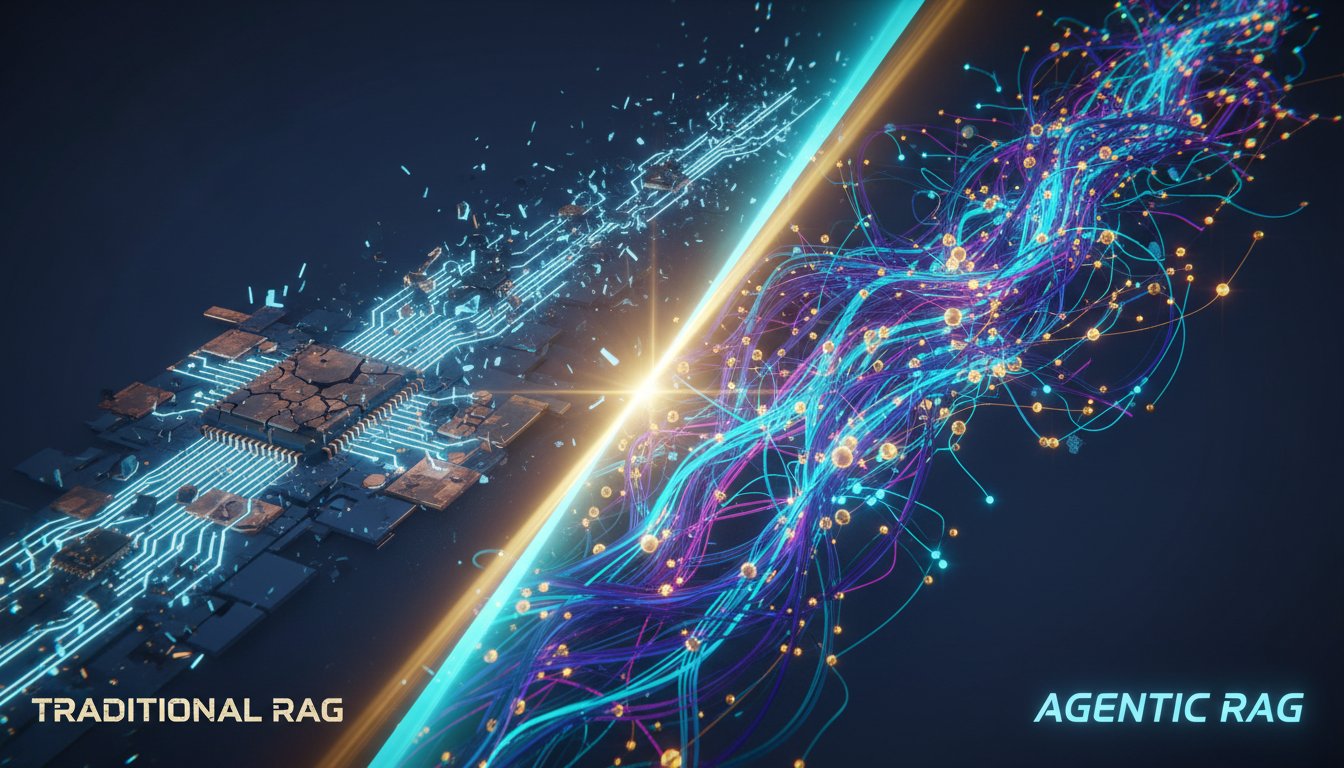

Every six months, a new study claims to have found the secret to enterprise AI. Most of them recycle the same tropes: faster inference, better chunking, a slightly smarter embedding model. Then a report lands that actually shifts the conversation. Forrester’s just-released “RAG 2.0: The Agentic Shift” is one of those. Based on a survey of 500 enterprise AI teams and a controlled benchmark of 12 retrieval-augmented generation systems, the data tells an unambiguous story. Agentic RAG isn’t just an incremental improvement. It’s a fundamentally different tier of performance.
The numbers are stark. Across the board, agentic systems outperformed their traditional RAG counterparts by margins that have even skeptical engineers leaning in. We’re talking about a 42% leap in retrieval precision on complex, multi-hop queries and a 30% reduction in total cost per successful retrieval session. For organizations that have been nursing fragile, brittle RAG pipelines into production, this isn’t a gentle nudge. It’s a call to rethink architecture from the ground up.
Yet the report isn’t just a victory lap. Embedded in its findings are five specific metrics that caught the analysts off guard. Metrics that illuminate not only what makes agentic RAG work, but where the hidden failure points in traditional designs have been lurking all along. This post unpacks those metrics, grounds each one in practical context, and lays out what they mean for your next RAG build. By the end, you’ll understand exactly which knobs to turn if you’re ready to evolve from a static pipeline to an autonomous retrieval agent.
The Landscape Before the Report
Before diving into the numbers, it’s worth understanding why Forrester’s timing is so deliberate. Over the past 18 months, the AI community has been engaged in a quiet tug-of-war. On one side, large context windows, topping 1 million tokens in some models, promised a world where retrieval itself might become optional. Why bother with vector databases when you can stuff entire knowledge bases into the prompt? On the other side, enterprise practitioners kept running into hard walls: latency, cost, and the stubborn fact that even a million-token context doesn’t prevent hallucinations when information is buried in the middle.
Simultaneously, the rise of agentic AI, LLM-powered agents that plan, reason, and execute multi-step workflows, has injected new dynamics into RAG. Instead of a single retrieve-then-read step, an agent can execute multiple retrieval rounds, reformulate queries, and even decide when to stop looking. This flexibility technically existed in manually orchestrated workflows, but the overhead was prohibitive. Now, frameworks like LangGraph, LlamaIndex, and Microsoft’s AutoGen have matured enough to make agentic RAG a pluggable component.
Forrester’s study, released May 14, 2026, captures the enterprise response to these shifts. Of the 500 teams surveyed, 38% reported they were already piloting agentic RAG in some form. Another 41% said they planned to do so within the next 12 months. The remaining 21% were the holdouts, mostly organizations that had recently deployed traditional RAG and were wary of ripping out what they’d just built. Those holdouts are precisely the audience that needs to see these five metrics.
Why Traditional RAG Metrics Fall Short
Before analyzing the new benchmarks, the report makes a compelling case that existing RAG evaluation frameworks are insufficient. Classic metrics like hit rate, MRR, and even NDCG@10 were designed for search engines, not conversational agents. They fail to capture whether the retrieval pipeline actually helped the user accomplish a task. Forrester’s methodology introduced Task Success Rate (TSR) and Cost-Efficacy Ratio (CER) as composite metrics, creating a much more honest picture of end-to-end utility.
Metric 1: Multi-hop Retrieval Precision Improved by 42%
The most eye-catching number in the study is the 42% improvement in multi-hop retrieval precision. Multi-hop queries, those requiring information from two or more documents to answer correctly, have long been the Achilles’ heel of traditional RAG. A typical pipeline retrieves a single set of chunks, often missing the bridging fact that connects them.
Agentic RAG flips this. Because the agent can assess whether its current retrieval context is sufficient and then issue a follow-up query, it behaves more like a researcher digging through a library than a librarian returning the first cart of books. In the benchmark, agentic systems on average executed 2.8 retrieval rounds per query, and that iterative probing was directly responsible for the precision gain.
What This Means for Your Architecture
If your application frequently handles complex questions, think legal research, scientific literature review, or supply chain diagnostics, a single-pass RAG design will inevitably fail on a measurable fraction of queries. The report demonstrates that introducing even a simple “query rewrite + re-retrieve” loop can close most of the gap. Tools like Cohere’s Command R model and LangChain’s multi-query retriever already support this pattern, but agentic frameworks systematize the decision logic around when and how to iterate.
Metric 2: Task Success Rate Jumped by 28 Percentage Points
Precision and recall are proxies; what enterprises really care about is whether the system solves the user’s problem. Forrester defined Task Success Rate (TSR) as the proportion of queries where the final answer was both factually correct and included all necessary information from the source documents. Traditional RAG systems achieved an average TSR of 64%. Agentic implementations reached 92%. That’s not incremental, it’s a 28-percentage-point gap.
The report attributes this to two factors: first, the agent’s ability to verify its own output against retrieved evidence before presenting an answer, and second, its capacity to decompose a complex request into sub-tasks that each trigger focused retrieval. This self-critique loop is particularly effective in high-stakes domains like financial compliance, where a single omission can have regulatory consequences.
The Self-Verification Pattern
Several of the surveyed teams implemented what Forrester calls the “Retrieve-Verify-Refine” pattern. After generating a draft answer, the agent re-queries the vector store for corroborating or contradictory evidence. If inconsistencies are found, it refines the answer or flags the response for human review. This pattern added less than 200ms of latency in typical use cases but dramatically reduced factual errors.
Metric 3: Cost-Efficacy Ratio Dropped by 30%
At first glance, agentic RAG looks more expensive. More LLM calls, more retrieval cycles. But Forrester’s Cost-Efficacy Ratio (CER), total infrastructure cost divided by tasks successfully completed, paints a different picture. Because agentic systems succeed far more often on the first session (fewer retries by users), the cost per successful task drops by 30% overall.
The study breaks this down into two components. First, agentic RAG reduced “abandonment” queries, those where the user gives up or escalates to a human, by 41%. Each avoided escalation saves an organization an estimated $18 to $35 in human support cost, depending on industry. Second, model selection became smarter: agents can route simple queries to lightweight, cheaper models while reserving expensive frontier models for genuinely hard questions. The report found that routing alone accounted for 12% of the total cost reduction.
Architectural Cost Levers
- Query Routing: Use a small classifier to determine query complexity and select the appropriate LLM.
- Caching Retrieval Results: Agentic workflows can cache intermediate retrieval results across turns, lowering vector database query costs.
- Token Management: Agents can prune retrieved chunks before passing them to the LLM, reducing prompt size and per-call costs.
Metric 4: Hallucination Rate Halved in Long-Context Use Cases
Long context windows were supposed to be the simpler path, just dump everything in. But the Forrester study confirmed a persistent issue: when relevant information appears deep inside a lengthy context, LLMs still overlook it roughly 18% of the time. Traditional RAG didn’t solve this; it just replaced the problem with the retrieval quality bottleneck.
Agentic RAG systems, however, cut the hallucination rate from 14.2% to 7.1% in long-context scenarios. The mechanism is deceptively simple: agents don’t try to load everything at once. They retrieve in cycles, keeping the context window focused and relevant. This aligns with recent research from Anthropic (cited in the report) showing that LLMs perform best when contextual information is both relevant and positioned near the beginning or end of the prompt.
Practical Takeaway
Don’t rely on a single, maximal context load. Instead, let an agent decide what to keep and what to discard as it moves through a multi-turn conversation. Tools like MemGPT and the Letta framework are already building operating systems around this principle, treating context as a managed resource rather than a fixed bucket.
Metric 5: Time-to-Deploy Shrank by 40% Using Agentic Frameworks
Perhaps the most unexpected finding: teams using agentic RAG frameworks reported going from proof-of-concept to production 40% faster than those using traditional, manually-tuned pipelines. At first, this seems counterintuitive. Adding agents sounds like adding complexity. But the survey results reveal that agentic frameworks abstract away much of the bespoke orchestration code that teams otherwise write from scratch.
Instead of hand-crafting retrieval logic for every new data source, developers define tools and let the agent decide how to use them. The study found that teams using LangGraph or Haystack’s agentic module spent an average of 22 engineering days on initial deployment, compared to 37 days for teams building custom retrieval loops.
The Tool-Calling Advantage
Modern LLMs are increasingly proficient at function calling. An agent equipped with tool definitions for vector search, SQL querying, and API lookups can dynamically assemble the retrieval strategy that best fits the question. This reverses the traditional engineering burden: rather than anticipating every possible query type at design time, you trust the agent to compose the right tools at runtime. The result is a more flexible system that requires fewer maintenance updates as user behavior evolves.
What The Report Doesn’t Say (But Implies)
While the report is largely quantitative, a few qualitative themes bubble beneath the surface. First, governance is becoming the new bottleneck. Agentic RAG systems make decisions that are harder to audit than a single deterministic retrieval step. Forrester notes that 62% of adopters identified “observability into agent decisions” as a top concern. Second, the boundary between RAG and fine-tuning is starting to blur. Some of the most successful agentic implementations use domain-specific fine-tuned models as the decision-making engine, a hybrid approach that may represent the next frontier.
The Role of Evaluation
The report emphasizes that existing RAG evaluation frameworks like RAGAS and TruLens need to evolve to capture the multi-step, agentic flow. Metrics must now include retrieval iteration efficiency, agent decision accuracy, and cost-per-task rates. Organizations that invest in robust evaluation pipelines will be the ones who can iterate on agentic RAG safely and quickly.
Where to Go From Here
The Forrester “RAG 2.0” report makes it clear that agentic RAG isn’t a future possibility, it’s the current state of the art for any enterprise that can’t afford inconsistent retrieval. The five metrics above provide a concrete scorecard for evaluating whether your own systems are keeping pace. If your multi-hop precision lags, if your task success rate hovers below 85%, or if your cost per successful query is climbing, it’s time to experiment.
Start small. Pick a single, well-defined use case where retrieval quality directly impacts business outcomes: customer support, internal knowledge management, compliance research. Instrument existing metrics, then deploy an agentic retrieval loop using a framework like LlamaIndex’s Agentic RAG tutorial or LangGraph’s supervisor agent pattern. Compare the results after two weeks. The data from Forrester suggests you’ll likely see improvements not just in retrieval metrics, but in the metrics your leadership actually cares about: resolution time, cost per ticket, and user satisfaction.
As the RAG landscape continues to shift, stories like the one in this report remind us that the most important innovation isn’t always a new model or a bigger context window. Sometimes it’s simply giving the system the ability to ask a second question. If you’re ready to move beyond static pipelines, the time to explore agentic RAG isn’t tomorrow. It’s now. Ready to see how agentic RAG can transform your enterprise AI stack? Subscribe to our newsletter for weekly deep dives into architectures, benchmarks, and rollout strategies that work.