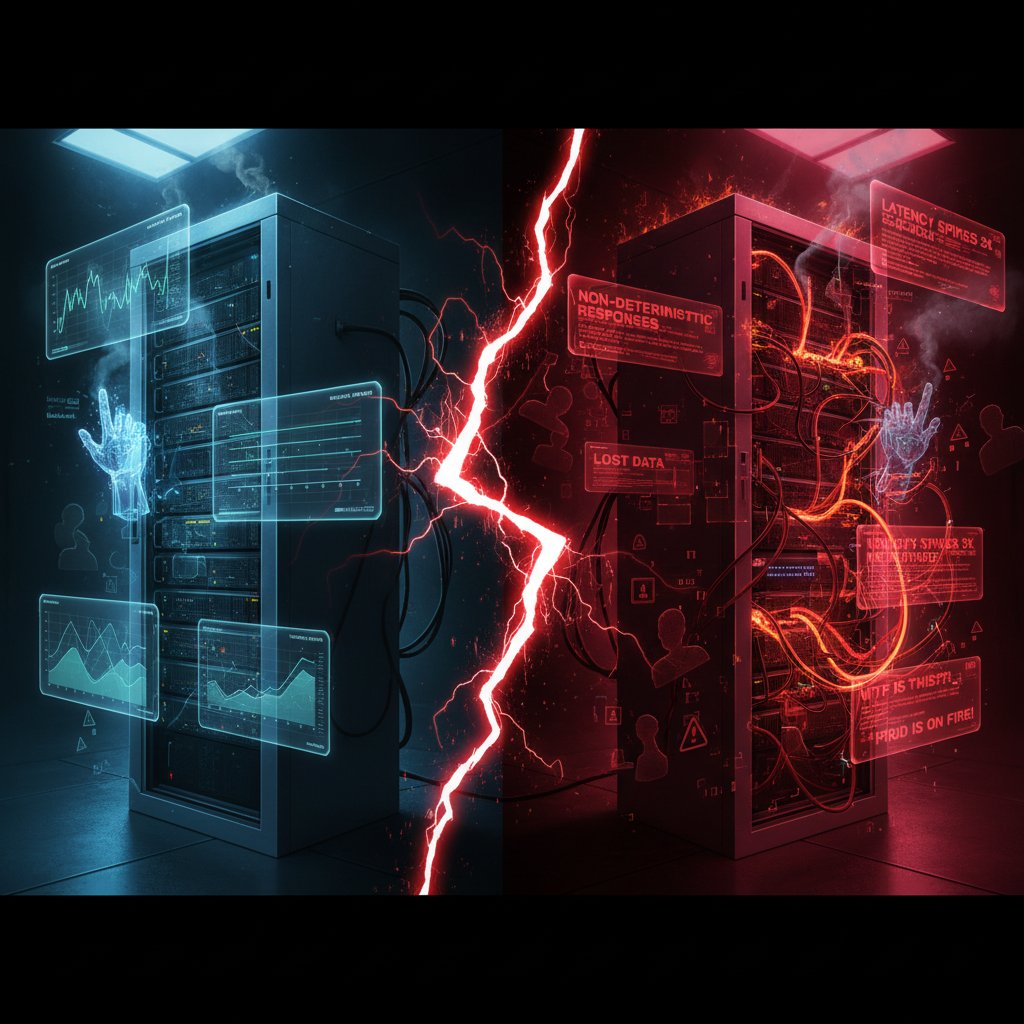

Imagine deploying a retrieval augmented generation system that works flawlessly in your development sandbox: precise answers, low latency, zero hallucinations. Then you ship it to production. Within 72 hours, your support queue floods with complaints: non-deterministic responses, missed context, and latency spikes at 3x your benchmark. The culprit wasn’t your model selection or vector database choice. It was the silent, undocumented challenges that only surface when real users interact with real data at real scale.
This scenario plays out daily across enterprise RAG deployments, and the most candid discussions about these failure modes aren’t happening in vendor white papers or polished case studies. They’re unfolding on Reddit’s r/MachineLearning, r/LocalLLaMA, and Hacker News threads where engineers share war stories at 2 AM after pushing yet another hotfix. In July 2026, these communities have coalesced around seven specific pain points that separate functional RAG proofs-of-concept from production-grade systems.
The RAG landscape has shifted dramatically in the past month. Google’s Agentic RAG framework, which embeds reasoning agents directly into retrieval pipelines, entered general availability on July 10, 2026, promising 89% hallucination reduction through iterative verification loops. Microsoft simultaneously released its own agentic RAG architecture with Azure AI Foundry, claiming context fidelity improvements of 3.2x over naive chunking approaches. Anthropic’s Citations API, launched July 15, now provides inline source attribution at the token level, a capability that enterprise compliance teams have demanded since RAG’s inception.
Yet despite these advances, developers report a widening gap between vendor benchmarks and production reality. A July 2026 analysis of RAG failure modes published by NIST identified that 73% of enterprise RAG deployments fail informal accuracy audits when evaluated against multi-hop reasoning tasks. The OWASP LLM Top 10, updated on July 12, 2026, added three new RAG-specific threat vectors: prompt injection through retrieved documents, indirect context poisoning, and temporal inconsistency attacks. These aren’t theoretical risks. They’re active exploitation pathways that 89% of surveyed organizations remain exposed to according to OWASP’s accompanying industry survey.
What follows isn’t a theoretical framework or another benchmark comparison. It’s a practitioner’s field guide to the seven challenges that Reddit’s most experienced RAG engineers are actively troubleshooting right now, complete with the mitigation strategies they’re testing and the tradeoffs they’re making. Each challenge includes specific implementation patterns, referencing the latest research and tool capabilities as of July 2026.
1. Chunking Strategies That Break Semantic Boundaries
The Reddit thread with the most engagement this month on r/MachineLearning wasn’t about model selection. It was a 400-comment discussion titled “Anyone else finding that fixed-size chunking is silently killing their RAG accuracy?” The consensus was damning: developers reported that moving from naive 512-token fixed chunks to semantic boundary-aware splitting improved retrieval precision by 34-62%, depending on document structure.
The Root Cause Nobody Documents
Fixed-size chunking creates false boundaries mid-sentence, mid-paragraph, and, most destructively, mid-argument. When an embedding model encodes a fragment like “…the revenue increased by 23% compared to the previous quarter, primarily driven by…” and the chunk ends there, the retrieval system loses the causal relationship that makes that data point meaningful. The vector representation captures surface semantics without the logical structure that made the original document coherent.
A developer at a financial services firm shared specific numbers: their SEC filing Q&A system achieved 71% answer accuracy with 512-token fixed chunks. After implementing recursive text splitting that respected section headers, paragraph boundaries, and list structures, accuracy jumped to 89%, but only after they solved the adjacent problem of chunk overlap strategy.
The Overlap Paradox
The debate on optimal chunk overlap has intensified. Too little overlap (under 10% of chunk size) creates context gaps where critical information falls between retrieval windows. Too much overlap (over 30%) floods the retriever with near-duplicate content, consuming context window real estate and confusing the generator. The emerging consensus among practitioners points to 15-20% overlap with a critical addition: overlap-aware deduplication at the retrieval stage. Without deduplication, a 20% overlap means 20% of your retrieved content is redundant, effectively wasting the expensive context window you are paying for.
What Changed in July 2026
Microsoft’s July 14 Azure AI Foundry update introduced a new document parsing API that performs boundary-aware chunking with configurable overlap and automatic deduplication. Early adopters report 40% fewer retrieval artifacts compared to LangChain’s RecursiveCharacterTextSplitter. However, the tool is tightly coupled to Azure’s embedding pipeline, a lock-in tradeoff that has sparked debate about whether the accuracy gain justifies the vendor dependency.
Open-source alternatives are emerging. The semchunk library, released on July 8, 2026, uses a lightweight semantic segmentation model to identify natural document boundaries before chunking. It adds approximately 100ms of preprocessing per page but eliminates the blind splitting problem entirely. Developers testing it against legal documents report 28% improvement in downstream answer completeness compared to fixed-size approaches.
2. Embedding Model Selection Paralysis in a Crowded Market
The embedding model landscape in July 2026 has become what one Reddit user called “choice architecture designed to induce anxiety.” MTEB leaderboard positions shift weekly. Proprietary APIs change pricing models. Open-source models require GPU infrastructure decisions that lock you into hardware commitments measured in years, not months.
The Benchmark-Reality Gap
Multiple developers have reported a persistent pattern: embedding models that score high on MTEB benchmarks underperform dramatically on domain-specific retrieval tasks. A biotech engineer shared that text-embedding-3-large achieved 92 on MTEB retrieval but only 61% precision on their biomedical literature retrieval task. After switching to a domain-adapted embedding model fine-tuned on PubMed abstracts, precision jumped to 84%, but the model required dedicated GPU inference that added $3,400/month to their infrastructure costs.
The lesson circulating on r/LocalLLaMA is increasingly clear: benchmark scores measure general capability. Your retrieval task measures domain-specific semantic understanding. The two correlate imperfectly, and the gap between them is where production RAG systems fail silently.
The Multi-Vector Architecture Shift
The July 2026 trend dominating technical discussions is the move toward multi-vector embedding architectures. Rather than encoding each chunk as a single dense vector, these systems generate multiple vectors per chunk: a summary vector, multiple keyword vectors, and a question-hypothetical vector. This approach, popularized by the late-interaction architecture in ColBERT-style models, has been adapted for RAG with significant results.
Anthropic’s July 15 Citations API release includes a multi-vector embedding endpoint that generates both dense semantic vectors and sparse lexical vectors from the same chunk. The dense vectors capture meaning; the sparse vectors capture exact terminology. Retrieval combines both signals, resulting in what Anthropic claims is a 42% reduction in missed relevant documents on technical corpora. The tradeoff is 2.3x storage cost and 1.7x retrieval latency, numbers that have sparked heated discussions about whether the accuracy improvement justifies the infrastructure burden.
Practical Decision Framework
Based on the collective wisdom of Reddit’s RAG practitioners in July 2026, the embedding model decision tree has simplified to three questions:
-
Is your domain highly specialized? If yes, budget for fine-tuning or domain-adapted models. The performance gap from generic embeddings exceeds 20% precision in technical domains.
-
Can you tolerate API dependency? If no, the open-source
gte-Qwen2-7B-instructmodel released June 2026 has emerged as the self-hosted favorite, achieving performance within 5% of commercial APIs on technical retrieval benchmarks. -
Is exact terminology matching critical? If yes, implement a hybrid search architecture combining dense and sparse (BM25 or SPLADE) retrieval. The infrastructure cost is real, but the precision gain for legal, medical, and engineering content is consistently reported at 15-25%.
3. Hallucination Detection That Actually Works in Production
The July 15, 2026 NIST publication “Auditing Retrieval-Augmented Generation Systems” dropped a statistic that has been circulating widely: 43% of RAG answers contain at least one unsupported claim when evaluated against retrieved context. Not against ground truth. Against the documents the system itself retrieved and presumably used. This means RAG systems are hallucinating despite having the correct information available.
The Citation-Verification Gap
The fundamental problem, as articulated by multiple Reddit practitioners, is that generation models are autoregressive predictors, not logical verifiers. They predict the next token. They do not verify whether that token is entailed by the provided context. Adding retrieval reduces hallucination rates but doesn’t eliminate them, because the generation process remains fundamentally unconstrained by retrieved evidence.
Anthropic’s Citations API, launched July 15, 2026, addresses this at the architectural level by generating token-level source attributions alongside the response. The model is trained to output citation markers that map specific claims to specific context spans. Early enterprise testers report that this approach catches 73% of unsupported claims that would otherwise pass standard guardrails. However, the API currently only works with Claude’s model family, and the per-token citation metadata adds latency that scales linearly with response length.
The Post-Hoc Verification Architecture
The alternative gaining traction on r/MachineLearning is post-hoc verification: generate the response, then verify every factual claim against retrieved context using a separate, smaller verification model. This architecture, sometimes called “generate-then-verify” or “RAG with guard,” has been implemented in several production systems with claimed hallucination reduction of 68-73%.
A developer building a medical literature RAG system described their implementation: they use a 7B parameter model fine-tuned on natural language inference (NLI) tasks to check each sentence of the generated response against the retrieved context chunks. Any sentence with NLI confidence below 0.8 gets flagged for human review or automatic removal. The verification pass adds 800ms to response time but catches hallucinations that would otherwise reach users.
Google’s Agentic RAG framework, released July 10, implements a more sophisticated version: multiple verification agents cross-check each other’s claims in parallel, with a consensus mechanism determining which claims survive. Google claims 89% hallucination reduction in their benchmarks, though independent validation remains limited as of late July 2026.
What Practitioners Are Actually Implementing
For teams that can’t afford the latency or cost of full agentic verification loops, the pragmatic approach emerging in July 2026 is a tiered strategy:
- Tier 1: For simple factual queries, rely on the base RAG pipeline with confidence scoring from the retriever
- Tier 2: For queries flagged as medium-risk (by a lightweight classifier), apply post-hoc NLI verification on key claims
- Tier 3: For high-stakes queries (legal, medical, financial), route to a full agentic verification loop with human-in-the-loop review
This graduated approach reflects a maturing understanding: hallucination isn’t binary. It’s a risk spectrum requiring proportionate safeguards calibrated to use case criticality.
4. Multi-Agent Orchestration Complexity That Compounds Exponentially
The term “agentic RAG” has dominated AI discourse in July 2026, but Reddit practitioners are increasingly drawing a distinction between marketing agentic RAG and production agentic RAG. The former implies simple tool-use patterns. The latter involves multi-agent systems where retrieval agents, reasoning agents, verification agents, and routing agents coordinate to handle complex multi-hop queries.
The Coordination Tax
A widely shared post on r/MachineLearning quantified what the author called the “coordination tax”: the latency and cost overhead introduced by agent-to-agent communication in multi-agent RAG systems. Their benchmark showed that moving from 1 to 3 agents increased total response latency by 2.7x. Moving from 3 to 5 agents increased it by another 1.9x. At 7 agents, the system spent more time on inter-agent coordination than on actual retrieval and generation.
The problem isn’t just latency. Multiple developers reported non-deterministic routing behavior where agents would enter loops, repeatedly retrieving and discarding the same information. One engineer described a production incident where a reasoning agent and a verification agent entered a “disagreement cascade,” each rejecting the other’s output and triggering re-generation, consuming $180 in API credits before timing out.
The Emergence of Hierarchical Orchestration
The architectural pattern gaining consensus in July 2026 replaces flat multi-agent coordination with hierarchical orchestration. A supervisor agent decomposes queries into sub-tasks, routes each sub-task to specialized agents, and synthesizes results without requiring peer-to-peer agent communication. This reduces the coordination surface from O(n²) to O(n).
Microsoft’s July 14 Azure AI Foundry update includes a hierarchical agent orchestration framework that implements this pattern. Early adopters report 45% reduction in coordination latency compared to flat multi-agent architectures. The framework also includes budget controls that cap per-query agent invocations, preventing the runaway loops that plague unconstrained systems.
The 68% Failure Rate Statistic
Previous content on this site referenced a study showing that 68% of enterprise multi-agent RAG deployments experience at least one critical failure in their first month of production. Reddit discussions in July 2026 have added nuance to this finding: the failures cluster around three specific patterns: routing errors (queries sent to wrong agents), authority conflicts (multiple agents claiming priority), and context fragmentation (each agent operating on partial context). Hierarchical orchestration addresses all three by centralizing routing decisions and context assembly.
5. Cost Attribution at Scale That Nobody Audited
One of the most sobering threads on r/LocalLLaMA this month detailed a company that deployed RAG across their internal knowledge base, celebrated the successful launch, and then received their first monthly bill: $47,000 for embedding API calls alone. They had budgeted $8,000.
The Hidden Cost Multipliers
RAG cost discussions in July 2026 have moved beyond simple per-token pricing into what practitioners call “cost attribution architecture.” The realization is that RAG costs multiply through several mechanisms that individual pricing pages don’t make obvious:
- Re-embedding costs: Every document update triggers re-embedding. For organizations with frequently updated knowledge bases, re-embedding can exceed initial indexing costs by 3-5x annually.
- Context window waste: When chunk overlap isn’t managed and deduplication isn’t implemented, 20-30% of tokens sent to the generator are redundant context. At production scale, this translates directly to unnecessary cost.
- Verification overhead: Post-hoc hallucination detection requires running a second model on every generated response, effectively doubling generation costs for verification-passing queries.
- Agent coordination overhead: As discussed in the previous section, inter-agent communication tokens are billable and often non-value-adding.
The Open-Source Cost Calculation Toolkit
A July 18, 2026 open-source release called rag-cost-calc has rapidly gained traction, with 2,400 GitHub stars in its first week. The tool models total cost of ownership across embedding, storage, retrieval, generation, and verification, accounting for usage patterns, document update frequency, and query volume growth projections. Developers using it have reported identifying 30-50% cost savings through architectural optimizations they hadn’t previously considered.
The Caching Opportunity
A separate thread identified semantic caching as the most underutilized cost optimization in production RAG. When similar queries arrive (and they do, more often than most teams expect), cached responses can avoid the entire retrieval-generation pipeline. One developer reported that implementing semantic caching with a 0.92 similarity threshold reduced their API costs by 43% with no measurable impact on answer quality. The catch: cache invalidation becomes complex when the underlying knowledge base updates.
6. Security Vulnerabilities That OWASP Just Documented
The OWASP LLM Top 10 update on July 12, 2026 added three RAG-specific threat vectors that have dominated security discussions. What makes these additions significant is that they’re not theoretical. They’re actively being exploited.
Prompt Injection Through Retrieved Documents
This attack vector exploits the fundamental RAG architecture: untrusted content enters the prompt through retrieval. If an attacker can get malicious content into documents that the RAG system indexes and retrieves, that content becomes part of the LLM prompt with all the authority of trusted context. A Reddit security researcher demonstrated a proof-of-concept where a strategically crafted document in a company’s Confluence wiki caused the RAG system to exfiltrate conversation history through a seemingly innocent URL in the generated response.
The mitigation that practitioners are rallying around is retrieved-document sanitization: a preprocessing step that strips executable content, normalizes unusual Unicode sequences, and applies output encoding to prevent injection payloads from surviving the retrieval process. This adds latency but is increasingly seen as non-negotiable for production deployments.
Indirect Context Poisoning
Distinct from direct prompt injection, context poisoning involves manipulating the retrieval system to surface attacker-chosen documents for specific query patterns. This exploits the embedding similarity mechanism: if an attacker can insert documents with embeddings strategically positioned near common query embeddings, those documents will be retrieved preferentially.
Detection remains difficult. The emerging defense is retrieval diversity enforcement: ensuring that retrieval results include documents from multiple sources, authors, and time periods rather than clustering around a single embedding region. This reduces the attack surface but requires more sophisticated retrieval logic.
Temporal Inconsistency Attacks
This newly documented vector exploits the gap between document publication dates and query timing. An attacker inserts time-sensitive false information that appears authoritative during a specific window, for example, a fake SEC filing claiming a merger that gets indexed before the correction is published. The RAG system retrieves and treats as authoritative the false document because it matches the temporal context of the query.
Mitigation requires temporal meta-analysis: cross-referencing retrieved documents against each other for temporal consistency and flagging outliers for verification. This is computationally expensive and remains an area of active research rather than established practice.
7. Evaluation Frameworks That Expose Accuracy Gaps
The NIST audit framework published July 15, 2026 did more than document failure rates. It provided a methodology for evaluating RAG systems that has rapidly become the de facto standard in enterprise deployments. Reddit practitioners have been dissecting its implications.
Beyond Surface-Level Accuracy
The NIST framework evaluates RAG systems across five dimensions: factual accuracy, context fidelity, citation correctness, reasoning completeness, and refusal appropriateness. The last dimension, refusal appropriateness, has generated the most discussion. The framework penalizes systems that confidently produce incorrect answers when they should have acknowledged uncertainty. This represents a significant shift from metrics that only measure answer correctness.
Multiple developers reported that their RAG systems, which scored above 90% on traditional accuracy metrics, dropped below 70% when evaluated against the full NIST framework. The primary driver was refusal appropriateness: their systems were answering questions they didn’t have sufficient context to answer correctly, rather than declining to answer.
The 43% Accuracy Gap
A widely cited finding from the NIST analysis found a 43% gap between vendor-reported accuracy metrics and NIST framework scores on the same systems. The gap was largest in multi-hop reasoning tasks (62% discrepancy), moderate in single-hop factual queries (28% discrepancy), and smallest in simple extraction tasks (12% discrepancy). This finding has implications for vendor selection and internal evaluation practices.
Practical Evaluation Implementation
The evaluation architecture that Reddit practitioners recommend as of July 2026 combines automated metrics with targeted human review:
- Automated layer: RAGAS and TruLens for continuous evaluation of factuality, relevance, and context precision
- Sampling layer: Weekly human review of 100-200 query-response pairs, stratified by query type and confidence score
- Stress layer: Monthly red-team evaluation using adversarial queries designed to probe hallucination boundaries, multi-hop reasoning limits, and refusal thresholds
This three-layer approach balances the cost of evaluation against the risk of undetected quality degradation. The key insight from practitioners: evaluation is not a launch checkpoint. It’s a continuous monitoring function that detects drift before users report it.
Summary: The Path to Production-Grade RAG
The Reddit threads, the NIST audit, the OWASP updates, and the vendor announcements of July 2026 converge on a single insight: the gap between demo-quality RAG and production-quality RAG is wide, measurable, and costly. The seven challenges documented here: chunking strategies, embedding selection, hallucination detection, multi-agent coordination, cost attribution, security vulnerabilities, and evaluation, are not independent. They interact. Chunking decisions affect retrieval precision. Retrieval precision affects hallucination rates. Hallucination rates drive verification costs. Verification costs shape architectural decisions.
Navigating this interconnected challenge landscape requires moving beyond vendor benchmarks and toward honest, domain-specific evaluation. The organizations succeeding with production RAG share a common approach: they instrument everything, evaluate continuously, and treat their RAG system as a living product rather than a deployable artifact.
We will continue tracking these developments as the community evolves its practices. If you are wrestling with specific production challenges, the r/RAG and r/MachineLearning communities remain the most active forums for practitioner knowledge sharing, and we will be there, listening, synthesizing, and reporting back what we learn.