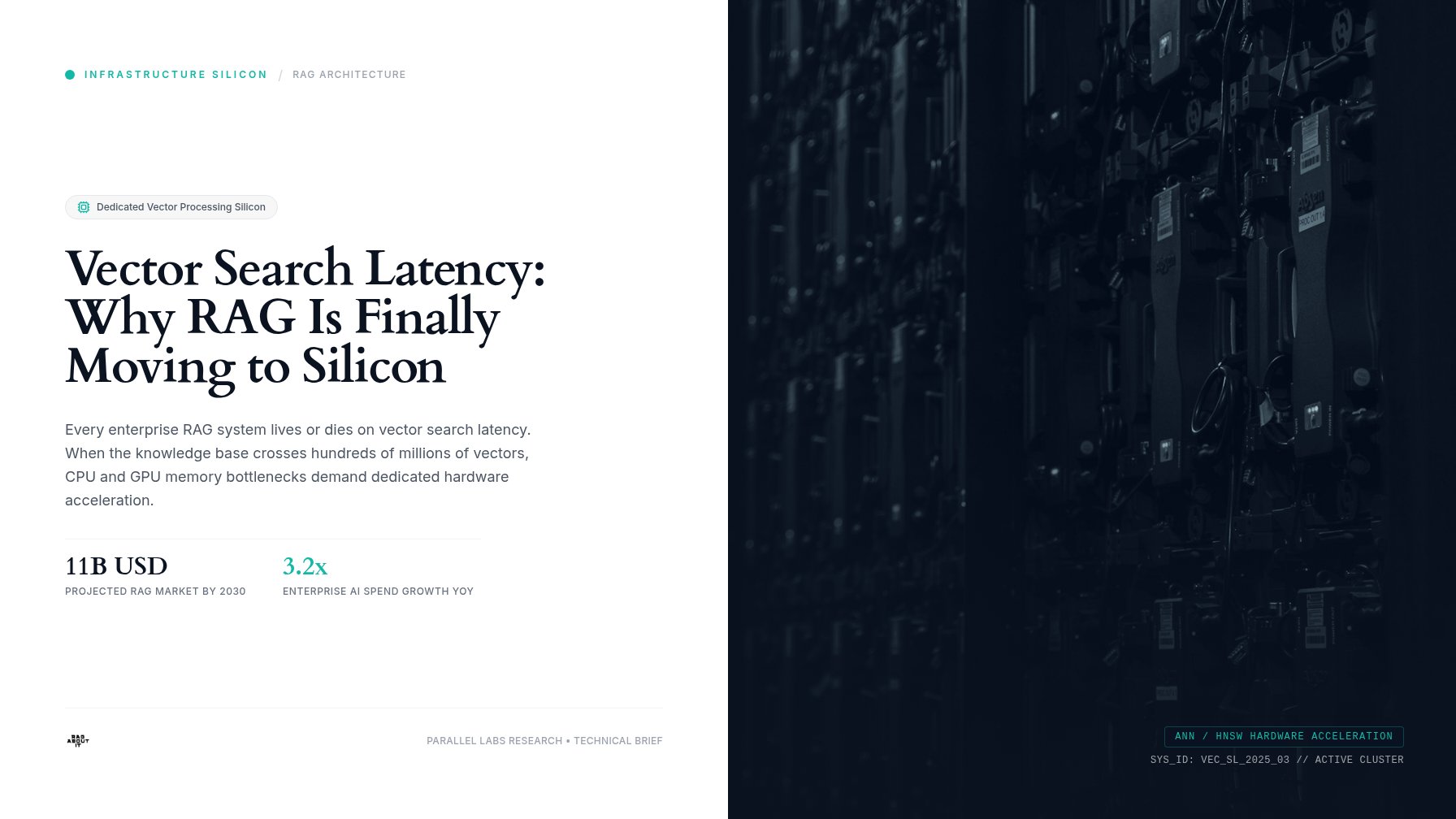

Something unusual showed up at the AI Infra Summit this week: server racks built around dedicated vector processing silicon. Dnotitia, the hardware company behind the announcement, designed its chips for one job. Find the nearest neighbors in huge vector spaces, fast. No general-purpose cores handling side work, no GPU kernels fighting over memory. Silicon that runs vector queries all day.
That sounds niche. It isn’t.
Every enterprise RAG system lives or dies on vector search latency. A user asks a question. Your stack converts it to an embedding, then hunts through millions or billions of stored vectors for the closest matches. That hunt, known as KNN or ANN search, is where the delays pile up. It hammers memory in ways CPUs and GPUs handle poorly. Both were built to compute, not to stream huge volumes of embedding data through comparisons.
For years, RAG teams have fought this in software. The toolbox runs from quantization and smaller embedding models to smarter graph indexes and caching layers bolted in front of the database. All of it works, up to a point. Then the knowledge base crosses a few hundred million vectors. Every query turns into a data-movement problem no amount of Python tuning can fix.
Dedicated silicon attacks that wall head-on. It also reframes a debate the RAG world has had entirely in software terms, from rerankers and compression to long context windows and agent loops.
The timing matters. Menlo Ventures reports enterprise generative AI spending grew 3.2x year over year, from $11.5 billion to $37 billion. Grand View Research projects the RAG market growing from $1.2 billion to roughly $11 billion by 2030. At those budgets, vector search latency is a line item.
This post covers what server-scale vector silicon does, why it shifts the real bottleneck back onto your data pipeline, and how to tell whether your stack needs any of it this year. We’ll stay concrete: architecture, numbers, and the cases where hardware acceleration beats software, plus the ones where it doesn’t. Vector search latency is only a hardware problem for some of you.
The Vector Search Latency Wall Every Large RAG Stack Hits
Vector search looks simple from the outside. Store embeddings, compare a query against them, return the top matches. Scale breaks the simplicity.
At 10,000 embeddings, brute force works. You can compare and sort the results in well under a millisecond. At 500 million 768-dimension vectors stored as float32, the raw data alone is about 1.5 terabytes. Scanning all of it per query is physically impossible inside an interactive latency budget.
So production systems use approximate nearest neighbor indexes like HNSW or IVF-PQ. These cut the search space down to a fraction, but the queries turn into pointer-chasing. An HNSW query hops between graph nodes scattered across memory, and nearly every hop risks a cache miss. The CPU stalls while data trickles in from RAM. Throughput collapses. Adding more cores doesn’t help much, because the problem isn’t arithmetic. At scale, vector search latency is mostly time spent waiting on memory. More cores can’t fix waiting.
Why GPU Money Doesn’t Fix Vector Search Latency
The reflex answer is to throw GPUs at retrieval. It rarely works the way people hope.
Vector search is memory-bound, not compute-bound. A graph traversal might do a few thousand cheap distance calculations while pulling data from dozens of random memory locations. GPUs shine when thousands of threads run the same operation on contiguous data. Graph traversal is the opposite workload. You pay data center prices for silicon that idles most of the time.
Sharding adds another layer. Vector databases scale by splitting collections across nodes, so one query can touch several machines over the network. Every shard adds a hop to your tail latency. Anyone who has chased a p99 incident at 3 a.m. knows how this goes.
Why Agentic Retrieval Multiplies Vector Search Latency
Agentic systems make the math worse. A single-hop lookup runs one query per answer. An agent that reformulates and retrieves in a loop can run five, ten, or twenty queries before responding. At 150 milliseconds per query, a multi-step agent burns two to three seconds on retrieval alone. That’s before the LLM generates a single token. Vector search latency that feels fine for one query becomes a deal-breaker at twenty.
Databricks has been blunt about this in its enterprise agent work. How agents retrieve context, not the model, is the main bottleneck for autonomous workflows. Iterative retrieval is what makes agents useful. It’s also what makes them expensive. The loop only stays viable when the per-query cost is low enough to multiply.
That’s the gap between ‘RAG works in the demo’ and ‘RAG works under an SLA.’
What Dedicated Vector Silicon Changes
The Dnotitia announcement matters less for the chips themselves than for the category it opens. For two decades, vector search has run as software on general-purpose hardware. There is now a third option: processors designed around the access patterns of ANN search itself.
Near-Memory Processing
The core idea is simple. Put comparison logic physically close to where vectors live, instead of dragging them across a memory bus into a CPU. Distance calculations happen in place. The data barely moves, which is the whole point, because moving data was the bottleneck.
Dedicated vector processing units also harden the parts of ANN search that general CPUs run through software: graph traversal, priority queues, distance scoring over compressed vectors. When those primitives live in fixed-function silicon, per-query vector search latency drops and throughput per watt climbs. For data center operators, power efficiency per million queries is becoming as important as raw speed.
The claim from the hardware side is straightforward. Real-time enterprise RAG becomes viable at petabyte-scale knowledge bases, where software-only stacks have to trade latency against recall.
How the Options Compare
| Dimension | CPU + software index | GPU + vector kernels | Dedicated vector silicon |
|---|---|---|---|
| Sweet spot | Small to mid collections | Batch embedding, dense scans | Huge collections, high query volume |
| Latency behavior | Fine at 10M vectors, degrades after | Good average, uneven p99 | Built for flat p99 at scale |
| Memory bottleneck | Severe | Present, and expensive | Addressed in the architecture |
| Ecosystem maturity | Very high | High | First generation |
| Integration | Everything supports it | Good library support | New, vendor-specific |
Caveats, honestly stated: this is first-generation hardware. Driver maturity, tooling, and integration with the vector databases most teams already run will take time. Any vendor benchmark deserves a second look, especially p99 numbers measured under production-like query mixes rather than synthetic scans.
The Bottleneck Moves to Your Data Pipeline
Here’s the part most coverage will miss. When vector search latency stops being the constraint, whatever remains becomes the constraint. In RAG systems, that’s almost always the data.
Hardware Can’t Fix Bad Embeddings
If your chunks are poorly parsed, your embeddings sit in the wrong neighborhoods. Faster search just returns wrong answers sooner. DeepMind’s findings on the limits of embedding models apply no matter what silicon runs the comparisons. Teams that skip embedding evaluation while shopping for hardware are paying to speed up the wrong layer.
Ingestion Becomes the Long Pole
Once queries answer in single-digit milliseconds, the time to parse, chunk, and index a document dominates. Tables, multi-column PDFs, and charts are still the messiest inputs in RAG engineering. No chip fixes them. Our guide to the document parsing problem covers the fixes that do work.
Freshness is the other half. A retrieval layer that answers instantly from stale data is a faster way to be wrong. Keeping vector stores current as source documents change is its own discipline. We covered it in our piece on knowledge decay in production RAG systems.
A related category is forming around this exact problem: storage and caching layers that pre-clean, chunk, and index corporate data before it reaches the retrieval path. If you’re enriching documents at ingestion anyway, entity extraction into a semantic layer is worth a look as well.
The Hallucination Budget
Amr Awadallah, CEO and co-founder of Vectara and a former Google VP of Data, describes where enterprise attention is heading. Developers are increasingly frustrated by LLMs hallucinating on internal corporate data. The newest RAG platforms, he says, focus on driving hallucination rates toward zero to make deployments commercially viable.
Retrieval speed helps that goal indirectly. It buys the latency budget to run verification steps, reranking passes, and fact-checking agents. Without that budget, they’d blow your response-time SLA. Faster hardware doesn’t reduce hallucinations. It makes hallucination reduction affordable.
Should You Change Your Stack Yet?
For most teams, not yet. For some, probably soon. Here’s how to tell which camp you’re in.
When Software Still Wins
Under roughly 10 million vectors with moderate query volume, the software toolbox is the right answer. It’s also cheap. Quantization, better chunking, reranking, and caching handle the majority of enterprise workloads. If you haven’t exhausted those options, hardware is an expensive detour around problems you can fix in code.
The cost question deserves real math. Our cost analysis of AWS S3 Vectors against traditional vector databases shows how differently managed retrieval options price out. Hardware acceleration adds another variable to that comparison. It only pays off when collection size and query volume push software stacks past their efficient operating range. Research and Markets pegs roughly 73% of RAG implementations inside large enterprises. That’s exactly where those limits get hit first.
When Hardware Starts Making Sense
Watch for three conditions stacking up. Your collection runs into the hundreds of millions of vectors. Your SLA demands consistent vector search latency, meaning sub-100-millisecond retrieval at p99, not just on average. Or your architecture is agentic, multiplying queries per user interaction. When two or more apply, benchmark dedicated hardware against your tuned software baseline. Use your real query distribution before believing any vendor deck.
If you’re building multi-agent RAG, per-query retrieval cost decides whether the architecture is viable at all. Iterative retrieval is the point of agentic systems. Flat, cheap retrieval is the enabling condition.
Questions for Any Hardware Vendor
- What is p99 vector search latency under a realistic query mix, including filtered and hybrid queries, not just pure ANN scans?
- How does the system handle incremental updates and deletes, not only bulk loads?
- What happens to recall at the latency numbers being quoted?
- Which vector databases and orchestration layers integrate today, versus ‘on the roadmap’?
- What does power draw look like per million queries?
Filtered queries deserve special scrutiny. Enterprise RAG is rarely pure similarity search. Metadata filters and hybrid BM25 combinations are the norm, and filtering interacts badly with ANN indexes. Any benchmark that skips filtered queries is testing a workload you don’t run.
Where This Leaves Your Stack
Server-scale vector silicon is the first real architectural change to retrieval infrastructure in years, not another library or wrapper. Dnotitia’s chips won’t replace your vector database next quarter. Most teams should keep tuning the software they have. But the direction is set. Vector search latency is becoming a hardware problem with a hardware answer, and the teams that benefit first will be the ones benchmarking honestly against their own p99 numbers.
The second-order effect matters more. When vector search latency drops, your data pipeline becomes the bottleneck. Parsing quality, embedding evaluation, and freshness become the whole game. The cheapest RAG wins of the next two years will still come from data work, not chip purchases.
We track this beat weekly at Rag About It, from the embedding ceiling to retrieval cost analysis. If this saved you a week of vendor-deck decoding, subscribe to the newsletter for the next installment. Or start with our guide to the document parsing problem and see how much latency you can remove before buying a single chip.