
Picture a four-person ML team a few months ago. Their support copilot answers questions across 40,000 product documents through a tidy RAG stack: chunker, embedder, vector store, reranker. Inference costs about forty dollars a month. Then a vendor ships a model with a two-million-token context window, and someone posts a demo in Slack. The entire doc set, in one prompt, with no retriever and no vector store to babysit. To half the internet, that demo settles the long context vs RAG question for good.
The team retires the retriever the same week.
Three weeks later the invoice is a hundred times bigger, the first token takes ten seconds to arrive, and the model cites a policy document that was replaced two months ago.
I invented that team. The pattern is real though. Every time a lab stretches a context window, the same take makes the rounds: RAG is dead, just stuff the prompt. It half makes sense. If a model can read everything, why bother retrieving anything?
Because “can read” and “can reliably use” turn out to be very different claims, and the people who test this for a living keep finding the gap. What follows are seven reasons retrieval still earns its slot in a production stack. Think of it as long context vs RAG, argued with receipts instead of vibes. The evidence comes from Stanford’s long-context research, NVIDIA’s RULER benchmark, Vectara’s NoLiMa test, and Anthropic’s retrieval experiments, plus cost math you can rerun against your own provider’s price sheet. There’s also a fair section on where long context genuinely beats RAG, because pretending the tradeoff is one-sided helps nobody choose correctly.
Two ground rules before the numbers. Every study gets named, so you can check the sources yourself. And where a figure depends on pricing, I’ll use round numbers, since token prices shift monthly and the ratios don’t. Swap in your own provider’s rates and the arithmetic carries over.
Expect a ten-minute read and a five-question decision test at the end. Here’s what the data says.
Long Context vs RAG: What the Benchmarks Actually Show
Reason 1: Recall Drops as the Haystack Grows
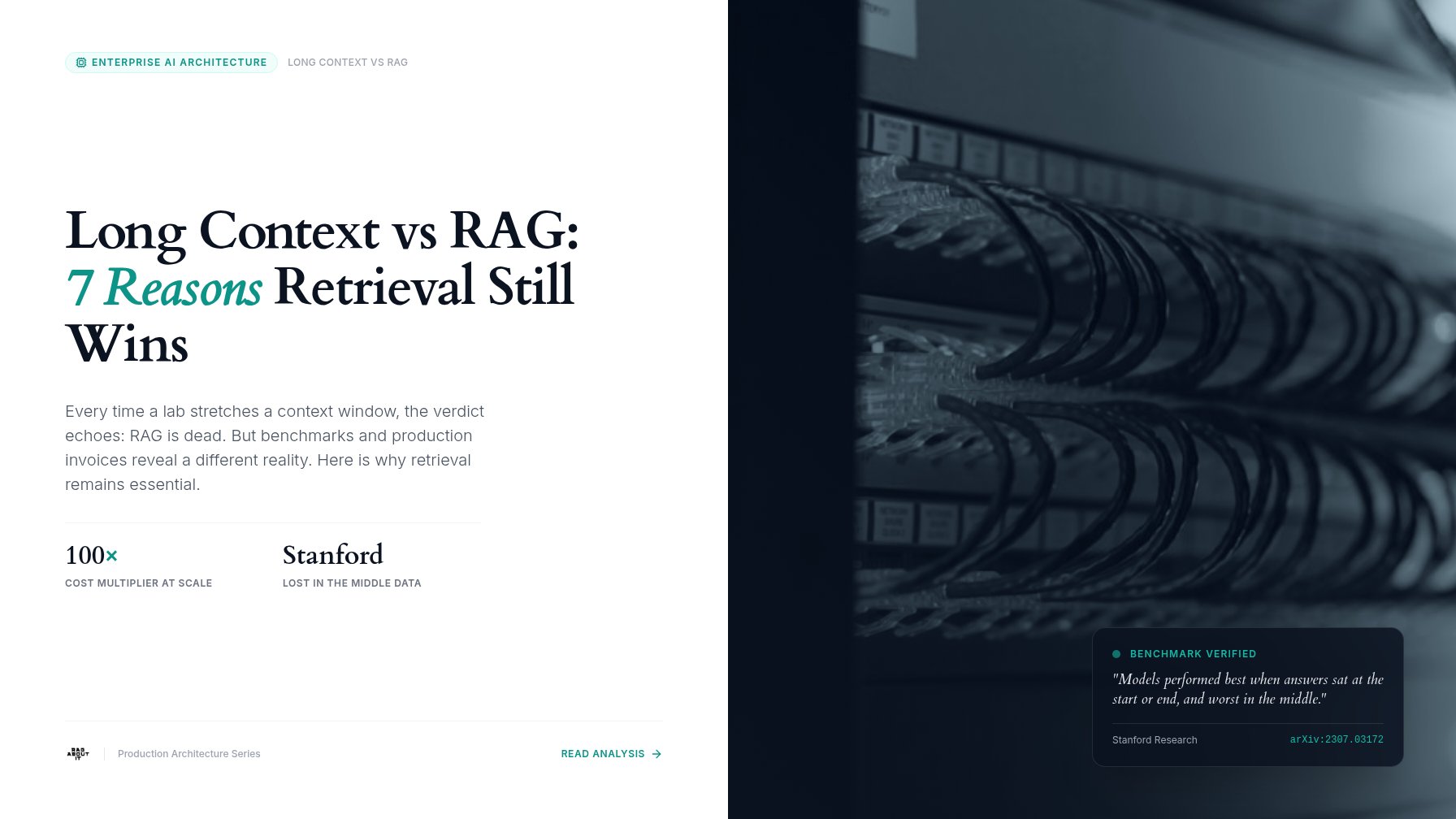
In 2023, Nelson Liu and colleagues at Stanford, UC Santa Barbara, and NVIDIA published “Lost in the Middle: How Language Models Use Long Contexts”. The experiment was simple. Give a model twenty passages, ask which one contains the answer, then slide the correct passage’s position around the prompt and watch what happens.
The results broke an assumption. Models performed best with the answer at the very start or end of the input, and worst when it sat in the middle. Accuracy dropped as passage count rose, even with total token count held constant. More documents, weaker retrieval, same prompt budget.
The paper’s own recommendation is the part that gets skipped in every long context vs RAG thread. Liu’s team found that reranking and filtering, so the model sees fewer and better documents, substantially improved accuracy. The cure for long-context weakness is showing the model less.
That’s the premise of RAG, restated by a benchmark built to test whether RAG is necessary.
Reason 2: Advertised Context Is Not Effective Context
Spec sheets list a maximum window. Benchmarks measure how much of that window you can actually use before quality slides, and the gap is wide. Effective context, not advertised context, is the number that matters in any long context vs RAG comparison.
NVIDIA’s RULER benchmark, released in 2024, evaluated ten long-context models on synthetic retrieval and reasoning tasks inside their claimed limits. Most models degraded well before the advertised ceiling. Many 128K-class systems started slipping between 32K and 64K, and one 32K-class model held up to only about 4K.
Vectara’s NoLiMa, published in March 2025, probed something subtler: whether models can connect facts that require real reasoning rather than literal string matching once the details sit far apart in the prompt. The average score across the ten strongest models at the time fell to 69% at 32K. At 128K, roughly half the answers came back wrong.
Two conclusions follow. “Supports 2M tokens” is a spec-sheet claim, and spec-sheet claims don’t survive RULER or NoLiMa. And if your corpus outgrows the window a model can reliably use, you’re doing retrieval anyway. Just badly, on hope alone.
The Cost Math Nobody Runs Before Deleting the Retriever
Reason 3: Every Query Pays the Full Token Bill
Long context charges per query. RAG charges once per document version.
Prices shift monthly, so use round numbers and watch the ratio. Assume your provider charges $5 per million input tokens and your corpus is 800K tokens.
Prompt-stuffing sends all 800K with every question. One query costs $4. At 200 queries a day, that’s $800 daily, roughly $24,000 a month on input alone.
RAG sends the top 20 chunks at 500 tokens each, plus question and instructions. Call it 10K tokens. Same provider, same rate: $0.05 per query, or $10 a day. About $300 a month.
Same model, same corpus, same answers. An 80x gap in the monthly invoice. This is the line item that ends most long context vs RAG arguments.
Reason 4: Latency Grows With the Prompt
Input tokens aren’t free in time, either. Before a model emits its first word, it runs prefill computation across the entire prompt, and attention cost grows with sequence length. Quadratically, before optimizations. Even with flash attention and friends, compute still scales with every token you add.
The practical version: a 5K-token prompt usually produces its first token in under a second. A 500K-token prompt can prefill for many seconds before anything appears. Users feel every one of those seconds. Support flows time out. Voice stops being an option.
RAG keeps prompts small. A vector search over a few million chunks returns in milliseconds. Reranking adds a few hundred. The model then reads 10K tokens instead of 800K, so generation starts sooner too. It’s one of the rare cases where the cheap option and the fast option are the same option.
The Operational Reasons Retrieval Survives Every Demo
The long context vs RAG debate usually gets argued on benchmarks and price. Operations is where retrieval actually pulls ahead.
Reason 5: Corpora Change, Prompts Don’t
Enterprise corpora aren’t static. Contracts get amended, policies get revised, pages get deprecated. When document 14,203 changes at 2pm, a RAG system re-ingests that one file, and the next query reflects it.
With prompt-stuffing, your options are worse. Resend the full window on every query and you multiply Reason 3. Cache the window, and it works until one document changes and the cache quietly serves stale knowledge. Cache invalidation across a two-million-token corpus isn’t a footnote. It’s an engineering project with a pager attached.
Freshness is the quiet reason retrieval survives the long-context demo. Demos run on frozen corpora. Production doesn’t.
Reason 6: Permissions Break in One Big Window
Enterprise documents carry access rules. Finance can read the revenue projections. Support can’t. A RAG system filters at retrieval time: the query runs as a specific user, and only chunks that user may see enter the prompt.
Stuff the whole corpus into one window and the model sees all of it, including the 4,000 pages this user has no right to open. Now you need output filtering that somehow guesses which slices of a 2M-token context leaked into the answer. That’s the failure class OWASP’s LLM Top 10 tracks under sensitive information disclosure, rebuilt with more steps and fewer guarantees.
Permissions are where the long context vs RAG gap stops being a cost problem and starts being a security problem. Retrieval-time filtering is boring, cheap, and already works. Prompt-stuffing deletes it.
Where Long Context Genuinely Beats RAG
The tradeoff runs both directions, and pretending otherwise wastes money in the other direction. Any honest long context vs RAG comparison has to admit where the big window wins.
Long context wins when the corpus is small, stable, and needs to be read as one unit:
- Single-document analysis. A 300-page contract, one legal review, cross-references between clause 4 and clause 47. Chunk ranking can’t know which clauses will matter until the analysis is underway.
- Version comparison. Diffing three revisions of a spec, or reviewing a pull request against the full file it touches.
- Small corpora. If everything fits in 50K tokens and rarely changes, skip the pipeline. A chunker, vector store, and reranker cost more to build and run than the tokens they’d save.
- Global summaries. “Summarize this document” wants the whole document, not the top 20 chunks.
The pattern in that list: one artifact, or a tiny set, read as a whole. The bigger and messier the corpus gets, the faster the math flips back toward retrieval.
Reason 7: Why the Hybrid Wins in Production
The strongest stacks shipping right now use both. The pattern has a name: retrieve-then-reason. Retrieval handles recall, permissions, and freshness. The long window handles multi-hop reasoning across the handful of documents that made it through. In practice, the long context vs RAG fight ends in a truce.
Three Upgrades That Pay for Themselves
Contextual retrieval. Anthropic ran this experiment in 2024: prepend a short, model-generated context blurb to each chunk before embedding it, so a chunk that starts with “The eligibility rules are…” also says what document, section, and topic it comes from. In tests across a codebase and a set of legal documents, top-20 retrieval failures fell 35% with contextual embeddings, 49% when combined with contextual BM25, and 67% once reranking was added. Failure rates dropped from 5.7% to 1.9%.
Reranking. A cross-encoder reranker scores each candidate chunk directly against the question instead of trusting embedding similarity alone. It’s usually the single biggest quality jump available in an existing RAG stack, and the numbers above show it stacking gains on top of contextual retrieval rather than replacing it.
Prompt caching. Anthropic charges about a tenth of its base input price for cached tokens, and Google discounts cached Gemini tokens by about 75%. Cache the system prompt and any stable context, and recurring costs shrink. Caching softens Reason 3’s math for prompt-stuffing fans too. It does nothing for cache-miss latency, recall degradation, or permission leaks.
The Long Context vs RAG Decision Test
Before you rip out a retriever, or rebuild one you never needed, answer these five questions:
- Does the whole corpus fit in about 50K tokens, and does it rarely change? Use long context alone. Ship it.
- Do different users have different document permissions? You need retrieval-time filtering. Full stop.
- Does the corpus change weekly or daily? Retrieval, with per-document re-ingestion.
- Is the task one artifact analyzed as a whole? Long context.
- Multi-hop questions across thousands of documents, with per-user access control? Retrieve-then-reason, with reranking and caching.
Yeses that point in different directions mean hybrid. Most real products land there.
The Short Version
The context window race isn’t a threat to RAG. It’s a subsidy for the reasoning half of the pipeline. Bigger windows make retrieved chunks far more useful, and the recall half still needs retrieval, because models read long but don’t read reliably, and every stuffed token bills you twice, in latency and in dollars. Lost in the Middle, RULER, and NoLiMa all point the same direction. So does the invoice. That’s the long context vs RAG answer in one line: bigger windows, same retriever.
Treat context length as a reasoning budget, not a storage decision. And the team from the opening? Last I checked the fiction, they’re back on a retriever with a big window for reasoning, and their bill is boring again.
If you’re rethinking your own stack, two pieces worth reading next: our breakdown of RAG evaluation frameworks shows how to measure retrieval quality before you change anything, and our guide to vector compression tricks keeps candidate sets cheap as your corpus grows. Or grab the newsletter. We publish implementation-focused breakdowns like this one every week, written for the people building these systems.