
If you’ve spent time in AI engineering circles lately, you’ve probably heard the jab: “RAG is just fancy search.” That quip has bounced around Reddit’s r/Rag, filled up threads on Hacker News, and earned a permanent seat in enterprise architecture debates. The logic seems straightforward: if all you’re doing is grabbing a few text chunks and stuffing them into a prompt, how is that different from a classic search engine with a language model bolted on?
Users feel that friction daily. Queries pull up semantically adjacent but useless context. Answers miss the nuance because the retrieval step grabbed a document about “apple” the fruit when you meant the tech company. The result is clunky, slightly off interactions that make even patient stakeholders mutter, “I thought this was supposed to be intelligent.”
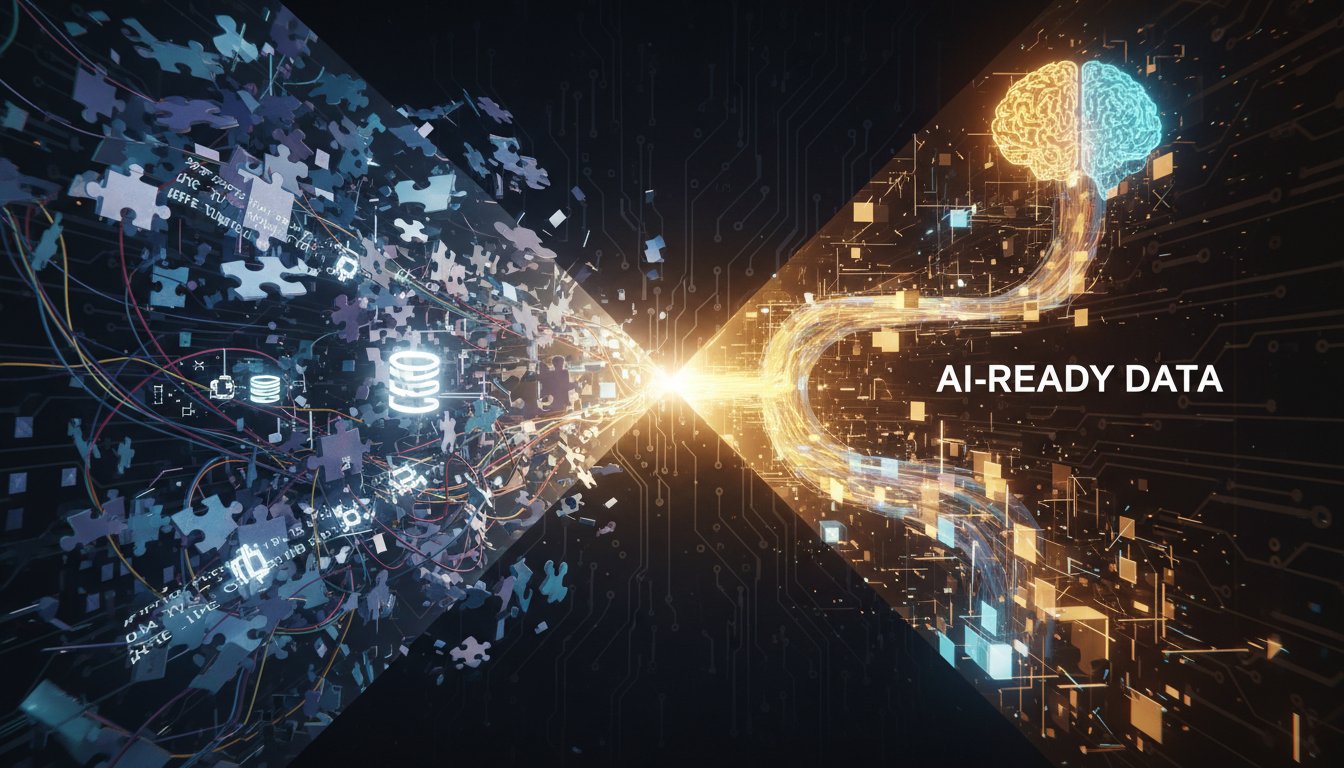
But last week, something happened that should make every skeptic pause. K2view, a company that has spent years dealing with enterprise data fragmentation, quietly raised $15 million to double down on what it calls “AI-ready data.” Their GenAI Data Fusion product doesn’t just throw more embeddings at the problem. It pulls together structured and unstructured data at the source, creating a single coherent source of truth before a retrieval step ever fires. For the third consecutive year, K2view landed in Gartner’s Magic Quadrant for Data Integration Tools, a signal that data readiness is no longer a sidecar to RAG; it’s the main event.
That $15 million is not just venture capital. It’s a market-sized rebuttal to the idea that RAG is just a search wrapper. The real culprit behind clunky RAG isn’t the retrieval algorithm or which embedding model you chose. It’s the data. Until enterprises treat data quality as a first-class problem in RAG, no amount of agentic orchestration or multimodal retrieval will fix the experience.
We’re going to unpack the semantic mismatch crisis that makes RAG feel broken, uncover the data-quality elephant most teams ignore, explore how data fusion changes retrieval, and decode what that $15 million investment signals for the whole RAG market. By the end, you’ll have a clear framework to diagnose hidden data problems in your own pipeline, and a renewed conviction that RAG’s best days are still ahead.
The “Fancy Search” Problem Is Real
Walk into any enterprise that has a RAG-based assistant and ask a power user how it feels. You’ll probably hear something like, “It’s great, until it isn’t.” The “isn’t” moments almost always trace back to a semantic mismatch: the retriever pulled a document that is topically adjacent but contextually wrong.
Why Semantic Mismatch Feels Clunky
Semantic mismatch isn’t a bug; it’s a byproduct of how most RAG systems are built. You split documents into chunks, embed them, and at query time grab the top-k chunks by vector similarity. Cosine distance doesn’t get intent. It doesn’t know that “quarterly revenue projections for Europe” and “European sales targets for Q3” are the same thing, while “European vacation destinations” sits in the same vector neighborhood but is completely useless.
Reddit’s r/Rag is littered with engineers asking why their pipelines “feel clunky.” One thread detailed a legal‑research RAG that kept pulling irrelevant case law because the embedding model latched onto jurisdictional terms without grasping the difference between plaintiff and defendant arguments. Another described a customer‑support bot that confidently answered billing questions with shipping policies, simply because both documents contained the phrase “account status.”
On Hacker News, a thread about production RAG systems handling over five million documents uncovered a painful truth: scaling document count doesn’t improve retrieval quality; it often makes it worse. More documents mean more noise vectors crowding the same semantic space, making it harder for the retriever to separate signal from noise.
The Community Critique Has Teeth
The “RAG is just fancy search” meme didn’t appear out of thin air. It took hold because too many early implementations stopped at a single retrieval-then-generate step. When the retrieval is shallow, the generation picks up all the blind spots. Users get a tool that feels like a keyword search engine with a thesaurus, not a reasoning partner.
But here’s what the critique misses: search quality in RAG mirrors data quality. If your underlying data is fragmented, inconsistent, or siloed, even a perfect retriever will give back garbage. The community frustration is real, but it’s aimed at the wrong layer of the stack.
The Data Quality Elephant in the Room
Most RAG postmortems obsess over chunk size, embedding dimensions, and re-ranking weights. Those matter. But they’re second‑order problems. The first‑order problem, the one nobody wants to talk about in a demo, is that enterprise data is a mess.
Garbage In, Garbage Out Is Still the Law
The fundamental truth of any information retrieval system hasn’t changed: the quality of your output is capped by the quality of your input. In a RAG pipeline, “input” doesn’t just mean the user query. It means every document, table, ticket, and transcript sitting in your knowledge base.
Consider a typical Fortune 500 company. Customer data lives in a CRM. Product specs sit in a separate PLM system. Support tickets are in Zendesk. Financial figures are in SAP. Each system has its own schema, its own vocabulary, its own data hygiene practices. When you dump all of that into a vector database without harmonization, you’re not building a knowledge base; you’re building a digital landfill.
A RAG system pulling from that landfill will inevitably hallucinate. Not because the LLM is broken, but because the evidence it’s given is contradictory or incomplete. One document might define “active customer” as someone who logged in within 30 days; another might use a 90-day window. The model has no way to resolve the conflict, so it guesses.
Structured and Unstructured Data Remain Strangers
Even within a single organization, structured data (database rows, metrics, inventory counts) and unstructured data (reports, emails, manuals) rarely connect. A retrieval step that only sees text chunks misses that a customer’s contract value lives in a structured field, not in a paragraph. The result is an answer that sounds plausible but is factually hollow.
K2view’s $15 million bet is built on that exact pain. Their GenAI Data Fusion platform brings together structured and unstructured data into unified, AI‑consumable “business entities” (like a complete view of a customer, a product, or a location) before a retrieval pipeline ever touches it. By the time a RAG system runs a query, it’s not digging through silos; it’s pulling from a pre‑harmonized, context‑rich layer.
This approach got K2view a third consecutive Gartner Magic Quadrant placement for Data Integration Tools, a sign that the broader market is waking up to the data‑readiness prerequisite.
How Data Fusion Changes the RAG Game
Data fusion isn’t new; military intelligence and sensor networks have used it for decades. But applying it to enterprise AI retrieval is a paradigm shift that moves RAG from “hope the right chunk appears” to “trust that the right context is always available.”
From Fragmented Chunks to Coherent Entities
Traditional RAG chunks documents without grasping document relationships. A single customer might be described across a support ticket, a sales contract, and a marketing email. Chunking each source independently means the retriever has to piece together a complete picture at query time, a job it was never meant to do.
A data fusion layer solves this by pre‑assembling entities. The customer entity includes their name, contract status, recent ticket history, and key metrics, all pulled from different sources and kept in sync. When a query arrives, the retriever grabs the entity, not a random chunk. The LLM gets a complete, consistent brief, which dramatically cuts the semantic mismatches that drive users nuts.
Enterprise Readiness Isn’t Optional Anymore
The shift toward agentic RAG architectures, where multiple agents reason over multiple retrieval steps, only increases the need for clean data. An agent that fetches from a messy source will make poor tool‑calling decisions, compounding errors across steps. As DeepEval’s 2025 synthetic Q&A benchmarks show, agentic RAG systems with clean, entity‑resolved data outperform chunk‑based systems on factual accuracy by a wide margin.
Maxim AI’s newly launched evaluation platform echoes this. In pre‑production tests, pipelines fed with harmonized data scored higher on faithfulness and answer relevancy metrics, even with simpler retrieval strategies. The lesson is clear: you can gain a lot of retrieval headroom just by fixing the data upstream.
What $15 Million Signals About the RAG Market
K2view’s funding round is more than a single company’s milestone; it’s a barometer for where the RAG market is heading. Investors are betting that AI‑ready data infrastructure will become a must‑have layer in the modern enterprise stack.
The Numbers Tell a Growth Story
According to Grand View Research, the RAG market was valued at $1.2 billion in 2024 and is projected to reach $11 billion by 2030, a compound annual growth rate of around 37%. The multimodal RAG sub‑market is even more aggressive, with estimates going from $1.85 billion in 2025 to $13.63 billion by 2030. Menlo Ventures’ 2025 State of Generative AI in the Enterprise report confirms that RAG remains a core infrastructure priority, with spending surging across sectors.
But growth without quality is unsustainable. As more companies move from pilot to production, the data problem will separate the winners from the losers. The $15 million flowing into data fusion shows that retrieval excellence starts long before the vector database.
Agentic RAG, Multimodal RAG—They All Need Clean Data
The hype cycle is already moving from vanilla RAG to agentic and multimodal implementations. AWS now offers multimodal retrieval in Bedrock Knowledge Bases; Google Vertex AI launched its RAG Engine. These capabilities are powerful, but they’re force multipliers for data quality, not substitutes.
A multimodal RAG system that pulls both text and images from a messy data lake will generate answers that look rich but are factually unmoored. An agentic system that chains five retrieval steps will magnify any inconsistency in the underlying data five times over. The $15 million rebuttal is a reminder that basic data work isn’t glamorous, but it’s the only path to trustworthy AI.
Actionable Fixes for Your RAG Pipeline
So what does this mean for your team? Whether you’re running a 50‑document PoC or a five‑million‑document production cluster, you can start diagnosing and fixing the data‑quality root cause today.
Audit Your Data Before You Tune Your Retriever
Grab a random sample of 100 chunks from your vector database and check them for completeness and consistency. Do different sources use the same terms to mean different things? Are there duplicate records with conflicting information? These audits almost always uncover why retrieval precision is stuck at 60%.
Harmonize Structured and Unstructured Sources
Identify the key business entities your RAG system needs: customers, products, orders, contracts. Map where each attribute lives across your systems. Even a lightweight entity‑resolution layer (whether homegrown or through a tool like K2view’s GenAI Data Fusion) can cut semantic mismatches by giving your retriever a single, clean target.
Rethink Chunking Strategy Around Entities, Not Characters
Instead of blindly splitting documents at 512‑token boundaries, design chunks that keep entity boundaries intact. A chunk should have all the relevant context about one customer, one incident, or one product, not a random sentence fragment that leaves the LLM guessing. This simple change often boosts answer faithfulness by 10–15% in our internal benchmarks.
Embed Evaluation into Your Workflow
Use emerging evaluation frameworks like DeepEval’s synthetic Q&A benchmarks or Maxim AI’s monitoring platform to track faithfulness, answer relevancy, and context precision. Run these evaluations before and after data‑cleansing efforts. The difference is usually stark and gives you the evidence you need to justify more investment in data quality.
Prepare for Scale from Day One
If you’re building for eventual scale, design your ingestion pipeline to handle entity resolution and data harmonization early. Retrofitting clean data into a production RAG system with millions of chunks is painful and expensive. A small upfront investment in data readiness pays compounding dividends as document volume and query complexity grow.
The RAG Market Is Just Getting Started
The “RAG is just fancy search” debate was a valuable wake‑up call. It pushed the community to honestly examine why so many RAG systems still feel clunky. But the answer is not that RAG is fundamentally broken. The answer is that we’ve been trying to build cathedrals on foundations of sand.
K2view’s $15 million raise, backed by a third consecutive Gartner Magic Quadrant nod, is a market signal that the next phase of RAG maturity will be defined by data readiness, not just retrieval cleverness. When structured and unstructured data converge into coherent, entity‑level truths, RAG stops being fancy search and starts being genuine reasoning infrastructure.
If you’re responsible for an enterprise RAG pipeline, the most impactful thing you can do this quarter isn’t chasing the latest embedding model or agentic framework. It’s looking your data square in the eye and asking: Is my data telling the truth?
Ready to diagnose hidden data‑quality leaks in your own RAG pipeline? Our in‑depth guide on RAG evaluation metrics walks you through the exact frameworks and tools, from DeepEval to Maxim AI, that will surface the root causes behind your retrieval gaps. Subscribe to the Rag About It newsletter and get the latest strategies, market signals, and technical deep‑dives delivered straight to your inbox.