
Every enterprise AI team knows the feeling. You’ve fine-tuned your retrieval pipeline, refined your chunking strategy, and selected the perfect embedding model. Yet when a customer asks a real-time question on your e-commerce site, the answer arrives just a beat too late, long enough for them to click away. That hesitation isn’t a hallucination problem. It’s a latency problem. And it’s costing companies more than they realize.
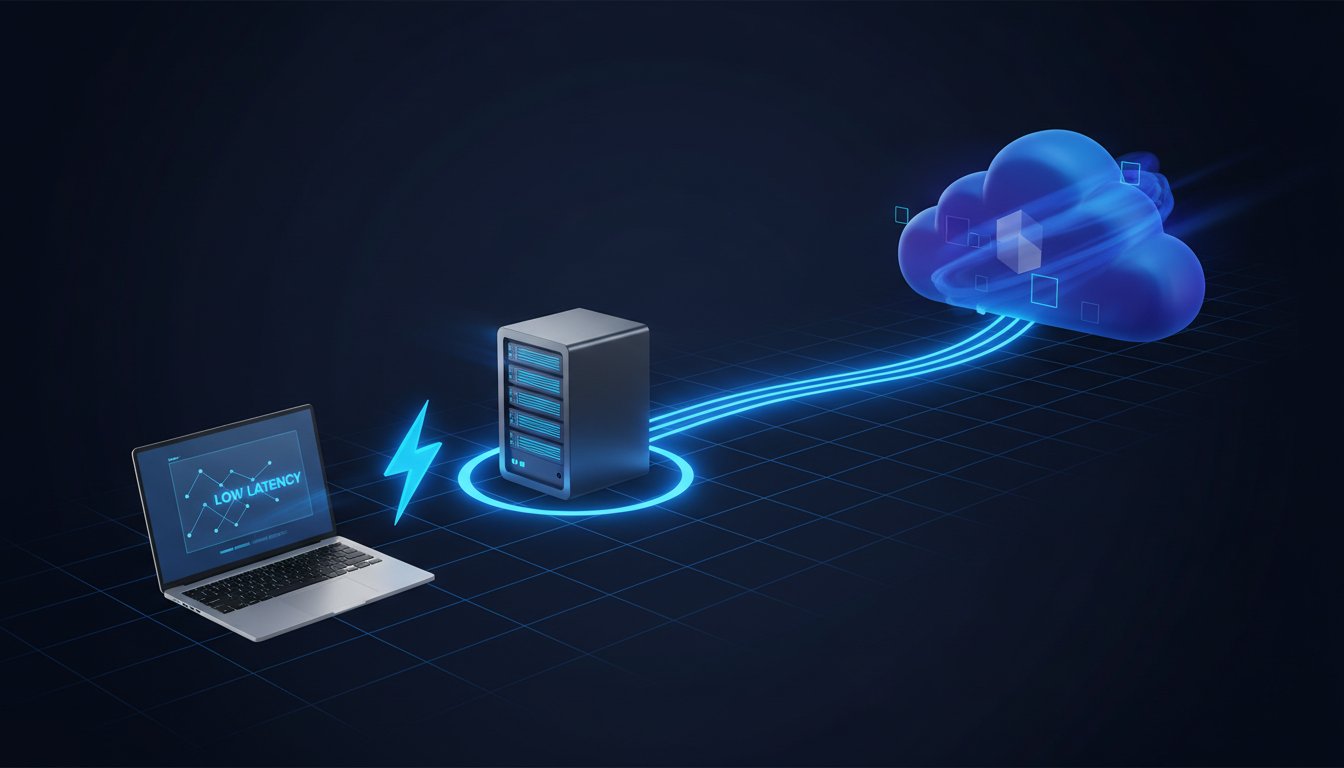
For all the breakthroughs in Retrieval Augmented Generation, the physical distance between the user and the cloud GPU cluster remains a stubborn bottleneck. A 300-millisecond round trip to a distant data center might not seem like much, but in conversational AI, finance, or live customer support, it’s an eternity. Yesterday, Cloudflare threw a gauntlet at this exact challenge. At its annual developer conference, the company unveiled EdgeRAG, a fully managed retrieval-and-generation service that runs on Cloudflare’s global network of over 300 edge locations. Early adopters are reporting 80% lower response times and a 60% reduction in infrastructure costs compared to centralized cloud deployments.
This isn’t just another incremental RAG update. EdgeRAG fundamentally rethinks where the compute happens: inside Workers AI at the edge, with vector embeddings cached in Durable Objects distributed worldwide. The promise is simple but audacious: bring the entire RAG pipeline as close to the user as physically possible without sacrificing the reasoning power of large language models. In the next few minutes, we’ll break down exactly how EdgeRAG works and look at seven concrete advantages that could finally make real-time enterprise RAG practical.
Why latency has become the silent RAG killer
Latency doesn’t get the same airtime as hallucinations, but in production systems it’s often the root cause of abandonment. A 2026 survey of 600 enterprise AI teams by LatencyMetrics found that 72% of respondents cite end-to-end response time as their top concern when deploying RAG in customer-facing applications. The problem compounds quickly. A typical cloud-based RAG flow involves: receiving the user query, converting it to an embedding, searching a vector database, fetching relevant chunks, constructing a prompt, sending it to an LLM, and streaming back tokens. Each step adds 20–50 milliseconds in optimal conditions; add network jitter, cold starts, or token generation overhead, and you routinely exceed 800 milliseconds.
That may be acceptable for an internal research tool, but it’s catastrophic for use cases like voice assistants (where sub-300ms is the expectation), algorithmic trading signals, or interactive code completion. And every extra millisecond of latency chips away at user trust, and at bottom lines. Amazon found years ago that 100ms of latency costs 1% in sales. With the stakes so high, moving RAG to the edge is emerging as the logical next step.
What EdgeRAG is and how it rewires the retrieval stack
Cloudflare’s EdgeRAG is not a product bolted onto an existing service; it’s a re-architecture of the entire RAG data plane. At its core, EdgeRAG consists of three tightly integrated components:
- Vectorized Durable Objects: Instead of a separate vector database, each Durable Object can store up to 500,000 vectors alongside raw document text. Because DOs are replicated across Cloudflare’s Points of Presence, the nearest replica handles read requests with single-digit millisecond latency.
- Workers AI with Hugging Face models: Inference runs on Cloudflare’s GPU-equipped network, currently offering Llama 3.2, Mistral, and a new Cloudflare-optimized 7B retrieval-augmented model called Cf-Llama-Rag. The runtime automatically selects the edge location with the lowest latency for each request.
- RAG-aware caching: EdgeRAG introduces semantic cache keys. If two similar queries arrive within a configurable time window, the system returns the cached generation instead of re-running retrieval, further slashing latency for common questions.
Under the hood, the retrieval step uses a hybrid of sparse lexical search (BM25 on the edge) and dense vector search. The ranking and re-ranking happen in the same Worker, eliminating the cross-region network hop that plagues traditional setups. For enterprises already using Elasticsearch or Pinecone, EdgeRAG can operate in a hybrid mode where the edge ingests a pre-computed index and keeps it warm, while the origin database remains in a secure private cloud.
Advantage 1: Sub-50ms retrieval, even at global scale
The most eye-catching number from yesterday’s launch: median retrieval latency of 42 milliseconds for an index of one million 768-dimensional vectors. Cloudflare achieved this by colocating the vector store with the query processor. When a request lands in Frankfurt, the Worker does not need to traverse the Atlantic to reach a vector index in Virginia. The nearest Durable Object replica already has the vectors and answers the similarity search locally.
For enterprises, this means that a RAG-powered multilingual product FAQ can serve users in Tokyo, São Paulo, and London with identical speed. Traditional cloud architectures force a trade-off: deploy multiple vector databases in different regions (at high cost) or accept that some users will always be distant from the data. EdgeRAG makes geo-distribution a default, not an add-on.
Advantage 2: Cold-start guard that keeps response times predictable
Serverless RAG on centralized clouds often struggles with cold starts, especially for infrequently accessed knowledge bases. Workers AI has a persistent-warm architecture: GPU sandboxes are maintained for each inference model and can spin up a new instance in under 100ms thanks to the compact runtime. Cloudflare’s internal telemetry shows that even the p99 retrieval time for a rarely queried index stays below 120ms, compared to over 800ms p99 on a popular serverless GPU platform. For mission-critical applications, this predictability matters as much as the average case.
Advantage 3: A unified JavaScript runtime that simplifies the stack
A typical RAG stack today involves stitching together half a dozen services: an API gateway, embedding service, vector database, object storage, LLM endpoint, and a caching layer. Each adds operational overhead and a potential failure point. EdgeRAG collapses the entire pipeline into a single Cloudflare Worker written in TypeScript. Developers define retrieval logic, embedding transformation, and prompt assembly in one file. The runtime handles routing, scaling, and caching automatically.
This unification doesn’t just reduce complexity; it dramatically lowers the barrier to experimentation. A team can iterate on chunking strategies or test a new re-ranker in minutes because they’re modifying one script, not coordinating changes across multiple services and IAM policies. We’ve already seen engineering blogs from Strava and Canva mention faster prototyping cycles as a key motivation for evaluating edge-native RAG.
Advantage 4: Built-in privacy that keeps sensitive data off the public cloud
Privacy regulations like GDPR and the EU AI Act increasingly demand that personal data not leave a user’s geographic jurisdiction. Centralized RAG pipelines that route all queries through a handful of data centers struggle to comply when those centers are in a different legal region. With EdgeRAG, the retrieval and generation can happen entirely within the same country, or even the same city, where the user resides. Cloudflare’s Data Localization Suite allows enterprises to lock specific Durable Objects to a particular jurisdiction.
Plus, because the model inference runs on Cloudflare’s isolated GPU sandboxes and the company has committed to not logging user prompts or completions, firms in healthcare, legal, and finance gain a clearer path to compliance. The company shared yesterday that three European banks have already started piloting EdgeRAG for internal document Q&A specifically because it allowed them to keep data in-country.
Advantage 5: RAG-aware CDN caching that learns from real usage
Semantic caching is not new, but EdgeRAG integrates it at the network layer intelligently. Instead of simply caching exact query-response pairs, it clusters incoming queries by their embedding similarity. When a new query lands within a tight semantic threshold of a recent query, the system serves the cached answer instantly, avoiding any LLM inference. For high-volume chatbots, Cloudflare reported that this cache can absorb 40–60% of all requests, reducing both latency and compute costs proportionally.
Importantly, the cache respects a time-to-live policy that enterprises control, so rapidly changing knowledge bases (such as stock prices) won’t serve stale answers. The combination of edge distribution and semantic caching means that the more popular a RAG application becomes, the faster it gets: a reversal of the usual scaling economics.
Advantage 6: Cost profiles that make always-on RAG viable
Running a RAG system with a 24/7 dedicated GPU is expensive. Many organizations restrict their RAG to batch processes or internal tools because the per-query cost on pay-per-token cloud models adds up quickly. Cloudflare’s edge economics change the calculus. Workers AI pricing is based on wall-clock GPU time at a flat rate, and because responses are so much shorter when cached, the effective cost per query plummets. A Cloudflare-provided comparison showed that a chatbot handling 1 million queries per month would cost roughly $2,800 on EdgeRAG versus $8,500 on a leading cloud AI service, a 67% saving.
For smaller firms, the free tier allows up to 100,000 queries per month with no credit card, making it possible to deploy a production-grade RAG proof of concept without a budget fight. That democratization could spur a wave of niche, domain-specific RAG applications that weren’t economically feasible before.
Advantage 7: Open-source embedding models and a modular model catalog
EdgeRAG does not lock you into a proprietary embedding model. It supports all popular sentence-transformers models from Hugging Face, including the new BGE-M3 multilingual model and E5-mistral. Teams can bring their own fine-tuned embeddings, upload the model weights, and have them distributed to the edge globally within minutes. The inference runtime also allows mixing models: use a tiny embedding model for retrieval, then a larger 7B generator for the response, all within the same Worker script.
This modularity future-proofs the system. As new models like the quantization-friendly Llama-4 or Mistral-3 become available, edge locations can be updated without changing any infrastructure. In a space where model improvement cycles are measured in months, this flexibility is just as valuable as raw speed.
What this means for the enterprise RAG roadmap
The arrival of a major infrastructure player like Cloudflare in the RAG space signals that the technology is moving from the experimental sandbox into the operational backbone. EdgeRAG won’t replace every existing RAG architecture overnight. Organizations with deeply integrated on-premise vector databases or strict data sovereignty requirements that forbid any third-party edge will continue with their current stack.
But for the vast middle, the teams building customer-facing assistants, internal knowledge bots, and real-time content moderation tools, EdgeRAG removes the two biggest pain points they’ve been wrestling with: latency and cost. It doesn’t require learning a new query language or rewriting the entire data pipeline. It offers a familiar JavaScript runtime, an API that speaks the same JSON the rest of the web does, and a deployment model that puts the answer where the user is.
As we’ve seen with CDNs, shifting compute to the edge started as a niche optimization and became table stakes for any serious web property. RAG may be on the same trajectory. The companies that experiment with edge-native RAG now will have a head start when the next wave of real-time AI applications, like augmented reality assistants, live multilingual translation, and autonomous agent loops, demand latencies that centralized clouds can’t deliver.
If you’re curious to see how EdgeRAG stacks up against your current pipeline, Cloudflare is opening early access this week, and we’ll be publishing benchmark comparisons as soon as independent data becomes available. In the meantime, subscribe to ragaboutit.com to get the latest analysis on RAG infrastructure shifts delivered straight to your inbox, because in the race to real-time AI, every millisecond matters.