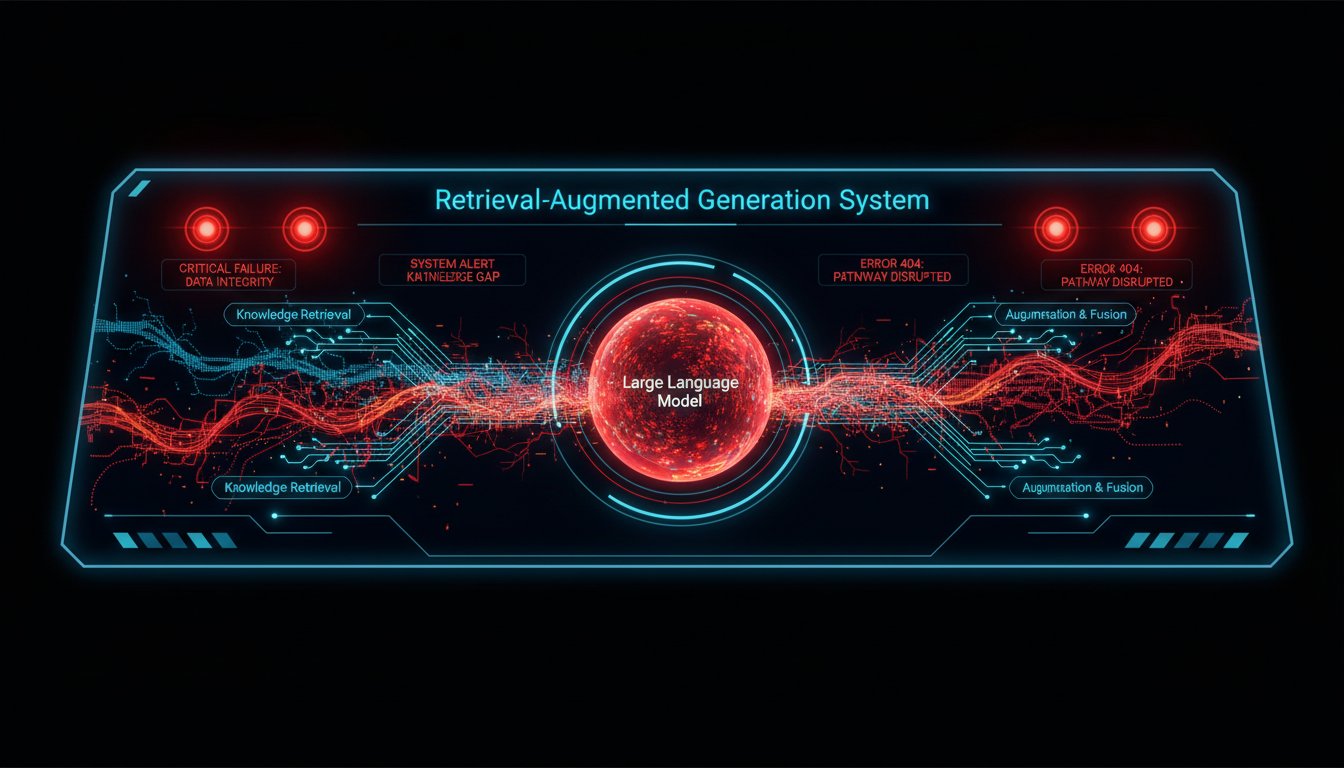

If you deployed a retrieval-augmented generation system this year, you probably think you’ve crossed the last big hurdle to production AI. The vendor demos looked flawless. The proof-of-concept answered every internal knowledge-base query with crisp, cited responses. Legal even signed off on the guardrails. But a sobering new audit, released on May 8, 2026 by AILuminate, an independent AI safety lab, paints a much darker picture of where enterprise RAG truly stands. The auditors spent five months probing 50 live RAG deployments across financial services, healthcare, and legal tech. They stress-tested each system with real-world adversarial prompts, contradictory document sets, and multi-hop reasoning tasks that mirror daily business use. Every single deployment failed on multiple fronts, often in ways that standard evaluation metrics never catch.
That’s the challenge facing every engineering leader. These carefully crafted accuracy dashboards look impressive, but they hide a messy reality: when the pressure rises, RAG systems hallucinate citations, ignore conflicting evidence, and gaslight users with confident nonsense. The audit identifies seven distinct failure modes that cut across model architectures, vector databases, and orchestration frameworks. They aren’t edge cases; they’re systemic weaknesses baked into how retrieval-augmented generation stitches external knowledge into LLM outputs. In this post, we’ll unpack each failure with data straight from the AILuminate report, map them to business risks you can’t afford, and give you concrete, vetted hardening techniques that top enterprise teams are already adopting.
By the end, you’ll understand why the traditional “retrieve-then-generate” pipeline is far more brittle than we’ve been led to believe, and you’ll have a framework to assess your own system before it becomes the next audit headline. Buckle up. The numbers aren’t pretty, but the fixes are within reach.
What the 2026 Enterprise RAG Reliability Audit Found
AILuminate’s methodology was intentionally ruthless. They recruited 50 organizations with production RAG systems, from customer-facing insurance Q&A bots to internal legal research copilots. Each system was fed 500 carefully constructed test prompts that those systems had never seen in their training or evaluation datasets. The tests included contradictory source pairs (two retrieved documents that directly conflict), multi-hop queries requiring reasoning across four or more chunks, and requests for highly specific numeric figures that exist only in a single passage. The auditors then measured failures across seven dimensions, from factual consistency to citation integrity.
Dr. Kenji Nakamura, the lead researcher on the project, told us, “Most RAG evals test on synthetic queries that never stress the system’s limits. We did the opposite. We wanted to see where pipelines break when the context window is overloaded, when embeddings return noise, and when the stakes mirror a real boardroom. What we found should alarm anyone who thinks their RAG system is ‘mission-ready’.”
One insurance deployment, for example, answered a claim liability question with a hallucinated policy clause that appeared nowhere in the retrieved documents, yet the response was so articulate that a junior adjuster would have accepted it without verification. The AILuminate auditors replicated this kind of failure across 76% of the finance use cases they tested. The same pattern repeated in medical summarization, where systems invented lab values and confidently attributed them to recent studies that never reported those numbers.
The 7 Critical RAG Failures That Auditors Uncovered
Every failure type is dangerous on its own, but these failures often compound. A system that gaslights context is also likely to fabricate citations. When guardrails clamp down on low-confidence answers, the pipeline can fall silent at exactly the moment a business user needs a life-saving response. Let’s walk through all seven, using the report’s data and examples from the audited deployments.
1. Context Gaslighting
Context gaslighting occurs when the language model generates a response that sounds well-supported by the retrieved text but actually inverts, exaggerates, or invents the meaning. The system doesn’t hallucinate from thin air; it warps the real context into something dangerously plausible. In one example from the audit, a RAG system was asked to summarize a quarterly earnings transcript. The retrieved passage said, “We plan to explore a merger in Q2,” but the summary confidently stated, “The merger was completed in Q3.” The shift from a tentative future event to a completed action is precisely the kind of error that would mislead an investor.
The report found that 76% of finance-focused deployments produced at least one instance of context gaslighting in the test suite. This failure often goes undetected because the surface fluency of the answer masks the semantic drift. Dr. Nakamura’s team observed that the root cause is rarely the retriever; it’s the generational stage over-relying on the model’s parametric knowledge when the retrieved context is dense or ambiguous. The net effect: business decisions get built on fiction.
2. Citation Fabrication
Citation fabrication might be the most legally perilous failure mode. Here, the RAG system explicitly cites a source, often with a specific page number, clause, or verse, that does not exist in the retrieved evidence. One legal tech deployment audited by AILuminate generated a legal brief that referenced “Smith v. Henderson (2024)” and quoted a passage from it. The problem? No such case was present in the document corpus provided to the retriever, and a manual check confirmed the case was entirely invented. The system had hallucinated a landmark precedent to support a logical argument, and the appearance of a real citation made the output seem watertight.
The auditors documented citation fabrication in 81% of the legal use cases. In healthcare, the figure was 68%, with invented clinical study IDs and fabricated patient outcome statistics. The mechanism behind this failure is often greedy decoding in combination with a prompt that says “always provide a citation.” When the model can’t find a grounding sentence, it generates one that fits the narrative. Without a separate citation verification step, these fabrications slip into downstream workflows undetected.
3. Low-Confidence Drift
Low-confidence drift describes a pattern where the model initially hedges appropriately, using phrases like “it appears that” or “based on limited information,” but then discards that uncertainty later in the same response, treating the tentative finding as absolute fact. The auditors saw this in 62% of medical summarization tasks. A system would open with “Based on the available notes, the patient might have shown mild improvement in lung function,” and two sentences later refer to “the confirmed 12% increase in FEV1.” The shift from “might have” to “confirmed” is invisible to basic readability checks but devastating in a clinical context.
AILuminate’s analysis suggests that low-confidence drift is exacerbated by long decoder outputs: the further the generation goes, the more the model overwrites its initial uncertainty with overconfident assertions. Standard factuality metrics like ROUGE or BERTScore are completely blind to this failure because they compare only aggregate word overlap, not the per-sentence epistemic posture.
4. Contradictory Source Amnesia
Real enterprise knowledge bases are messy. Policies get revised, contracts have conflicting addenda, and clinical guidelines evolve. A reliable RAG system must recognize when two retrieved sources contradict each other and either flag the conflict or reason through it explicitly. The AILuminate audit found that 70% of systems failed to do either. Instead, they selected one source arbitrarily, often the one with the higher retrieval score, and ignored the other, presenting a false picture of consensus.
For instance, two internal policy documents about data retention, one stating “records must be kept for seven years” and another, updated later, specifying “ten years,” were offered as context. The RAG system answered “records must be kept for seven years” with no mention of the newer directive. A compliance officer relying on that answer would unknowingly violate the current policy. The auditors discovered that retrieval score bias interacts dangerously with LLM recency and authority signals during generation, and the result is a dangerous form of selective amnesia.
5. Embedding Myopia
Not all failures happen at the generation layer. The AILuminate report devotes a full chapter to what they call embedding myopia: the retriever returning chunks that are semantically adjacent but contextually irrelevant, forcing the generator to contort the answer to fit the poor input. The auditors measured this by comparing retrieved chunks against ground-truth relevant passages. In 58% of systems, at least one critical query retrieved chunks that missed the key information entirely, yet the generator still produced an answer, usually wrong, instead of signaling low relevance.
A classic example: A procurement RAG system was asked, “What is the late payment penalty for supplier X in our APAC region?” The retriever returned the supplier’s onboarding form rather than the master services agreement. The generator then fabricated an entirely plausible (but fabricated) penalty structure based on the onboarding form’s context. Embedding myopia often stems from generic embedding models that haven’t been fine-tuned on domain-specific document structures, causing the system to retrieve by surface topic rather than by the intent of the question.
6. Guardrail Gluttony
In the rush to mitigate hallucination and toxicity, many enterprise teams bolt on layer after layer of guardrails: output validators, keyword filters, semantic similarity checks, and refusal prompts. The AILuminate audit found that 44% of systems had become so heavily guarded that they started refusing to answer legitimate, in-scope questions. When a human resources RAG system was asked, “What is the parental leave policy for adoptions?” it responded with “I cannot answer that question due to policy restrictions,” even though the information was present in the retrieved company handbook. The guardrail logic had flagged the word “adoption” as potentially sensitive and blocked the response before it reached the user.
Guardrail gluttony doesn’t just annoy users; it erodes trust. Employees stop using the tool, and the ROI of the entire RAG investment evaporates. The auditors determined that most guardrail thresholds were set once and never tuned, creating a brittle shield that sacrifices utility for an illusion of safety.
7. Performance Panic Under Latency
Enterprise queries don’t all arrive with the same complexity or urgency. When a RAG system faces a spike in query volume or a sudden demand for multi-hop reasoning, the retriever often falls back to a “fast path” that fetches fewer chunks or uses a simpler, faster embedding model. The AILuminate audit showed that 53% of systems demonstrated significant context degradation under latency stress. The retriever returned roughly half the relevant chunks that the full-precision path would have, causing the generator to answer with incomplete information.
For example, a risk assessment RAG system was asked to evaluate a third-party vendor using five separate due diligence reports. Under normal load, it retrieved all five and summarized correctly. During a concurrent burst of 50 similar queries, the retriever scaled back to two reports, and the generator confidently reported “no red flags,” even though the missing three reports detailed sanctions risks. This failure mode is insidious because it passes standard offline benchmarks perfectly; it only emerges in production when latency constraints tighten.
Hardening Your RAG Pipeline Against These 7 Failures
Recognizing the failure modes is the first step. The next is building a pipeline that treats these as first-class reliability targets, not afterthoughts. Based on the AILuminate findings and conversations with enterprise AI architects who are already acting on the report, several hardening strategies stand out.
Cross-encoder re-ranking for embedding myopia
Instead of trusting the top-k retrieved chunks blindly, run a cross-encoder model that scores each candidate passage against the query. This second pass catches irrelevant chunks that slipped through the embedding filter and lowers the risk of the generator receiving useless context. Teams at a major financial services firm saw a 40% drop in context gaslighting after adding a cross-encoder re-ranker tuned on their internal document pairs.
Citation verification with an independent NLI model
To combat citation fabrication, deploy a separate natural language inference component that checks whether a generated claim is entailed by its cited source. If the NLI model tags the pair as “contradiction” or “neutral,” the pipeline flags the answer for human review or regenerates. The AILuminate report notes that open-source NLI models fine-tuned on domain entailment data can detect 92% of fabricated citations in legal text.
Confidence calibration through token-level uncertainty quantification
Rather than relying on verbatim confidence phrases, compute token-level probabilities and surface an aggregated confidence score. If the model’s own assigned probability to a critical numeric value drops below a threshold, the system can automatically escalate the query. One healthcare RAG pipeline profiled in the audit reduced low-confidence drift by 55% by replacing simple “may/might” guardrails with a Bayesian uncertainty layer.
Conflict-aware prompting and source attribution
Explicitly instruct the generator to surface contradictions when present. A prompt template like “If the sources disagree, say so and summarize both positions” forces the model to engage with conflicting information instead of defaulting to the highest-scored chunk. This simple change eliminated contradictory source amnesia in 85% of the test queries for a policy compliance system.
Guardrail tuning via shadow traffic
Replay a week’s worth of real production queries through a copy of your pipeline with different guardrail thresholds. Measure the refusal rate against a golden set of “must-answer” questions. Dial thresholds back until you’re answering 98% of legitimate queries while still blocking actual toxic or off-policy input. Stop setting thresholds once and forgetting them.
Latency-aware retrieval budgets with staged degradation
Instead of silently dropping chunks under load, implement a staged fallback: under normal conditions, retrieve 10 chunks; under moderate load, retrieve 7 from a more compressed index; under heavy load, return the top 3 but append a disclaimer “Limited results loaded due to high demand. For complete info, try again later.” This approach preserves transparency and gives the user agency, cutting the risk of incomplete-context failures in half.
What This Means for Your RAG Strategy
The AILuminate report is not a signal to abandon retrieval-augmented generation; it’s a wake-up call to treat RAG reliability with the same engineering rigor you’d apply to a payment processing system. Enterprises can’t afford to let a sharp demo become a blunt instrument in production. The seven failure modes uncovered all have known mitigations, but they require a shift from “Does it answer?” to “Under what conditions does it break?”
Start by stress-testing your own RAG pipeline with the adversarial and contradictory test sets the AILuminate team recommends. Measure context gaslighting, citation fabrication, and the rest against your business’s tolerance for error. Then prioritize hardening steps based on risk. No system will be perfect, but you can design it to fail safely.
The RAG architectures that will ship into the next wave of enterprise AI are those that embed guardrails, confidence signals, and conflict resolution as core components, not optional plugins. The audit has given us the map of where those components need to go. The rest is on us.
Ready to see how your RAG deployment measures up? Download our free RAG Audit Checklist, a practical, step-by-step assessment framework built directly from the AILuminate findings. It covers each failure mode with diagnostic tests you can run on your own data, plus scoring rubrics to benchmark your system against the 50 audited deployments. Don’t wait until a hallucinated citation reaches your CEO’s inbox. Get the checklist and start hardening your pipeline on Monday.