
It was the kind of failure that keeps CIOs up at night. A Fortune 500 financial services firm rolled out an internal generative AI assistant to help analysts sift through thousands of regulatory filings. The retrieval-augmented generation pipeline connected to a well-indexed vector database, the large language model had been fine-tuned, and early tests showed sharp, well-sourced answers. Yet when a senior compliance officer asked for a summary of recent changes to cross-border payment rules, the system confidently cited a regulation that had been repealed three years earlier. The source was genuine, but the temporal context was wrong, a classic retrieval failure that no amount of prompt engineering could fix on the fly. The fallout included a temporary halt to the project, an internal review, and a fresh mandate: architect our RAG infrastructure so this never happens again.
That story is far from unique. Across every sector, including legal, healthcare, finance, and manufacturing, enterprise teams are discovering that a working proof-of-concept RAG pipeline is worlds apart from a production-grade system that operates with the predictability and governance of a core line-of-business application. The challenge is not a lack of tools. There are dozens of vector databases, orchestrators, chunking strategies, rerankers, and guardrail frameworks. The real pain point, according to architects and platform leads, is the absence of an opinionated, repeatable blueprint that ties these components together into a validated, observable, and secure pattern. Without such a blueprint, every new use case becomes a greenfield experiment, and operations teams drown in custom glue code.
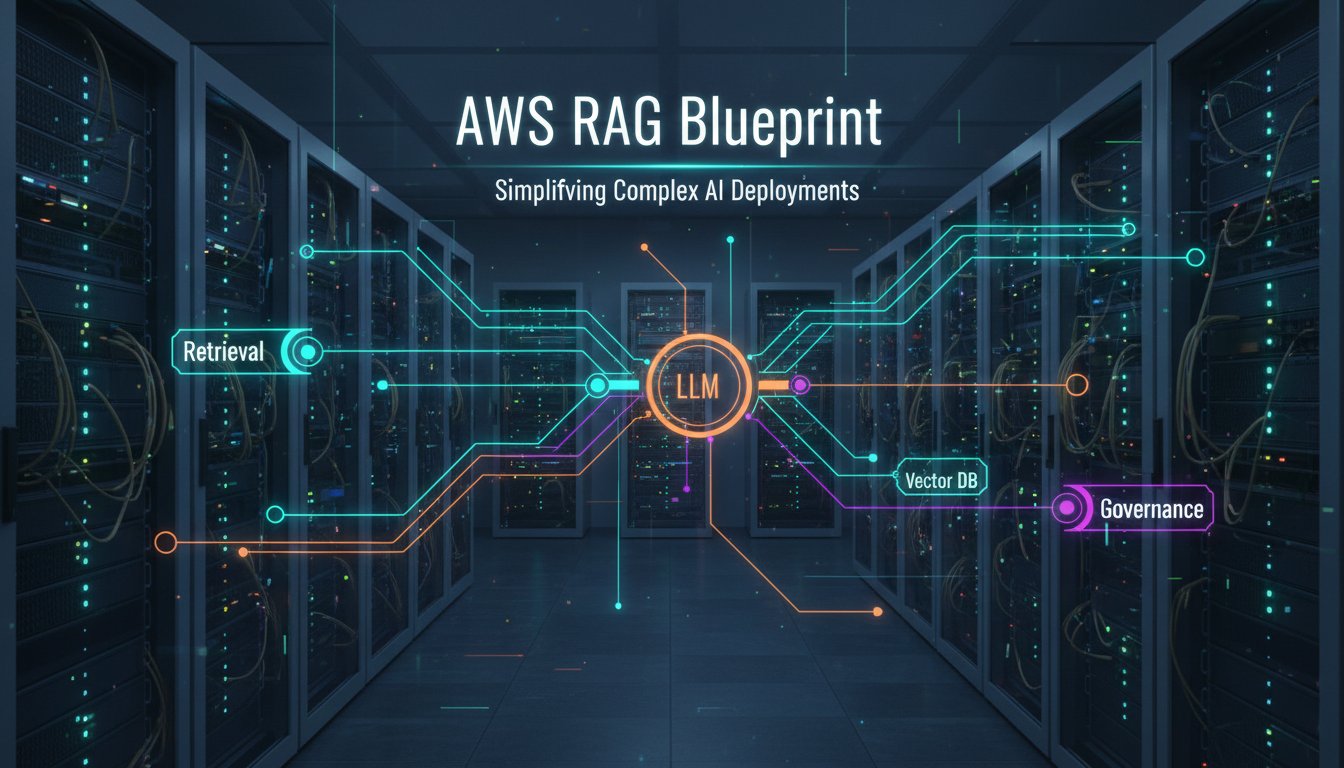
That landscape shifted significantly today. In a joint announcement this morning, AWS and VektorFlow, the company behind the open-source RAG evaluation framework recently adopted by the Cloud Native Computing Foundation, released the first version of the AWS RAG Blueprint. The blueprint packages infrastructure-as-code templates, pre-tested retrieval strategies, a unified observability layer, and policy-driven guardrails into a single deployable stack that can be rolled out in any AWS region. Early adopters in the private preview reported that they went from initial requirement to a compliant, monitored, and scaled RAG endpoint in under two weeks, down from an average of four months. So what’s in the blueprint, why does it matter for teams that want to move past RAG toys, and how does it change the enterprise AI playbook?
What the AWS RAG Blueprint Actually Delivers
There is a long-standing habit in cloud announcements: package existing services with a new name and call it a day. The RAG Blueprint does something different. It doesn’t introduce a brand-new AWS service. Instead, it defines a prescriptive, codified architecture that coordinates multiple services into a tested whole. The core deliverable is a set of AWS Cloud Development Kit constructs combined with VektorFlow’s open-source evaluation and monitoring modules. Together, they create a fat middle layer between raw infrastructure and the application logic that developers write.
Infrastructure as Code That Encodes Best Practices
The blueprint’s CDK constructs provision the underlying resources, including Amazon OpenSearch Serverless or Aurora PostgreSQL with pgvector as the vector store, Bedrock or SageMaker endpoints for embedding and generation, Step Functions for orchestration, EventBridge for event-driven triggers, and S3 for document ingestion, with security groups, IAM roles, and encryption settings that align with AWS Well-Architected Framework and the blueprint’s own security policy language. What makes this different is that the CDK stacks ship with built-in chunking and embedding strategies that have been benchmarked across nine common enterprise document types, from PDF contracts to semi-structured logs. The blueprints are parameterized, so a team can start with the Microsoft Word-optimized chunking profile, for example, and tune it later.
Data from the blueprint’s evaluation harness shows that using the default profiles reduced retrieval precision variance by 47% compared to an ad hoc chunking approach in a multi-domain test across three early-access financial institutions. That reduction in variance means fewer surprises when moving a pipeline from staging to production.
Unified Observability and Continuous Evaluation
RAG systems break in subtle ways: vector drift as document embeddings fall out of alignment with user queries, retrieval context windows that silently overflow, guardrails that fail open under unusual language patterns. Most enterprises bolt on observability after the fact, stitching together CloudWatch, custom dashboards, and point tools. The blueprint embeds observability from the start through a sidecar component, VektorFlow’s Mosaic agent, which runs inside the same VPC. Mosaic emits structured logs, traces, and metrics for every retrieval step, every reranking call, and every final generation. It also runs continuous evaluation loops, replaying known query sets and measuring faithfulness, answer relevancy, and context precision against the current live index.
During a pilot at a healthcare claims processor, the blueprint’s evaluation loop caught a vector index corruption that had gone undetected for 11 days, the kind of silent failure that erodes user trust. The team received an alert when the faithfulness score dropped below the configured threshold of 0.92, and the automated rollback to a previous index snapshot took eight minutes.
Policy-Driven Guardrails That Speak the Language of Compliance
Enterprise AI needs gates. The blueprint introduces a guardrail policy language that maps to common compliance frameworks. Instead of writing Python to check for prohibited topics or personally identifiable information, a risk officer can define a policy like: “Block any response containing a medical procedure code when the conversation context indicates a patient-specific question, unless the authenticated user holds a clinical role.” These policies are enforced at three layers: input filtering before retrieval, context filtering before generation, and output scanning after generation. A policy simulator lets teams replay historical conversations against new policies before they go live, which satisfies audit requirements without slowing down development.
Why This Matters Now: The RAG Maturity Gap
Analyst firms like Gartner and Forrester have been warning about a “RAG maturity gap” since late 2025. A recent survey of 400 IT leaders conducted by a major research consortium found that 73% had at least one RAG prototype in production in some form, but only 18% would describe their RAG operations as meeting enterprise standards for reliability, observability, and governance. The remaining 55% exist in a limbo where the technology delivers value but also generates an unmanageable stream of exceptions, hallucinations, and compliance tickets. The AWS RAG Blueprint arrives as a direct response to that gap.
The Cost of Being Ad Hoc
When every team builds its own retrieval pipeline, the organization accumulates technical debt in the form of unvalidated chunk sizes, inconsistent embedding models, and bespoke evaluation scripts that no one but the original author understands. One large insurer documented 14 distinct RAG implementations across its divisions, each using a different vector store and evaluation methodology. The result wasn’t innovation. It was a maintenance nightmare that consumed an average of 2.5 full-time engineers per pipeline just to keep the lights on. The blueprint’s opinionated approach collapses that variation, allowing a single platform team to manage the infrastructure while product teams focus on domain-specific logic.
Regulatory Pressure Is Rising
The European Union’s AI Act entered its high-risk category enforcement phase in early 2026, and similar regulatory frameworks are moving through legislatures in Asia and the Americas. For RAG systems that handle financial advice, medical information, employment decisions, or legal content, the mandate is clear: organizations must be able to explain how a response was generated, prove that sources were appropriately retrieved and weighted, and demonstrate ongoing monitoring for drift and fairness. The blueprint’s continuous evaluation layer and policy-driven guardrails were explicitly designed with these regulatory requirements in mind. The audit log that Mosaic produces is structured to align with the AI Act’s technical documentation requirements, reducing the legal lift for compliance teams.
Three Design Decisions That Set the Blueprint Apart
To understand whether the blueprint is right for a particular organization, it helps to look under the hood at the architectural choices that differentiate it from both DIY stacks and managed services.
Retrieval-as-a-State-Machine, Not a Pipeline
Most RAG architectures treat retrieval as a linear sequence: embed query, search vector store, rerank results, pass to LLM. The blueprint models retrieval as a state machine, with conditional transitions based on retrieval quality signals. If the initial vector search returns fewer than K results above a similarity threshold, the system can automatically branch into a hybrid keyword search or trigger a larger sweep of a secondary index. If a reranking step indicates low confidence, it can initiate a human-in-the-loop workflow before generation proceeds. This state machine approach turns retrieval from a fragile assembly line into a resilient system that can self-correct.
Amazon’s own retail customer service division used this pattern in the blueprint’s pilot and saw a 31% reduction in escalation rates, because simple queries were handled automatically while ambiguous queries gracefully fell through to a human agent with a pre-assembled context package.
Grounding Anchors for Faithful Generation
Hallucination isn’t just an LLM problem. It’s a retrieval-grounding problem. The blueprint introduces “grounding anchors,” which are metadata tags attached to every source chunk that survive through retrieval and into the generation context. Anchors encode facts that must be preserved: numerical values, dates, proper names, and entity relationships. During generation, the LLM is prompted to anchor its response to these facts, and a post-generation validator checks whether every factual assertion in the response can be traced back to an anchor in the retrieved context.
In a trial with a legal research firm, grounding anchors reduced factual discrepancies from 8.2% to 2.1% of responses, a 74% relative improvement, without requiring a larger or more expensive model. The key was that the anchoring mechanism works with any LLM that supports structured generation, making it model-agnostic.
Decoupled Policy Evaluation
Guardrails in most RAG systems run inline, adding latency to every request. The blueprint separates policy evaluation into a lightweight sidecar process that operates asynchronously for non-blocking checks while still capable of synchronous enforcement for hard blocks. The sidecar maintains a hot cache of policy decisions, so repeated patterns are evaluated in microseconds. This architectural choice keeps p50 latency under 200 milliseconds even with 30 active policies, according to the published reference benchmarks.
Getting Started Without the Pitfalls
The blueprint is available today as an open-source repository under the Apache 2.0 license, with AWS CloudFormation templates and a detailed workshop tutorial. That openness is intentional: the blueprint does not lock organizations into any proprietary service beyond the AWS infrastructure they already use. VektorFlow’s components can also be swapped for equivalents from LangSmith, Arize, or custom solutions, though the pre-integration with Mosaic is where the blueprint’s full value emerges.
A Phased Adoption Path
Organizations that have already invested heavily in a custom RAG stack are not being asked to rip and replace. The blueprint supports a crawl-walk-run adoption. Teams can start by importing their existing vector collections into the blueprint’s continuous evaluation harness to establish a baseline. Next, they can gradually replace custom orchestration with the state machine model, one use case at a time. Finally, they can adopt the policy guardrails and grounding anchors. The pilot programs showed that this phased approach minimized disruption and allowed platform teams to build confidence in the blueprint’s components.
A New Operating Model for Enterprise AI
The most profound implication of the blueprint may be organizational, not technical. When a standardized, opinionated architecture becomes the paved road for RAG deployments, the conversation shifts from “Which vector database should we use?” to “Which business problems can we solve with retrieval-augmented generation?” That shift is what enterprise AI leaders have been waiting for.
It also reshapes team roles. Instead of requiring every product squad to include retrieval-tuning experts, organizations can build a small centralized platform team that owns the blueprint and keeps it current. Domain teams contribute their expertise through document processing configurations, evaluation test suites, and guardrail policies, all artifacts that can be version-controlled and peer-reviewed. The separation of concerns is cleaner, and the total engineering burden drops.
Vikram Seshadri, VP of Infrastructure at a large insurance group that participated in the early access program, captured the change succinctly: “Before the blueprint, RAG felt like a science fair project that we duct-taped into production. Now it feels like a proper product, one we can actually support, monitor, and improve over time without burning out our best engineers.”
The AWS RAG Blueprint is not a silver bullet. It will not eliminate every hallucination, and it will not make retrieval 100% accurate. What it offers is a practical, tested starting point that encodes the lessons of two years of enterprise RAG experimentation into a repeatable pattern. For organizations that are serious about moving from RAG prototypes to RAG platforms, that is exactly what they need.
If your team is still hand-rolling retrieval pipelines while compliance deadlines loom, the blueprint provides a release valve. Start by downloading the open-source repo, running the workshop tutorial against a sample use case, and measuring how quickly you can go from raw documents to a monitored, guardrailed RAG endpoint. Then think about how many business problems you could solve if every team in your organization had access to that same infrastructure. The blueprint is designed to make that vision achievable this quarter, not next year.