
Your RAG agent just generated a perfect answer. It’s coherent, well-written, and cites specific documents. There’s just one problem: the answer is fundamentally wrong because the agent connected two unrelated facts from separate documents to create a false logical bridge. This isn’t a hallucination in the traditional sense. It’s a multi-hop reasoning failure, and it’s the silent killer lurking in most enterprise vector-based RAG pipelines.
This challenge isn’t hypothetical. Leaders at financial institutions, legal firms, and pharmaceutical R&D divisions are hitting the same wall. They deploy RAG to tame sprawling internal wikis, decades of technical documentation, and complex regulatory binders, only to discover that simple keyword searches work fine, but nuanced questions about processes, causality, or relationships between entities fall apart. The system retrieves relevant chunks, but it can’t reconstruct knowledge. It’s like having a library where you can find individual pages, but the table of contents, the index, and the narrative thread connecting all the ideas have been shredded.
There is a solution, and it requires moving beyond the flat, statistical world of vector embeddings alone. It’s a hybrid approach that marries the semantic power of vectors with the explicit, logical structure of a knowledge graph. This architectural pattern, GraphRAG, is rapidly shifting from academic concept to enterprise necessity. It enables systems to perform true multi-hop reasoning, tracing connections between people, projects, regulations, and outcomes that are only implied across thousands of disparate documents.
What follows is a deep dive into why vector-only retrieval hits a fundamental ceiling, the architectural blueprint for a hybrid GraphRAG system, and the specific, measurable impact this shift has on accuracy and trust in production environments. We’ll move beyond theory into implementation patterns, cost considerations, and hard-won lessons from teams who’ve made the transition.
The Fundamental Ceiling of Vector-Only RAG
Traditional Retrieval-Augmented Generation operates on a simple, powerful premise: convert documents into numerical vectors, store them, and find the most semantically similar ones to a user’s query. For straightforward, factoid questions like “What is our PTO policy?” or “List the steps in the Q3 closing procedure,” this works remarkably well. The system finds the chunk where that information is explicitly stated. But enterprise knowledge is rarely so simple. Real value lies in understanding relationships and answering complex, implicit questions.
The Multi-Hop Reasoning Problem
Consider a query like: “What compliance risks did we identify in the Singapore expansion project, and which mitigation controls from the London office could apply?”
A vector search might retrieve: 1) A chunk from the Singapore project charter mentioning “regulatory hurdles.” 2) A separate chunk from an internal audit report listing “compliance risks.” 3) A document from the London team detailing “control frameworks.” Each chunk is individually relevant to a keyword in the query, but the RAG system has no real model of how these concepts connect. Is the “regulatory hurdle” from Singapore the same as the “compliance risk” from the audit? Does the London control framework govern the specific activity in Singapore? The LLM, presented with these three disjointed pieces of context, is forced to guess at the relationship. That’s where it fabricates links or glosses over critical nuances, leading to confident, dangerous inaccuracies.
As an AI Infrastructure Lead at a major vector database vendor recently put it, “Static retrieval is obsolete. The next generation of RAG must act, verify, and self-correct before a single token reaches the user.” Vector search handles the “retrieve” part well, but it lacks any built-in capacity to verify logical connections across retrieved items.
The Entity Disambiguation Challenge
Another critical failure mode is entity confusion. In a large enterprise, “Project Aurora” could refer to a marketing campaign, a software development initiative, and a research partnership. A vector search for “Aurora budget status” will retrieve chunks containing “Aurora” and “budget,” but it can’t tell which Aurora is relevant to the user’s context without explicit metadata tagging, which is often inconsistent or missing. The result is a blended, confusing answer that references multiple projects at once.
The Hybrid Architecture: Marrying Vectors with Graphs
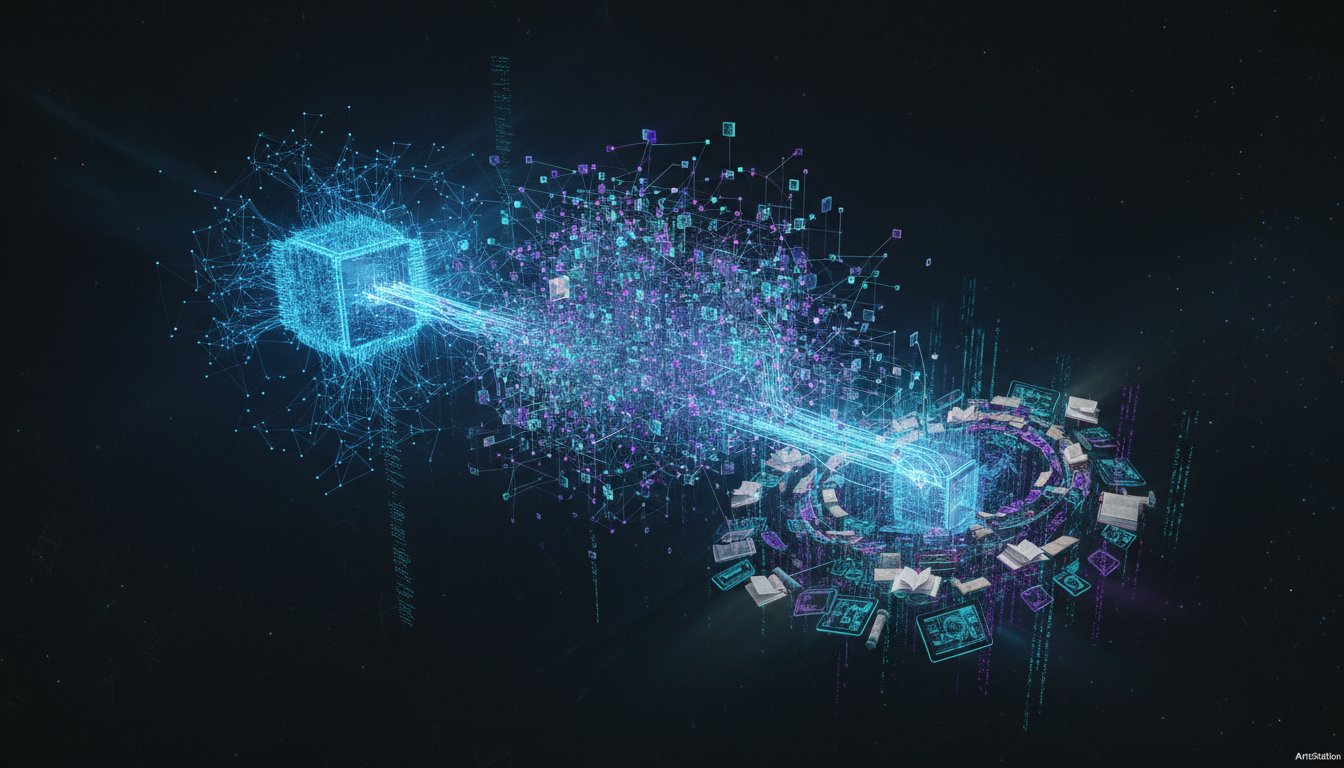
GraphRAG solves these problems by introducing a knowledge graph layer that sits alongside the vector store. This graph explicitly models the entities (people, projects, products, regulations) and the relationships (works-on, impacts, violates, mitigates) within your corpus. The retrieval process becomes a two-stage operation: first, use the vector store to find semantically relevant text chunks; second, use the knowledge graph to explore and validate the connections between the entities mentioned in those chunks.
Core Components of a GraphRAG Pipeline
- Dual Ingestion and Knowledge Extraction:
- Vector Path: Documents are chunked and embedded as usual, stored in a vector database for semantic search.
-
Graph Path: At the same time, an entity recognition and relationship extraction model (like a fine-tuned LLM or a specialized NLP pipeline) processes the documents. It identifies named entities and the semantic relationships between them, for example,
[Project Phoenix] - [is impacted by] -> [Regulation GDPR]. These become nodes and edges in a knowledge graph. -
The Graph-Enhanced Retriever:
When a query arrives, the system first runs a vector search to get a baseline set of relevant chunks (Candidate Set A). It then extracts key entities from the query and the top chunks. Using these entities as entry points, it traverses the knowledge graph to find connected entities and evidence paths. This traversal retrieves a second set of chunks (Candidate Set B) that are graphically connected to the first set, even if they aren’t semantically similar to the original query text. The final context passed to the LLM is a fusion of Set A and Set B. -
Reasoning-Aware Prompt Construction:
The prompt to the LLM is enriched with not just chunks, but a summary of the graph traversal path. For example: “The user asked about compliance risks in Singapore. We found a ‘regulatory hurdle’ mention in the Singapore project doc (Node A). In our knowledge graph, Node A is linked to ‘Compliance Risk C-12’ from the 2025 audit report (Node B). Node B is mitigated by ‘Control Framework CF-7’ (Node C) authored by the London office.” The LLM now has an explicit logical map to follow, which drastically cuts down on guesswork.
Implementation Example: Code Skeleton
Here’s a simplified architectural view using common open-source tools:
# Pseudo-code for a GraphRAG retrieval step
from langchain.graphs import Neo4jGraph  # Knowledge Graph Store
from langchain.vectorstores import Weaviate  # Vector Store
from langchain.chains import GraphQAChain  # Hypothetical enhanced chain

# 1. Initialize connections
graph = Neo4jGraph(url="bolt://localhost:7687", username="neo4j", password="...")
vectorstore = Weaviate(client, "DocumentChunk", "text")

# 2. Define a GraphRAG retrieval function
def graphrag_retrieve(query):
    # Step A: Semantic retrieval
    semantic_chunks = vectorstore.similarity_search(query, k=5)

    # Step B: Extract entities from query and top chunks
    extracted_entities = entity_extractor(query, semantic_chunks)

    # Step C: Graph traversal to find connected chunks
    graph_cypher = """
    MATCH (e:Entity)-[:RELATED_TO]->(connected:Entity)
    WHERE e.name IN $entity_list
    MATCH (connected)<-[:MENTIONS]-(chunk:Chunk)
    RETURN chunk.text, chunk.id
    LIMIT 5
    """
    connected_chunks = graph.query(graph_cypher, params={"entity_list": extracted_entities})

    # Step D: Fuse contexts
    final_context = semantic_chunks + connected_chunks
    return final_context

# 3. Use in a QA chain
context = graphrag_retrieve("What risks from Project X affect our Q4 goals?")
augmented_prompt = build_prompt_with_graph_summary(query, context)
answer = llm.invoke(augmented_prompt)
Measurable Impact: From Theory to Production Benchmarks
The move to GraphRAG isn’t a marginal improvement. For complex queries, it’s a genuine step-change in capability. Industry data is starting to quantify this shift.
Reduction in Reasoning Failures: According to a 2026 Enterprise AI Architecture Survey by TechTarget, “Organizations implementing GraphRAG report a 68% reduction in multi-hop reasoning failures compared to pure vector pipelines.” This directly translates to higher user trust and less reliance on manual fact-checking for critical decisions.
Beyond Hallucination Metrics: Standard RAG evaluations focus on chunk relevance and answer faithfulness. GraphRAG introduces a new critical metric: Relationship Accuracy. This measures whether the connections and inferences drawn between retrieved facts are actually correct. Early adopters report raising relationship accuracy from a baseline of roughly 45% with vector-only search to over 85% with a well-tuned GraphRAG system.
Cost vs. Value Analysis: Yes, maintaining a knowledge graph adds complexity. But the alternative cost is higher. The cost of a wrong decision based on flawed RAG output, whether a missed compliance risk or a misguided product direction, dwarfs the infrastructure overhead. On top of that, the graph itself becomes a reusable enterprise asset, powering advanced analytics, recommendation systems, and data lineage tracking well beyond the RAG use case.
Production Lessons and When to Pause
GraphRAG is a strategic evolution, not a starting point. Here are key lessons from the field:
- Start with a bounded domain. Don’t try to graph your entire corporate corpus. Start with a high-value, interconnected domain like product management, compliance, or customer support. This limits complexity and makes it easier to show clear ROI.
- Invest in entity consistency. The quality of your graph is everything. Build and enforce a canonical entity registry, a list of approved project names, product codes, and so on, to avoid creating a messy graph full of duplicates.
- Use LLMs for relationship extraction. Fine-tuning a small, open-source LLM (like Llama 3.1 8B) on your domain-specific documents to extract
(subject, predicate, object)triplets is often more effective and controllable than relying on brittle pre-trained NLP models.
When NOT to Use GraphRAG
This architecture is powerful, but it’s not a universal fix. Stick to a simpler, vector-only RAG if:
1. Your use case is exclusively simple, factual Q&A with no need for connection-making.
2. Your corpus lacks rich, relational information, such as a repository of standalone API response examples.
3. You have tight latency constraints under 100ms and can’t afford the extra hop for graph traversal.
4. You don’t have the data engineering resources to build and maintain the knowledge graph pipeline.
The Ugly Truth About Enterprise RAG Compliance Audits
One of the most overlooked advantages of GraphRAG is auditability. In regulated industries, you need to explain why an answer was generated. A vector search gives you a list of similar chunks, but it can’t justify why those specific chunks, and not others, were deemed connected. The knowledge graph provides a deterministic, traversable audit trail. You can log the exact Cypher query that connected [Risk A] to [Control B], giving regulators a clear line of reasoning rather than a statistical similarity score. This moves RAG from a black box to a glass box system.
The Path Forward for Enterprise Knowledge
The original promise of RAG was to ground AI in truth. Vector search delivered the first half of that promise by tethering outputs to source text. GraphRAG delivers the second half by tethering those sources to each other, reconstructing the narrative and logical fabric that turns raw information into actionable knowledge.
This evolution mirrors the broader shift in enterprise AI from experimental chatbots to reliable, mission-critical copilots. As one engineering lead from the Open Source RAG Benchmarking Collective noted, “73% of enterprise RAG failures stem from poor chunking strategies, not weak models.” GraphRAG addresses the next layer: it’s not about what you chunk, but how you understand the connections between chunks. The organizations that master this hybrid approach won’t just have better chatbots. They’ll have a dynamic, queryable representation of their institutional knowledge, an asset that compounds in value over time.
If your team is hitting the multi-hop reasoning wall, the path forward is clear. Start by mapping a core business domain as a proof-of-concept graph. Use the architectural patterns outlined here to build on top of your existing RAG pipeline. Measure the impact not just on answer fluency, but on relationship accuracy and user confidence. The future of enterprise knowledge management isn’t just about retrieving the right page. It’s about finally being able to read the whole book. Start building your graph today.