
The most interesting story in AI this month didn’t come out of a model lab. It came out of Brussels.
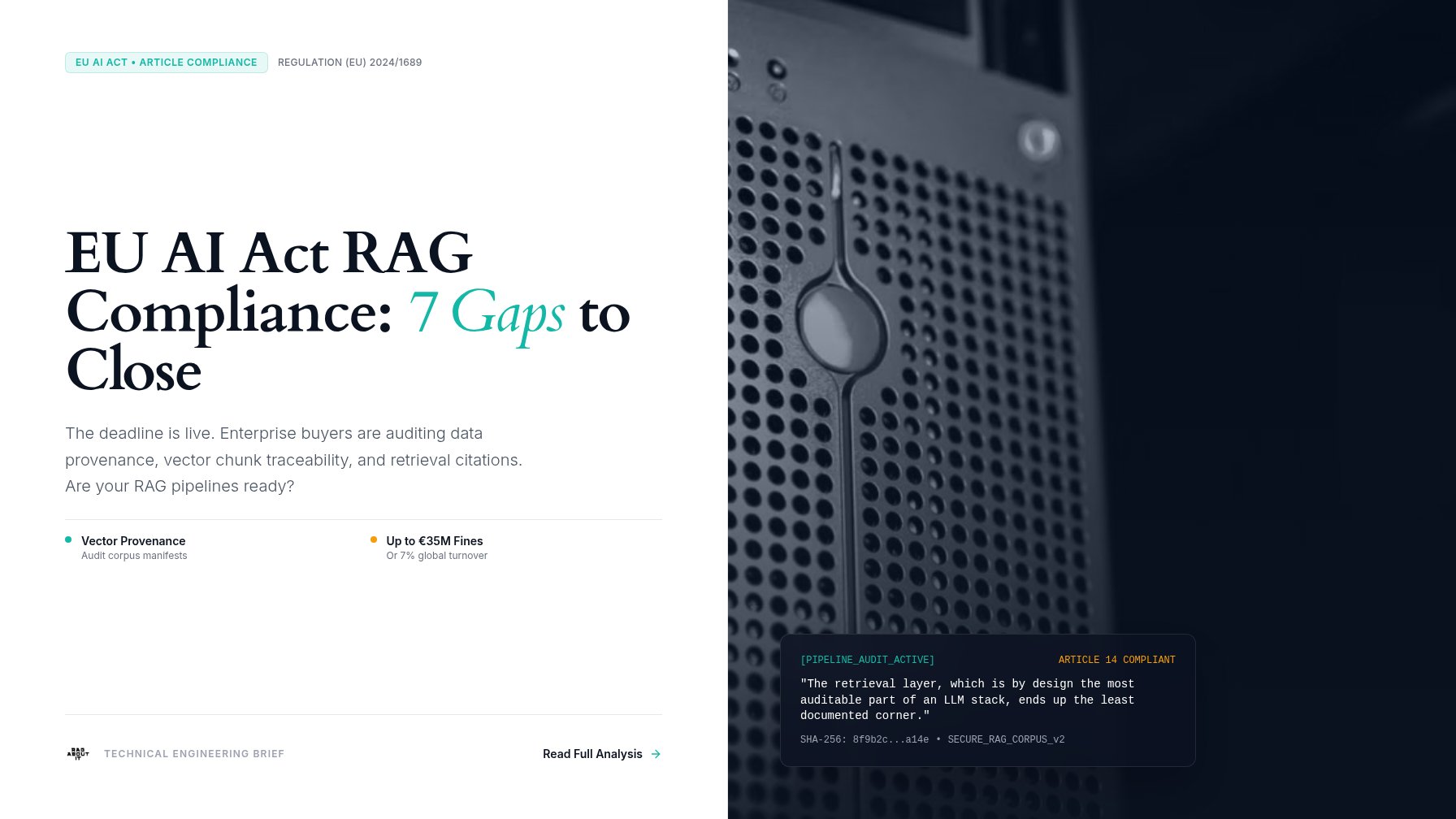
On August 2, the last major layer of the EU AI Act took effect across all 27 member states. If you run RAG in production, EU AI Act RAG compliance is now part of your job description. The general-purpose AI models your pipeline calls at inference time, the ones from OpenAI, Anthropic, Google, Mistral, and the rest, now operate under binding duties. Technical documentation. A copyright policy. A public summary of training data. For the biggest models, systemic risk reporting and incident logging on top. Providers that ignore any of it face fines up to €15 million or 3 percent of global annual turnover, whichever is higher. The worst violations, like putting a prohibited system into service, reach €35 million or 7 percent.
That’s the news. Here’s why it landed on your desk.
If you build RAG systems at a small company, you’re probably not a model provider. You’re a deployer, the party that puts an AI system to work for its own purposes. Deployers carry their own duties under the Act, and August 2 turned several of them from theory into enforceable rules. Enterprise buyers in the EU have noticed. Questions about data provenance, logging, and documentation that never surfaced in 2025 sales calls now surface in 2026 ones.
The uncomfortable part is how most RAG stacks got built. PDFs in, chunks out, embeddings into a vector database, a model on the other end of an API call. Few teams kept a manifest of what went into the corpus. Fewer still log what their system retrieves, cites, or says. So the retrieval layer, which is by design the most auditable part of an LLM stack, ends up the least documented corner of the company.
This post covers what EU AI Act RAG compliance actually asks of a RAG team, the seven gaps we keep finding in otherwise well-built systems, and a 30-day plan to close them before an auditor or an enterprise customer asks. Article numbers are cited throughout so your legal team can verify every claim against the official text. One caveat up front: this is engineering guidance written by engineers, not legal advice.
What EU AI Act RAG compliance now requires
Most coverage of the Act stops at “the fines are big.” The useful parts are the dates and the role you occupy. Both are simpler than they look.
The dates that matter
- August 1, 2024: the Act entered into force and its clocks started running.
- February 2, 2025: the Article 5 prohibitions and the Article 4 transparency duty began applying. If your chatbot tells users it’s AI, that’s Article 4 at work.
- August 2, 2025: member states were due to have their national oversight authorities in place.
Then came the general-purpose model rules.
- May 2, 2026: the statutory deadline for the general-purpose AI Code of Practice. The final version landed earlier this year, and providers that adhere to it get a presumption of conformity. One catch worth knowing: providers had to commit to the Code before August 2, 2026. Anyone entering the market after that date has to show compliance with the Act directly.
- August 2, 2026: obligations for general-purpose AI models and most of the Act’s remaining requirements went live. This is what people mean when they say the AI Act is now enforceable.
- August 2, 2027: the same rules extend to AI embedded in regulated products like medical devices and machinery.
Penalties sit in Article 99 and scale with the violation. €15 million or 3 percent of global turnover for breaches of the general-purpose AI rules. €35 million or 7 percent for prohibited practices. Whichever amount is higher wins. None of this touches GDPR, which still applies to personal data in your corpus with its own ceiling of €20 million or 4 percent.
Which role your RAG team plays
EU AI Act RAG compliance turns on your role. The Act splits the world into providers, who place AI systems on the market under their own name, and deployers, who use those systems for their own purposes. A small company running RAG over a hosted API is almost always a deployer. Almost.
Two moves can flip your role. Substantially fine-tuning a model, or rebranding and reselling an API under your own product name, can make you a provider, with everything that comes with it, including Annex XI technical documentation. Plain RAG over an API doesn’t do this. But plenty of startups white-label a model behind their own brand for customers, and that’s exactly the case where you want counsel reading the value chain guidance before you assume anything.
One trap deserves its own paragraph. Article 5 prohibits emotion recognition in the workplace. If someone proposes bolting sentiment scoring of employees onto your internal HR knowledge assistant, that idea is now illegal in the EU. It used to be merely unwise.
Why EU AI Act RAG compliance starts at the retrieval layer
An LLM system has four sensitive surfaces: what it ingests, what it stores, what it says, and what it can prove. RAG touches all four. Your corpus holds copyrighted documents and possibly personal data. Your index stores derived vectors of both. Your answers stream to users who, since February 2025, are legally owed a disclosure that they’re talking to AI. And your evidence trail is wherever you decide to keep it.
There’s a twist here, and most teams miss it. RAG is the only part of the LLM stack that generates receipts by default. Every answer traces back to chunk IDs, source documents, and a specific model version. Log those and you can reconstruct any answer your system ever gave, citations included. That’s the dream artifact for an auditor, and it costs a few fields per request.
Almost nobody logs them. That’s the distance between where RAG teams are and where EU AI Act RAG compliance now points.
Copyright shows up on the output side
Article 53(1)(b) obliges the model provider to keep a policy against reproducing copyrighted content from training. That duty belongs to the provider. The deployer’s half of EU AI Act RAG compliance shows up in the output. If your system answers a question by reproducing three paragraphs from a paywalled analyst report sitting in your corpus, that exposure is yours.
The line got drawn in a US courtroom, and it matters for RAG teams everywhere. Judge William Alsup’s June 2025 ruling in the Anthropic case found that training on pirated books was fair use, but producing their text in outputs was not. RAG is, mechanically, an output machine pointed directly at your documents. For you, the guardrail matters far more than the training debate ever will.
GDPR never left the room
Your chunks carry personal data, and EU AI Act RAG compliance doesn’t replace the GDPR duties that come with it. Support tickets, customer contracts, HR policies, the emails an ambitious ingestion script pulled in last spring. A GDPR erasure request doesn’t stop at the source document. It has to propagate through the chunks, the vectors derived from them, any cached answers, and your logs. Most vector stores make delete-by-metadata awkward, so for many teams the honest answer is that a deletion means a re-index, and a re-index means a pipeline that should have been tested long before the request arrived.
The 7 gaps to close before anyone asks
These seven show up again and again in otherwise well-built stacks. None require new vendors. All require a decision, and together they get you most of the way to EU AI Act RAG compliance.
1. No retrieval audit trail
Log every request. A workable schema fits in one object:
{
  "ts": "2026-09-25T09:14:02Z",
  "session": "anon-8f3a2c",
  "query_hash": "d41d8c",
  "retrieved": ["doc-117#chunk-4", "doc-012#chunk-9"],
  "source_hashes": ["9c1f...", "7ab2..."],
  "model": "provider/model-2026-06",
  "answer_id": "a-114",
  "latency_ms": 843
}
Article 20 expects deployers of high-risk systems to keep the logs those systems generate automatically, and the Act sets six months as the retention floor. Six to twelve months covers most RAG use cases, and the storage cost is trivial next to the first contract this log saves. This log is the backbone of your EU AI Act RAG compliance file.
2. No corpus manifest
A manifest is one table. Source document, license, date ingested, permitted use, owner, and a personal data flag. That’s it. The test is simple, too. If you can’t answer “where did this chunk come from, and are we allowed to use it that way” in a single query, you don’t have a manifest. You have a folder.
3. Verbatim regurgitation unchecked
Run an n-gram or embedding similarity check between generated answers and their retrieved chunks. Flag or block matches above a threshold; somewhere around 40 consecutive tokens is a reasonable starting line. Log every override. It’s an afternoon of work, and it marks the difference between citing a document and republishing one.
4. Personal data with no deletion path
Write the deletion runbook while nothing is on fire. Pseudonymize session IDs at log time. Map which sources carry personal data. Test delete-by-metadata on your store once a quarter, and if the store can’t do it, make the runbook a documented re-index procedure with a named owner. GDPR fines reach €20 million or 4 percent, and no regulator has ever accepted “we’re working on it” as a defense.
5. Transparency missing at the interface
Article 4 has applied since February 2025. Users must know they’re interacting with AI. For a B2B support bot, that means a visible disclosure in the interface, not a line buried in your terms of service. Where your outputs fall under Article 50’s marking rules, add machine-readable markers to generated content as well. This is a front-end afternoon, and it’s the EU AI Act RAG compliance gap most visible from the outside.
6. No vendor documentation file
Ask every model provider in your stack for four things: their EU AI Act technical documentation, their public training data summary, their copyright policy, and their status under the Code of Practice. The major providers publish all four, most now on dated, versioned pages built for exactly this purpose. Almost nobody on the buying side keeps copies. Download them, date them, note the model versions they cover, and add flow-down language to new contracts so updates arrive without being chased.
7. No evaluation evidence
Keep a versioned evaluation report. Retrieval recall at k, citation accuracy, hallucination rate against your golden set, with the dataset hash, the model version, and the date on every page. When an enterprise buyer asks how you know the system doesn’t fabricate, a dated report is an answer. “We tested it before launch” is a story.
The 30-day plan
One engineer, a few hours a week, no procurement cycle. The whole EU AI Act RAG compliance plan fits in a month.
- Week 1: ship the retrieval log schema and start the corpus inventory. You want log records flowing into storage and a manifest spreadsheet listing every source you can find.
- Week 2: finish the manifest, record license terms for each source, and write and test the deletion runbook once, end to end.
- Week 3: collect vendor documentation for every model in the stack, ship the interface disclosure, and put the regurgitation guardrail into staging.
- Week 4: run the eval suite, version the report, and sit down with counsel for an hour to review roles and open gaps. Publish a one-page system card for your RAG stack while you’re in there.
Then you’re not scrambling. You’re answering.
Where this leaves your stack
The story in AI this month is that the industry’s paper trail became a product feature. Model providers now document training data, copyright policies, and risk under legal deadline, and the buyers building on top of those models inherit every question that comes with them.
For RAG teams, EU AI Act RAG compliance lands better than it looks. The retrieval layer you built for answer accuracy happens to generate exactly the evidence regulators and enterprise buyers now ask for. Chunk IDs, source documents, model versions, timestamps. A stack that cites its sources can audit itself, and a stack that can audit itself can sell into regulated industries without holding its breath.
Close the seven gaps. Run the 30-day plan. Brussels started asking questions in August, and your logs are how you answer.
We cover this beat weekly at Rag About It, from retrieval evaluation to vector security to EU AI Act RAG compliance guides for enterprise-grade systems. Subscribe if you want the follow-ups, including a full walkthrough of the log schema and manifest templates from this post. And if your team needs documentation written, a system card drafted, or an audit trail designed into a RAG system before a customer asks for it, that’s our job. Start with the logging schema above. It’s the best hour of engineering you’ll spend this quarter.