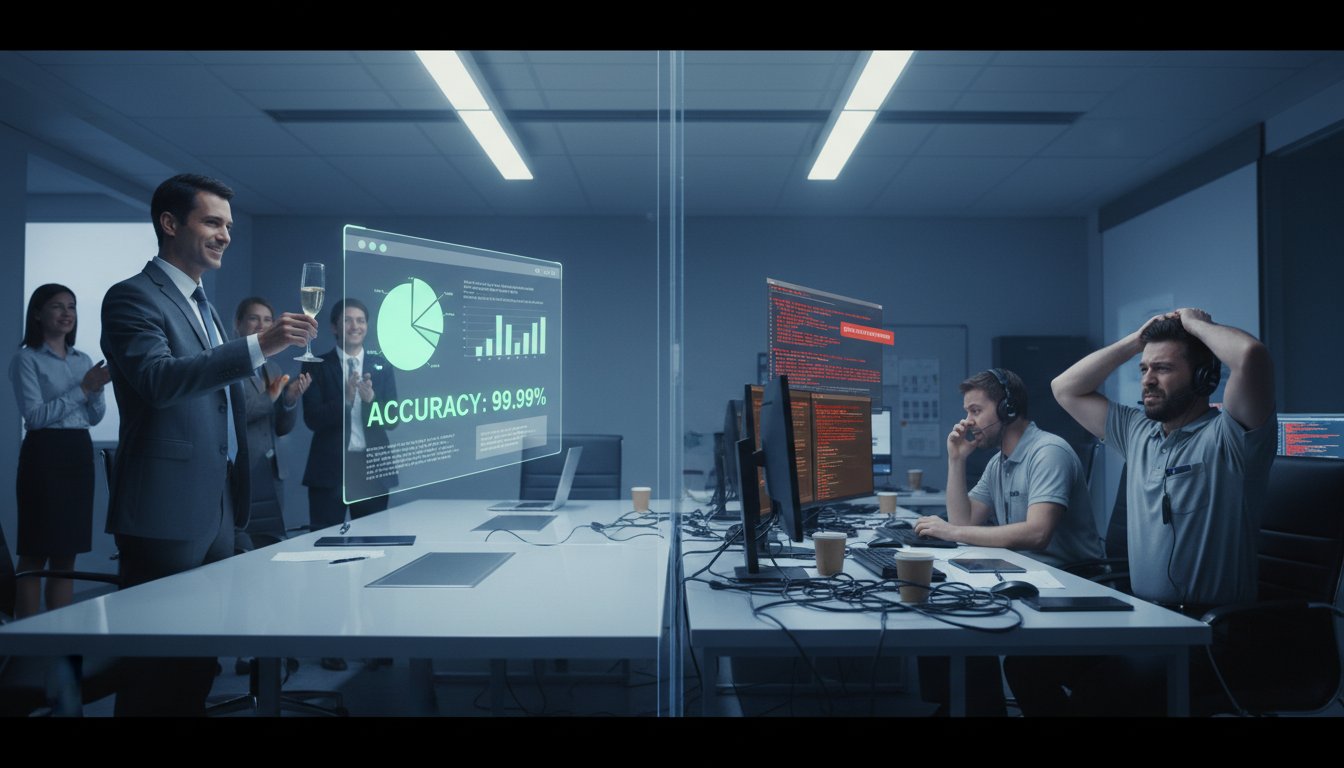

It’s a scene playing out in boardrooms from San Francisco to Singapore. A CTO, beaming with pride, demos their new Retrieval Augmented Generation system. The chatbot answers complex policy questions in seconds, pulling from thousands of internal documents. The demo is flawless. The champagne gets popped. But six months later, the support team is drowning in escalations, and an internal audit reveals something terrifying: the system is wrong nearly half the time on critical questions. That early euphoria hid a silent killer of enterprise AI, a massive, unobserved evaluation gap. This isn’t just a cautionary tale. It’s the daily reality for organizations that trusted standard metrics like semantic similarity, which simply don’t correlate with business value. A new wave of 2026 benchmarks shows that standard RAG pipelines lose a staggering 43% of their accuracy when faced with tasks that require deep, multi-layered reasoning. That gap is completely invisible to most current evaluation suites. The root cause isn’t a single broken component; it’s a systemic failure in how we measure what counts as ‘accurate’ retrieval and generation. We’re grading AI systems with a ruler when we need a surgical microscope. What’s missing isn’t better models, but evaluation frameworks that can dissect failure modes with real precision—measuring adherence to complex instructions, the completeness of multi-hop answers, and contextual grounding against noise. These five modern evaluation frameworks are that surgical microscope. They expose the root causes of that 43% accuracy gap and give you the diagnostic tools to turn a RAG system from a demo-night star into a production-floor workhorse.
How Noisy Context Collapse Masquerades as Success
The most dangerous failure? One that looks like a success. A model spits out a confident, articulate paragraph with direct citations. BERTScore gives it a 0.95, near perfect. But a human reviewer recoils. The cited document was an outdated HR policy that was rewritten six months ago. The model faithfully, catastrophically parroted the wrong information. This isn’t hallucination; it’s a contextual grounding failure, and it’s the main reason behind that huge accuracy gap. Traditional metrics compare output to a single idealized reference answer. They can’t check if the response is actually supported by the retrieved context, especially when that context is full of contradictions, stale jargon, and domain-specific noise typical of enterprise knowledge bases.
The Decomposition of Answer Integrity
To get past surface scores, new frameworks are breaking down what it really means to give a good answer. First, completeness. A query like, “What are the parental leave policies for employees in Germany and Canada, and how do they interact with our global short-term disability plan?” often gets a partial response. The model might nail the German policy but give a vague, useless statement about Canada, while totally ignoring the interaction with the disability plan. A legacy evaluation scores this train wreck as moderately accurate, completely missing the catastrophic failure to address the full depth of the question. That’s where the 43% gap starts taking shape. Evaluators that rely on a single vector similarity can’t measure whether the answer really covers everything, creating a false sense of security by rewarding confident-sounding incompleteness.
The shift toward atomic fact decomposition, pioneered by frameworks like RAGAS, tackles this head-on. Instead of evaluating a big block of text, these systems break both the ground truth and the generated answer into a list of independent, verifiable atomic facts. Then a natural language inference (NLI) model cross-references each atomic fact against every chunk of retrieved context and every line of ground truth, checking for strict entailment. So if a generated answer has three facts, two correct and one hallucinated, the score transparently shows 66.7% factual completeness. You see exactly which part failed. This granular approach lines up with the 43% accuracy gap finding: most of the loss isn’t from completely wrong answers, but from answers that are partially right, smoothly blending truth and fiction in a way standard metrics can’t untangle.
The Multi-hop Reasoning Wall That BERTScore Can’t See
Enterprise data isn’t a flat pile of independent facts; it’s a deeply connected web. A standard RAG pipeline crushes single-hop questions, where the answer is in one paragraph. But the real value is in multi-hop reasoning: connecting a clause in a German supplier contract to an EU compliance regulation updated last Tuesday. The research that exposed the 43% gap didn’t use simple FAQ datasets. It came from adversarial benchmarks specifically designed to test this connective ability, and the results are a wake-up call. A system might retrieve ten documents perfectly for a complex legal question, but if it misses the critical logic linking documents five and nine, the answer becomes a beautifully written non-sequitur. Traditional evaluation, focused only on the final output, shows none of this chain-of-thought collapse.
This requires a totally different evaluation approach, one that looks into the model’s reasoning workflow. The best new frameworks use multi-step trajectory evaluation, where a separate, heavy-duty LLM acts as a judge with a very specific lens. Say you ask about a molecule’s efficacy, pulling chemical property data from one paper and toxicology results from a separate trial. A trajectory evaluator can score the final answer not against a single reference, but by reconstructing and verifying the necessary reasoning steps. The evaluation prompt for the LLM judge is brutally specific: “For a full score, the response must clearly bridge the chemical mechanism of action and the Phase II safety data. Each logical connection must be assigned a binary support status.”
This process can be automated and scaled. Now frameworks generate a “reasoning gold map” by having a frontier model like Gemini 2.0 or GPT-4o parse a complex query and output the exact atomic reasoning steps needed to answer it. Then the RAG system’s output is evaluated by a second, less powerful model, not just on its final conclusion, but on whether it successfully walked through that pre-mapped reasoning graph. Failing to hit even one node in this graph gets quantified precisely. That shows how a system rated 95% accurate on single-hop tests can tank to 57% when the evaluation metric is retooled for connectivity. That delta is the 43% gap made real.
The Parallel Evolution of Human and Model-Based Evaluation
The scale of enterprise RAG makes human evaluation impossible, and purely automated metrics are blind to nuanced failures. The fix is a close partnership between fast, targeted LLM-based judges and sparse, hyper-focused human expert review. This method is called calibrated human-model alignment. The old approach failed because human evaluators were used as a slow, expensive replacement for massive-scale scoring, reviewing thousands of random samples. The new frameworks use humans not to score, but to calibrate the automated judge’s rubric. That’s a fundamental shift in efficiency.
Take context relevance, a top cause of hallucination. An auto-evaluator might think a retrieved chunk is relevant because it shares keywords. But a human expert, a senior tax accountant or chemical engineer, will instantly see that the chunk is semantically similar but legally inapplicable, from a different jurisdiction. The new approach takes this one human-flagged error, along with a three-sentence explanation of why it’s irrelevant, and feeds it into the auto-evaluator’s system prompt as a new Rule for Exclusion. The automated judge isn’t just computing cosine similarity anymore; it’s learning to apply a proprietary, business-specific exclusion logic. Over a week, five to ten detailed human corrections can permanently boost a custom context-relevance evaluation metric by over 30%, creating a self-improving evaluation flywheel that generic public benchmarks can’t touch.
This closed-loop calibration system changes how we measure RAG hallucination rates. Verbose, plausible-sounding fabrications, like inventing a meeting date in 2020 that never happened, are often missed by standard metrics. A human evaluator catches one of these temporal hallucinations and documents the pattern. That pattern gets encoded into the LLM judge’s framework as a “temporal contradiction detection parameter.” From then on, the automated system scans millions of tokens, flagging any date assertion with no clear origin in the context and giving it a temporal grounding score of zero. This human-machine teamwork lets enterprise teams get at-scale evaluation that’s both cheap and clinically accurate, catching the exact error classes behind that hidden 43%.
Deploying Real-time Observability to Stop the Drift
The last piece of closing the evaluation gap is realizing that an evaluation run isn’t a one-time certificate; it’s a continuous monitoring process. RAG systems are constantly shifting. A model update from the API provider, a silent data schema change in the vector database, or a change in how users phrase questions can cause accuracy to drift by ten points in a weekend. This drift is invisible to static, nightly batch evaluations. A benchmark run in June is useless by August without a live observability framework. Otherwise, it’s just a costly retrospective autopsy, not a preventative diagnostic.
Modern frameworks handle this with real-time drift detection via statistical process control. They sample live traffic: for every 1,000th production query, the framework automatically runs an evaluation using the calibrated methods from earlier, generating a live fidelity score. Then it watches the score, not for an absolute threshold, but for non-random departures from the baseline using CUSUM charts. One drop is noise; three consecutive drops below the 2-sigma line signal a systemic drift event. That triggers an immediate automated alert and a diagnostic pipeline, often even a temporary, automatic rollback to a previously validated model snapshot. This turns evaluation from a project milestone into a core part of site reliability engineering.
This diagnostic pipeline gives automated root cause analysis. When drift is detected for a query cluster, the system doesn’t just say “accuracy dropped by 5%.” It automatically kicks off a parallel analysis: it replays the anomalous queries through a separate retrieval relevance scorer and a contextual grounding classifier. If the grounding score dropped but retrieval relevance stayed flat, the diagnosis is clear: a model-side hallucination spike, probably from a provider update. If retrieval relevance tanked, the data pipeline gets flagged for an ingestion failure. This granular, continuous visibility breaks the big 43% accuracy gap into a manageable set of component-level performance indicators. Teams can then fix issues surgically before they hit a single user.
The conclusion is clear: that 43% accuracy gap isn’t inevitable; it’s a direct result of evaluation naivety. By moving from monolithic similarity scores to atomic fact verification, from output-only assessments to multi-hop reasoning path analysis, and from static benchmarks to continuously calibrated human-model teamwork, organizations can reclaim that lost fidelity. They can turn RAG systems from unreliable liability machines into the reliable precision tools they were supposed to be. Start by deploying a non-semantic, decomposition-based evaluator on your next 100 production logs. You’ll see not just a score for the first time, but a surgical map of the path to true production readiness.