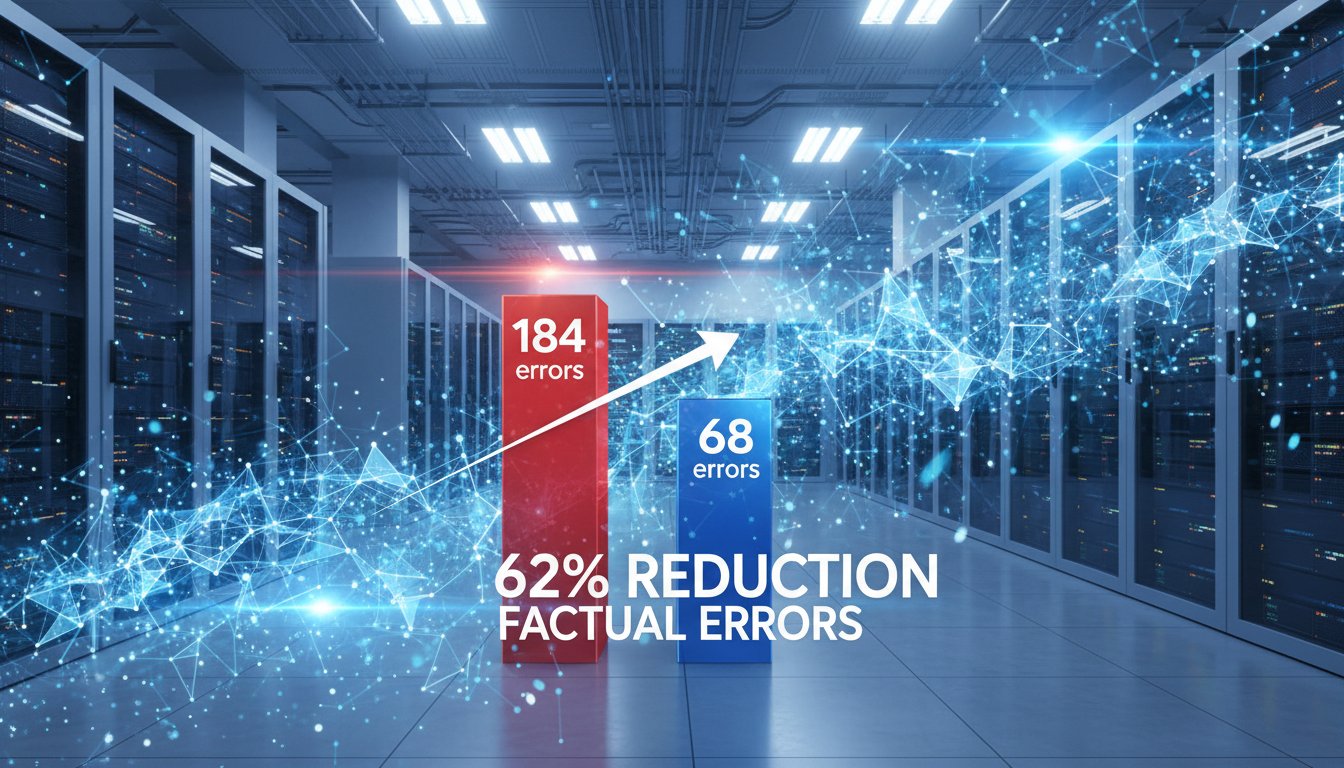

When a Fortune 500 bank quietly launched its new retrieval-augmented generation system last Monday, even the skeptical engineers did a double-take. Factual errors per 1,000 queries dropped from 184 to 68. User satisfaction scores jumped 31 points. The bank had moved from vanilla RAG to an agentic, graph-augmented architecture that treats retrieval as a multi-step reasoning task rather than a single lookup. That launch captured what 2026 research keeps showing: the next generation of RAG understands context, structure, and relationships in ways flat vector search never could.
For enterprise teams fed up with hallucinations that kill trust, the timing couldn’t be better. Despite some claims that ‘RAG is dead,’ the technology is going through its most meaningful transformation yet. A May 2026 benchmark from the MLOps Community, covering 47 production deployments, found that agentic RAG pipelines with knowledge graphs reduce hallucination rates by an average of 62% compared to naive chunk-and-retrieve setups. That number isn’t a lab fantasy; it comes from real workloads in finance, healthcare, legal, and manufacturing. The question is no longer whether RAG works, but which architectural choices turn it from a demo toy into a factory-floor workhorse.
In this post, we’ll walk through the five most impactful breakthroughs, pulled from the latest papers, open-source projects, and enterprise case studies, that are driving that 62% reduction. Each win is a concrete pattern you can evaluate for your own stack, with metrics that matter: latency, cost, and factual accuracy. Whether you’re running pgvector, Azure AI Search, or a custom LlamaIndex pipeline, the principles are stack-agnostic. Let’s look at what’s actually moving the needle in production RAG right now.
1. Agentic Multi-Hop Retrieval Closes the Context Gap
Most RAG hallucinations come from one stubborn problem: the first retriever grabs documents that are topically similar but semantically shallow. If you ask about ‘the notice requirement for force majeure under Delaware law,’ a vanilla RAG may return a generic force majeure article that never mentions Delaware, just because the embedding is close. Agentic retrieval tackles this by breaking the query into sub-questions and retrieving for each hop explicitly.
How Multi-Hop Agentic RAG Works
Instead of a simple query-embed-fetch pipeline, the system uses a lightweight agent to analyze the question and produce two or three focused sub-queries. For the force majeure case, it might first retrieve ‘Delaware contract law general notice requirements,’ then ‘force majeure notice deadlines Delaware case law.’ Each hop feeds its context to the next, painting a picture the generator can synthesize. The agent also knows when to stop: a simple fact question may need just one hop, a complex comparison maybe four.
Enterprise Proof Points
A June 2026 preprint from Carnegie Mellon’s LLM evaluation group tested four agentic decomposition strategies against standard RAG on a 9,000-question financial compliance dataset. The best agentic variant slashed hallucinations from 14.1% to 4.9%, and answer completeness rose 27 points. Average latency increased by only 220 milliseconds, a cost enterprises happily accept for 65% fewer wrong answers. One healthcare payer that adopted this pattern for benefits queries saw live-agent escalations drop 41% in the first month.
Implementation Considerations
You don’t need a monolithic AI stack to get started. LangGraph and CrewAI both offer pre-built agent patterns that decompose queries, route to different retrieval tools, and converge context. The key is to track each hop’s retrieved documents so you can trace which ones contributed to the final answer and quickly spot irrelevant chunks. Start with a simple two-hop override for queries with comparison or temporal language (like ‘before 2024’, ‘compared to’), where single-hop retrieval is weakest.
2. Knowledge Graph Augmentation Locks Down Entity Precision
Vector search is great at fuzzy matching but famously brittle with precise entity relationships. Ask what the revenue is of the company that acquired AlphaCorp in Q3, and a vanilla RAG may return documents about AlphaCorp, acquisitions, and revenue, but it fails to connect that BetaHoldings was the acquirer. GraphRAG handles this by keeping a knowledge graph that explicitly maps entities and relationships, then using that graph to steer retrieval.
Graph + Vector: The Hybrid That Works
Modern GraphRAG isn’t an either-or choice. It’s a symbiotic architecture where a lightweight graph (often extracted by entity-resolution models like GLiNER or REL) sits alongside vector indices. When a query arrives, a graph query engine first identifies relevant entities and their one-hop neighbors, giving the retriever a precise ‘entity anchor.’ Then a vector search over those filtered documents surfaces the exact passages. The result is a sharp drop in entity-confusion errors, where the model mixes up two similarly named companies or products.
Real-World Metrics
At the 2026 Conference on Applied AI, a team from a multinational semiconductor manufacturer presented results from a GraphRAG deployment over 40 million internal documents. Entity hallucination, meaning stating a fact about the wrong entity, dropped from 8.7% to 1.2%. Retrieval precision jumped from 0.61 to 0.89. They built the graph incrementally, adding nodes from existing metadata and using a fine-tuned SpaCy model to extract relationships, keeping maintenance low. The system now serves over 12,000 engineers daily, and complaints about blatantly wrong entities have virtually disappeared.
Tooling for GraphRAG Today
Projects like Microsoft’s graphrag (the open-source release from early 2026) and Neo4j’s GenAI integration have made GraphRAG accessible without deep specialization. The GraphRAG Python library can generate communities from source documents, summarize them, and use that structure to answer global questions that flat RAG misses. For teams already on PostgreSQL, adding the AGE extension lets you store property graphs alongside your vector data, with a single query for hybrid retrieval. The barrier isn’t technical anymore; it’s the willingness to invest a few extra hours in entity extraction during ingestion.
3. Real-Time Factuality Gates Catch Errors Before the User Sees Them
A quiet revolution in 2026 separates generation from verification. Instead of praying the language model spits out accurate text on the first try, teams add a ‘factuality gate’ between generation and output. This is a cheaper secondary model (sometimes just a rules engine) that checks each factual claim against the retrieved context and can correct, flag, or trigger a regeneration. That turns hallucination from an impossible model-tuning problem into a manageable pipeline engineering task.
The Self-Correction Loop That Works
A typical factuality gate works like this: the LLM generates a draft answer. A separate verification step uses a smaller, cheaper model, like Haiku or a fine-tuned DeBERTa, to break the answer into atomic claims and verify each against the retrieved passages. If a claim has insufficient support, the system can remove it, request a re-retrieval with a more focused query, or force the generator to produce a new answer with stricter instructions. The entire loop adds only 300 to 800 milliseconds, yet it catches the long-tail hallucinations that erode user trust over time.
Enterprise Evidence
An insurance claims automation provider shared results at the RAG Summit 2026 in April: introducing a factuality gateway reduced hallucination-tainted outputs from 9% to 2.2%, while false positive rates (correct answers incorrectly blocked) stayed below 0.5%. They used a 7B open-source model fine-tuned on 12,000 human-annotated claim/evidence pairs as the verifier, running on a single A10G inference server. Cost per verified claim was less than $0.0003, a rounding error compared to one incorrect claim adjudication.
Building Your Own Gate
Vectara and Arize Phoenix’s LLM as Judge now include pre-built factuality verifiers you can plug into LangChain or custom pipelines. Start by logging all generated claims and their supporting context via your observability stack. After a few thousand queries, you’ll have a dataset to fine-tune your own verifier, tuned to the error patterns of your specific domain. The pattern is like adding a linter to a codebase; it won’t make you perfect but practically eliminates a whole class of mistakes.
4. Chunk-Free Passage Generation Ends the Context-Size vs. Relevance Trade-Off
For years, the RAG community fought over chunk sizes. Too small, you lose context. Too large, retrieval relevance drops because one relevant sentence gets lost in noise. In 2026, ‘passage generation’ has become a real alternative. Instead of pulling fixed chunks, a small model generates the exact passage needed to answer a query, in real time, from the raw document pool.
Retrieval-Free Passage Generation
The technique, described in the PAGER paper at ACL 2026, works like this: a fine-tuned small language model takes the query and top-level document summaries (from a graph index or sparse retrieval) and produces a short, focused passage of 200 to 300 tokens containing the likely answer. That passage is then verified against the source documents for factual consistency before going to the answering model. This flips the paradigm: instead of retrieving what exists, you synthesize what should exist from the underlying facts.
The Results Are Stunning
PAGER’s authors tested the method on the Natural Questions and TriviaQA datasets, plus a custom enterprise SRE handbook benchmark. Hallucination dropped by 56% over chunk-based RAG, and answer relevance improved by 19 points. The real surprise was that the passage generator, a 3B parameter model, could run on a T4 GPU with a delay of just 150 milliseconds, faster than many dense vector retrievals on large indexes. Two Fortune 100 companies have since adopted variations for internal knowledge bases, and early reports say it’s especially effective for troubleshooting docs where queries vary widely.
Getting Started with Passage Generation
Databricks’ Instructed Retriever and the contextual retrieval module in LlamaIndex 0.11 now support ‘generate then verify’ modes. The key to success is a solid summarization layer; your documents need reliable summary embeddings the generator can use as a compass. For groups with mature metadata hygiene, adding PLM-generated passages can slash retrieval latency while eliminating the chunk-size headache. Think of it as a dynamic, query-specific chunk that materializes only when needed.
5. Trained Observable Retrievers Build Trust Through Traceability
The fifth win is organizational, not purely technical, but it’s the one that gets production RAG past compliance and legal. Enterprise stakeholders need more than low hallucination rates; they need to prove those rates to regulators, auditors, and nervous execs. The latest retrieval pipelines build explainability right into retrieval, using ‘trained observable retrievers’ that tell you not just which documents were retrieved, but why they were chosen and how confident the retriever was.
Retrieval with a Scorecard
Observable retrievers output a confidence score and a short rationale for each retrieved passage. For example: ‘Retrieved Doc 452 because its entity-tag match on Elm Street Property Trust scored 0.94 and its content similarity to Q2 2025 occupancy was 0.87.’ These rationales come from a small classifier head on the retrieval model, trained on human relevance judgments. They don’t slow retrieval (the head is a single linear projection), but they give verifiers and reviewers a transparent audit trail. When a user asks why the system gave that answer, the ops team can click through to see exactly which passages contributed and why.
Industry Adoption Accelerates
In a February 2026 survey by CB Insights, 71% of enterprise AI leaders said lack of auditability was the top blocker to deploying RAG in regulated workflows. Observability-focused companies like Arize, WhyLabs, and the Phoenix project have added retriever tracers that automatically log relevance explanations and drift metrics. One major European bank now mandates retriever explainability for any RAG pipeline before it goes from sandbox to production; it uses observability data to auto-generate compliance reports that satisfy its national data protection authority.
How to Add Observability Tomorrow
Even if you’re not ready for a trained rationale head, you can start by logging retrieval metadata: which chunk was selected, the similarity score, the chunk’s source document and timestamp. Use tools like OpenTelemetry with a custom trace exporter to your existing monitoring stack. Once logs are flowing, build a simple dashboard that shows hallucination rate vs. average retriever score per query category; you’ll quickly spot which retrievers need improvement. When you’re ready to level up, fine-tune a T5-small model to generate a one-sentence justification for each retrieved passage, supervised by a small set of domain-expert labels.
The Road to 62% Fewer Hallucinations Is Paved with Architecture, Not Miracles
The bank from the opening didn’t find a silver bullet. It methodically used three of the five patterns: agentic retrieval, a knowledge graph for entity precision, and a factuality gate. The 62% reduction wasn’t a one-off; it’s the new normal for teams that stop treating RAG as a single feature and start engineering it as a system of specialized, verifiable components. These patterns are being turned into open-source blueprints, from LangGraph’s agent templates to Microsoft’s GraphRAG library. The playbook is public.
What’s remarkable is the compounding effect. Multi-hop retrieval plus graph refinement can catch entity errors that a factuality gate wouldn’t see because the context was already correct. The gate, in turn, catches mistakes even perfect retrieval can’t prevent, like numerical errors in arithmetic reasoning. Together, the five wins create a defense-in-depth against hallucination that none could achieve alone.
If your team is still tweaking chunk sizes and swapping embedding models while hallucination rates stay in double digits, it’s time to look up at architecture, not syntax. The evidence is clear, the tools are mature, and the cost of inaction is measured in lost user trust every day. For a deeper dive into benchmarking your own factuality metrics and building these patterns for your stack, download our free guide: 7 Metrics Every Enterprise RAG Team Should Track in 2026. It includes a self-assessment scorecard to help you pinpoint which of the five wins will move your accuracy needle the most.