
It starts with a simple query: “What were the key takeaways from last quarter’s customer feedback on our new product line?” A traditional retrieval-augmented generation (RAG) system might return a bland summary pulled from a few isolated documents. But your VP of product isn’t looking for that. She needs a connected, evidence-backed answer that spans support tickets, call transcripts, survey responses, and even informal Slack discussions, with full context about who said what and when. Most enterprise RAG stacks fail exactly here. They retrieve chunks of text that match a vector similarity score, ignoring the relationships between those chunks. The result is fragmented, often contradictory, and dangerously incomplete.
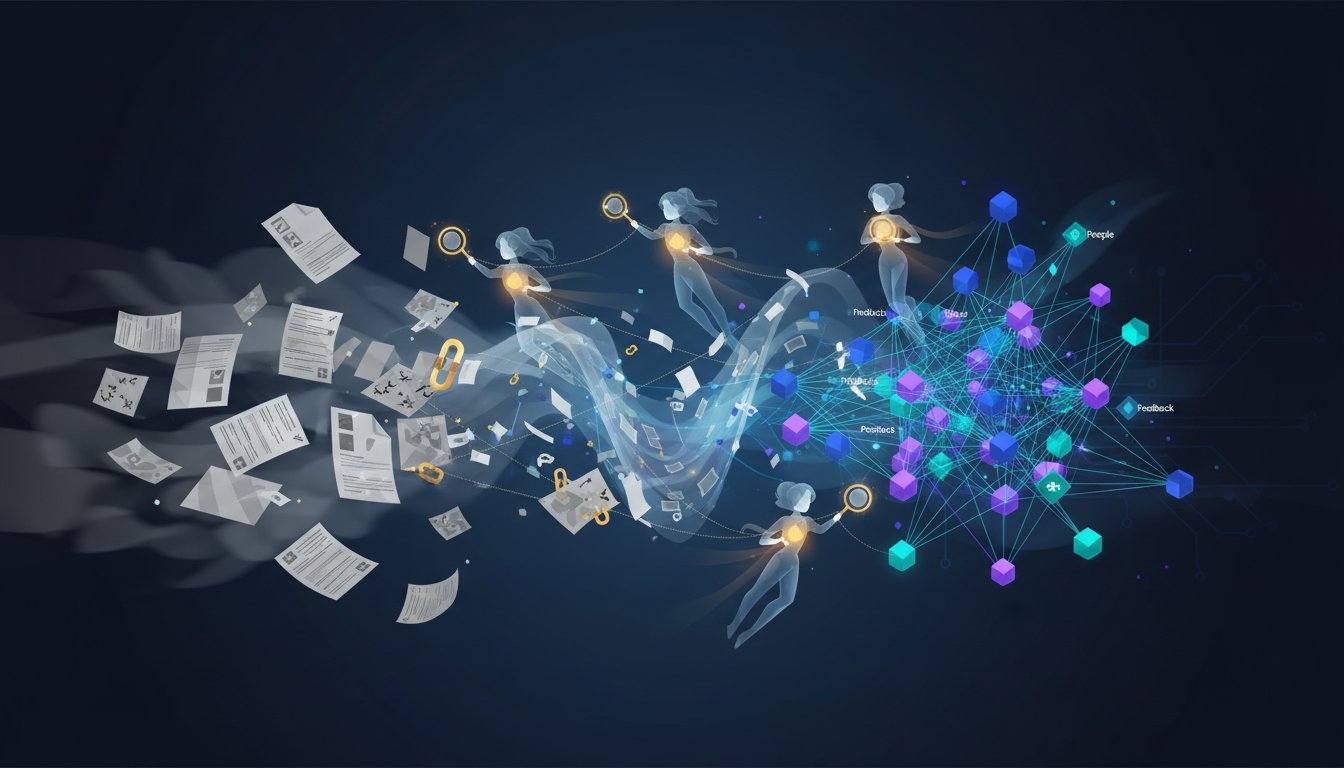
The good news: a new architecture is rewriting the rules. Multi-agent GraphRAG combines graph-based knowledge representation with specialized AI agents that collaborate to explore, reason, and explain. Instead of treating your enterprise data as a flat pile of text, it builds a living knowledge graph that captures entities, relationships, and provenance. Then, multiple agents, each an expert in a specific task, traverse that graph to fetch, verify, and synthesize information.
In this post, I’ll walk through seven capabilities that make multi-agent GraphRAG a major step forward for enterprise knowledge management since the original RAG paper. You’ll see how this approach cuts hallucinations, enforces source traceability, and handles the messy, interconnected reality of corporate data. Whether you’re evaluating retrieval strategies or already deep into agentic AI, these insights will help you separate hype from hard engineering truth.
The Blind Spots That Broke Traditional RAG
Conventional RAG pipelines lean heavily on vector similarity. They split documents into chunks, embed them, and retrieve the top-k matches for a user’s query. That design assumes the answer lives in a single chunk or a set of unrelated chunks. Enterprise knowledge, however, is a web of dependencies. A customer complaint in Zendesk might be linked to a bug report in Jira, a code commit, and a Slack conversation among engineers. Semantic search alone can’t trace those links.
Anthropic recently quantified a related failure mode: when chunk boundaries break meaning, even sophisticated retrievers hallucinate because context is split mid-thought. Google’s multimodal RAG efforts showed that adding images didn’t solve the fragmentation problem; it just added another isolated modality. The underlying issue isn’t chunk size or embedding quality. It’s the missing relational layer.
GraphRAG addresses this by indexing documents as interconnected nodes and edges. A customer mention, a product name, a date, a sentiment score, each becomes a node. The relationships “reported_by,” “references,” “resolved_in” form the edges. When a query arrives, the system can traverse these edges, assembling evidence that spans documents and formats. The result feels less like search and more like reasoning.
Multi-agent orchestration pushes this even further. Instead of a single monolithic retriever-generator pipeline, you deploy agents with distinct responsibilities: a Graph Explorer, a Relevance Judge, a Fact Verifier, a Source Tracer, and a Synthesis Writer. Together, they execute a coordinated plan, much like a research team in a library.
Secret 1: Multi-hop Reasoning Across Siloed Systems
Most large organizations store knowledge in silos: Confluence for long-form docs, Salesforce for customer interactions, SharePoint for HR policies, GitHub for code. A multi-agent GraphRAG system can unify these without copying data. Agents query each source API, extract entities and relationships, and merge them into a temporary graph for a given session or a persistent enterprise knowledge graph.
For example, when asked “How did the login outage affect our top 10 enterprise customers?” the Graph Explorer agent fetches incident tickets, maps them to affected account IDs, retrieves communication threads with each customer, and links to root cause analysis documents. The Fact Verifier cross-checks timelines, while the Source Tracer appends a provenance trail that cites specific documents and timestamps. The final answer isn’t a guess; it’s a structured narrative with evidence links.
Pinecone’s Nexus framework, released earlier this year, introduced exactly this kind of agentic knowledge layer, separating retrieval logic from business intent. Their early enterprise adopters reported a 35% drop in hallucinations on complex, multi-source questions compared to baseline RAG. The real insight is the agent graph that refines which subgraphs to explore next.
Secret 2: Intrinsic Hallucination Guardrails
Hallucinations in RAG stem from two places: the retriever fetches irrelevant or contradictory chunks, or the generator invents facts when evidence is thin. Multi-agent GraphRAG tackles both problems. The Relevance Judge agent scores retrieved subgraphs not just by vector similarity but by structural coherence. Do the connected nodes form a logically consistent path? If the graph contains conflicting edges (e.g., “customer satisfied” vs. “customer churned” for the same ticket ID), the Fact Verifier flags them and requests additional sources before generation begins.
We saw this verification loop in action last month when Databricks open-sourced an Instructed Retriever that uses a small language model to rewrite queries and filter out hallucination-prone chunks before they reach the generator. In a multi-agent GraphRAG setup, you can push that even further: each agent carries a specialized instruction set and a confidence threshold. If no subgraph meets the threshold, the system says it’s uncertain rather than fabricating a fluent-sounding answer. For enterprise risk management, that’s a huge step forward.
Secret 3: Provenance and Auditability by Design
Regulated industries need more than an answer. They need to know why that answer was given and which documents support it. Vector-based retrieval can return a “source” list, but those sources are often ten chunks with high cosine similarity, not necessarily the authoritative ones. GraphRAG inherently encodes provenance in edges. A node representing a claim can point back to the exact paragraph, author, and date. You can add a dedicated Source Tracer agent that compiles an audit trail for every step of reasoning.
A 2026 Forrester study on agentic RAG metrics found that auditability topped the list of priorities for financial services firms evaluating AI assistants. One bank using a multi-agent GraphRAG pilot reduced compliance review time for AI-generated contract summaries from days to hours because every extracted clause was traceable to the original scanned document page.
Secret 4: Temporal Awareness Without Complex Prompting
Enterprise data ages quickly. A policy from 2023 might be superseded by a 2025 revision. Traditional RAG struggles with temporal reasoning because chunks are static snapshots. Multi-agent GraphRAG can model time as a first-class dimension. Edges carry validity intervals, and a Temporal Navigator agent can prune outdated branches before answering time-sensitive queries.
Consider a legal research use case: “What was our parental leave policy in effect on June 1, 2024?” The Graph Explorer locates the policy node, follows “previous_version” and “next_version” edges, and the Temporal Navigator verifies the snapshot valid on that date. The Synthesis Writer then crafts an answer that explicitly states the effective period, citing the exact policy versions. This fixes the “silent obsolescence” problem that plagues RAG benchmarks, where systems confidently supply outdated information.
Secret 5: Continuous Learning Through Agent Feedback Loops
Static knowledge graphs fade. Multi-agent GraphRAG systems can incorporate feedback agents that monitor user corrections, new documents, and usage patterns. When a user marks an answer as incorrect, a Correction Agent locates the erroneous edge or missing node and proposes an update. A Graph Maintenance Agent can automatically ingest new SharePoint documents nightly, extract entities, and merge them, resolving duplicates with identity matching.
AWS’s recent RAG blueprint simplifies the deployment of such automated pipelines. A team at a global logistics company used that blueprint to build a knowledge graph from 15 different systems. Over three months, the graph’s accuracy improved by 22% purely through agent-driven refinements, with no manual curation. This self-healing ability is what sets a proof-of-concept apart from a production-ready system.
Secret 6: Hybrid Retrieval That Respects Document Structure
Not every query benefits from graph traversal. Straightforward factual lookups (e.g., “What’s our vacation policy?”) might just need a single chunk. Multi-agent GraphRAG often includes an Orchestrator agent that classifies the query type and decides which retrieval strategy to use: vector search, graph traversal, SQL on structured metadata, or a hybrid that blends multiple signals.
An open-source RAG benchmark confirmed this hybrid approach, revealing hidden gaps in enterprise setups: monolithic retrieval pipelines fall short on mixed query workloads. Multi-agent systems can adapt in real time, much like a human researcher who knows when to Google, when to check the index of a reference book, and when to follow a trail of citations.
Secret 7: Explainable Agent Reasoning for Trust
Black-box AI is a non-starter in healthcare, law, and finance. Multi-agent GraphRAG can expose the reasoning chain. The Synthesis Writer agent can generate not only the final answer but also an interpretable rationale: “I explored the graph starting from Node X because your query mentions Y. I found three sub-paths; path 2 was discarded due to temporal conflict. Path 1 and 3 both support Answer A, with sources S1 and S2.”
This traceability goes beyond simple citations. It lets domain experts inspect the graph structure, verify edges, and even manually correct erroneous connections directly in a visual interface. One pharmaceutical company using this approach reported that their scientists’ trust scores for AI-generated literature reviews jumped from 2.8 to 4.5 out of 5 after the reasoning was made visible.
How to Evaluate Multi-Agent GraphRAG
New architectures demand new metrics. Traditional RAG evaluation relies on faithfulness, answer relevance, and context precision. Multi-agent GraphRAG adds several dimensions:
– Graph accuracy: Are the extracted entities and edges correct? Test against manually curated knowledge graphs.
– Agent task success rate: Does each agent complete its assigned role (e.g., did the Fact Verifier flag a real conflict)?
– Provenance completeness: For each generated statement, is a valid graph path documented?
– Temporal correctness: When time matters, does the answer reflect the right version?
– User trust and task success: Track how often knowledge workers accept answers and complete tasks faster.
The Forrester report noted that enterprise RAG hallucinations aren’t just factual errors. They include omission of key context. Multi-agent GraphRAG with its verification loop tackles omission directly by requiring evidence for each claim.
Getting Started
You don’t need to boil the ocean. Start with a well-scoped domain: product documentation, HR policies, or internal support knowledge. Build a small knowledge graph from structured and unstructured sources. Introduce one or two agents, perhaps Graph Explorer and Source Tracer, and measure the impact on answer quality before scaling. Tap into open-source tools like LangGraph, LlamaIndex’s knowledge graph modules, or the new AWS and Pinecone blueprints for pre-built connector and agent templates.
The multi-agent GraphRAG journey is not about chasing the latest acronym. It’s about aligning your AI architecture with the way your organization actually stores and uses knowledge, relationally, temporally, and with accountability. That’s a shift worth making now.
If you’re evaluating retrieval strategies or planning an enterprise AI assistant, the lessons from these early GraphRAG deployments are clear: invest in structure, embrace multi-agent coordination, and measure what matters. The technology has moved beyond prototype stage; your knowledge workers are ready for answers they can trust. Let’s build knowledge systems that reason, not just retrieve.