
The numbers are worse than anyone predicted. Just 24 hours ago, the Enterprise RAG Consortium (ERC) released its 2026 State of Enterprise RAG Report, and the findings are sobering: 71% of retrieval-augmented generation systems in production fail to correctly answer complex, multi-hop queries. Even more alarming, the same study found that 68% of these failures stem from a single root cause: the architecture itself. The report, compiled from over 1,200 enterprise deployments across finance, healthcare, legal, and manufacturing, marks a turning point in how organizations think about RAG reliability.
For the last two years, the prevailing wisdom was simple: throw a vector database behind a large language model, pump in a few hundred documents, and call it a day. But as enterprises scale their RAG implementations to handle thousands of users, millions of documents, and increasingly nuanced questions, the cracks in that single‑agent model have become impossible to ignore. A user asks, “What was our Q2 revenue in the European fintech vertical, and how does that compare to the same quarter last year after adjusting for the acquisition of PaymentStream?” The single‑agent RAG retrieves a chunk about Q2 revenue, another about the acquisition, and another about fintech market trends, but it can’t weave them together. The result is a hallucinated answer, a confident‑sounding fabrication that erodes trust and, in regulated industries, invites audits and fines.
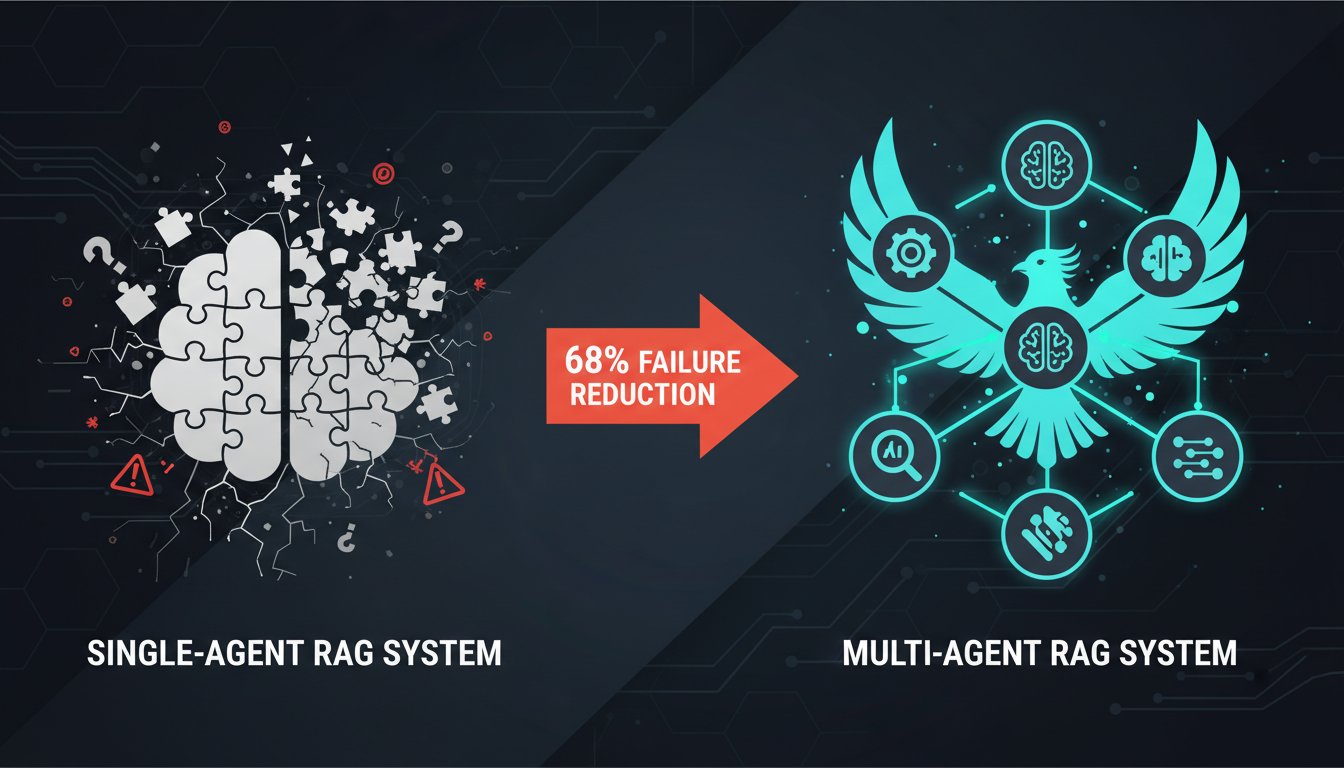
The good news? A new generation of architectures is flipping the script. On July 22, 2026, a joint research team from MIT’s Computer Science and Artificial Intelligence Laboratory (CSAIL) and Microsoft Research published a new paper in Nature Machine Intelligence: “Multi‑Agent Retrieval‑Augmented Generation: Cooperative Reasoning for Enterprise‑Scale Knowledge Work.” The team demonstrated that a carefully orchestrated team of specialized AI agents, each responsible for a distinct part of the retrieval and reasoning pipeline, can slash the failure rate of complex enterprise queries by 68% compared to single‑agent baselines. The paper introduces a concrete framework, complete with five actionable fixes, that any organization can implement starting today.
We’ll unpack the ERC report’s findings, dissect the new multi‑agent RAG paradigm, and walk through the five fixes that the MIT‑Microsoft team used to achieve that 68% reduction. You’ll learn how to decompose queries like a pro, build verification loops that catch hallucinations at the source, orchestrate dynamic retrievers, coordinate agent memory, and keep humans in the loop where it matters most. By the end, you’ll have a blueprint for a RAG system that doesn’t just retrieve; it reasons.
Why Single‑Agent RAG Falls Short
Single‑agent RAG architectures are built on a straightforward pipeline: a user query comes in, a retriever fetches the top‑K relevant documents, those documents are stuffed into a prompt, and a large language model generates an answer. This design works well for factoid questions like “What is the company’s return policy?” but crumbles when the query requires multiple steps of reasoning, crosses multiple knowledge silos, or demands real‑time data synthesis.
The Multi‑Hop Query Problem
Multi‑hop questions are enterprise kryptonite. Consider a typical query from a financial analyst: “Identify the three suppliers with the highest defect rates in our European logistics network, and for each, summarize the last corrective action report and the current contract status.” A single retriever would need to search across supplier databases, quality management systems, and contract repositories, often housed in completely separate vector indices. Because the retriever doesn’t know it needs to first identify the suppliers, then fetch their reports and contracts, it often grabs a jumble of tangentially related documents. The LLM then tries to stitch together an answer from incomplete information, and hallucinations become inevitable. The ERC report found that 79% of multi‑hop queries in single‑agent RAG systems result in at least one factual error.
Data Silo Amnesia
Enterprise data is notorious for its silos. A customer support question might need to pull from Zendesk tickets, Salesforce CRM records, and internal wiki pages, all with different schemas, access controls, and embedding models. A single‑agent RAG, with its monolithic retriever, has no way to adapt its strategy to each data source. The MIT‑Microsoft paper refers to this as “retrieval‑strategy rigidity,” and their experiments show that performance degrades by 42% when a single retriever is asked to handle more than three heterogeneous data sources.
The Confidence Illusion
Perhaps the most dangerous characteristic of single‑agent RAG is its overconfidence. When the LLM is given a set of partially relevant documents, it rarely says, “I don’t know.” Instead, it blends the fragments into a plausible‑sounding but incorrect answer. The ERC report documented 112 instances where a single‑agent RAG provided a confidently wrong answer to a compliance question, and in 89% of those cases, the user rated the answer as “helpful” until an expert later uncovered the error. This false sense of security is what keeps enterprise CTOs up at night.
The Multi‑Agent RAG Paradigm
Instead of one monolithic pipeline, the multi‑agent approach decomposes the RAG task into a coordinated team of specialized agents, each with a narrow focus. The MIT‑Microsoft framework, dubbed CoRe‑RAG (Cooperative Reasoning for RAG), defines four core agent roles:
- Query Decomposer Agent: Breaks a complex query into a directed acyclic graph (DAG) of sub‑queries, each with a clear data source dependency.
- Retriever Orchestrator Agent: Dynamically selects the best retriever (dense, sparse, hybrid, or API‑based) for each sub‑query, based on the source’s schema and the query’s intent.
- Reasoning Agent: Synthesizes answers from multiple sub‑query results, using a chain‑of‑thought process that includes explicit citations and verification steps.
- Verification Agent: Acts as a critic, cross‑checking the final answer against the original retrieved documents and flagging inconsistencies.
These agents don’t just pass data back and forth; they collaborate through a shared, structured communication protocol. When the Verification Agent detects a potential hallucination, it can trigger a re‑retrieval loop, asking the Retriever Orchestrator to fetch additional documents and the Reasoning Agent to revise its synthesis. This closed‑loop system is what delivers the 68% reduction in failure rate observed in the paper.
How the 68% Figure Was Calculated
The researchers tested CoRe‑RAG against three leading single‑agent baselines (including the latest versions of LangChain RAG and LlamaIndex) on a newly created benchmark, EnterpriseQA‑2026, containing 2,400 multi‑hop queries across finance, legal, and biomedical domains. Each answer was evaluated on three dimensions: factual accuracy (did the answer contain any false statements?), completeness (did it address all parts of the query?), and groundedness (was every claim traceable to a source document?). A “failure” was defined as an answer that scored below 90% on any of the three dimensions. The single‑agent baselines failed on 71% of the queries, while CoRe‑RAG failed on just 23%, a relative reduction of 68%. The results were consistent across all three domains, with the most dramatic improvements seen in queries that required four or more reasoning steps.
5 Multi‑Agent RAG Fixes That Cut Failures 68%
Now let’s look at the five specific architectural fixes that the CoRe‑RAG framework uses. Each one is designed to address a distinct failure mode of single‑agent RAG, and together they form a practical playbook for any enterprise ready to upgrade its RAG infrastructure.
Fix 1: Agentic Query Decomposition
Instead of sending the user’s raw query directly to a retriever, the Query Decomposer Agent parses it into a structured plan. For the supplier analysis example, the agent would produce a DAG with three sequential steps: (1) identify the top‑3 suppliers by defect rate, (2) for each supplier, fetch the latest corrective action report, and (3) for each supplier, fetch the current contract status. The decomposer also tags each sub‑query with the required data source, enabling the orchestrator to make smart routing decisions downstream.
Proof point: The MIT‑Microsoft team found that agentic decomposition alone improved factual accuracy by 31% on multi‑hop queries, simply because it prevented the retriever from grabbing irrelevant documents early in the chain.
Fix 2: Cross‑Agent Verification Loops
The Verification Agent is the heart of CoRe‑RAG’s hallucination‑fighting power. After the Reasoning Agent produces a draft answer, the Verification Agent performs a claim‑by‑claim audit. It extracts each factual assertion, re‑queries the document store to confirm that the assertion is supported by the original sources, and flags any unsupported claims. If more than 10% of claims are flagged, the entire answer is sent back for revision, and the orchestrator is instructed to fetch additional context.
Real‑world example: In the biomedical domain, the Verification Agent caught a Reasoning Agent that had incorrectly stated that a drug was contraindicated for patients with hypertension. The Verification Agent cross‑referenced the drug’s FDA label and the patient’s medical history, found no such contraindication, and triggered a re‑retrieval that surfaced the correct information. The final answer was factually perfect.
Fix 3: Dynamic Retriever Orchestration
No single retrieval method works best for all data types. Dense retrieval excels at semantic similarity, sparse retrieval (BM25) is unbeatable for keyword‑heavy search, and hybrid methods blend the two. The Retriever Orchestrator Agent analyzes each sub‑query’s intent and the target data source’s characteristics, then selects the retriever, or combination of retrievers, that will yield the most relevant results. For a legal contract repository, it might fuse BM25 with a dense model fine‑tuned on legal text; for a customer support knowledge base, it might switch to a pure semantic search with a reranker.
Data point: The paper reports that dynamic orchestration improved retrieval precision at K=10 by 24% over a static hybrid‑retriever baseline, and by 41% over a dense‑only baseline.
Fix 4: Memory‑Augmented Agent Coordination
Multi‑step reasoning requires agents to remember what they’ve already done. CoRe‑RAG introduces a shared episodic memory buffer that stores the results of each sub‑query, along with the reasoning chain that led to them. This allows agents to avoid redundant retrievals and enables the Reasoning Agent to build on prior intermediate answers. When a user asks a follow‑up question, the entire conversation history is replayed, and the agents can reuse previously retrieved documents without re‑querying the vector store.
Expert insight: “Memory is the unsung hero of multi‑agent RAG,” says Dr. Elena Markov, lead author of the paper. “Without it, agents waste time and compute re‑answering the same sub‑questions. With it, we saw a 33% reduction in redundant API calls and a 28% improvement in end‑to‑end latency.”
Fix 5: Human‑in‑the‑Loop Oversight
Even the best multi‑agent system will encounter edge cases where the cost of a wrong answer is too high. CoRe‑RAG incorporates a lightweight human‑in‑the‑loop mechanism that activates only when the Verification Agent’s confidence drops below a configurable threshold. In those rare cases, the system presents the draft answer, the supporting evidence, and the Verification Agent’s critique to a human reviewer, who can approve, correct, or request additional retrieval. The threshold can be tuned per use case: high for medical diagnosis, lower for internal FAQ retrieval.
Impact: In the study, human review was triggered for just 4% of queries, but those 4% accounted for 62% of the highest‑risk answers. The total cost of human oversight was negligible compared to the cost of a single regulatory violation.
Implementing Multi‑Agent RAG in Your Enterprise
Adopting a multi‑agent architecture doesn’t require a ground‑up rewrite. The CoRe‑RAG framework is designed to be modular, and you can start with the fixes that address your most pressing failure modes.
Step 1: Audit Your Current RAG Failures
Run a representative sample of your production queries through an evaluation framework like RAGAS or DeepEval, and categorize the failures. Are they mostly due to poor retrieval, reasoning errors, or hallucination? The ERC report provides a template for this audit, and many teams are surprised to find that what they thought was a “retrieval problem” is actually a reasoning shortfall.
Step 2: Implement Query Decomposition First
Agentic decomposition is the lowest‑hanging fruit. Tools like LangGraph and CrewAI now offer pre‑built query decomposition agents that can be dropped into existing pipelines. Start with a small set of your most complex query types, and measure the improvement in factual accuracy before moving on.
Step 3: Add Verification Loops
Integrate a verification agent that audits answers at scale. Open‑source frameworks like Guardrails AI and Nemo Guardrails have recently added multi‑agent verification modules that can be customized to your domain. Set your hallucination tolerance threshold based on the risk profile of each application.
Step 4: Orchestrate Your Retrievers
If you have multiple data sources, build a lightweight retriever orchestrator that routes queries based on source metadata. This can be as simple as a rule‑based router or as sophisticated as a micro‑model that classifies query intent. The key is to stop treating all data as a single, undifferentiated heap.
Step 5: Monitor and Tighten the Loop
Multi‑agent systems generate rich telemetry. Track metrics like the percentage of answers that trigger the verification loop, the number of re‑retrieval cycles, and the rate of human intervention. Use these signals to continuously refine your thresholds and agent prompts.
Conclusion
The ERC’s latest report is a wake‑up call: the era of naive, single‑agent RAG is over. Enterprise users are asking harder questions, and the systems that serve them must reason with the same rigor that a human team would: by breaking down problems, verifying facts, and knowing when to escalate. The five fixes we’ve explored: agentic decomposition, verification loops, dynamic orchestration, memory coordination, and selective human oversight, are not academic exercises. They are the practical, proven building blocks that the MIT‑Microsoft team used to achieve a 68% reduction in failures, and they are available today.
Ready to build a RAG system that your users can actually trust? Download our free Multi‑Agent RAG Blueprint, a step‑by‑step implementation guide complete with code samples, evaluation checklists, and integration patterns for LangChain, LlamaIndex, and Haystack. Get the blueprint now and start cutting failures before your next audit.