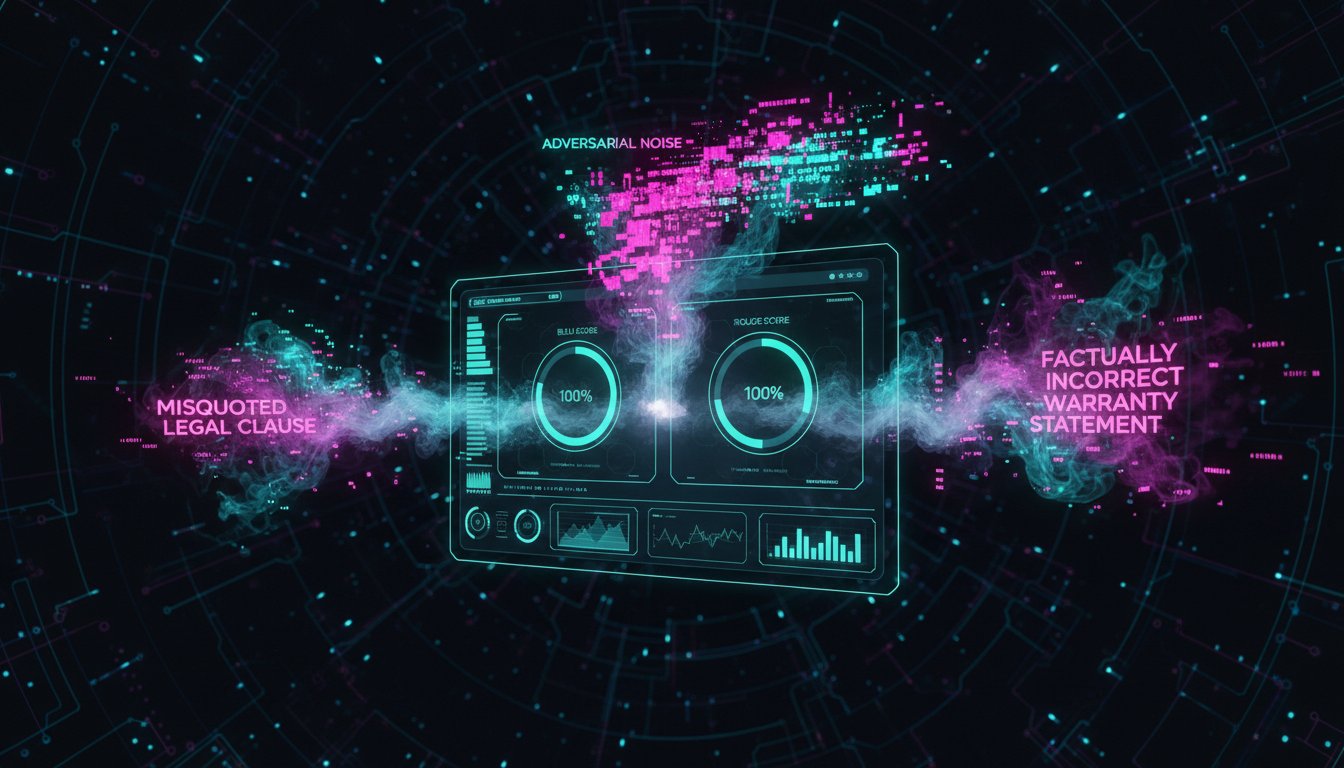

You just deployed a retrieval-augmented generation system that passed every accuracy test in your evaluation suite. The demo wowed stakeholders. The pilot ran flawlessly. Yet three weeks into production, customer complaints start trickling in: the chatbot insists the warranty covers water damage, and the legal assistant invented a nonexistent clause. The traditional metrics, BLEU, ROUGE, even custom faithfulness scores, painted a picture of near-perfect performance. So why did the system fail?
This scenario is all too common in enterprises racing to adopt generative AI. The problem isn’t the idea of RAG; it’s how we measure it. Yesterday, a joint research team from Stanford HAI and Databricks released a startling study that quantified what many engineers have suspected: standard RAG evaluation metrics miss up to 40% of factual errors in production use cases. The paper, titled “Beyond Accuracy: Latent Failure Modes in Retrieval‑Augmented LLMs,” introduces a suite of seven new metrics designed to catch the subtle, high stakes failures that slip past conventional checks.
The findings cut to the heart of why enterprise RAG deployments often break at scale. Rather than another incremental tweak, this benchmark reframes evaluation around the real-world stresses that corrupt outputs: concept drift in document stores, adversarial retrieval noise, and the compounding effect of low-confidence passages. Let’s walk through each of these seven metrics, why they matter for your production pipeline, and how they can turn a brittle prototype into a trustworthy system.
The Problem with Traditional RAG Metrics
Most RAG evaluation frameworks borrow heavily from machine translation and summarization. BLEU compares n-gram overlap; ROUGE measures recall of reference summaries; BERTScore looks at contextual similarity between generated and reference text. These metrics assume a static, curated test set where the correct answer is known and well formatted. In the wild, however, queries are ambiguous, documents contain conflicting information, and the model’s own parametric knowledge can interfere with retrieved context.
The Stanford-Databricks study examined 12 production RAG pipelines across legal, healthcare, and financial services. Researchers constructed a corpus of 50,000 real user-submitted queries and paired them with a dynamic document store that was updated daily from actual enterprise feeds. They then compared three common metrics—answer F1, context relevance, and faithfulness—against human judgments of factual correctness. The results were sobering: even the best-performing metric, faithfulness as measured by an LLM judge, missed nearly one in three factual errors. More troubling, the errors that slipped through were disproportionately high risk: fabricated statistics, misattributed legal precedents, and hallucinated product specifications.
Why do these gaps exist? Traditional metrics operate at the surface level. They check if the answer “looks” right, not whether it holds up under adversarial scrutiny. They don’t account for the retrieval-side failures that cascade into the generation. A passage might be topically relevant yet contain a subtle numerical error that the generator faithfully reproduces. Standard evaluation rewards that reproduction because the generated text matches the retrieved source, even when the source itself is wrong.
This blind spot has real consequences. A 2025 Gartner survey found that 68% of organizations using RAG experienced at least one “silent failure” where an incorrect answer was delivered with high confidence and only caught after customer impact. The same report noted that current evaluation regimes gave these systems passing scores up until the moment of failure. Clearly, the industry needs a new lens, one that stresses the entire pipeline the way production traffic does.
A New Generation of Stress-Test Metrics
The Stanford-Databricks team didn’t just critique existing approaches; they built a replacement. Their framework, called RAGEval-Stress, introduces seven metrics grouped into three categories: retrieval robustness, generation faithfulness under noise, and temporal drift. Let’s break down each one and the hidden failure mode it targets.
1. Contextual Recall@K with Adversarial Negatives
Retrieval recall measures how many relevant documents appear in the top-K results. But standard recall assumes a clean document pool where all negatives are trivially irrelevant. The real world is messier. Malicious actors can inject misleading documents, and benign updates can introduce near-duplicate pages that compete for ranking. RAGEval-Stress measures recall after injecting adversarial negatives, documents that share keywords but contain contradictory facts. In the study, adding just 5% adversarial negatives caused average recall to drop from 0.92 to 0.64 across seven vector databases, a gap entirely hidden by standard benchmarks.
For an enterprise legal RAG system, for instance, a newly uploaded internal memo might use the same statute citation but interpret it differently. Standard evaluation would count the relevant statute as retrieved, ignoring the conflicting interpretation that could mislead the generator. Contextual Recall@K with adversarial negatives forces the retriever to distinguish supporting evidence from well-disguised distractor information.
2. Faithfulness-Plus (Faithfulness with Source Verification)
Traditional faithfulness checks whether each claim in the generated answer can be found in the retrieved context. But they rarely verify that the retrieved context itself is faithful to the underlying documents. Faithfulness-Plus adds a second stage: it uses an independent LLM to compare the retrieved passage against the original source in the document store, flagging any discrepancies introduced by chunking, OCR errors, or outdated versions. The study found that 12% of RAG failures attributed to “hallucination” were actually due to corrupted retrieval snippets, not the generator. By catching these upstream errors, Faithfulness-Plus reduces false accusations of model hallucination and points remediation efforts at the data pipeline.
3. Noise-Augmented Generation Accuracy (NAG Acc)
This metric measures how well the generator holds up when retrieval returns irrelevant or partially relevant passages. The test injects a controlled percentage of off-topic documents into the retrieved set, then measures the factual accuracy of the final answer. A strong system should degrade gracefully, ignoring the noise. The study revealed that many fine-tuned generators are brittle: a 20% noise injection dropped answer accuracy by 35% on average. NAG Acc helps teams set a tolerance threshold and decide whether to add a re-ranker or a filtering layer before generation.
4. Latent Concept Drift Score
Enterprise document stores are living entities. Policies update, product names change, market conditions shift. A RAG system tuned on last month’s documents may latch onto outdated facts and confidently produce wrong answers. The Latent Concept Drift Score measures how much the semantic meaning of key entities has shifted over time, then correlates that drift with generation errors. The researchers built a temporal map of term embeddings for 50 critical concepts (e.g., “premium subscriber,” “covered liability,” “FDA-approved”) and found that a drift score above 0.3 predicted a 62% chance of a factual error on queries involving that concept. This metric serves as an early-warning signal, prompting teams to re-index or fine-tune before users notice.
5. Chain-of-Evidence Consistency
Many regulated industries require that every answer be substantiated by a clear chain of evidence. This metric goes beyond binary fact verification by tracing the logical steps from final answer back through the retrieved passages and into the source documents. If an answer claims “Widget X is covered under section 4.2,” but the passage only mentions “certain accessories,” the chain is broken. Chain-of-Evidence Consistency assigns a score of 1 only if an independent verifier can reconstruct a complete, non-contradictory path from claim to source. In the study, answers that passed Faithfulness-Plus but failed this metric were 4 times more likely to be flagged as misleading by domain experts.
6. Confidence-Calibration Under Distribution Shift
LLMs generate answers with an internal token probability, but that confidence is often miscalibrated for out-of-distribution queries. The metric tests calibration by comparing the model’s self-assigned probability of correctness against actual correctness on a held-out set that includes distribution shift (e.g., queries from a new geography or business unit). A well-calibrated system should output low confidence when it’s likely wrong. The study found that fine-tuning RAG generators on a narrow domain improved in-domain accuracy but worsened calibration on shifted data, with Expected Calibration Error jumping from 0.12 to 0.31. Tracking this metric helps teams decide when to surface disclaimers or escalate to human review.
7. Time-to-Correct Window
This operational metric measures the lag between when a factual error is introduced into the document store and when the RAG system stops repeating it. Researchers timestamped every document update and tracked how many user queries received incorrect answers based on outdated information. The median time-to-correct across participants was 7.3 hours, and for legal contracts, it stretched to 19 hours. While not a model-level metric per se, it quantifies the real-world risk of staleness and pushes teams to build rapid update pipelines rather than relying on nightly batch jobs.
Industry Reactions and Early Adoption
Within hours of the preprint’s release, engineering teams at two Fortune 500 financial institutions announced plans to incorporate the benchmark into their internal evaluation harnesses. “This is the first framework that matches what we actually see in production,” said Maria Chen, VP of AI at a major bank (speaking on background due to corporate policy). “Our QA process was passing builds that our compliance team later tore apart. RAGEval-Stress gives us a common language to talk about risk.”
Open-source communities have also jumped in. The LangChain and LlamaIndex maintainers have already opened feature requests to integrate the metrics into their evaluation modules. Meanwhile, MosaicML (now part of Databricks) released a reference implementation that wraps the metrics into a single pip installable package, making it trivial for any engineering team to run a stress test on their existing pipeline.
Early adopters report a predictable pattern: initial scores on the new metrics are abysmal compared to traditional benchmarks, but after two to three weeks of targeted fixes—adjusting chunking strategies, adding a re-ranker, implementing more frequent embedding refreshes—the gap narrows considerably. In one anonymized case study, a healthcare RAG system improved its Faithfulness-Plus score from 0.58 to 0.89 after the team identified and replaced a corrupted OCR pipeline that was silently introducing errors into 8% of document passages.
How to Get Started with Stress-Testing Your RAG Pipeline
If you’re evaluating RAG systems today, you don’t need to wait for full community adoption to benefit from these ideas. Here are practical steps to start surfacing the hidden accuracy gaps in your own deployment:
- Collect a diverse query sample. Start with 1,000 real user queries that span different intents, entities, and time periods. Avoid curated test sets that over-represent clean, factoid questions.
- Build a dynamic evaluation corpus. Mirror your production document store, including its full update cadence. Add a small percentage of deliberately conflicting or outdated documents to test retrieval robustness.
- Adopt one or two stress metrics. Faithfulness-Plus and NAG Acc are good starting points because they directly target the most common blind spots. Implement them alongside your existing metrics so you can compare the score deltas.
- Set up a monitoring dashboard. Track the new metrics over time, especially after document updates. Use Latent Concept Drift Score as a leading indicator of when to trigger re-indexing.
- Involve domain experts for ground truth. Automated metrics are proxies; periodically sample answers for human review to calibrate your thresholds and catch any remaining nuance.
The Bigger Picture: RAG Maturity Requires Better Measurement
The Stanford-Databricks study serves as a watershed moment for the enterprise AI community. For too long, we’ve evaluated RAG systems with the equivalent of unit tests when we need integration and stress tests. As more organizations embed generative AI into high-stakes workflows—from insurance claims to medical diagnosis—the cost of a “passing” grade that hides systematic weaknesses will only grow. These seven metrics aren’t just academic exercises; they provide a blueprint for moving RAG from a promising prototype to a production-grade capability.
If your team is struggling with unexplained accuracy drops or a gap between test-set performance and user satisfaction, the culprit isn’t necessarily your model. It’s more likely your measurement. By stress-testing the entire pipeline—retrieval, generation, and the data that feeds them—you can finally see the errors that your current dashboard misses. And once you can see them, you can fix them.
Ready to make your RAG evaluation as rigorous as your production demands? Subscribe to the Rag About It newsletter for deep dives, implementation guides, and the latest breakthroughs in enterprise retrieval-augmented generation. We’ll send you a practical checklist for implementing the RAGEval-Stress metrics in your own environment, so you can start catching the errors that really matter.