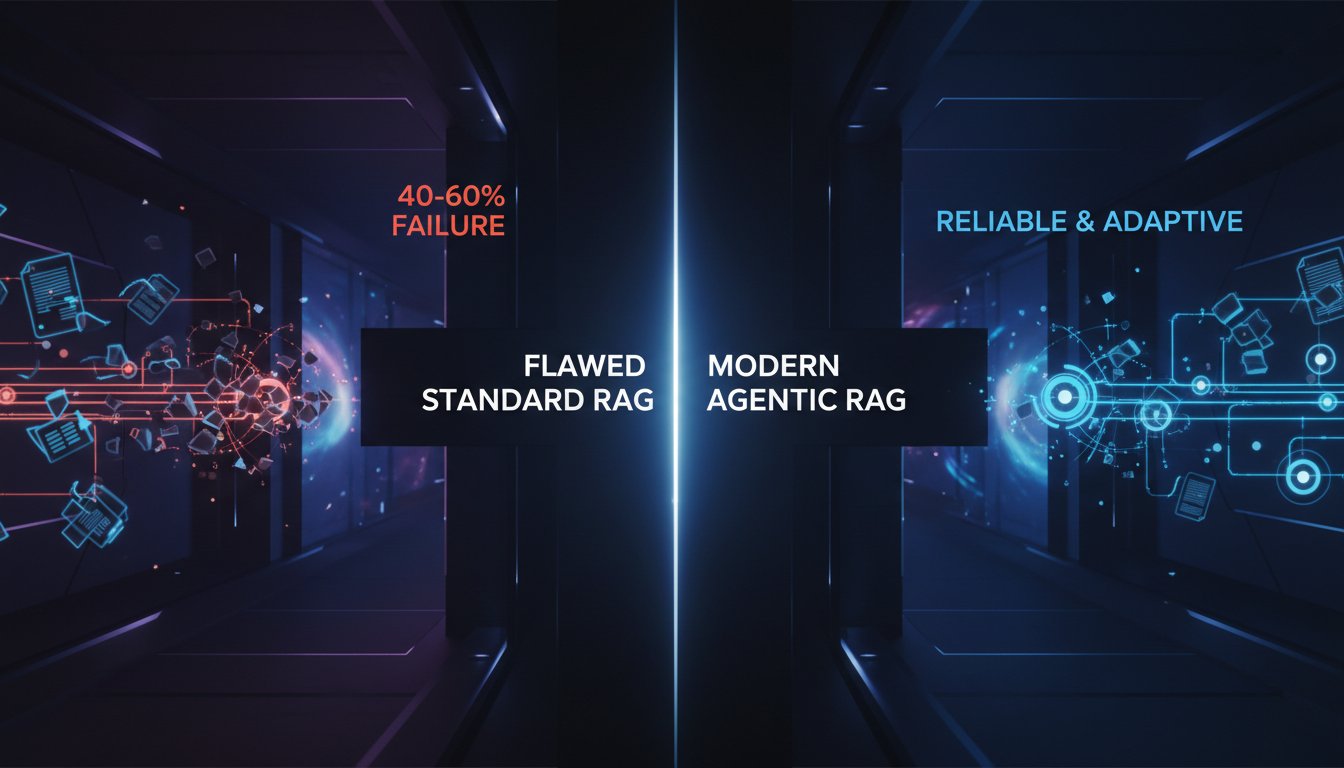

The conventional RAG architecture, simple vector search feeding an LLM, was never built for the complexity of enterprise knowledge. For years, organizations deployed it hoping to open up their document silos, only to discover that the approach breaks down at exactly the moments that matter most. Retrieval becomes unreliable. Context evaporates. The system can’t explain its own reasoning. These aren’t minor inconveniences. They’re architectural limitations that explain why 40-60% of enterprise RAG implementations fail within their first year of production.
The numbers tell a stark story. While 84% of production AI assistants now rely on retrieval-based workflows, most are running on fundamentally flawed architectures. A recent report from NeuraMonks declared “Standard RAG Is Dead,” arguing that the approach has hit its ceiling. Databricks’ introduction of the KARL agent in March 2026 reinforces this shift, using reinforcement learning to solve exactly the problems that traditional RAG can’t address. The industry is moving toward agentic RAG architectures, and organizations that don’t adapt will find their AI initiatives increasingly sidelined.
This post examines the three critical failures undermining standard RAG deployments and explains why agentic architectures represent the necessary evolution for enterprise knowledge systems.
The Fundamental Architecture Problem
Standard RAG follows a straightforward pipeline: embed documents into vectors, store them in a database, retrieve the most similar results when a user queries, and pass those results to an LLM for generation. The simplicity is appealing. The execution is not.
The core issue is that this architecture treats retrieval as a one-shot operation. A query enters the system, matching documents emerge, and generation proceeds without any meaningful understanding of whether the retrieved content actually addresses the underlying need. The system can’t assess its own confidence. It can’t identify gaps in its knowledge. It can’t revise its approach when initial results prove insufficient.
Consider a practical enterprise scenario: a legal team asks, “What are our indemnification obligations under Section 5.2 of the vendor agreement?” A standard RAG system might retrieve all contract sections mentioning “indemnification” or “Section 5.2,” but it lacks the capability to understand that the query requires synthesizing language across multiple clauses, verifying jurisdictional variations, and flagging ambiguities that require human interpretation. The retrieval is technically accurate but fundamentally inadequate for the task.
This limitation stems from a deeper architectural decision: standard RAG separates retrieval and reasoning into distinct, sequential operations. The retrieval component operates without context about why information is needed, and the generation component operates without visibility into how retrieval occurred. This architectural divorce creates failure modes that no amount of tuning can resolve.
The Context Collapse Crisis
Enterprise knowledge isn’t static. It exists in overlapping contexts, evolving interpretations, and interconnected dependencies that simple vector similarity can’t capture. Standard RAG systems struggle with this reality in a way researchers have started calling “context collapse.”
The problem shows up in several ways. First, temporal context gets lost entirely. If a policy was updated last month, standard RAG has no inherent mechanism to weight newer information over older content unless explicit timestamp filtering is implemented, a feature most deployments lack. Second, organizational context disappears. The same phrase might mean different things in different departments, but vector embeddings treat all instances identically. Third, conversational context evaporates. Standard RAG processes each query independently, meaning follow-up questions like “and what about the exceptions to that?” leave the system flailing.
The implications are severe for knowledge-intensive workflows. In financial services, compliance queries require understanding how regulations have evolved over time. In healthcare, patient record retrieval demands synthesizing information across visits while respecting chronological priority. In legal contexts, precedent analysis requires distinguishing between holding and dicta across decades of case law. Standard RAG can’t handle any of these scenarios reliably.
The 40-60% failure rate in production RAG deployments isn’t simply a technology problem. It’s an architectural mismatch between what enterprises need and what standard retrieval can provide. These systems work adequately for simple Q&A over static document collections, but enterprise knowledge is rarely either.
The Evaluation Trap
Perhaps the most insidious problem is that organizations are measuring the wrong things. High benchmark scores on academic datasets correlate poorly with real-world problem-solving capability, yet enterprises keep fine-tuning for these vanity metrics.
Standard RAG evaluation focuses on retrieval precision, recall, and latency. These measurements assess whether the system returns relevant documents quickly, but they say nothing about whether those documents enable correct answers. A system can achieve 95% recall on a medical Q&A benchmark while consistently recommending incorrect treatments because the retrieved content, while semantically related, fails to capture critical contraindications.
Databricks’ development of KARL directly addresses this evaluation problem by incorporating reinforcement learning that fine-tunes for end-to-end task completion rather than intermediate retrieval metrics. The agent learns which retrieval strategies lead to accurate, helpful responses and adapts its approach accordingly. This represents a fundamental shift: from optimizing components to optimizing outcomes.
The industry is gradually recognizing that benchmark performance doesn’t translate to production reliability. Organizations that keep evaluating RAG systems based on academic metrics will make procurement decisions that fall apart when deployed against real enterprise workloads.
The Agentic Alternative
Agentic RAG architecture addresses these three problems by introducing three core capabilities that standard implementations lack: autonomous planning, iterative refinement, and tool-use flexibility.
Autonomous planning transforms retrieval from a one-shot operation into a deliberate process. When faced with a complex query, an agentic system first analyzes what information is needed, develops a retrieval strategy, and executes that strategy with explicit awareness of its goals. If the initial retrieval proves inadequate, the system doesn’t just return whatever it found. It identifies the gap and performs additional searches.
Iterative refinement allows the system to improve its own outputs. After generating an initial response, agentic RAG can evaluate whether the answer is complete, identify missing pieces, and perform follow-up retrieval to fill those gaps. This creates a back-and-forth between retrieval and generation that produces substantially more reliable results.
Tool-use flexibility enables agents to pull from multiple data sources, invoke different retrieval strategies depending on query type, and even bring in humans when ambiguity is detected. Rather than forcing all queries through a single vector database, agentic RAG can select the right tool for each information need.
Databricks’ KARL is a good example of this architecture in practice. Its reinforcement learning foundation allows it to learn which retrieval approaches work best for different query types, generalizing across enterprise search behaviors in ways that traditional RAG can’t match. The system isn’t just retrieving documents. It’s reasoning about what information is needed and how best to get it.
What This Means for Your RAG Implementation
The shift from standard to agentic RAG isn’t optional. It’s already underway. Organizations that keep investing in architectures designed for simpler use cases will find their AI initiatives increasingly unable to meet enterprise demands. The 40-60% failure rate will keep climbing as knowledge workloads grow more complex.
Making this transition requires evaluating your current architecture against three questions. First, does your system handle multi-step reasoning, or does it treat each query as isolated? Second, can your retrieval adapt when initial results prove inadequate, or does it simply return what it finds? Third, are you measuring benchmark performance or actual task completion?
If the answers reveal gaps, the path forward involves adopting agentic frameworks, retraining evaluation metrics around end-to-end outcomes, and building infrastructure that supports dynamic retrieval strategies. The investment is significant, but the cost of inaction, continued failure rates, unreliable outputs, and unmet AI promises, is greater.
Standard RAG solved a foundational problem: how to connect large language models to enterprise knowledge. It accomplished that. Now the problem has evolved, and the architecture has to evolve with it. If you’re still running standard RAG in production and wondering why results feel inconsistent, the answer probably isn’t your prompts or your embeddings. It’s the architecture itself. That’s worth taking seriously before the gap between what your system promises and what it delivers gets any wider.