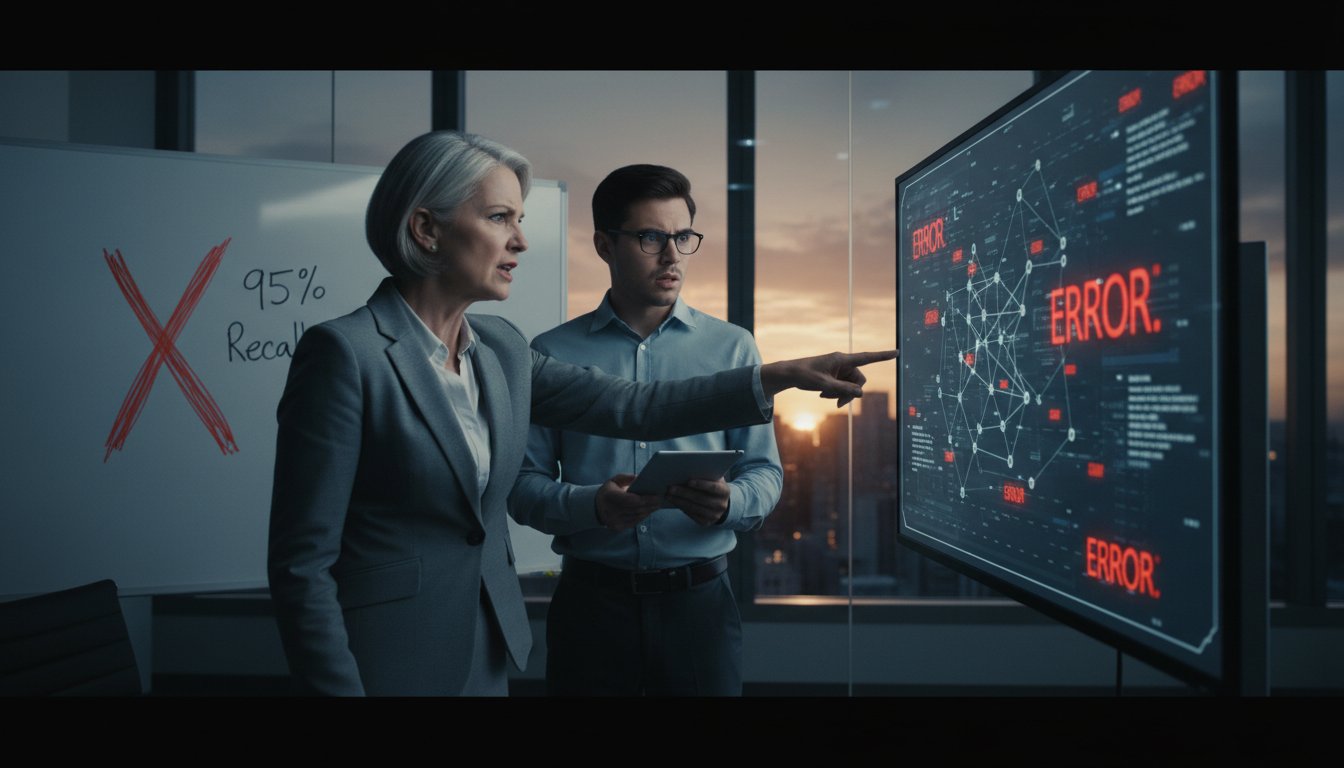

The engineering team had just deployed their new RAG system to the legal department. Initial tests were flawless: 95% recall on sample queries, sub-second response times, glowing feedback from the pilot group. Two weeks later, the first compliance audit arrived. The senior partner pulled up a contract negotiation history: “Show me all instances where clause 7.2 was modified after initial review, and cross-reference with email approvals from Q3.”
The system failed. Not with an error message, but with confidence. It returned three seemingly relevant document snippets about clause 7.2 from various contracts, but completely missed the critical email thread where the modification was approved. The legal team lost trust instantly. The engineers were baffled; their evaluation framework showed excellent performance. What they missed was the architecture’s silent assumption: that all enterprise queries fit neatly into a single retrieval pattern.
This scenario plays out daily across organizations deploying retrieval-augmented generation. Teams focus obsessively on vector search accuracy, embedding models, and prompt engineering, while overlooking a fundamental architectural principle that determines real-world success. The challenge isn’t building a RAG system that works in isolation. It’s building one that works when enterprise complexity arrives. When queries demand reasoning across multiple documents, when source verification becomes mandatory, when costs suddenly spike at scale, the simple retrieve → generate pipeline crumbles.
The solution lies in what leading AI architects now call orchestration-first architecture: designing retrieval systems that dynamically route queries, verify sources, and self-correct before generation. This isn’t about adding more complexity. It’s about building intelligent simplicity that handles enterprise reality. As Dr. Aravind K., Principal AI Architect, noted in the latest Gartner brief: “Enterprise RAG is no longer a retrieval problem. It’s an orchestration problem. Static pipelines fail under complex query routing; agentic fallbacks are becoming non-negotiable.”
In this deep-dive, we’ll move beyond the basic RAG tutorial and examine the production-grade architecture patterns that separate successful deployments from expensive failures. You’ll learn why 61% of RAG production failures trace back to evaluation drift rather than model degradation, how tiered retrieval cuts inference costs by 28-35%, and why cryptographic audit trails are becoming baseline requirements. Most importantly, you’ll see how to transform your retrieval pipeline from a fragile chain into a resilient, self-correcting system that earns and keeps enterprise trust.
The Orchestration Gap: Why Simple RAG Pipelines Break Under Load
Most RAG implementations follow a predictable pattern: chunk documents, embed them, store vectors, retrieve top-k, stuff into context, generate answer. This works beautifully for simple Q&A against homogeneous documents. But enterprise queries don’t play by these rules.
When Single-Pattern Retrieval Fails
Consider three real enterprise queries that break simple RAG:
1. Multi-hop reasoning: “Compare our Q3 marketing spend in Europe against competitor initiatives mentioned in last month’s analyst reports.”
2. Temporal verification: “Show me all policy changes implemented after the July compliance audit but before the CEO announcement.”
3. Source provenance: “What evidence supports this claim about supplier performance, and which departments validated it?”
These aren’t edge cases. They’re daily business questions. A vector similarity search might retrieve vaguely related documents, but it can’t reason across them, verify temporal sequences, or track source lineage. This explains why GraphRAG adoption grew 210% year-over-year among Fortune 500 deployments, particularly for compliance, legal, and supply chain use cases where relationships matter as much as content.
Key Takeaway: Enterprise queries demand multiple retrieval strategies working in concert, not a single vector search endpoint.
The Hidden Cost of Retrieval Monoculture
The financial impact is significant. Teams deploying single-strategy retrieval often see costs explode at scale because every query, whether simple or complex, hits the same expensive embedding inference and vector search operations. According to the April 2026 Enterprise AI Infrastructure Survey, 73% of enterprise AI teams now deploy tiered retrieval (hot/warm/cold vector indexes) specifically to cut embedding inference costs by 28-35%.
Think about querying an employee handbook for the vacation policy versus analyzing cross-departmental project dependencies. The former needs fast, simple retrieval; the latter needs multi-source reasoning. Running both through the same expensive pipeline wastes resources and slows response times for simple queries.
Building the Orchestration Layer: A Practical Framework
Orchestration-first architecture introduces intelligent routing between retrieval strategies based on query analysis. Think of it as a traffic controller for information retrieval.
Step 1: Query Intent Classification
Before any retrieval happens, analyze the query to determine its complexity and requirements:
# Simplified intent classification logic
query_intent = classify_query(user_query)

if query_intent == "simple_fact":
    # Route to fast vector search on hot index
    results = hot_vector_search(query)
elif query_intent == "multi_document":
    # Route to hybrid search (vector + keyword)
    results = hybrid_search(query)
elif query_intent == "temporal_reasoning":
    # Route to knowledge graph traversal
    results = graph_traversal(query)
elif query_intent == "source_verification":
    # Route to retrieval with cryptographic verification
    results = verified_retrieval(query)
This classification can use rule-based patterns, a small classifier model, or even the LLM itself. The critical insight is making this decision before committing to a retrieval strategy.
Step 2: Implementing Tiered Retrieval
Tiered retrieval matches resource intensity to query complexity:
- Hot Tier: Frequently accessed documents with pre-computed embeddings in memory. Handles roughly 80% of simple queries with under 100ms latency.
- Warm Tier: Larger document sets with on-demand embedding generation. Used for complex queries requiring broader context.
- Cold Tier: Complete archives with metadata-only indexing until retrieval is confirmed. Eliminates embedding costs for rarely accessed documents.
Best Practice: Start with a 70/20/10 distribution (hot/warm/cold) and adjust based on your query patterns. Monitor cache hit rates monthly.
Step 3: Adding Self-Correction Loops
Even with solid routing, retrieval can fail. Agentic RAG systems handle this through self-correction mechanisms. As the LangChain Engineering Blog noted in April 2026: “Self-corrective retrieval loops reduce hallucination rates in regulated industries by 41%, but require strict evaluation guardrails to prevent infinite retry loops.”
Here’s a simplified correction workflow:
- Initial Retrieval: Execute based on query intent
- Confidence Scoring: Evaluate retrieved context relevance
- Threshold Check: If confidence falls below 85%, trigger correction
- Correction Strategies:
- Query rephrasing with LLM
- Retrieval parameter adjustment (increase k, adjust weights)
- Fallback to alternative retrieval method
- Maximum Attempts: Cap at 3 retries to prevent loops
This transforms retrieval from a single-shot operation into an adaptive process that improves its own outcomes.
The Compliance Imperative: Audit Trails and Source Provenance
For regulated industries, including finance, healthcare, and legal, retrieval isn’t complete without verification. The NIST AI Risk Management Framework 2.0 now explicitly states: “Verifiable data provenance and retrieval audit trails are now baseline requirements for federal and enterprise AI deployments.”
Cryptographic Verification Patterns
Modern enterprise RAG systems embed verification at multiple levels:
- Document Fingerprinting: Generate cryptographic hashes for each source document during ingestion
- Chunk-Linking: Maintain immutable links between chunks and their source documents
- Retrieval Logging: Record which chunks were retrieved for each query, with timestamps and confidence scores
- Chain of Custody: For compliance queries, provide complete audit trails showing how information flowed through the system
This isn’t just about compliance. It’s about trust. When a system can say “this answer came from these three verified documents, retrieved at these confidence levels, with these specific excerpts,” stakeholders move from skeptical to confident.
Key Metric: Implement retrieval audit trails that reduce compliance review time by 60% while providing clear source attribution.
Evaluating Orchestrated RAG: Beyond Simple Metrics
Traditional RAG evaluation focuses on retrieval accuracy (recall@k) and answer relevance. Orchestrated systems need more sophisticated evaluation that accounts for routing decisions, correction effectiveness, and cost efficiency.
The Four-Pillar Evaluation Framework
- Routing Accuracy: How often does the system choose the right retrieval strategy for a given query? Target above 90% routing precision.
- Correction Efficiency: When retrieval fails initially, how well does the system recover? Measure improvement in confidence scores after correction.
- Cost-Per-Query: Track embedding inference costs, vector search operations, and LLM token usage by query type. Aim for a 30-40% reduction compared to monolithic retrieval.
- End-to-End Latency: Measure total time from query to verified answer, not just retrieval time. Complex queries may take longer but deliver far more value.
The MLOps.org Production AI Report explains why this matters: “61% of RAG production failures trace back to evaluation drift, not model degradation. Continuous monitoring pipelines are now standard.”
Implementing Continuous Evaluation
Static benchmark testing misses production realities. You’ll want to build in:
- Real-time confidence scoring on every retrieval
- A/B testing for new routing strategies
- Drift detection on query type distributions
- Cost alerts when inference spending spikes unexpectedly
Open-source frameworks like RAGAS, DeepEval, and Arize Phoenix now support these production monitoring patterns out of the box.
From Proof of Concept to Production: A Deployment Checklist
Moving from orchestration theory to production reality requires careful planning. Use this checklist to avoid common pitfalls:
Architecture Validation
- [ ] Query intent classifier covers more than 95% of expected query patterns
- [ ] Tiered retrieval implemented with clear promotion/demotion policies
- [ ] Self-correction loops include guardrails against infinite retries
- [ ] Audit trail system captures all retrieval decisions and sources
Performance Benchmarks
- [ ] Simple queries resolve in under 200ms with hot tier retrieval
- [ ] Complex queries show appropriate latency/quality tradeoffs
- [ ] Embedding inference costs reduced by at least 25% vs baseline
- [ ] Routing accuracy exceeds 85% on validation set
Compliance Readiness
- [ ] Cryptographic document verification implemented
- [ ] Retrieval audit trails exportable in standard formats
- [ ] Data provenance visible for every generated answer
- [ ] Access controls restrict retrieval based on user permissions
Monitoring and Maintenance
- [ ] Continuous evaluation pipeline tracking all four pillars
- [ ] Alert system for routing degradation or cost spikes
- [ ] Monthly review of query pattern evolution
- [ ] Quarterly architecture review against new framework capabilities
The Future of Retrieval: Where Orchestration Is Heading
The orchestration layer is becoming the central nervous system of enterprise RAG. Three developments will shape its evolution in 2026:
Multi-Modal Retrieval Standardization
Tables, PDFs, code repositories, and images are now being chunked and indexed alongside text. A recent Meta AI Research finding highlights the opportunity: “GraphRAG outperforms pure vector retrieval by roughly 34% on multi-hop enterprise queries, but the embedding overhead remains the primary bottleneck for cost-sensitive deployments.” Expect specialized retrieval strategies for different content types, with orchestration managing the cross-modal reasoning.
Federated Retrieval Networks
Enterprises increasingly operate across hybrid clouds, on-premises data centers, and partner ecosystems. Orchestration will evolve to manage retrieval across these boundaries while maintaining security, compliance, and performance guarantees. Think of it as a service mesh for AI retrieval.
Intelligence-Driven Optimization
Beyond static routing rules, future systems will use reinforcement learning to fine-tune retrieval strategies based on continuous feedback. The system will learn which approaches work best for which query types in your specific environment, constantly improving its own performance.
The legal team’s failed query about clause 7.2 wasn’t a retrieval failure. It was an orchestration failure. The system had excellent components but no intelligence to route the complex temporal query to the right retrieval strategy, no mechanism to verify it had found all relevant sources, and no way to self-correct when initial results were incomplete.
Orchestration-first architecture transforms RAG from a promising technology into a reliable