
The enterprise AI community just witnessed a quiet revolution that most teams will read about but few will implement. RAG 2.0’s unified training architecture—where retrievers and language models train together as a single system—has achieved state-of-the-art performance on every major benchmark from open-domain question answering to hallucination reduction. Yet the same architectural innovation that makes it superior also makes it prohibitively expensive for most organizations.
This isn’t another incremental improvement in retrieval techniques. This is a fundamental rethinking of how RAG systems should be built, and it’s forcing enterprise teams to confront an uncomfortable trade-off: accept the limitations of cheaper modular systems, or invest significantly more resources for measurably better results. The gap between what’s technically possible and what’s financially practical has never been wider.
For teams currently running production RAG systems—or planning deployments—understanding this divide isn’t academic. It directly impacts architecture decisions, budget planning, and performance expectations. The unified training approach represents where RAG technology is heading, even if most organizations aren’t ready to follow yet.
The Architectural Shift Nobody Saw Coming
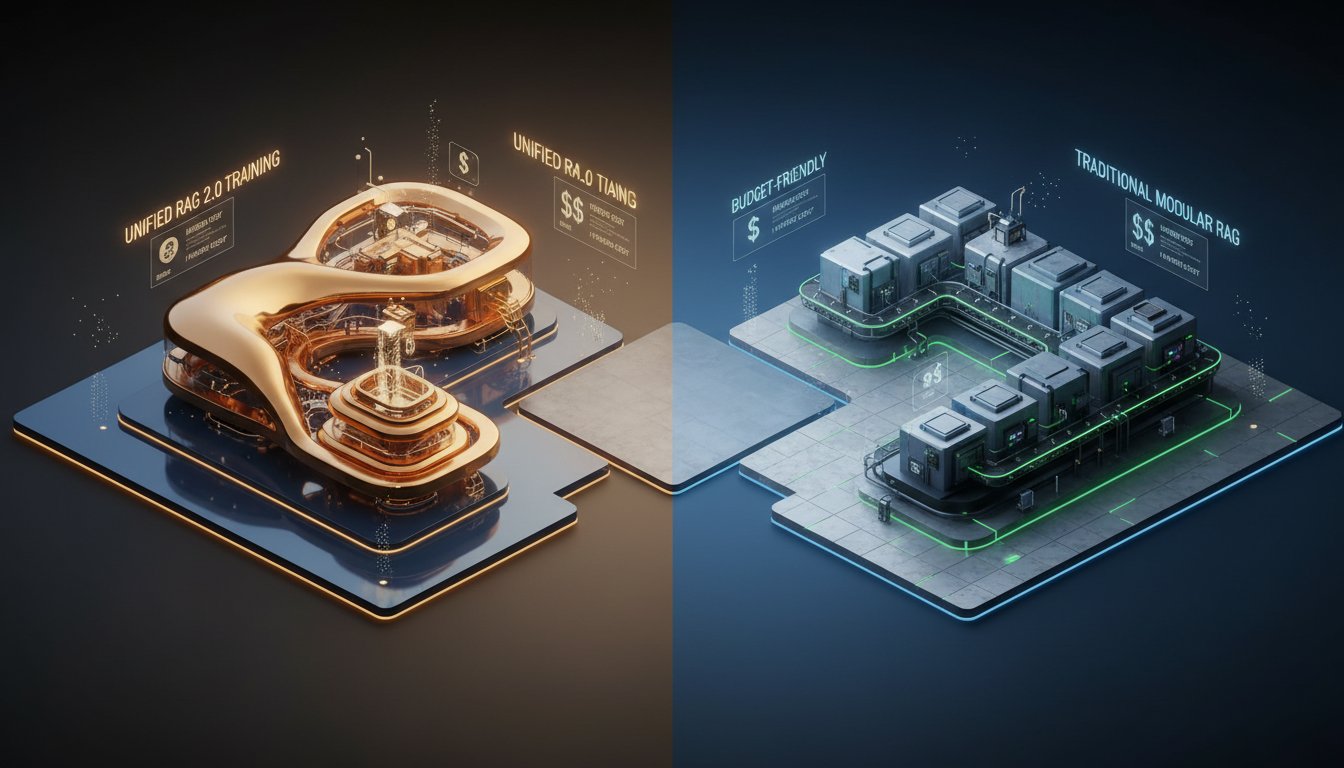
Traditional RAG systems operate like assembly lines. You take a pre-trained language model, bolt on a separately trained retriever, add your vector database, and orchestrate the components to work together. Each piece is optimized independently, then integrated through careful engineering. It’s modular, flexible, and most importantly—achievable with existing budgets and infrastructure.
RAG 2.0 throws out this modular approach entirely. Instead of training components separately, the retriever and language model are pre-trained, fine-tuned, and aligned as a unified system. Errors backpropagate through both the retrieval and generation components simultaneously, creating a feedback loop that traditional architectures can’t replicate.
The technical implications are profound. When your retriever learns in isolation, it optimizes for retrieval metrics without understanding how the language model will use that information. When your language model trains separately, it can’t influence what gets retrieved. RAG 2.0’s joint optimization eliminates this disconnect, allowing the entire system to learn as one coherent unit.
What Joint Training Actually Means
Backpropagation through retrieval components sounds straightforward until you attempt implementation. Traditional RAG systems treat retrieval as a discrete, non-differentiable operation—you can’t compute gradients through a vector database lookup. RAG 2.0 requires making the entire retrieval process differentiable, allowing gradients to flow backward from generation errors through the retrieval mechanism and into the retriever’s parameters.
This end-to-end optimization creates contextual language models (CLMs) that fundamentally understand the relationship between what they retrieve and what they generate. The retriever learns to find information that the specific language model can use most effectively. The language model learns to generate outputs that align with the retriever’s strengths and compensate for its weaknesses.
The Performance Gap Is Undeniable
RAG 2.0’s contextual language models achieved state-of-the-art results across multiple critical benchmarks. On open-domain question answering datasets like Natural Questions, HotpotQA, and TriviaQA, CLMs outperformed traditional RAG systems built on GPT-4. These aren’t marginal improvements—they represent measurable accuracy gains on tasks that directly mirror enterprise use cases.
The faithfulness improvements are even more striking. On HaluEvalQA and TruthfulQA—benchmarks specifically designed to measure hallucinations and adherence to retrieved evidence—RAG 2.0 demonstrated superior performance. For enterprises where accuracy and reliability are non-negotiable, these results are compelling.
Perhaps most importantly, RAG 2.0 excels at freshness: the ability to incorporate fast-changing world knowledge. Evaluated on FreshQA benchmarks, CLMs showed they could generalize to current information more effectively than models with extended context windows. This addresses one of the most persistent challenges in enterprise RAG deployments—keeping outputs current without constant retraining.
The Cost Reality Enterprise Teams Aren’t Discussing
Here’s what the RAG 2.0 announcements don’t emphasize: joint training is resource-intensive in ways that fundamentally change project economics. Training a retriever and language model as a unified system requires computational resources that dwarf traditional RAG implementations. The backpropagation through retrieval components, the joint optimization process, the iterative alignment—all of this demands infrastructure most organizations simply don’t have.
Benchmark data suggests RAG system development costs range from $10,000 to $100,000 in 2026, but these figures represent traditional modular architectures. Joint training approaches require substantially more compute, longer training times, and specialized expertise. The actual resource requirements remain closely guarded, but experts consistently note that the “high cost” of RAG 2.0’s approach creates significant adoption barriers.
The Infrastructure Investment
Traditional RAG systems let you leverage existing pre-trained models with minimal fine-tuning. You’re primarily investing in data preparation, vector database infrastructure, and orchestration logic. The model training itself is often unnecessary—you use models as-is or with light adaptation.
RAG 2.0 requires training infrastructure capable of joint optimization across both retrieval and generation components. This isn’t a weekend project on cloud GPUs. It’s sustained compute resources for extended training runs, sophisticated monitoring to ensure both components are learning effectively, and the expertise to debug failures in a much more complex training process.
For organizations already struggling with the costs of running inference at scale, adding significant training infrastructure represents a fundamental shift in project scope and budget.
The Data Requirements
Joint training doesn’t just need more compute—it needs more data, and more carefully curated data. Traditional RAG systems can work with your existing documents and knowledge bases. The retriever learns from one dataset, the language model from another, and you orchestrate them without requiring perfectly aligned training data.
RAG 2.0’s unified approach requires training data that supports learning across both components simultaneously. You need examples that teach the retriever what to fetch and the language model how to use that fetched information, all within the same training instance. Creating these datasets requires careful planning, annotation, and validation that goes beyond typical RAG data preparation.
The Expertise Gap
Building traditional RAG systems requires understanding vector embeddings, retrieval mechanisms, and LLM orchestration. Challenging, certainly, but within reach for teams with strong ML engineering capabilities. Building RAG 2.0 systems requires expertise in joint optimization, differentiable retrieval, and end-to-end system training that few teams currently possess.
This expertise gap creates dependency on specialized vendors or consultants, adding costs and reducing the ability to iterate independently. Organizations that valued RAG specifically for its accessibility—the ability to enhance LLMs without massive ML research teams—find themselves facing research-level complexity again.
The Performance-Cost Trade-Off Nobody Wants to Make
Enterprise teams now face a decision that didn’t exist six months ago. Traditional RAG systems deliver measurable value at predictable costs. They work well enough for most use cases, they’re implementable with current resources, and they can be deployed without betting the entire AI budget on a single approach.
RAG 2.0 delivers superior performance on every meaningful metric. Better accuracy, reduced hallucinations, improved freshness, more efficient use of retrieved information. For applications where these improvements matter—legal analysis, medical information systems, regulatory compliance—the performance gains could justify significant investment.
But “could justify” isn’t the same as “does justify.” The ROI calculation depends on factors most organizations are still figuring out: How much is accuracy improvement worth? What’s the cost of hallucinations in your specific context? How often does freshness actually impact user outcomes?
When Traditional RAG Is Still the Right Choice
For many enterprise deployments, traditional modular RAG architectures remain the pragmatic choice. If your use case doesn’t require absolute cutting-edge accuracy, if your tolerance for occasional hallucinations is non-zero, if your knowledge base doesn’t change rapidly—the incremental performance gains of RAG 2.0 may not justify the substantial increase in complexity and cost.
Traditional RAG systems let you iterate quickly, experiment with different retrieval strategies, swap components as better models become available, and maintain control over your architecture. The modularity that RAG 2.0 sacrifices for performance is precisely what makes traditional RAG practical for resource-constrained teams.
When Unified Training Becomes Necessary
Certain applications demand the performance that only joint optimization can deliver. Medical diagnosis support systems where hallucinations could harm patients. Legal research platforms where accuracy directly impacts case outcomes. Regulatory compliance tools where outdated information creates liability.
In these contexts, the superior faithfulness and freshness of RAG 2.0 aren’t nice-to-have features—they’re requirements. The cost of getting it wrong exceeds the cost of implementing unified training, even with all its resource demands. For these organizations, RAG 2.0 represents not just an improvement but a necessary evolution.
What This Means for Your RAG Strategy
The emergence of RAG 2.0 doesn’t invalidate traditional approaches, but it does change the landscape. Enterprise teams need to understand where they fall on the performance-cost spectrum and make deliberate architecture choices accordingly.
Assess Your Actual Requirements
Before being swayed by impressive benchmarks, honestly evaluate what your use case requires. Map your accuracy requirements, hallucination tolerance, and freshness needs to specific metrics. Do you need state-of-the-art performance on open-domain question answering, or is “good enough” actually good enough?
Most organizations discover their requirements fall well within traditional RAG capabilities. The use cases that genuinely need RAG 2.0’s performance are real but relatively narrow. Understanding where you actually fall prevents both over-investment in unnecessary capability and under-investment in critical accuracy.
Plan for Eventual Migration
Even if RAG 2.0 isn’t practical today, its architectural approach represents the direction of the technology. As training techniques improve, costs decrease, and tooling matures, unified training will become more accessible. Building your traditional RAG system with eventual migration in mind—clean data pipelines, well-documented retrieval logic, modular architecture—makes future transitions easier.
This doesn’t mean designing for a specific migration path. It means avoiding architectural decisions that would make migration prohibitively difficult if business requirements change.
Invest in Understanding Joint Optimization
Whether or not you implement RAG 2.0 now, understanding unified training principles improves traditional RAG systems. The insights about retriever-generator alignment, the importance of end-to-end optimization, the value of differentiable retrieval—all of these inform better modular system design.
Teams that understand what makes RAG 2.0 superior build better traditional systems by incorporating those principles where possible within existing constraints. Conversely, teams that dismiss unified training as “too expensive” miss learning opportunities that could improve their current implementations.
Monitor the Ecosystem Evolution
RAG 2.0 is emerging from research organizations and specialized vendors, but the broader ecosystem will respond. Expect to see partial implementations of joint optimization principles, hybrid approaches that combine modular flexibility with selective unified training, and tooling that makes certain aspects of RAG 2.0 more accessible.
Staying aware of these developments helps identify when the cost-performance trade-off shifts enough to reconsider your architecture. The teams that will succeed aren’t necessarily the early adopters or the holdouts—they’re the ones who can assess when the right time for their specific situation arrives.
The Path Forward: Performance and Pragmatism
RAG 2.0’s unified training architecture represents genuine technical progress. The performance improvements are real, measurable, and significant for applications that need them. But the resource requirements are equally real, and they create legitimate barriers for most organizations.
This creates a two-tier landscape: organizations with critical accuracy requirements and sufficient resources will adopt unified training approaches, achieving superior performance at premium costs. The broader market will continue with traditional modular RAG, iterating on retrieval strategies, orchestration logic, and data quality to extract maximum value from more accessible architectures.
Neither approach is wrong. The mistake is choosing based on benchmarks alone without considering the total cost of implementation, the actual performance requirements of your use case, and the resources your organization can realistically deploy.
The unified training divide isn’t a problem to solve—it’s a landscape to navigate. Understanding where your organization falls on that landscape, what your actual requirements demand, and how the technology will evolve determines whether RAG 2.0 represents your immediate future or an interesting development to monitor from a distance.
For teams building enterprise RAG systems today, the question isn’t whether unified training is better—it clearly is. The question is whether “better” justifies the investment for your specific use case, with your specific constraints, at this specific moment. That’s a question only you can answer, but understanding the full scope of the trade-offs ensures your answer is based on reality rather than benchmark envy.