
Your RAG system just failed. Not because your embeddings were wrong. Not because your retrieval algorithm needs tuning. Not because your LLM hallucinated. Your system failed because while your GPU sat idle waiting for data, your storage infrastructure became the silent assassin of enterprise AI performance.
Cloudian’s February 2026 launch of their HyperScale AI platform—built on NVIDIA Blackwell GPUs with throughput capabilities exceeding 10 TB/s—just exposed what most enterprise AI teams have been ignoring: the storage layer is where RAG systems actually live or die. While the industry obsesses over vector similarity scores and context window sizes, the brutal reality is that 80% of your RAG latency comes from a place nobody’s measuring: the milliseconds your data spends trapped between storage and compute.
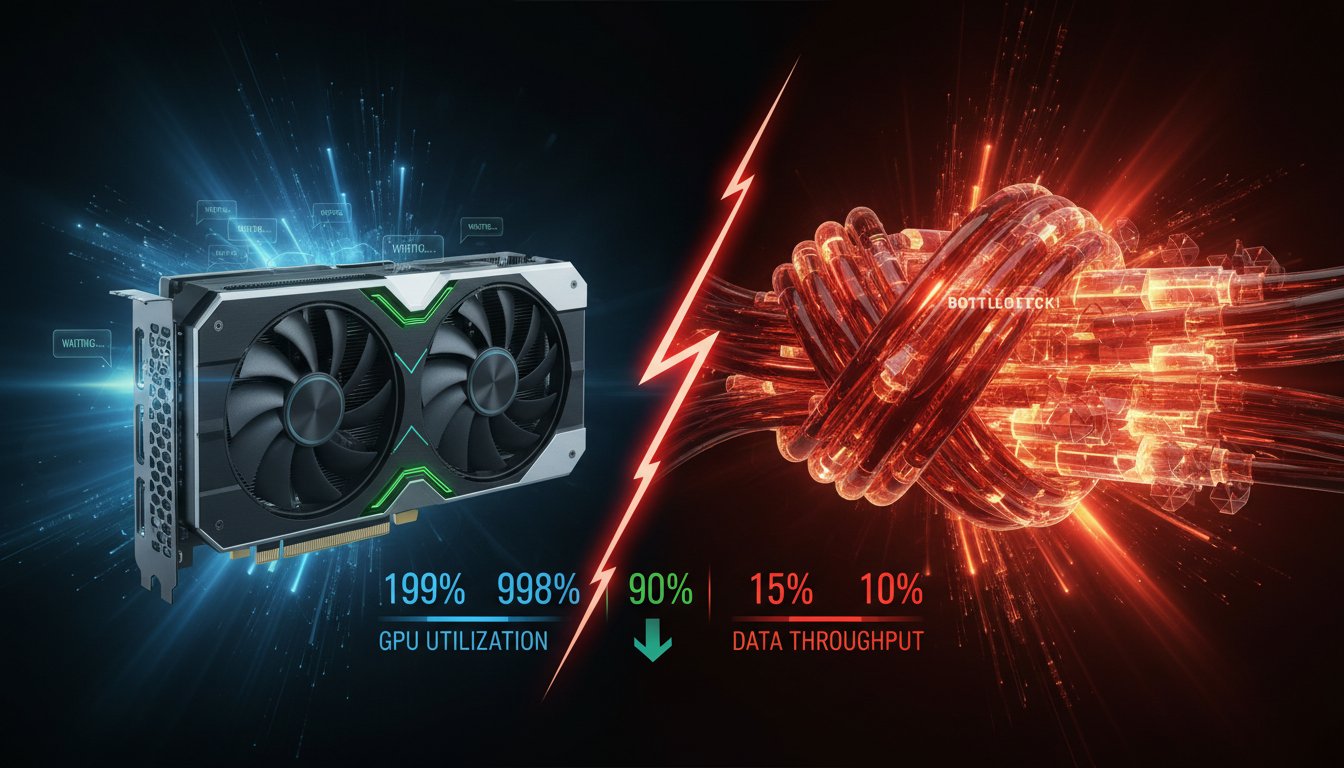
Here’s the harsh truth that storage vendors won’t tell you: Your $50,000 GPU is spending 70% of its time waiting for your $5,000 storage array to catch up. And that gap? It’s killing your RAG performance before your retrieval algorithm even gets a chance to fail.
The Storage Infrastructure Crisis Hiding in Plain Sight
Enterprise RAG deployments are hitting a wall that has nothing to do with the algorithm sophistication everyone’s chasing. The wall is physical: data can’t move fast enough from where it lives to where it needs to be processed.
Consider the typical enterprise RAG workflow. Your system needs to retrieve relevant document chunks from millions of stored vectors, pull the actual document content from object storage, feed that data to your GPU for embedding comparison, then stream results back through the same pipeline. At each stage, you’re fighting against storage I/O constraints that GPU manufacturers never account for in their benchmark numbers.
WEKA’s analysis of AI inference at scale reveals the uncomfortable truth: while AI model training gets all the attention, inference—the actual retrieval and response generation in RAG systems—demands storage infrastructure that operates at microsecond latencies with billions of small, random data accesses. Traditional enterprise storage architectures weren’t designed for this access pattern. They were optimized for sequential reads and writes, not the chaotic, concurrent retrieval patterns that RAG systems generate.
The data loading bottleneck research from multimodal AI training exposes the three-stage latency trap: storage to local disk, local disk to RAM, RAM to GPU memory. Every transfer point introduces delays that compound across millions of retrieval operations. When Cloudian claims 35GB/sec read performance per node, they’re not just throwing out impressive numbers—they’re addressing the specific chokepoint where RAG systems suffocate.
Three Ways Storage Architecture Sabotages Your RAG Performance
The Object Storage Latency Tax
Most enterprise RAG systems store document corpora in S3-compatible object storage because it’s cheap and scales infinitely. But object storage introduces request latencies measured in tens of milliseconds—an eternity when your RAG system is trying to retrieve and compare hundreds of document chunks per query.
The latency math is brutal. A single RAG query retrieving 50 relevant chunks from object storage could introduce 500-1000ms of storage latency alone, before any embedding comparison or LLM inference happens. Your users are staring at loading spinners not because your retrieval algorithm is slow, but because your storage architecture is fundamentally mismatched to your access pattern.
Cloudian’s integration of NVMe-based SSDs with S3 API compatibility attempts to solve this mismatch: give enterprises the scalability of object storage with the latency characteristics of block storage. But here’s what they’re not saying: even with NVMe, you’re still dealing with network round trips, API overhead, and the inherent serialization costs of object storage protocols.
The GPU-Storage Integration Gap
NVIDIA’s Blackwell GPUs can process AI workloads at speeds measured in teraflops. Your storage infrastructure delivers data measured in gigabytes per second. The unit mismatch tells the whole story: your compute is starving while your storage struggles to keep up.
GPUDirect Storage and RDMA (Remote Direct Memory Access) technologies exist specifically to bypass this bottleneck by creating direct paths from storage to GPU memory, eliminating CPU and RAM as intermediate stops. But deployment reality reveals a different story: most enterprise storage systems don’t support these protocols, and the ones that do require complete infrastructure redesigns.
The hidden cost here isn’t just latency—it’s GPU utilization. When storage can’t feed data fast enough, expensive GPU resources sit idle. In a RAG system retrieving and processing thousands of document chunks per minute, even small inefficiencies compound into massive underutilization. You’re paying for GPU compute you’re not using because your storage can’t keep pace.
The Concurrent Access Collapse
RAG systems don’t retrieve one document at a time. They retrieve dozens simultaneously, compare hundreds of embeddings in parallel, and serve multiple user queries concurrently. This creates storage access patterns that traditional enterprise infrastructure handles poorly: billions of small, random I/O operations with unpredictable timing.
Storage systems optimized for throughput (moving large sequential files) fail catastrophically when faced with RAG’s random access patterns. IOPS (Input/Output Operations Per Second) becomes the critical metric, not bandwidth. A storage array advertising 10GB/s throughput might deliver only a fraction of that when hammered with the random 4KB reads that vector database retrievals generate.
This is where Cloudian’s claimed “10 TB/s throughput” requires scrutiny. Throughput numbers are meaningless without IOPS specifications and latency percentiles under concurrent load. The question isn’t “how fast can you move data in ideal conditions?” It’s “how consistently can you serve 100,000 random 4KB reads per second while handling concurrent writes from embedding updates?”
The Storage-First RAG Architecture Nobody’s Building
The industry’s approach to RAG architecture is backwards. Teams start with the retrieval algorithm, choose a vector database, select an LLM, then treat storage as an afterthought—something you bolt on at the end to “just store the data.”
A storage-first architecture inverts this thinking:
Start with access patterns, not capacity. Before choosing storage infrastructure, map exactly how your RAG system will access data: retrieval frequency, chunk sizes, concurrent query loads, update patterns. Your storage architecture should match these patterns, not force your RAG system to adapt to storage limitations.
Co-locate compute and storage. Network latency between storage and compute is pure overhead in RAG systems. Every hop adds milliseconds. Storage-first architectures minimize network distance, ideally placing NVMe storage on the same physical infrastructure as GPU compute. This is the real innovation in Cloudian’s Blackwell integration—not just fast storage and fast GPUs, but their physical proximity.
Design for the 99th percentile, not the average. Average retrieval latency is meaningless when one slow storage operation blocks an entire RAG query. Storage-first design optimizes for worst-case latency: What happens when your storage node experiences a brief spike? How do you ensure consistent sub-millisecond access even under heavy concurrent load?
Build caching into the storage layer, not above it. Most RAG systems implement caching at the application layer—storing frequently accessed embeddings or document chunks in Redis or Memcached. Storage-first architectures push caching down into the storage infrastructure itself, using tiered NVMe and DRAM caches that automatically prioritize hot data without application-level complexity.
Cloudian’s platform represents one vendor’s approach to storage-first RAG, but the principle applies regardless of vendor: if your storage can’t feed your compute at the speed your retrieval algorithm needs, your RAG system will fail before it gets a chance to demonstrate its algorithmic sophistication.
What This Means for Your RAG Infrastructure Decisions
The storage dimension changes how you evaluate RAG deployment options:
Benchmark storage latency under RAG-specific loads. Don’t trust vendor throughput claims. Test your actual retrieval patterns: concurrent random reads of 512-4KB chunks (typical embedding vector sizes), mixed with sequential reads of larger document segments, under the concurrent query load your system will face in production. Measure 95th and 99th percentile latencies, not averages.
Calculate GPU utilization, not just GPU performance. Your GPU performance benchmarks are irrelevant if storage bottlenecks prevent the GPU from running at capacity. Monitor GPU idle time and correlate it with storage I/O wait times. If your GPUs are underutilized, your problem isn’t compute—it’s storage.
Account for storage infrastructure in your RAG TCO. The cheapest storage option creates the most expensive operational costs when it throttles your entire RAG system. Storage that costs 3x more but delivers 10x better latency reduces your compute costs by eliminating GPU idle time and improves user experience by cutting query response times.
Evaluate NVMe and storage-GPU integration as requirements, not nice-to-haves. For enterprise RAG systems handling millions of documents and thousands of concurrent queries, traditional SAS or SATA storage is fundamentally inadequate. NVMe isn’t a luxury upgrade—it’s the minimum viable storage tier for production RAG workloads.
Design for storage failure modes. What happens when a storage node fails during a retrieval operation? How does your RAG system handle degraded storage performance? Storage-first design includes explicit failure mode handling: timeouts, fallbacks, graceful degradation.
The Build vs. Buy Decision for Storage-Optimized RAG
Cloudian’s platform launch—and similar offerings from vendors integrating storage and compute—forces a strategic decision:
Do you build a storage-first RAG architecture from components (selecting your own vector database, storage infrastructure, GPU compute, and integrating them), or do you buy an integrated platform where the vendor has already solved the storage-compute integration challenges?
Building gives you flexibility and control. You can optimize for your specific access patterns, choose best-of-breed components, and avoid vendor lock-in. But you inherit the integration burden: ensuring your storage infrastructure can actually feed your compute at the rates your RAG system demands requires deep storage and systems engineering expertise most AI teams don’t have.
Buying an integrated platform like Cloudian’s Blackwell-based system gets you vendor-validated storage-compute integration and shifts the performance risk to the vendor. But you accept their architectural choices, their scaling limitations, and their cost structure. More critically, you trust that their “optimized for RAG” claims actually translate to better performance for your specific workloads.
The decision framework:
Build if: You have storage engineering expertise in-house, your RAG access patterns are highly specialized, you need multi-cloud portability, or you’re operating at scales where custom optimization delivers significant cost savings.
Buy if: You need to deploy quickly, you lack storage infrastructure expertise, your access patterns match common RAG workloads, or you want to outsource the storage-compute integration risk.
Hybrid approach: Use managed storage services (Cloudian, AWS FSx, Azure NetApp) for your document corpus and metadata, but self-manage your vector database and compute layers where you need customization.
Regardless of approach, the storage decision is now a first-order architectural choice, not an implementation detail you defer to your DevOps team.
The Next Frontier: Storage-Aware Retrieval Algorithms
The storage infrastructure conversation opens a deeper question: Should RAG retrieval algorithms themselves become storage-aware?
Current retrieval algorithms optimize for relevance and accuracy—finding the most semantically similar document chunks regardless of where they physically reside or how expensive they are to retrieve. A storage-aware retrieval algorithm would factor in retrieval cost: preferring document chunks that are cached, co-located, or otherwise faster to access when relevance scores are similar.
This creates a multi-objective optimization problem: maximize relevance while minimizing retrieval latency. The tradeoff might be: “Return the 10 most relevant chunks within 50ms” rather than “Return the absolute 10 most relevant chunks regardless of latency.”
Storage-aware retrieval could dramatically improve RAG system responsiveness by avoiding the long tail of slow storage retrievals that block query completion. But it requires tight integration between the retrieval algorithm and the storage layer—the retrieval system needs real-time visibility into which data is hot-cached, which requires cross-storage latency, which is stored on slower tiers.
Cloudian’s storage platform doesn’t explicitly support storage-aware retrieval, but the tiered caching architecture they describe (NVMe SSDs backed by object storage) creates the foundation: fast access to hot data, slower access to cold data. A storage-aware retrieval algorithm could query the cache state and preferentially select cached chunks when relevance scores are within acceptable thresholds.
This is the next evolution of RAG architecture: systems that don’t just retrieve the most relevant information, but retrieve the most relevant information that can be delivered within latency budgets. Storage stops being invisible infrastructure and becomes an active participant in the retrieval decision.
Your Storage Audit Checklist
Before you deploy your next RAG system—or if you’re troubleshooting an existing deployment with mysterious performance issues—audit your storage infrastructure:
✅ Measure actual retrieval latency from storage to compute under production load patterns. Don’t accept vendor benchmarks.
✅ Profile GPU utilization and correlate with storage I/O wait times. Identify if storage is causing GPU starvation.
✅ Test concurrent access patterns that match your expected query load. How does storage latency degrade under concurrent random reads?
✅ Evaluate IOPS, not just throughput. Your RAG workload is IOPS-bound, not bandwidth-bound.
✅ Benchmark 95th and 99th percentile latencies, not averages. The worst-case determines user experience.
✅ Map your data access patterns: retrieval frequency, chunk sizes, update rates. Does your storage architecture match these patterns?
✅ Calculate storage cost per query including GPU idle time costs. Is cheap storage creating expensive compute waste?
✅ Test failure modes: storage node failures, network degradation, cache misses. How does your RAG system degrade?
✅ Verify NVMe and RDMA support if using high-performance compute. Are you actually getting direct storage-GPU paths?
✅ Review caching strategy. Is hot data actually cached where retrieval happens, or are you cache-missing on frequent queries?
The storage layer is where your RAG system’s theoretical performance meets physical reality. Cloudian’s platform launch is less about their specific product and more about the industry finally acknowledging what should have been obvious: in systems that retrieve and process massive amounts of data at millisecond latencies, storage infrastructure isn’t a supporting player—it’s the main act.
Your RAG system is only as fast as your slowest storage operation. And right now, for most enterprise deployments, that’s the bottleneck nobody’s measuring. Start measuring. Your GPU is waiting.