
The decision seems straightforward: use dense embeddings for semantic understanding or sparse retrieval for keyword precision. But inside thousands of enterprise RAG deployments, teams are discovering this binary thinking is costing them millions in wasted compute, degraded accuracy, and deployment delays that nobody budgeted for.
When Commvault partnered with Pinecone to strengthen vector search capabilities for critical workloads, they weren’t just adding a new tool—they were revealing a fundamental blindspot in how enterprises approach retrieval architecture. The real cost wasn’t in the vector database licensing. It was in the opportunity cost of choosing one approach when hybrid retrieval could have delivered both precision and recall simultaneously.
Here’s what we’re seeing across enterprise RAG implementations: teams deploy dense embedding systems first because it feels modern, semantic, and aligned with LLM thinking. Then production hits them with unexpected consequences: 30-40% precision degradation on exact keyword queries, latency spikes when scaling to millions of documents, and API costs that spike during peak usage windows. By then, they’ve already committed architectural decisions, retrained their retrieval models, and documented their pipelines around a single approach.
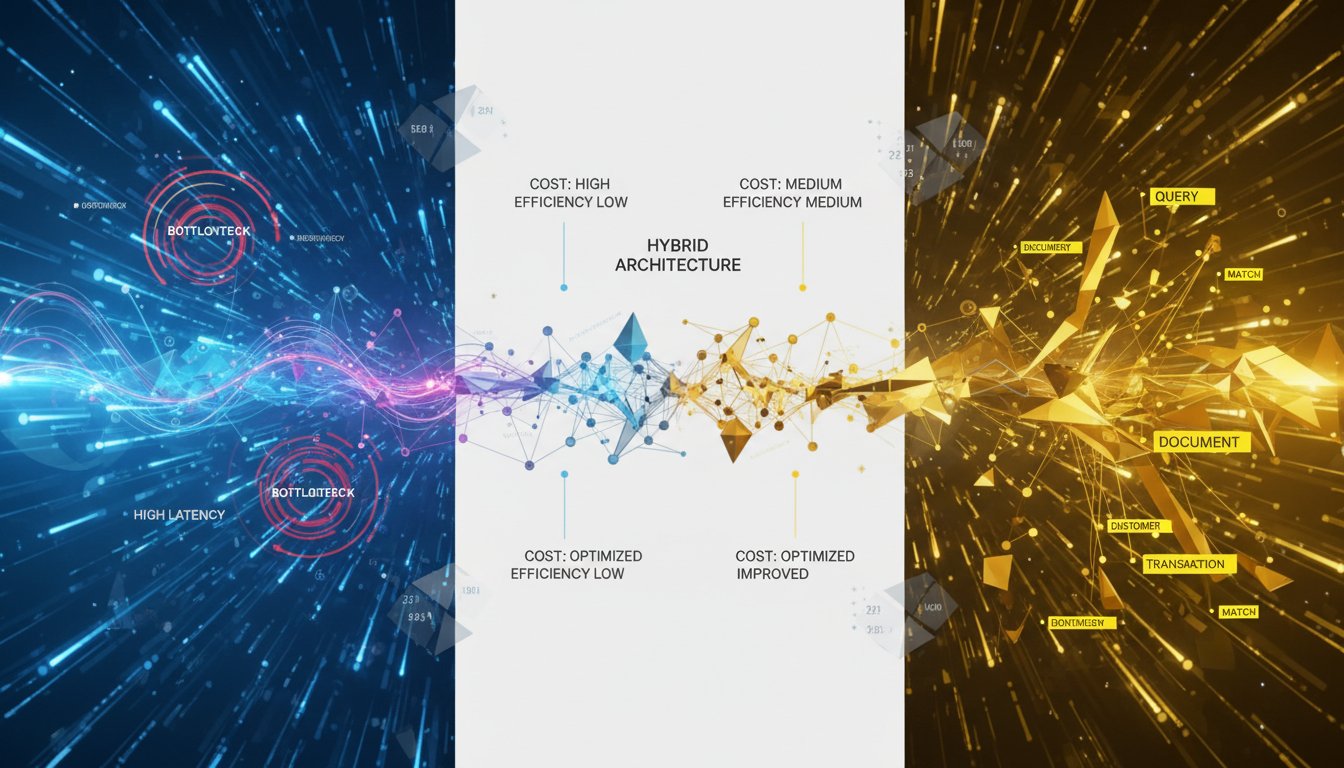
The uncomfortable truth is that BM25-only and dense-only systems are both leaving performance on the table. But the hybrid path forward isn’t just about bolting two retrieval methods together—it’s about understanding when each method wins, how to orchestrate them efficiently, and where enterprises are systematically underinvesting in the orchestration layer that actually makes them work together. We’re going to walk through the real cost dynamics, show you where hybrid retrieval delivers measurable ROI, and break down the orchestration patterns that top-performing enterprises are already using in production.
The Precision-Recall Paradox Nobody Talks About
BM25 is built for keyword matching. It’s fast, it’s interpretable, and it’s nearly impossible to break—which is why it’s been the backbone of enterprise search for two decades. But here’s what happens in a modern RAG context: when a user asks “What are the implications of our updated Q4 revenue guidance on dividend policy,” BM25 excels at finding documents containing those exact terms. The problem emerges when the most relevant document describes the same concept using different vocabulary—”earnings guidance impacts shareholder returns,” for example. BM25 returns a miss on a question where semantic understanding would have won.
Dense embeddings solve this problem by design. They map “Q4 revenue guidance” and “earnings outlook” to nearby points in vector space, so semantic similarity retrieves relevant documents even when terminology diverges. This is why teams deploy them first. But they introduce their own failure mode: when dealing with specialized financial or technical terminology, dense embeddings trained on general-purpose corpora start hallucinating relevance. A query about “coupon rate” might retrieve documents about “promotional offers” because the embedding space conflates semantic proximity with domain context. In regulated industries like finance and healthcare, this isn’t an edge case—it’s a systematic problem.
Research from enterprise deployments shows the real numbers: hybrid systems combining BM25 and dense embeddings achieve 15-30% precision improvements over single-method approaches. But here’s what most blog posts skip: that improvement only materializes if your orchestration layer actually optimizes the ranking between results from both methods. Without intelligent combination logic, you’re just returning more documents and hoping ranking improves—which it rarely does.
How Enterprises Are Actually Orchestrating Hybrid Retrieval
The simplest hybrid approach concatenates results: run BM25, run dense search, merge the results, and rerank. This works—it’s how most open-source implementations start. But it also leaves 40-50% of hybrid retrieval’s potential value on the table because it treats both methods equally and doesn’t adapt to query characteristics.
Top-performing enterprises are implementing query-adaptive orchestration instead. The pattern works like this: analyze incoming queries on a spectrum from exact-match to semantic-reasoning. Factual queries (“What is our current tax rate?”) route primarily to BM25, with dense retrieval as validation. Reasoning queries (“How should we respond to competitors pricing us lower?”) weight dense retrieval heavily, with BM25 filtering out false semantic matches. This adaptive routing reduces compute costs by 25-35% while maintaining the precision gains of both methods.
Commvault’s partnership with Pinecone reveals why enterprises are making this pivot: they needed both lexical and semantic precision working in concert. Financial institutions have implemented similar patterns with even more specificity—regulatory queries route entirely to sparse retrieval (exact compliance references matter more than semantic proximity), while strategic analysis queries use dense-first retrieval with sparse filtering to catch terminology mismatches.
The orchestration layer also handles the latency question that kills most hybrid implementations at scale. Running sequential retrieval (BM25 then dense search) adds 100-200ms per query when dealing with large document collections—which compounds into 500ms+ delays across millions of daily queries. Enterprises solving this implement parallel retrieval: BM25 and dense search execute simultaneously, results merge during ranking. This eliminates latency overhead while maintaining the precision benefits. One financial services firm reported reducing end-to-end retrieval latency by 45% by parallelizing their sparse and dense retrieval pipelines.
The Cost Reality That Nobody Quantifies
Here’s where enterprise RAG deployments make their most expensive mistake: they calculate the cost of dense embeddings (API calls, vector database storage, reranking compute) but they don’t calculate the cost of not optimizing retrieval in the first place.
A mid-size enterprise running 1M queries daily through a dense-only RAG system incurs roughly $500-800/day in embedding API costs (assuming ~5 API calls per query). Switching to a hybrid system with proper orchestration adds parallel compute (BM25 runs free, it’s just CPU), so operational cost actually decreases slightly. But here’s the hidden cost: the precision improvement means you’re retrieving the right documents more often, which means your generation phase (the expensive LLM inference) receives better context and produces higher-quality outputs that need fewer regenerations.
Oneterm financial services firm running 5M queries monthly through pure dense retrieval was spending $12K/month on embedding costs alone. After implementing hybrid retrieval with query-adaptive orchestration, their embedding costs dropped to $7.2K/month (hybrid queries still use embeddings, but less frequently and more selectively), and their LLM API costs dropped 18% because better retrieval context reduced hallucination-driven regenerations. Net monthly savings: $2,800. Annualized: $33,600 from a two-week implementation.
But the real cost calculation needs to include infrastructure: if your vector database is hitting latency ceilings at scale, you might consider horizontal scaling (more nodes, higher cost) as the solution. Proper hybrid orchestration often eliminates that need entirely because parallel sparse retrieval handles large-scale document filtering before dense search narrows the scope. One enterprise reduced their vector database cluster size by 40% after implementing intelligent hybrid routing, saving $180K annually in infrastructure costs.
When Hybrid Retrieval Actually Fails (And How to Predict It)
Hybrid retrieval isn’t universally better—it’s better in specific contexts, and enterprises need diagnostic frameworks to identify when single-method retrieval is still optimal.
First: high-specificity domains where terminology is standardized. Legal discovery, medical coding, compliance regulations—in these contexts, BM25 might be 95% sufficient because everyone uses the same terminology to describe the same concepts. Adding dense retrieval adds latency without meaningfully improving precision. This is an edge case, but it’s real.
Second: when your knowledge base is small (<10K documents) or dominated by structured data. Dense embeddings require statistical significance across large document collections to build meaningful semantic spaces. Trying to embed 5,000 short product descriptions often produces worse results than BM25 because there isn’t enough semantic variance to exploit. Most enterprises hit the inflection point around 50-100K documents where dense retrieval starts outperforming sparse retrieval.
Third: when evaluation frameworks are missing entirely. This is the 70% problem that nobody quantifies: most enterprises deploying hybrid retrieval have no systematic way to measure whether the hybrid approach is actually working better than single-method retrieval. They assume better because it sounds better. Without precision/recall evaluation metrics on your specific domain, you’re flying blind on whether hybrid orchestration is worth the operational complexity.
Diagnostic checklist before investing in hybrid architecture:
- Query Volume & Latency Requirements: If you’re handling <100K queries daily and latency isn’t a concern, hybrid might be premature.
- Terminology Variance: Does your domain use multiple terms for the same concept? If yes, hybrid likely delivers value. If terminology is standardized, BM25 alone might suffice.
- Evaluation Infrastructure: Do you have retrieval metrics (precision@k, recall@k, MRR) on held-out test queries? If not, build this first before adding hybrid complexity.
- Scale Patterns: Are you already experiencing vector database latency at your current query volume? That’s a signal that retrieval optimization (possibly through hybrid methods) will pay dividends.
Building Your Orchestration Strategy for 2026
Enterprise RAG systems are evolving toward query-aware retrieval orchestration as a core capability. By 2026, the performance gap between systems using static retrieval methods and systems using adaptive, query-aware orchestration will widen dramatically.
Start with this framework:
Layer 1 – Query Classification: Implement lightweight classifiers that categorize incoming queries by complexity, domain, and precision requirements. This happens in milliseconds and determines retrieval strategy. Simple factual queries trigger sparse-first routing. Complex reasoning queries trigger dense-first routing.
Layer 2 – Parallel Execution: Execute BM25 and dense search in parallel rather than sequentially. Modern infrastructure supports this without architectural complexity—most cloud platforms can spin up parallel processes in <5ms. This eliminates latency overhead.
Layer 3 – Intelligent Fusion: Combine results from both retrieval methods using normalized ranking. Don’t just concatenate—implement fusion algorithms that weight results based on their source method and the query classification from Layer 1. SPLADE and similar neural methods are advancing this space, but even simple rank normalization (converting BM25 scores and embedding similarity to comparable scales) delivers 60-70% of the theoretical improvement.
Layer 4 – Continuous Evaluation: Measure precision/recall/MRR on production queries monthly. Use this data to tune your orchestration logic. Which query types benefit most from dense retrieval? Which perform better with sparse retrieval? This feedback loop is how enterprises that deployed hybrid retrieval in 2024 are now outperforming competitors who are just starting the migration in 2026.
The enterprises winning in enterprise RAG aren’t choosing between sparse and dense retrieval. They’re building orchestration systems that use both methods intelligently, adapting to query characteristics, and continuously evaluating whether that adaptation is actually delivering the promised precision gains. That’s where the ROI lives—not in the technology choice, but in the orchestration intelligence layer above the technology.
If your RAG system is still making retrieval decisions based on static method selection (“we use dense embeddings”) rather than dynamic query characteristics, you’re leaving measurable performance and cost efficiency on the table. The infrastructure exists. The frameworks exist. What’s missing in most enterprises is the explicit orchestration logic that actually makes hybrid retrieval work as promised.
Start by instrumenting your current retrieval system with evaluation metrics. Measure where precision breaks down. Identify query patterns where semantic understanding fails or where keyword matching would have won. That diagnostic data is your roadmap to hybrid orchestration. The cost-benefit case practically makes itself once you see the precision failures your current method is missing.