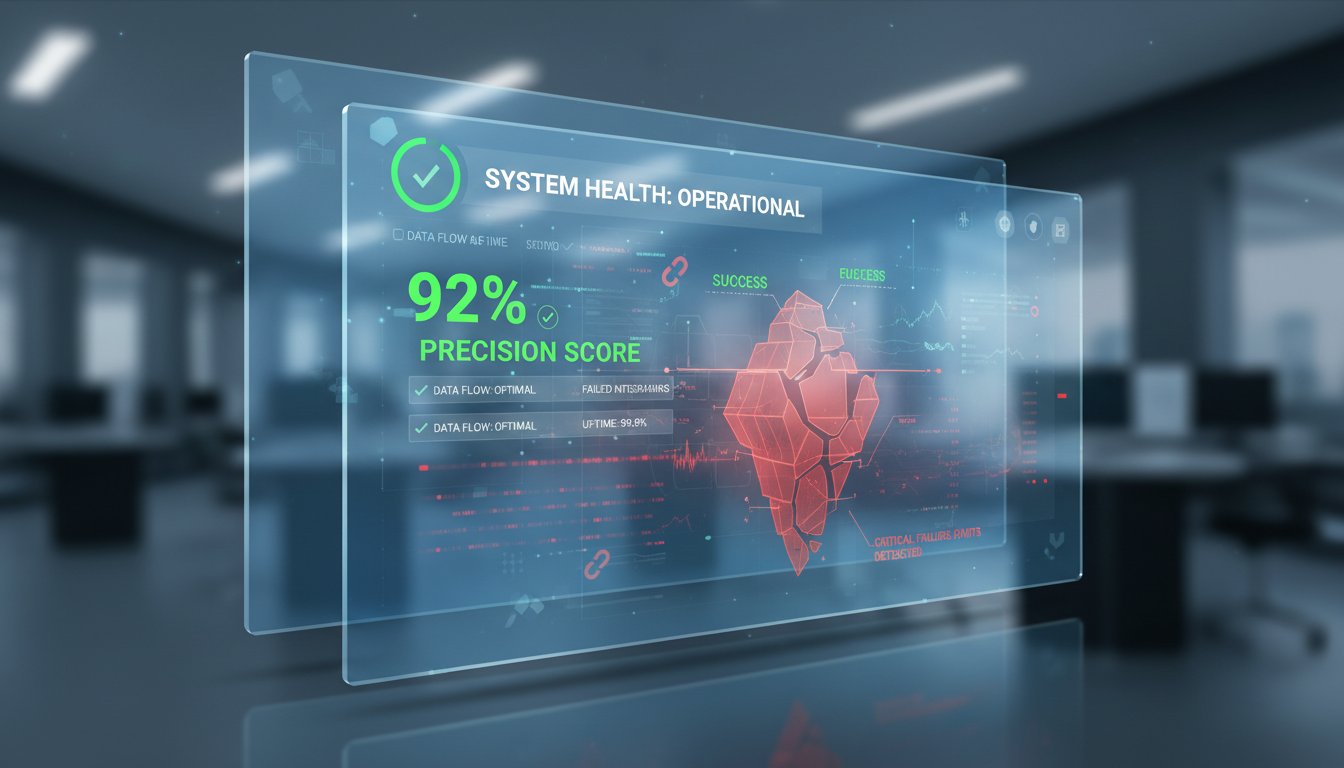

Your RAG system appears to be working. Queries return results. The LLM generates responses. Production dashboards show green. But underneath, precision is silently degrading—and you won’t know until a customer gets a hallucinated answer grounded in irrelevant context.
This is the retrieval precision crisis facing enterprise teams in 2026. Most organizations treat retrieval evaluation as an afterthought: a checkbox in the deployment process rather than a first-class operational concern. They measure aggregate metrics (precision, recall) after deployment, but lack the instrumentation to catch precision failures before they reach users. Even worse, the metrics themselves often mask systemic blindspots—a 92% precision score might hide catastrophic failures on a specific query type or domain.
The real problem isn’t that RAG systems fail to retrieve relevant documents. It’s that enterprises lack visibility into when and why they fail. Without continuous evaluation frameworks embedded into your retrieval pipeline, you’re flying blind. Cross-encoder re-ranking improves precision, but only if you can measure its actual impact. Hybrid search (BM25 + vectors) outperforms single-method retrieval, but only if you’re tuning it against the right metrics. Chunking strategy matters, but you can’t optimize it without understanding retrieval failure modes.
This guide reveals the evaluation frameworks that leading enterprises are using in 2026 to move from reactive monitoring to predictive retrieval health. You’ll learn which metrics actually matter, how to instrument them without manual annotation, and how to build debugging workflows that catch precision degradation before it impacts users.
The Metrics Illusion: Why Standard Precision Scores Lie
Traditional retrieval metrics—Precision@k, Recall@k, Mean Reciprocal Rank (MRR)—are useful starting points, but they hide critical failure modes in enterprise RAG systems.
The Precision@5 Problem: A 90% Precision@5 score sounds impressive. It means that, on average, 4.5 of your top 5 retrieved documents are relevant to the query. But this aggregate masks query-specific catastrophes. Legal discovery queries might have 100% precision while product support queries drop to 60%. Your overall metric stays respectable while entire use cases fail silently.
The Ranking Quality Blindspot: Standard precision doesn’t distinguish between “all relevant documents in top 5” and “relevant documents buried at rank 20.” Discounted Cumulative Gain (DCG@k) and Normalized DCG (NDCG@k) fix this by weighting document position—but most teams still rely on simpler metrics that miss ranking degradation until it affects real users.
The Context Relevance Gap: Precision measures whether retrieved documents are relevant, but not whether they contain the specific information needed to answer the query. A product manual might be technically relevant to a support question, but if the relevant section is buried in a 50-page PDF, your retrieval system failed. Context Precision (the fraction of retrieved context that’s actually relevant to answering the question) captures this failure mode—but it’s rarely tracked.
Enterprise teams are moving beyond aggregate metrics to context-aware measures: Context Precision, Context Recall, Answer Relevancy, and Faithfulness. These capture whether your system actually answers the user’s question, not just whether it retrieves topically relevant content.
Building the Retrieval Evaluation Framework: Three Layers
Leading enterprises structure retrieval evaluation across three tiers: real-time instrumentation, query-type segmentation, and continuous benchmarking.
Layer 1: Real-Time Pipeline Instrumentation
Instrument your retrieval pipeline to emit metrics at every stage. When a query executes, capture:
- Retrieval scores (BM25 rank, vector similarity, combined hybrid score)
- Re-ranking deltas (how much re-ranking changed document order—large deltas indicate retrieval was wrong)
- Context usage (what percentage of retrieved context the LLM actually cited in its answer)
- Latency (retrieval time, re-ranking overhead, total augmentation time)
These signals flow into your monitoring system in real-time. You’re not waiting for end-of-day analysis; you’re tracking retrieval health query-by-query.
Example: A support chatbot retrieves 10 documents for a user query. You capture the BM25 score for the top result, the vector similarity of all 10, the re-ranking scores, and how many of those documents the LLM actually referenced in its response. If the LLM cites documents ranked #8 and #10 while ignoring #1, your retrieval ranking failed—even though precision@10 might still look acceptable.
Layer 2: Query-Type Segmentation
Not all queries are created equal. Aggregate metrics obscure query-specific failures. Segment your evaluation by query type, domain, and difficulty level.
For example, a financial services RAG system might segment queries into:
– Simple lookup queries (“What is our current APR?”) → expect 98%+ precision
– Multi-document reasoning (“Compare our fund performance vs. competitor X”) → expect 85%+ precision; harder to retrieve all necessary context
– Ambiguous intent (“Why did my account get locked?”) → expect 70%+ precision; requires disambiguation and contextual understanding
Track metrics separately for each segment. You’ll likely find that your overall 85% precision score masks 95% precision on simple queries and 60% on ambiguous ones. Now you know exactly where to invest optimization effort.
Context Recall becomes critical here: for multi-document reasoning queries, did you retrieve all documents needed to answer the question? Precision alone won’t tell you. A 90% Precision@10 on a multi-document query might mean you retrieved 9 relevant documents but missed the critical one that changes the answer.
Layer 3: Continuous Benchmarking Without Manual Annotation
The biggest barrier to retrieval evaluation is the cost of manual relevance judgments. Creating a ground truth dataset of “document X is relevant to query Y” requires human annotators.
Modern approaches eliminate manual annotation through four strategies:
-
LLM-Based Relevance Judging: Use an LLM to score whether a retrieved document contains information relevant to the query. This is faster and cheaper than human annotation, though it can suffer from hallucinations. Best practice: use this as a screening tool, then spot-check with human judges on high-stakes queries.
-
Synthetic Query Generation: Generate synthetic queries from your document corpus, then use those queries to evaluate retrieval. If a document generated query “What is our return policy?” but your retrieval system can’t find that document when given the query, you’ve found a failure mode. Tools like BenchmarkQED (Microsoft Research) automate this.
-
Click-Through Data: User clicks and query-document interactions provide implicit relevance signals. If users consistently click document #5 over document #1, your ranking is wrong. This scales to thousands of queries without manual effort.
-
Context Citation Analysis: Track which documents the LLM cites in its response. If the LLM ignores highly-ranked documents and cites lower-ranked ones, your retrieval ranking degraded. This provides continuous feedback without annotation overhead.
At scale, enterprises combine all four approaches: LLM judges score a sample of queries, synthetic queries provide continuous baseline evaluation, user clicks validate ranking quality, and citation analysis catches ranking failures in production.
Debugging Retrieval Failures: A Diagnostic Workflow
When precision drops—from 85% to 78% overnight, or on a specific query type—how do you diagnose the problem? Is it retrieval? Re-ranking? Index quality? Prompt engineering?
Leading teams follow this diagnostic sequence:
Step 1: Isolate the Failure Domain
First, determine scope. Did precision drop globally or only on specific query types? Only in production or also in staging? Across all document types or only on recent documents?
If precision dropped only on customer service queries (not product questions), your problem likely isn’t overall retrieval quality—it’s query-type-specific. If precision dropped only on documents added in the last week, your problem is data freshness, not retrieval configuration.
This isolation dramatically narrows debugging scope.
Step 2: Evaluate Retrieval, Not Generation
The LLM might hallucinate even with perfect retrieval. To measure pure retrieval quality, you need ground truth at the retrieval stage, not the generation stage.
Test: For your failing queries, manually assess whether the top 5 retrieved documents should answer the question. If yes, your retrieval is fine—the problem is LLM prompting or hallucination. If no, your retrieval failed.
Quantify this: What percentage of failing queries have irrelevant top-5 results? If 80% of failures are retrieval issues and 20% are generation issues, you know where to focus.
Step 3: Diagnose Retrieval Layers
If retrieval failed, diagnose which layer: keyword matching, semantic search, or re-ranking?
-
Run the same queries using only BM25 (keyword matching). Did you get relevant results? If yes, keyword search works. If no, your query has no matching keywords in your index—problem might be query reformulation or index freshness.
-
Run the same queries using only vector similarity. Did you get relevant results? If yes, semantic search works. If no, your embedding model isn’t capturing semantic meaning for this query type.
-
Run the hybrid results through re-ranking. Did re-ranking improve or degrade precision? If it degraded, your re-ranking model isn’t tuned for this query type. If it improved slightly but precision still dropped, your hybrid retrieval baseline is weak—fix keyword/vector balance before tuning re-ranking.
This layered diagnosis tells you exactly what broke and where to fix it.
Step 4: Investigate Index and Configuration
If retrieval components individually seem fine, suspect configuration:
-
Chunking strategy: Did you recently change chunk size, overlap, or semantic boundary detection? Larger chunks might include irrelevant content; smaller chunks might fragment relevant information.
-
Vector database configuration: Did you change embedding model, vector dimension, or similarity metric? These changes affect semantic search dramatically.
-
Hybrid fusion weights: What percentage of your score comes from BM25 vs. vectors? For a specific query type, you might need 60% keyword + 40% semantic instead of your default 50/50.
-
Index freshness: When was your index last refreshed? Stale indexes cause precision to degrade gradually. Enterprise teams refresh indexes continuously for fast-changing data (product specs, policies) but less frequently for stable content (technical documentation).
Many precision degradations stem from configuration drift—someone adjusted a parameter weeks ago, and the impact is only now visible in production. Versioning your configuration and reviewing recent changes catches these quickly.
Instrumenting the Recovery Loop
Once you’ve diagnosed the problem, how do you verify that your fix actually improved precision—without waiting weeks for user feedback?
Deploy a recovery validation pipeline:
- Capture baseline metrics on the failing queries before your fix
- Deploy the fix to a staging environment
- Re-evaluate on the same queries using your instrumentation framework
- Compare precision@k, recall@k, NDCG@k before vs. after
- Validate with human judges on a sample of queries (10-20 queries is usually sufficient)
- Canary deploy to 5-10% of production traffic, monitoring precision metrics on new queries
- Full deployment once confidence threshold is met
This entire cycle can run in days, not weeks. You’re not waiting for aggregate metrics to show improvement; you’re validating on the specific failing queries.
Enterprise teams increasingly automate this recovery loop. When precision drops below threshold, the system automatically runs diagnostic queries, identifies the likely failure layer, suggests configuration changes, and runs recovery validation before alerting engineers. By the time a human gets involved, the problem is already diagnosed and a fix is staged for approval.
The Operational Shift: From Deployment Validation to Continuous Retrieval Health
The teams winning in 2026 treat retrieval evaluation not as a pre-deployment checklist but as a continuous operational practice. They instrument their pipelines to emit evaluation signals, segment metrics by query type to catch silent failures, and maintain automated diagnostic workflows to shrink mean-time-to-resolution from weeks to days.
This requires mindset shifts: acceptance that perfect precision is impossible (you’re managing precision degradation, not eliminating it), investment in evaluation infrastructure (it’s not free), and cross-functional collaboration (retrieval engineers, LLM engineers, and product teams all need visibility into precision metrics).
But the payoff is substantial. Teams with mature evaluation frameworks catch precision degradation before users notice, optimize their systems against real production failure modes, and reduce the cost of retrieval engineering by automating diagnosis and recovery validation.
Start small: instrument one critical user-facing query type with baseline metrics, set up LLM-based relevance judging for synthetic evaluation, and establish a diagnostic workflow for the next precision incident. From there, expand to more query types and build continuous benchmarking pipelines. By the time you’ve covered your core use cases, evaluation will be embedded in your operational rhythm—and precision failures won’t be silent anymore.
The retrieval precision crisis isn’t inevitable. It’s only inevitable if you can’t see it coming. With the right evaluation frameworks in place, you’re monitoring retrieval health continuously, catching degradation early, and maintaining the precision your enterprise RAG system requires. That’s the difference between a system that appears to work and one that actually does.