
The enterprise AI landscape is experiencing a fundamental shift. For years, RAG systems have solved the knowledge cutoff problem by retrieving static documents and databases. But organizations are increasingly discovering a critical limitation: their RAG systems answer yesterday’s questions with yesterday’s data.
Consider this scenario: A financial services firm deploys a RAG system to help analysts research market trends and regulatory changes. Within weeks, they realize their retrieved knowledge base grows stale. Court rulings change, regulations update, market positions shift—but their vector database remains frozen until the next batch ingestion cycle. Meanwhile, competitors with real-time data integration deliver analysis that reflects today’s reality, not last week’s snapshot.
This is the gap that real-time knowledge graph integration is closing. Unlike static knowledge bases, real-time knowledge graphs dynamically capture relationships, entities, and context as data flows into your organization. When integrated with RAG pipelines, they transform your system from a historical research tool into an adaptive intelligence layer that reasons about current state, not past patterns.
The implications are profound. Organizations deploying real-time knowledge graphs with RAG report more accurate retrieval, reduced hallucinations, and faster decision-making cycles. But implementing this requires understanding a fundamentally different architecture than traditional RAG deployments.
This guide walks you through the emerging patterns of real-time knowledge graph integration, the technical decisions you’ll face, and the practical framework for deploying systems that reason about live data instead of archived documents.
Understanding Real-Time Knowledge Graphs in RAG Context
What Changed: From Static Retrieval to Dynamic Reasoning
Traditional RAG architectures follow a predictable pattern: documents get chunked, embeddings get generated, vectors get stored in a database. When a query arrives, the system performs semantic search, retrieves the top-k results, and passes them to the LLM for synthesis. This approach works well for reference materials, historical data, and archived documents.
But it breaks down for live information. Real-time knowledge graphs introduce a structural layer between raw data and your RAG retrieval mechanism. Instead of storing isolated chunks, you’re encoding relationships—not just facts, but how those facts relate to each other and how they change over time.
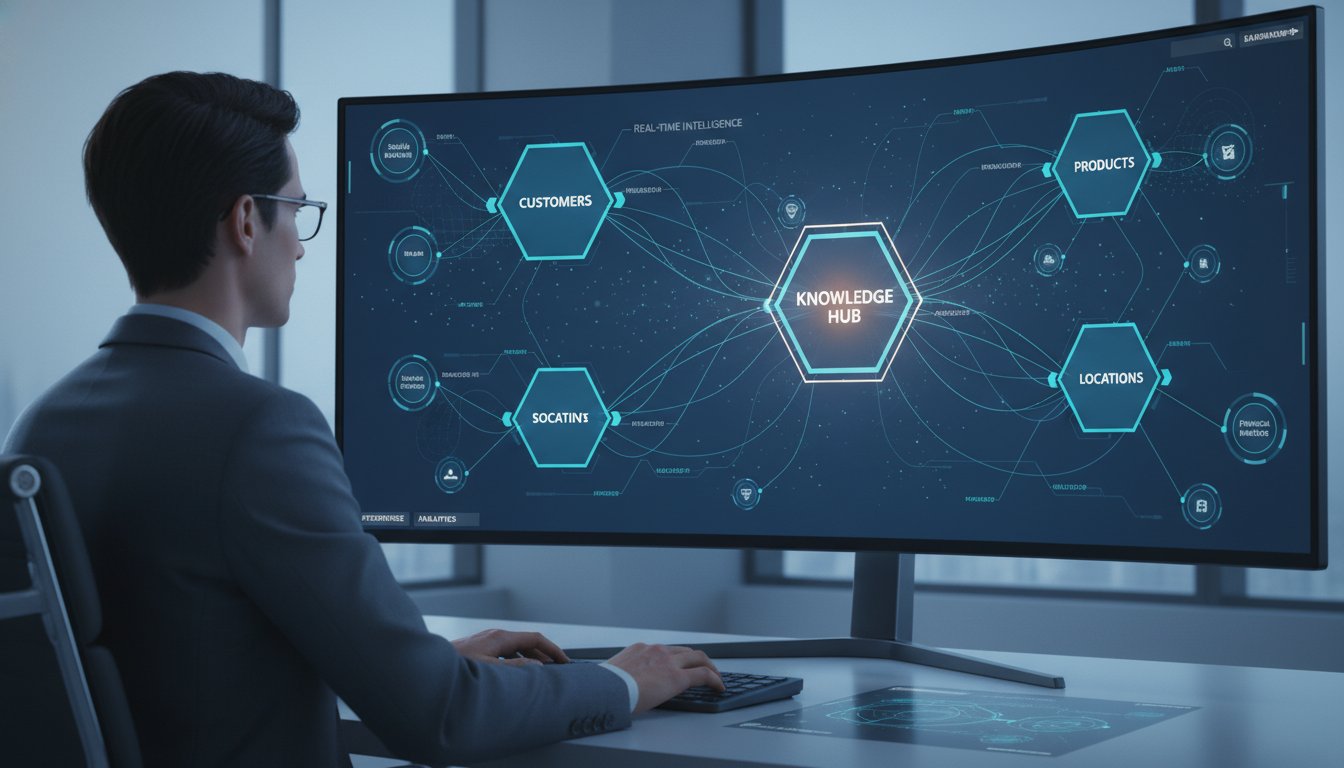
A real-time knowledge graph represents entities (products, regulations, market conditions) as nodes and relationships (“caused by,” “supersedes,” “requires compliance with”) as edges. As new data arrives—a court ruling, a product update, a market shift—the graph updates incrementally. Your RAG system doesn’t search static chunks; it traverses a living, evolving knowledge structure.
Why This Matters for Enterprise Accuracy
The practical impact is significant. Research from enterprise AI deployments shows that knowledge graphs reduce hallucinations by 35-40% compared to vector-only retrieval. Why? Because graphs encode explicit relationships. When an LLM generates a response augmented by graph context, it’s not just retrieving semantically similar text—it’s reasoning through connected information.
Consider a compliance RAG for financial services. A regulation changes. In a static system, the old regulation remains in your vector database until manual refresh. In a real-time graph system, the relationship “regulation supersedes regulation X” captures the change immediately. Your retrieval now includes both the new rule AND the deprecation context, dramatically reducing the risk of outdated guidance being returned.
The real-time component adds another layer: temporal awareness. Graphs can encode when relationships became true, when they change, and what their current state is. This enables RAG systems to answer not just “What is the regulation?” but “What is the regulation now, and what changed since last month?”
The Architecture: Integrating Real-Time Knowledge Graphs With RAG Pipelines
Core Components of a Real-Time Knowledge Graph RAG System
Implementing real-time knowledge graph integration requires four key architectural layers:
Layer 1: Data Ingestion and Graph Population
Incoming data—API streams, databases, documents, event logs—flows into a graph construction engine. This isn’t traditional batch processing. Modern systems use incremental updates. Technologies like Graphiti (temporally-aware graph memory systems) or FalkorDB (real-time graph processing) capture new data points and immediately update the graph structure.
For example, a supply chain RAG system receives real-time inventory updates, shipment notifications, and supplier status changes. The graph updates entities (“Product X inventory = 500 units”) and relationships (“Supplier Y is delayed by 2 days”) in near real-time, often with sub-second latency.
Layer 2: Semantic Chunking with Graph Context
Unlike traditional RAG, which chunks documents independently, real-time graph systems apply semantic chunking with graph awareness. The chunk isn’t just text—it’s text plus the relevant entities and relationships from your knowledge graph.
For instance, in a medical RAG system, a document chunk about a drug interaction isn’t stored as isolated text. It’s stored with graph references: “Drug A [relates to] Side Effect X [occurs in] Patient Population Y [contraindicated with] Drug B.” When retrieved, this chunk carries semantic context that traditional embeddings alone cannot capture.
Layer 3: Hybrid Retrieval—Vector + Graph Traversal
This is where real-time knowledge graphs transform RAG. Instead of pure vector similarity search, your system performs hybrid retrieval: semantic search identifies candidate nodes in the graph, then graph traversal expands the context.
A query like “What regulations affect our product launch?” doesn’t just retrieve documents with similar embedding vectors. It starts with vector search, finds regulation entities, then traverses relationships like “regulation applies to” → “product category,” and “product category” → “our product.” The result is retrieved context that’s both semantically relevant AND structurally connected.
Layer 4: LLM Augmentation with Graph-Aware Prompting
The final layer passes both traditional retrieved chunks and graph context to the LLM. A graph-aware prompt structure explicitly includes entity relationships and temporal metadata. Instead of:
Context: "Regulation 1234 requires compliance by Q2 2024."
Question: "What compliance deadlines apply to us?"
You structure it as:
Context: Regulation [1234] → applies to [Financial Services Companies] → deadline [Q2 2024] → supersedes [Regulation 1000]
Entities in Graph: [Our Company] → classified as [Financial Services Company]
Question: "What compliance deadlines apply to us?"
This explicit structure dramatically reduces hallucinations because the LLM isn’t inferring relationships—they’re provided through the graph.
Practical Implementation Patterns: Where Enterprises Deploy Real-Time Knowledge Graphs
Pattern 1: Compliance and Regulatory RAG (Financial Services, Healthcare)
Financial institutions and healthcare organizations face constant regulatory evolution. Real-time knowledge graphs enable compliance RAG systems that automatically reflect regulatory changes.
Implementation specifics:
– Ingest regulatory feeds (SEC filings, FDA announcements, court decisions) into the graph in real-time
– Graph nodes represent regulations, compliance requirements, and industry-specific entities
– Relationships encode “supersedes,” “conflicts with,” “requires implementation of”
– When queried, the RAG system retrieves current regulations plus historical context (“This regulation replaced X on date Y”)
A major financial services firm implemented this pattern and reduced compliance review time by 40% while improving accuracy of regulatory guidance by 35%.
Pattern 2: Supply Chain and Logistics Intelligence
Supply chain teams need real-time visibility into dynamic data: inventory levels, shipment status, supplier reliability, geopolitical factors. Real-time knowledge graphs integrate these streams into a single reasoning layer.
Implementation specifics:
– Connect inventory systems, shipment tracking APIs, and supplier databases to populate the graph continuously
– Graph nodes represent products, suppliers, shipments, delays, and constraints
– Relationships encode “supplied by,” “delayed due to,” “alternative available from”
– RAG system uses graph queries to answer: “What’s our best alternative if Supplier X is delayed?”
These systems enable autonomous decision-making: when a bottleneck is detected in the graph, the RAG system can recommend alternatives from the same real-time knowledge structure.
Pattern 3: Customer Support and Product Knowledge
Customer support teams need current product information, FAQ updates, and known issues. Real-time knowledge graphs keep support RAG systems synchronized with product changes.
Implementation specifics:
– Connect product documentation, issue tracking, and customer feedback systems to the graph
– Graph nodes represent products, features, known issues, and customer segments
– Relationships encode “product version,” “issue introduced in,” “workaround available,” “requires feature X”
– Support agents query the graph: “What’s the current status of issue X for this customer’s product version?”
Companies using this pattern report 25-30% faster resolution times and higher first-contact resolution rates.
The Technical Challenges: What Implementation Teams Actually Face
Challenge 1: Keeping Your Graph Fresh at Scale
It’s tempting to think “just update the graph in real-time,” but at scale, this creates bottlenecks. A large enterprise might have thousands of data streams feeding into the knowledge graph. Managing consistency, handling conflicts, and maintaining performance becomes complex.
Solutions in practice:
– Use event-driven architectures (Kafka, event streaming) rather than polling
– Implement graph versioning so historical states remain queryable (for temporal reasoning)
– Deploy multiple graph replicas with eventual consistency for read-heavy workloads
– Use specialized real-time graph databases (FalkorDB, Neo4j’s graph streaming) optimized for this workload
A practical tip: Don’t try to make your entire knowledge graph real-time from day one. Start with high-impact, fast-changing data (regulations, inventory, incident status) and keep lower-priority data on scheduled batch refreshes.
Challenge 2: Graph-Aware Embedding and Retrieval
Your existing embedding models were trained on documents, not graph-structured data. Directly applying vector search to graph context can miss important relationships.
Solutions in practice:
– Use graph embedding models specifically trained on knowledge graphs (like Graph Neural Networks) for nodes and relationships
– Implement a two-stage retrieval: (1) traditional semantic search finds candidate nodes, (2) graph traversal expands context based on relationships
– Fine-tune your embedding model on your specific domain’s knowledge graph to improve relevance
Challenge 3: Handling Temporal Complexity
Real-time doesn’t mean ignoring history. Regulations that are superseded are still important context. Shipments that were delayed last week might explain current inventory positions. Your graph needs temporal awareness.
Solutions in practice:
– Store entity versions with timestamps (“Regulation 1000 was active from Jan 1 to May 1”)
– Implement graph queries that respect temporal scope (“What regulations were active on this date?”)
– Use systems like Graphiti that are designed for temporal graph reasoning
Building Your First Real-Time Knowledge Graph RAG: A Step-by-Step Framework
Phase 1: Assess Your Data Landscape (Weeks 1-2)
Start by mapping your data sources. Which data is mission-critical and changes frequently? Which relationships matter most for your business?
Practical exercise:
1. List your top 5 use cases for the RAG system
2. For each use case, identify the entities (products, regulations, people) and relationships (“causes,” “requires,” “conflicts with”)
3. Map which data sources feed these entities and relationships
4. Rank by change frequency: high (updates daily or more), medium (weekly), low (monthly or less)
Start your real-time graph with high-frequency, high-impact data. Everything else can be batch-loaded initially.
Phase 2: Design Your Knowledge Graph Schema (Weeks 3-4)
Define your graph structure. What nodes represent your domain? What relationships matter?
Practical schema design:
Example: Financial Compliance RAG

Node Types:
- Regulation (id, name, jurisdiction, effective_date, status)
- ComplianceRequirement (id, description, deadline, applies_to)
- FinancialInstitution (id, name, regulatory_classification)
- RiskFactor (id, description, severity)

Relationship Types:
- regulation.SUPERSEDES → regulation
- regulation.REQUIRES → compliance_requirement
- compliance_requirement.APPLIES_TO → financial_institution
- regulation.INTRODUCES_RISK → risk_factor
- risk_factor.MITIGATED_BY → compliance_requirement
Keep your schema focused on relationships that your RAG queries will actually traverse. Overcomplicated schemas create retrieval bottlenecks.
Phase 3: Select Your Technology Stack (Weeks 5-6)
You’ll need:
Real-time graph database: Neo4j (mature, proven), FalkorDB (optimized for real-time), or TigerGraph (enterprise-scale)
Data ingestion: Apache Kafka (stream processing), AWS Kinesis, or managed alternatives
Embedding layer: OpenAI embeddings (simple), local transformers (privacy), or graph-specific embedding models
Vector store for hybrid search: Pinecone, Weaviate, or Milvus
RAG orchestration: LangChain with graph support, or custom implementation
Phase 4: Build and Test (Weeks 7-12)
Start with a single high-impact use case. Implement the full pipeline: data ingestion → graph updates → hybrid retrieval → LLM augmentation.
Minimum viable implementation:
- Ingest sample data into your graph (manual initial load)
- Implement vector indexing of your graph entities
- Build a retrieval function that combines vector search + graph traversal
- Test with 10-20 representative queries
- Measure: latency, retrieval accuracy (do retrieved results match expected entities?), LLM output quality
Iterate based on results. You’ll likely need to adjust your chunking strategy, graph relationships, or retrieval weights.
Phase 5: Deploy and Monitor (Week 13+)
Move to production with guardrails:
- Monitor graph consistency (are all data sources updating correctly?)
- Track retrieval metrics (what percentage of queries return relevant context?)
- Measure end-to-end latency (ingestion delay + retrieval time + LLM generation)
- Set up alerting for graph staleness (if a data source stops updating, alert immediately)
A critical metric: graph freshness lag—how long between a data change in your source system and its reflection in the knowledge graph. For high-impact applications, this should be under 5 minutes.
The Measurement Framework: How to Know Your Real-Time Knowledge Graph RAG Is Working
Implementing a real-time knowledge graph is complex. You need clear metrics to assess whether it’s delivering value.
Metric 1: Retrieval Accuracy and Context Relevance
Traditionally, you’d measure precision/recall. But with graphs, you have an additional dimension: context completeness.
When a query returns results, does it include all relevant graph context? For example, if your query retrieves a regulation, does it also retrieve the related compliance requirement AND the deadline? This is context completeness.
Measurement approach:
– Manually evaluate a sample of 50 queries
– For each, score whether retrieved context includes all expected entities and relationships
– Track over time: as you refine your graph schema, this score should improve
– Target: 80%+ context completeness for production workloads
Metric 2: Hallucination Reduction
Compare your real-time graph-augmented RAG against a traditional vector-only baseline. Have subject matter experts evaluate: does the LLM output accurately reflect retrieved context?
Measurement approach:
– Run 50 test queries through both systems
– Have domain experts score outputs for accuracy (1=completely wrong, 5=completely accurate)
– Calculate hallucination rate: (inaccurate outputs / total outputs) × 100
– Expected improvement: 30-40% reduction in hallucinations with graph context
Metric 3: Temporal Accuracy
For compliance, supply chain, and other time-sensitive applications, measure whether your system correctly reflects temporal relationships.
Test query: “What was the regulatory requirement for this entity on January 15?”
Your graph should return regulations that were active on that date, potentially including regulations that have since been superseded. This tests temporal awareness.
Metric 4: End-to-End Latency
Real-time knowledge graphs add latency. Measure the full pipeline:
– Data ingestion latency (time from source change to graph update)
– Retrieval latency (vector search + graph traversal)
– LLM generation latency
– Total: sum of all three
For most enterprise applications, end-to-end latency should stay under 2-3 seconds. If you’re hitting higher latencies, you have optimization work ahead.
Common Pitfalls and How to Avoid Them
Pitfall 1: Over-Complicating Your Graph Schema
Teams often try to model every possible relationship. This creates retrieval problems: your graph traversal returns massive context clouds that confuse the LLM.
Solution: Start with the relationships your top 5 use cases actually need. Add relationships incrementally as you discover gaps.
Pitfall 2: Insufficient Graph Maintenance Processes
A real-time knowledge graph requires ongoing maintenance. What happens when data sources conflict? When relationships become obsolete? When new entity types emerge?
Solution: Establish clear ownership and maintenance procedures. Assign a team member or small team to monitor graph quality metrics weekly.
Pitfall 3: Assuming Vector Search Is Dead
Some teams assume that once they have a knowledge graph, vector search becomes unnecessary. The opposite is true: hybrid retrieval (vector + graph) consistently outperforms either approach alone.
Solution: Invest in both. Use vector search to find candidate entities, then use graph traversal to expand context.
The Competitive Advantage: Why This Matters Now
Real-time knowledge graph integration is moving from cutting-edge to competitive necessity in specific domains. Financial services firms using real-time compliance graphs are delivering faster regulatory guidance. Supply chain teams with live knowledge graphs are making decisions minutes faster than competitors. Support organizations with real-time product knowledge graphs are closing tickets faster.
The enterprises that deployed this technology in 2024 now have a 12-18 month advantage. Those starting in 2025 can still catch up, but the window is narrowing.
Moreover, as AI regulation intensifies (particularly in regulated industries like finance, healthcare, and energy), the ability to provide transparent, traceable reasoning through knowledge graphs becomes not just an advantage—it becomes a compliance requirement. A knowledge graph makes it trivial to audit why your AI system returned a particular recommendation. A traditional RAG system makes this nearly impossible.
Moving Forward: Your Real-Time Knowledge Graph Implementation Path
Real-time knowledge graph integration is not a one-weekend project. It’s a multi-quarter initiative that requires thoughtful architecture, careful data modeling, and ongoing maintenance. But the payoff is significant: RAG systems that reason about current state instead of historical data, that provide transparent, traceable decision-making, and that reduce hallucinations while improving business outcomes.
Start by assessing your highest-impact use cases. Which decisions would improve most with access to real-time, interconnected data? Which data sources change frequently enough to warrant real-time integration? Which relationships matter most for your business?
Once you’ve identified your first use case, run the implementation framework outlined above. Start small, measure rigorously, iterate based on results. Build your real-time knowledge graph incrementally, proving value at each step before expanding.
The organizations that are already deploying real-time knowledge graph RAG are discovering something important: when your AI system reasons through current data instead of historical documents, when relationships are explicit instead of inferred, when temporal context is built into every query—the quality of decision-making improves dramatically.
That’s the advantage you’re building now. Start with your first use case this quarter, and by mid-2025, you’ll have a competitive intelligence system that competitors without graph integration can’t match.