
Enterprise AI agents are moving from pilot projects to production systems that stakeholders expect to deliver measurable ROI. But here’s the uncomfortable truth: most RAG architectures powering these agents were designed for human queries, not autonomous agents making thousands of decisions per hour. The gap between expectation and reality is creating a production accountability crisis that’s quietly derailing enterprise AI initiatives.
The shift happening right now isn’t about whether AI agents will handle critical business workflows—it’s about which organizations have RAG systems robust enough to support them reliably. Early adopters automating back-office tasks are seeing the highest returns, but they’re also discovering that traditional RAG architectures buckle under agent workloads in ways that never surfaced during human-facing deployments. The problem isn’t the agents themselves; it’s the retrieval infrastructure beneath them that was never architected for production-scale autonomous operation.
By 2026, the market expects multi-agent orchestration as standard functionality. Your customer support agent needs to collaborate with your compliance agent, which needs to coordinate with your data processing agent. Each handoff multiplies the retrieval requests, context switching, and potential failure points. When these systems fail, they don’t just frustrate users—they create compliance risks, operational delays, and measurable revenue impact. Production accountability means someone answers for those failures, and right now, most RAG architectures can’t provide the visibility needed to even diagnose what went wrong.
The Architecture Mismatch Nobody Talks About
Human users send predictable query patterns with natural pauses between requests. They tolerate 2-3 second response times and can rephrase questions when retrieval fails. AI agents operate under completely different assumptions. They generate queries in parallel, chain retrieval operations across multiple knowledge sources, and expect sub-second responses to maintain workflow velocity. When an agent encounters a retrieval failure, it doesn’t adapt—it either retries indefinitely, hallucinates an answer, or crashes the entire workflow.
Traditional RAG systems use chunking strategies optimized for human question patterns. Fixed token chunking assumes queries target specific facts or procedures that fit neatly within 512-1024 token windows. But agents don’t ask “What’s our refund policy?” They ask “Given customer order #47291, our refund policy section 3.2, the customer’s purchase history, and current inventory levels, what’s the optimal resolution?” That query requires coordinated retrieval across four different knowledge domains with different chunking requirements.
The semantic search component in most RAG systems prioritizes finding the single most relevant chunk for a given query. Agents need comprehensive context across multiple moderately relevant chunks to make reliable decisions. A customer support agent deciding whether to approve a $5,000 refund can’t rely on retrieving just the refund policy—it needs coordinated access to policy documents, transaction history, customer tier information, and inventory data. Miss any one piece, and the agent makes decisions with incomplete context.
The Query Volume Explosion
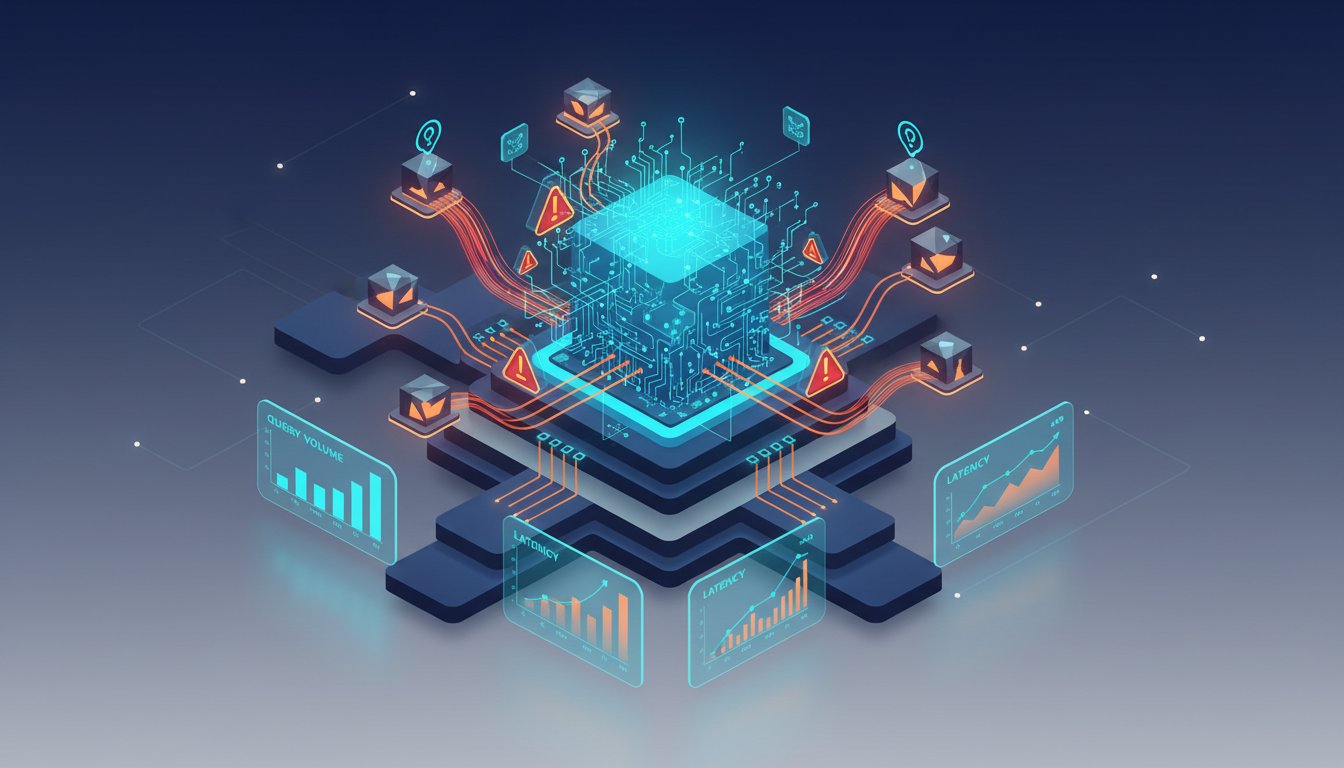
Pilot projects with a dozen agents making a few hundred queries per day don’t stress-test retrieval infrastructure. Production deployments with agent teams handling thousands of customer interactions simultaneously create query patterns that expose every bottleneck in your vector database, embedding service, and retrieval pipeline. One enterprise automating invoice processing deployed 50 agents and discovered their RAG system could handle approximately 12 simultaneous agents before retrieval latency spiked from 200ms to 8+ seconds.
The cost implications compound faster than most teams anticipate. Human users might make 20-30 queries per day. An agent handling customer support makes 200-300 retrieval requests per customer interaction, multiplied across hundreds of concurrent sessions. Vector database costs scale with query volume and index size. Teams discover their monthly vector database bill jumped from $500 during pilots to $15,000 in the first month of production—and they haven’t even deployed their planned agent fleet yet.
The Context Management Crisis
Human conversations maintain context through natural dialogue flow. Users provide clarifying information, ask follow-up questions, and naturally limit scope. Agents working autonomously across multiple workflows accumulate context that quickly exceeds LLM token limits. A compliance agent reviewing a contract might retrieve initial contract terms (2,000 tokens), then relevant regulatory requirements (3,000 tokens), then previous similar contracts for comparison (4,000 tokens), then company policy exceptions (1,500 tokens). You’ve exceeded most LLM context windows before the agent even begins analysis.
Traditional RAG systems don’t manage context accumulation because human users naturally reset context by ending conversations. Agents running continuously need intelligent context pruning, relevance scoring across accumulated retrievals, and strategies for maintaining critical context while discarding peripheral information. Without these capabilities, agents either lose critical context and make poor decisions, or they hit context limits and crash.
Why Domain-Specific Models Change RAG Requirements
The shift toward domain-specific AI models fundamentally changes RAG architecture requirements in ways most teams haven’t recognized yet. General-purpose models like GPT-4 were trained on broad knowledge and use RAG primarily for proprietary or current information. Domain-specific models for legal compliance, financial analysis, or medical diagnosis assume specialized knowledge is available through retrieval—they’re designed to be incomplete without it.
This dependency inverts the traditional relationship between model and retrieval system. In general-purpose deployments, RAG enhances accuracy and grounds responses in current data. In domain-specific deployments, RAG becomes the primary knowledge source the model can’t function without. When retrieval fails, domain-specific agents don’t fall back to general knowledge—they have no general knowledge to fall back on. Retrieval reliability becomes the single point of failure for the entire agent system.
Domain-specific models also expect retrieved context to follow specialized formats and terminologies. A financial analysis agent retrieving quarterly reports expects structured data in standard accounting formats, not unstructured prose. Your chunking strategy needs to preserve table structures, numerical precision, and relationship hierarchies. Sentence-based chunking that works fine for customer support documentation destroys the semantic structure of financial statements.
The Self-Learning Feedback Loop
Next-generation agents implement self-learning capabilities that improve accuracy over time by analyzing which retrievals led to successful outcomes versus failures. This creates a feedback loop your RAG system needs to support: tracking which chunks were retrieved for each agent decision, correlating retrieval patterns with outcome metrics, and updating retrieval strategies based on performance data.
Most RAG implementations have no mechanism for this feedback loop. They retrieve chunks based on semantic similarity at query time with no tracking of whether those retrievals actually helped the agent accomplish its task. Without feedback integration, your agents can’t learn which knowledge sources are most valuable, which chunking strategies work best for different query types, or which embedding models produce the most useful semantic matches for your specific domain.
Teams building production agent systems need RAG architectures that log every retrieval with sufficient context to analyze effectiveness. Which chunks were retrieved? What query generated them? What decision did the agent make? What was the outcome? Did the user override the agent’s decision, suggesting retrieval provided inadequate context? This telemetry transforms RAG from a static retrieval system into a learning infrastructure that improves alongside your agents.
The Production-Ready RAG Architecture
Production accountability for enterprise agents requires rethinking RAG architecture around reliability, visibility, and continuous improvement. The difference between pilot-ready and production-ready RAG isn’t incremental—it’s architectural.
Reliability Through Redundancy and Fallbacks
Production RAG systems need multiple retrieval strategies with intelligent fallback mechanisms. Primary retrieval might use dense vector search for semantic matching, with fallback to BM25 keyword search when semantic results have low confidence scores, and final fallback to structured database queries for entities and relationships. When an agent needs customer contract terms and vector search returns low-confidence results, the system automatically falls back to querying your contract database directly.
This requires maintaining multiple indexes and retrieval mechanisms—vector databases, traditional search indexes, and structured data stores—with orchestration logic that selects the optimal retrieval path based on query characteristics and confidence thresholds. The added complexity pays for itself the first time your vector database experiences latency spikes but your agents continue functioning by routing to alternate retrieval paths.
Chunking strategies also need redundancy. Store the same documents chunked multiple ways—fixed tokens for specific fact retrieval, semantic paragraphs for conceptual queries, and full sections for comprehensive context. Query-time logic determines which chunking strategy best matches the agent’s information needs. A compliance agent checking whether a contract violates specific regulations needs fine-grained chunks containing individual clauses. That same agent analyzing overall contract risk needs larger semantic chunks preserving contextual relationships.
Visibility Through Comprehensive Instrumentation
When an agent makes an incorrect decision, production accountability requires understanding exactly what information the RAG system provided and why. Every retrieval operation needs instrumentation capturing: query text and embeddings, chunks retrieved with relevance scores, retrieval latency, which indexes were queried, whether fallback mechanisms activated, and what context was ultimately provided to the agent.
This telemetry enables debugging agent failures by replaying exactly what the RAG system returned. Why did the customer support agent approve a refund that violated policy? Because the RAG system retrieved the general refund policy but missed the specific exception clause due to a chunking boundary that split the exception into a separate chunk that didn’t match the query embedding. Without instrumentation, you’re guessing. With comprehensive telemetry, you can identify the root cause and fix the chunking strategy.
Visibility also means real-time monitoring of RAG system health metrics that predict failures before they impact agents. Track retrieval latency distributions, confidence score trends, cache hit rates, fallback activation frequency, and embedding service availability. When median retrieval latency starts creeping up, you scale your vector database before agents start timing out. When confidence scores trend downward, you investigate whether your knowledge base needs updating or embeddings need regeneration.
Continuous Improvement Through Automated Feedback
Production RAG systems capture outcome data to identify improvement opportunities automatically. When users override agent decisions or escalate to human support, that signals potential retrieval failures. Correlate those outcomes with the retrieval operations that preceded them. Which chunks were retrieved? Were confidence scores unusually low? Did the query fall outside your knowledge base coverage?
This analysis identifies systematic gaps. If agents handling product returns consistently escalate questions about a specific product category, your knowledge base probably lacks adequate documentation for that category. If queries about regulatory compliance have 30% lower confidence scores than other query types, your chunking strategy may not work well for regulatory content. Automated analysis transforms anecdotal failures into systematic improvement priorities.
The feedback loop should also update retrieval strategies automatically where safe. If certain types of queries consistently get better outcomes with larger chunk sizes, adjust chunking parameters for those query patterns. If fallback to keyword search activates frequently for queries containing specific terminology, update your embedding model fine-tuning to handle that terminology better. Production RAG systems aren’t static—they evolve based on real usage patterns.
Implementation Roadmap for Production-Ready RAG
Transforming pilot-grade RAG into production infrastructure requires systematic architectural evolution, not point solutions. Teams that succeed follow a staged approach that builds reliability progressively.
Stage 1: Instrumentation and Visibility
Before changing any retrieval logic, implement comprehensive instrumentation of your existing RAG system. You can’t improve what you can’t measure. Add logging for every retrieval operation capturing all the telemetry described above. Build dashboards showing retrieval latency distributions, confidence scores, query patterns, and failure modes. Run your pilot agents in shadow mode against production data to stress-test current capabilities and identify bottlenecks.
This stage typically takes 2-3 weeks and requires minimal changes to existing architecture—you’re adding observability, not rebuilding systems. The data you collect becomes the foundation for prioritizing architectural improvements. Maybe retrieval latency is fine but confidence scores are terrible, suggesting embedding quality issues rather than infrastructure problems. Maybe 80% of queries hit the same 20% of your knowledge base, suggesting caching could solve performance concerns without expensive infrastructure scaling.
Stage 2: Reliability Infrastructure
Build redundancy and fallback mechanisms into your retrieval layer. Implement multiple retrieval strategies with intelligent routing based on query characteristics. Add caching for frequently retrieved chunks to reduce vector database load. Create circuit breakers that prevent cascade failures when components experience issues. Deploy your redundant retrieval infrastructure alongside existing systems, routing a small percentage of queries to new infrastructure while monitoring comparative performance.
This stage takes 4-6 weeks and requires careful testing to ensure fallback mechanisms activate correctly and improve reliability rather than adding complexity that creates new failure modes. The goal is reaching 99.9% retrieval availability even when individual components fail. When your vector database goes down for maintenance, agents continue operating by routing to fallback retrieval mechanisms.
Stage 3: Adaptive Chunking and Indexing
With reliability established, optimize for quality by implementing multiple chunking strategies and query-time selection logic. Re-chunk your knowledge base using different strategies and store all versions in parallel. Build classification logic that examines agent queries and selects the optimal chunking strategy for each query type. Fine-tune embedding models on your domain-specific content to improve semantic matching quality.
This stage takes 6-8 weeks because chunking strategy changes require re-indexing your entire knowledge base and carefully validating that retrieval quality improves across diverse query types. Use A/B testing to compare retrieval quality between strategies, using the outcome data from your feedback loops to measure which approach produces better agent decisions.
Stage 4: Feedback Integration and Continuous Learning
Implement automated feedback loops that correlate retrieval operations with outcome metrics. Build pipelines that identify systematic retrieval failures and knowledge gaps. Create automated alerts when confidence scores drop or escalation rates increase for specific query patterns. Deploy automated improvement systems that adjust retrieval parameters based on performance data within safe boundaries.
This final stage takes 4-6 weeks to implement the technical infrastructure, but continuous learning is an ongoing process. You’re building systems that improve automatically, identifying issues proactively rather than waiting for failures to surface through user complaints. Production-ready RAG becomes a living system that evolves alongside your agent fleet and business needs.
The Bottom Line: Infrastructure Investment Now Prevents Failures Later
The gap between pilot-grade and production-ready RAG architecture represents 3-4 months of focused engineering work and significant infrastructure investment. Teams routinely underestimate this transition because pilot projects mask the reliability, visibility, and scaling requirements that only surface under production workloads. The cost of building production-ready RAG infrastructure before deploying agents is substantial. The cost of retrofitting it after your agent systems are failing in production is 3-5 times higher when you account for emergency engineering resources, business disruption, and reputational damage.
Enterprise AI agents moving to production aren’t a future trend—they’re deployed today in organizations that built RAG infrastructure capable of supporting them reliably. The production accountability trap catches teams that treated RAG as a feature to add to agents rather than foundational infrastructure that determines whether agents succeed or fail. Domain-specific agents with self-learning capabilities require RAG systems designed specifically for autonomous operation at scale, with reliability, visibility, and continuous improvement built in from the start.
If your organization is deploying enterprise AI agents, audit your RAG architecture against production requirements now. Can your system maintain sub-second retrieval latency under 10x current query volume? Do you have instrumentation to debug why an agent made a specific decision? Can you identify knowledge gaps automatically based on agent outcomes? Do you have fallback mechanisms when primary retrieval fails? If the answer to any of these questions is no, you’re building agents on infrastructure that will fail under production accountability.
The organizations winning with enterprise AI agents in 2026 aren’t those with the most sophisticated models or the largest agent fleets. They’re the ones who recognized that production-ready RAG infrastructure is the foundation everything else depends on—and invested in building it before their agents went into critical business workflows. Start architecting for production accountability today, or start preparing explanations for why your agent systems failed when stakeholders demanded ROI.