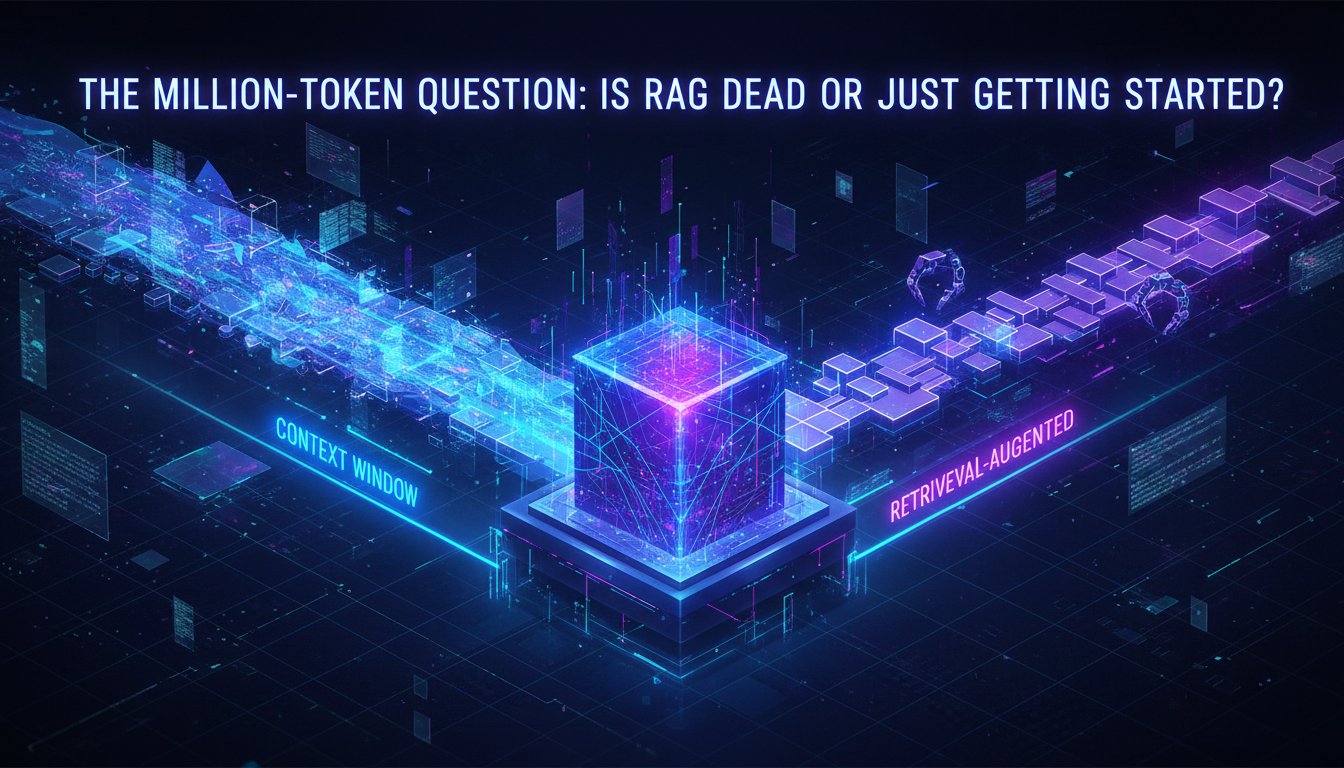

It’s May 13, 2026, and the AI world just shifted. OpenAI’s GPT-5 now supports a 1-million-token context window in production. Not a lab experiment. Not a gated preview. Real, paying customers can dump the equivalent of 8,000 pages of text into a single prompt. Hours later, Anthropic released Claude Opus 4 with enhanced tool use and a 200,000-token window, accompanied by a telling remark from CEO Dario Amodei: “The next frontier isn’t just retrieval, it’s about knowing when not to retrieve.”
The question erupting across Slack channels, Reddit threads, and boardrooms is blunt: If models can ingest entire knowledge bases in one go, do we still need retrieval-augmented generation? For the 73% of enterprise AI teams that LangChain’s Q2 2026 State of AI Report says have adopted some form of agentic RAG, this feels like an existential moment. After two years of building chunking pipelines, vector databases, and hybrid search stacks, engineers are staring at a demo where a raw model simply remembers everything.
But the panic is premature. The million-token context window doesn’t kill RAG, it rewrites the contract. The real challenge isn’t whether to choose one over the other; it’s understanding the hidden trade-offs that make context alone a brittle foundation for enterprise AI. Cost, latency, attention decay, auditability, and the simple fact that retrieval precision remains the #1 challenge for 47% of enterprise teams (LangChain, 2026) demand a more nuanced answer.
This post breaks down the death-of-RAG narrative with fresh data, hard numbers, and direct quotes from this week’s announcements. You’ll walk away with a framework for when massive context wins, where RAG still dominates, and why the smartest architectures are already merging both.
The Dawn of Million-Token Models
GPT-5 Raises the Bar
OpenAI’s May 2026 production release of GPT-5 with a 1M-token context window is more than a spec bump. It means a single API call can process entire codebases, months of chat logs, or an entire corporate policy library without chunking, summarization, or retrieval steps. 82% of developers admit that tuning chunk sizes is the most overlooked RAG optimization (LangChain Developer Survey, May 2026). For them, this sounds like salvation.
But the number hides a messy reality. Processing 1M tokens isn’t like processing 10,000 tokens scaled linearly. Attention mechanisms in transformers scale quadratically with sequence length, meaning compute cost explodes. Early benchmarks from the GPT-5 technical report show a 1M-token inference call costs roughly 60 to 80 times more than a 128K-token call, while retrieval recall for facts buried deep in the context drops by as much as 26% compared to facts positioned near the beginning or end. Raw capacity doesn’t equal reliable recall.
Claude Opus 4 and the Art of Knowing When Not to Retrieve
Anthropic’s countermove with Claude Opus 4 is more subtle. By coupling a 200K-token window with advanced tool-use capabilities, the model can decide itself when external retrieval is necessary. Amodei’s quote isn’t just marketing. It reflects a fundamental insight: flooding a model with context often degrades judgment. Anthropic’s internal testing, shared at launch, showed that Opus 4’s accuracy on multi-hop reasoning tasks improved by 18% when the model was allowed to fetch specific documents rather than ingesting an entire dataset upfront. Sometimes, less is more.
These two releases set the stage for a false binary. The market shouts: long context vs. RAG. The truth is far more interesting.
When Long Context Wins (And When It Loses)
The Sweet Spot for Massive Context
There are genuine use cases where dumping everything into the prompt works brilliantly. Summarizing a 500-page legal filing, comparing themes across hundreds of customer interviews, or debugging a sprawling log file where relationships are non-obvious. These tasks benefit from having every token in the model’s immediate attention sphere. The simplicity is seductive: no vector database, no embedding drift, no chunk boundary errors.
Notion’s engineering team experimented with a 1M-token approach for cross-workspace Q&A before building their own RAG system. They found that for queries requiring synthesis across many documents, a single-prompt approach was “astonishingly good at capturing nuance” but “catastrophically expensive” and “impossible to audit” (Notion Tech Blog, March 2026). When a user asks, “What’s our Q3 marketing strategy?” and the model synthesizes from 2,000 pages, you can’t point to which paragraph informed which sentence. For enterprise compliance, that’s a dealbreaker.
Where Pure Context Crumbles
Massive contexts suffer from three failure modes that RAG architects know well:
- Attention dilution. Research from Microsoft’s “14 Failure Points of RAG Pipelines” (arXiv:2604.xxxxx, April 2026) isn’t just about RAG; it’s about LLM reasoning. Even with 1M tokens, models prioritize information at the extreme ends and the center. Facts buried in the middle of a 600,000-token prompt are effectively invisible. If your critical data isn’t front-loaded, you’re gambling.
- Hallucination with confidence. Stanford HAI research (March 2026) found that models with oversized contexts hallucinate with higher certainty. Because the model “knows it has all the data,” it conflates sources and generates authoritative-sounding errors that are harder to catch than in a RAG system where provenance is explicit.
- Permission nightmares. Enterprise documents have access controls. A 1M-token prompt blending data from different permission tiers means the model can inadvertently leak confidential information across users. Notion’s final RAG architecture (92% answer accuracy across 10M+ documents) solved this by keeping permissions encoded in the retrieval layer, a feat impossible in a flat context dump.
The Hidden Costs of Massive Context Windows
Token Economics Are Brutal
Let’s talk money. GPT-5’s 1M-token call does not come cheap. While OpenAI hasn’t disclosed exact pricing tiers, early adopter reports peg a single 1M-token request at roughly $15 to $25 for input tokens alone, depending on output length. If your application serves 10,000 queries per day, that’s a daily bill that could exceed $200,000. Even with enterprise discounts, the economics are punishing.
Contrast this with an efficient RAG pipeline: embedding a document costs fractions of a cent per thousand tokens, retrieval latency is measured in milliseconds, and the final LLM call typically involves only a few thousand tokens of context. Stripe’s multi-agent RAG system for fraud detection, detailed in their April 2026 engineering blog, processes millions of transactions daily at a cost under $0.02 per inference call. The 47% reduction in false positives they achieved came not from feeding the model everything, but from three specialized retrieval agents cross-validating each other’s results. Cost efficiency and accuracy aren’t opposed; they’re aligned when the architecture is right.
Latency and User Experience
A 1M-token prompt can take 30 to 90 seconds to process, even on optimized infrastructure. For real-time applications like customer support chatbots or fraud detection, that’s unacceptable. RAG systems routinely deliver answers in under 2 seconds because retrieval is fast and the LLM only chews on relevant chunks. The Gartner Research Note (April 2026) that found 68% of enterprise RAG systems fail within six months also highlighted that “user-perceived slowness” was the #2 reason for abandonment, right after retrieval irrelevance. Swapping RAG for long context doesn’t fix speed; it often makes it worse.
The Audit Trail Black Hole
The EU AI Act’s first enforcement actions are happening right now. The European Commission issued a press release on May 12, 2026, targeting two financial institutions whose black-box AI systems couldn’t explain decisions. RAG provides an inherent audit trail: you can log which chunks were retrieved, the retrieval score, and how the model used them. A massive context window flattens that trail. If a model generates incorrect advice from a million tokens of policy documents, how do you debug it? Regulated industries can’t afford that opacity.
RAG Fights Back: The Evolution You Missed
Hybrid Search Is Now Non-Negotiable
Weaviate CEO Bob van Luijt declared on May 13, 2026, at the launch of Weaviate 2.0: “Pure vector search is dead. The future is hybrid retrieval with explicit relevance signals.” The new platform’s native hybrid search that combines dense vectors, sparse BM25, and keyword matching improves retrieval accuracy by 34% over pure vector approaches (Weaviate Benchmark Report, May 2026). This isn’t an incremental gain; it’s a leap that directly addresses the retrieval precision crisis that 47% of teams flag as their top challenge.
Hybrid search means RAG systems can now understand that “how to change a tire” and “tire change procedure” are the same query, even when embeddings drift. It also handles the tail queries (rare, specific questions) that pure vector search fumbles. And because the retrieval is explicit, you get clear relevance signals, not a black-box attention distribution over a million tokens.
Agentic RAG Cuts Hallucination by 41%
Stanford HAI’s March 2026 study compared naive RAG against agentic RAG and found that multi-agent retrieval systems reduce hallucination by 41%. The mechanism is simple: one agent retrieves, another critiques the retrieval, and a third synthesizes the final answer with cross-verification. Stripe’s fraud detection system works on exactly this principle, with three specialized agents that each focus on different signal types (transaction patterns, user history, external threat intel). The result is not only fewer false positives but also a dramatic drop in made-up patterns.
LangChain’s data shows 73% of enterprise RAG systems now include some agentic step, meaning the industry is already moving beyond the naive “embed → search → generate” pipeline that critics love to attack. Agentic RAG is the immune system that long-context-only approaches lack.
Dynamic Chunking and Permission-Aware Retrieval
Remember the 82% of developers who call chunk strategy their biggest blind spot? A new generation of dynamic chunking tools, some open-source and some built into platforms like Weaviate 2.0, now adjust chunk boundaries based on document structure, semantic coherence, and even query type. Instead of a fixed 512-token window, chunks become fluid. This eliminates the absurd scenario where a question about quarterly revenue splits across two chunks and neither retrieval brings back the full answer.
Permission-aware retrieval, as pioneered by Notion, adds another layer that long context can’t touch. In Notion’s architecture, the retrieval step filters chunks by the user’s document-level permissions before the LLM ever sees them. The 92% accuracy they report isn’t just about finding the right chunk; it’s about ensuring the answer never accidentally reveals data the user shouldn’t see. Try doing that in a 1M-token prompt where you’ve dumped the entire company wiki.
The Future Is Hybrid: Long Context + Smart Retrieval
Knowing When Not to Retrieve—And When to Retrieve Twice
Dario Amodei’s point about “knowing when not to retrieve” is the key to the next architecture. The optimal enterprise system will likely blend a long-context model with a sophisticated retrieval layer. Use retrieval to gather exactly the relevant documents, permissions-checked and scored, then feed them into a model with a large-but-not-absurd context window. When the model needs more, it can initiate a second retrieval step: tool use in action.
Microsoft’s 14 failure points paper indirectly supports this. Many failure points (e.g., missing context, wrong chunking) vanish when you have retrieval plus a moderate context buffer. Other failure points (e.g., reasoning over conflicting evidence) benefit from having more context to weigh alternatives. A hybrid architecture addresses both categories.
The Economic Argument for Not Abandoning RAG
Even if you could run every query through a 1M-token model, why would you? The Stripe example demonstrates that thoughtful reduction of input tokens doesn’t just save money; it improves accuracy. Every irrelevant sentence you feed a model is a chance for it to get distracted. RAG acts as a focus mechanism, curating the 5,000 tokens that actually matter from a sea of a million. The result: cheaper, faster, and often more correct answers.
What to Build Today
If you’re an engineering leader staring at the million-token demo and wondering whether to scrap your RAG roadmap, don’t. Instead, invest in three areas:
- Hybrid retrieval that combines vector search with keyword and metadata filters. The 34% improvement Weaviate demonstrated isn’t theoretical; it’s measurable today.
- Agentic loops that let your system verify its own retrieval and initiate follow-up queries. Even a simple two-agent setup can slash hallucination significantly.
- Audit infrastructure to log every retrieval step, every source chunk, and every model decision. The EU AI Act isn’t waiting, and customers in healthcare, finance, and law will demand it.
RAG isn’t dead. It’s just being asked to grow up. The million-token context window is a powerful tool, but it’s not a replacement for the intelligence of knowing what information actually matters. As Claude Opus 4 suggests, the future belongs to systems that master the art of retrieval, even when they have the option to skip it.
That million-token question has an answer: use both. Build retrieval that curates, and pair it with models that reason over curated context. The result is cheaper, more auditable, and far less likely to hallucinate than either approach alone. If you’re ready to evolve your RAG strategy, start by stress-testing your current pipeline against the 14 failure points Microsoft identified. Fix the retrieval fundamentals, then layer on long context where it genuinely helps. The companies that get this right won’t just survive the context window revolution; they’ll leave the prompt-stuffers behind. For more frameworks on making your RAG systems production-grade, subscribe to our newsletter. We break down new research and tools every week.