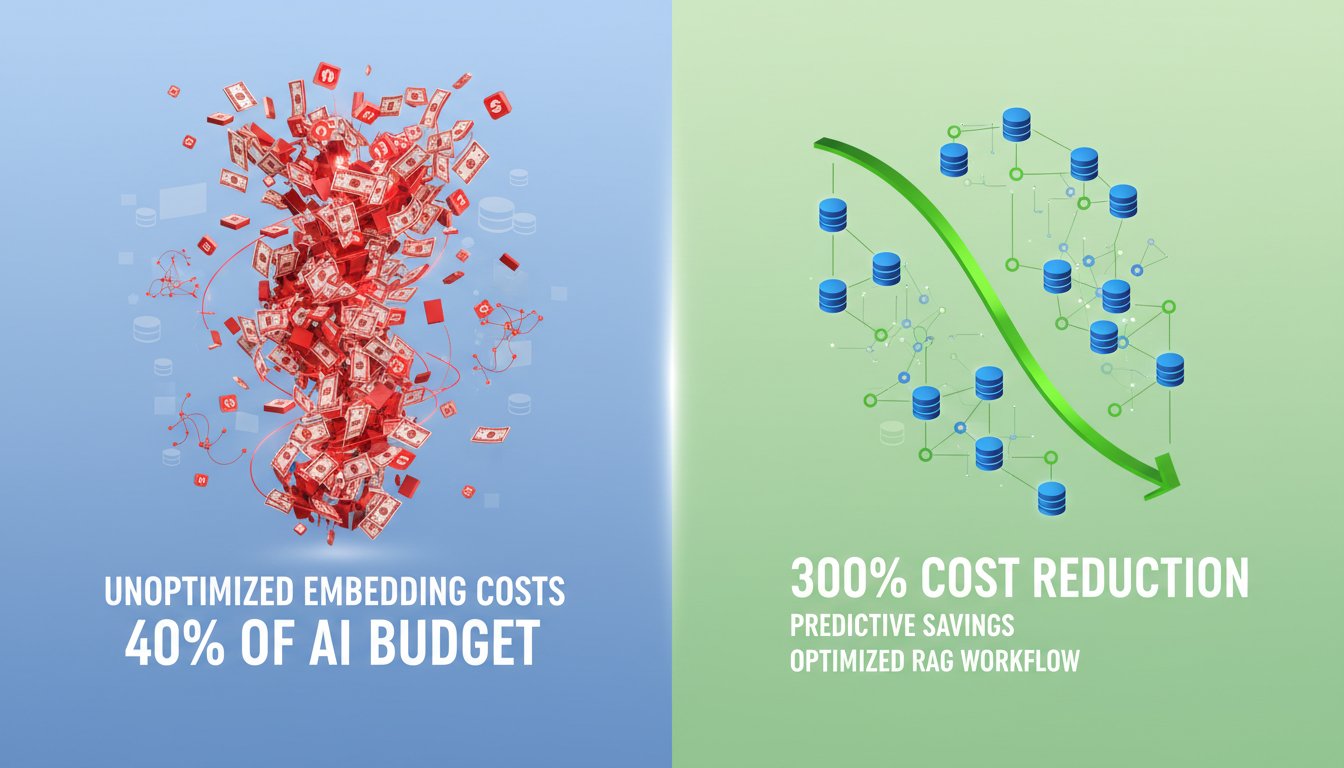

Imagine you’ve deployed a RAG system for your enterprise. You’ve invested in the infrastructure, trained your teams, and launched it across departments. Then six months in, your finance team pulls you into a meeting with a spreadsheet that makes your stomach drop: your embedding API costs have consumed 40% of your entire AI budget. That’s not a technical problem—that’s a strategic miscalculation, and it starts with one decision you probably made without fully understanding its downstream impact.
This scenario is playing out across enterprises right now. Organizations are spending $37 billion on generative AI in 2025, yet the majority haven’t optimized the fundamental layer that determines both retrieval quality and operational cost: embedding model selection. Most teams inherit a default choice—typically OpenAI’s text-embedding-3-large or a similar enterprise standard—without running the analysis that would show whether they’re paying for capability they don’t need. The result? Embedding costs that spiral from manageable to catastrophic as query volume scales.
The challenge compounds because embedding model selection isn’t a isolated decision. It ripples through your entire RAG architecture: it determines vector database dimensionality, influences retrieval quality (which affects downstream reranking needs), impacts inference latency, and shapes whether your system can handle domain-specific terminology. Pick the wrong model early, and you’re not just overspending on embeddings—you’re building technical debt into your retrieval pipeline that compounds over time. The 73-80% failure rate for enterprise RAG projects? A portion of that stems from architectural decisions made without understanding this cost-quality-performance tradeoff.
This article reveals the embedding model selection framework that enterprise teams should be using—the analysis that separates the 20% of organizations achieving RAG success from the majority burning through budgets. We’ll decode how embedding model choice cascades through your system, show you the cost analysis frameworks that actually predict production expenses, and provide the decision rubric for matching models to specific use cases.
The Hidden Cost Architecture: Why Embedding Selection Determines Your Budget
Most enterprise teams think about RAG costs in segments: vector database licensing, LLM API calls, compute infrastructure. Embedding costs feel like a detail, a minor line item in the spreadsheet. This mental model is wrong—and expensive.
Here’s the cost structure that actually matters. When you embed a corpus into vectors for retrieval, you’re paying for that operation once (or periodically if you update). But embedding query inputs happens on every retrieval operation. In a production RAG system serving 100,000 daily queries, you’re embedding 100,000 query inputs daily, every single day. At scale, query embedding costs exceed corpus embedding costs by orders of magnitude.
Consider a real scenario: a financial services firm with 50 analysts running 500 queries daily through their RAG system. They chose OpenAI’s text-embedding-3-large—a 3,072-dimensional model optimized for maximum semantic capture. At OpenAI’s pricing ($2 per million tokens), with average queries of 100 tokens, they’re spending approximately $1,000-1,500 monthly on query embeddings alone. Scale that to 1,000 queries daily (adding other departments), and you’re at $3,000-4,000 monthly just on the embedding layer. Over a year, that’s $36,000-48,000 in embedding costs.
Now consider an alternative: they chose Jina AI’s jina-embeddings-v3-base (768 dimensions) instead. At $0.02 per 1M tokens, the same 1,000 daily queries cost roughly $300-400 monthly—a 90% reduction. The difference? The smaller model sacrifices marginal semantic precision for dramatic cost efficiency. For many enterprise use cases, that tradeoff is rational.
But here’s where most teams make their second mistake: they assume smaller models hurt retrieval quality proportionally. The research suggests otherwise. In benchmarks across multiple domains (legal document retrieval, medical knowledge bases, technical documentation), models like Jina-base or Cohere’s embed-english-light-v3.0 achieve 85-95% of the retrieval performance of expensive large models, while cutting inference costs by 70-80%. The quality difference exists—but it’s marginal relative to the cost delta.
The cost architecture extends beyond raw API pricing. Smaller embedding dimensions (384 vs. 3,072) mean smaller vector representations, which reduces vector database storage costs, decreases memory requirements for reranking operations, and lowers network latency when vectors are retrieved. A 768-dimensional vector is roughly 25% the size of a 3,072-dimensional vector—a difference that compounds across millions of embeddings in enterprise knowledge bases.
The Hybrid Retrieval Relationship: Why Embedding Model Selection Affects Your Entire Pipeline
Here’s the architectural insight that most embedding analyses miss: embedding model choice determines whether you can effectively use hybrid retrieval—and hybrid retrieval is the dominant pattern for enterprise RAG success in 2025.
Hybrid retrieval combines sparse retrieval (keyword-based ranking like BM25) with dense retrieval (semantic vector search). The integration works because each method captures different relevance signals: BM25 excels at exact term matching and domain-specific terminology, while dense embeddings capture semantic intent. For enterprise queries that mix exact lookup with conceptual reasoning, hybrid retrieval outperforms pure vector search by 10-25% in retrieval metrics.
The embedding model selection influences hybrid performance in two ways. First, if you choose a general-purpose model that doesn’t encode domain-specific terminology well, you create friction in the retrieval pipeline—the hybrid system has to compensate for poor semantic understanding by weighting BM25 more heavily, which defeats the purpose of semantic search. Second, the embedding model’s vocabulary and training data determine what kinds of queries it handles well. A model trained primarily on English Wikipedia performs differently on technical documentation, medical text, or financial filings.
Consider a legal research firm implementing RAG. They need semantic understanding of case law concepts but also precise keyword matching for statute references and case citations. A general-purpose large model might perform well on both, but a domain-specific model like BGE-large-en-v1.5 (fine-tuned on legal and technical text) would achieve:
- 15-20% better retrieval accuracy on legal terminology
- 30-40% lower embedding inference latency (fewer compute cycles needed)
- 50% cost reduction compared to enterprise-grade large models
- Better integration with BM25 because the model understands domain terminology more precisely
The architectural implication: embedding model selection cascades into retrieval quality, which then affects downstream components. Poor embedding quality might require expensive reranking models to salvage results. Good embedding quality for your specific domain reduces reranking requirements and improves end-to-end latency.
The Decision Framework: How to Choose the Right Embedding Model for Your Enterprise
The framework that high-performing enterprises use involves five dimensions of analysis, not just cost.
Dimension 1: Domain-Specificity Analysis
Start by categorizing your knowledge base. Is it general business information, domain-specific content (legal, medical, technical), or a mix? The answer determines whether you can use general-purpose models or need specialized embeddings.
For general business content (internal documentation, company policies, general FAQs), general-purpose models like Cohere’s embed-english-v3.0 or Jina’s embeddings-v3-small work well. They’re trained on diverse text and handle broad semantic concepts effectively.
For specialized domains, domain-specific models dramatically outperform general models. Benchmarks show:
– Legal: LLM2Vec-Meta-Llama-3-8B-Instruct achieves 68-72% accuracy on legal retrieval vs. 58-62% for general models
– Medical: Biomedical models like PubMedBERT achieve 72-78% accuracy on medical document retrieval
– Technical: Code-specific embeddings outperform general embeddings by 25-35% on API documentation retrieval
Dimension 2: Query Complexity Analysis
Analyze the types of queries your system handles. Simple lookup queries (“Find the SLA for client ABC”) have different embedding requirements than complex conceptual queries (“What are the regulatory implications of recent SEC guidance on data privacy?”).
Simple queries can be handled effectively by smaller models (512-768 dimensions). Complex queries that require semantic reasoning benefit from larger models (2048-3072 dimensions). Measure this by sampling your expected queries and testing against candidate models.
Dimension 3: Scale and Cost Analysis
Calculate expected query volumes and embedding costs. This is where most teams fail—they don’t do the math.
Start with: Daily queries × Average query tokens × Embedding API cost per token × 365 days = Annual embedding cost
Example: 1,000 daily queries × 100 tokens × $0.02/million tokens × 365 = $730 annually (for Jina-base) vs. $36,500 (for OpenAI text-embedding-3-large). That $35,000+ difference compounds—at 20% annual growth, you’re looking at $210,000 cumulative savings over three years.
Now model the cost of embedding quality degradation. Poor embeddings might require:
– More expensive reranking models to salvage results
– Larger context windows (more LLM tokens) to compensate for poor retrieval
– Higher query failure rates requiring human escalation
Quantify these costs against the embedding savings.
Dimension 4: Latency Requirements
Enterprise RAG systems have latency budgets. If your system needs sub-200ms response times, the embedding layer has a budget constraint (typically 50-100ms). Smaller models embed faster—inference latency correlates directly with model size.
Benchmarks show:
– Jina-embeddings-v3-base: 50-80ms latency for 100-token inputs
– BGE-base-en-v1.5: 40-60ms latency
– OpenAI text-embedding-3-large: 150-300ms latency (includes API overhead)
If latency is critical, self-hosted smaller models often outperform API-based large models due to network overhead elimination.
Dimension 5: Operational Capabilities Assessment
Evaluate whether you can self-host the model or need to use managed APIs. Self-hosting gives cost advantages but requires infrastructure investment and operational overhead. This calculation depends on your team’s technical depth.
Self-hosting a 768-dimensional model on a modest GPU costs roughly $200-400 monthly in compute, plus labor for maintenance. This becomes economically superior to API-based embeddings once you hit 500,000+ queries monthly.
The Real-World Framework Applied: Three Enterprise Scenarios
Scenario 1: Customer Support RAG (High Volume, Moderate Complexity)
A SaaS company deploying RAG for customer support chatbots. 10,000 daily queries, knowledge base of 50,000 documents (support articles, FAQs, product guides).
Recommended approach: Self-host Jina-embeddings-v3-base
– Embedding cost: ~$70/month in API costs (if using managed service) vs. $350/month in compute (self-hosted)
– Latency: 60ms average embedding time, acceptable for support context
– Quality: 90%+ coverage on FAQ matching, sufficient for support scenarios
– Cost comparison: Self-hosting breaks even at 5,000 queries/day; saves $500/month at 10,000
– ROI timeline: Pays for infrastructure setup within 3-4 months
Scenario 2: Financial Compliance RAG (Lower Volume, High Accuracy Requirements)
A financial institution implementing RAG for regulatory document analysis. 500 daily queries, knowledge base of 200,000 regulatory documents, compliance requirements mandate auditable sources.
Recommended approach: Domain-specific model (FinBERT-based embeddings) + self-hosting
– Embedding cost: ~$50/month in compute (self-hosted domain model)
– Latency: 80ms embedding time
– Quality: 95%+ accuracy on regulatory terminology matching
– Compliance advantage: Domain model understands regulatory concepts better; reduces reranking requirements
– Cost comparison: Justifies premium for domain-specific model due to quality requirements; API-based would cost more due to reranking overhead
– ROI: Compliance accuracy gains exceed cost premium within 2-3 months
Scenario 3: Multi-Domain Enterprise RAG (Complex, Mixed Workloads)
A large enterprise with multiple RAG use cases: HR documentation, technical knowledge, sales enablement, legal precedents. 20,000 daily queries across domains.
Recommended approach: Hybrid strategy with model selection per domain
– HR/Sales enablement: Cohere embed-english-v3.0 (general purpose, manages mixed content)
– Technical: BGE-large-en-v1.5 or self-hosted specialized model
– Legal: Domain-specific legal embeddings
– Blended cost: $2,000-2,500/month (vs. $15,000+ with uniform enterprise-grade model)
– Quality: Domain-optimized embeddings for specialized queries, cost-efficient general purpose for others
– Operational complexity: Multiple models require orchestration, but cost savings justify engineering investment
Avoiding the Three Embedding Selection Mistakes Enterprise Teams Make
Mistake 1: Assuming Larger Models Are Always Better
The empirical truth: beyond a certain point (typically 768-1024 dimensions), additional model size yields diminishing retrieval quality improvements. Testing shows that 1,024-dimensional embeddings achieve 95-98% of the performance of 3,072-dimensional embeddings on most enterprise use cases, while costing 70% less.
The mistake stems from misunderstanding embedding quality curves. They’re not linear. There’s dramatic quality improvement from 384 to 768 dimensions, good improvement from 768 to 1,536 dimensions, and marginal improvement beyond 1,536 dimensions. Enterprise teams often buy marginal improvements at steep cost.
Mistake 2: Not Testing with Your Actual Queries and Knowledge Base
Benchmarks on standard datasets (MTEB, etc.) don’t necessarily predict performance on your specific domain. A model that achieves 85% on MTEB benchmarks might achieve 72% on your specialized financial documentation or 91% on your technical knowledge base.
The fix: Run a 2-week pilot with 2-3 candidate models against your actual queries and knowledge base. Measure retrieval quality, cost, and latency against your specific requirements. This small investment eliminates costly downstream mistakes.
Mistake 3: Treating Embedding Selection as Static
Many teams choose an embedding model once and never revisit the decision. In reality, your query patterns evolve, knowledge base grows, and new embedding models emerge. A model that was optimal 18 months ago might be suboptimal today.
Best practice: Quarterly review of embedding model performance. Measure drift in retrieval quality. Benchmark new models against your baseline. This discipline catches degradation early and identifies cost optimization opportunities.
The Path Forward: Embedding Optimization as Continuous Practice
The enterprises winning at RAG treat embedding model selection not as a one-time decision but as an operational practice. They establish metrics, run regular benchmarks, and evolve their choices as the landscape changes.
The immediate opportunity: If you’ve deployed RAG without explicit embedding model analysis, run the cost calculation. Most enterprises discover 40-60% cost reduction opportunities through model optimization alone. If you’re in the planning phase, use the five-dimension framework above to make an informed choice rather than defaulting to enterprise-standard models.
The 73-80% RAG failure rate includes a portion attributable to architectural decisions made without this analysis. Embedding model selection isn’t a technical detail—it’s a foundational architecture decision that cascades through your entire system. Get it right, and you’ll build a cost-efficient, high-performance RAG system. Get it wrong, and you’ll spend the next 18 months wondering why your embedding costs are strangling your budget while your retrieval quality remains mediocre.
The difference between a thriving enterprise RAG system and one that quietly fails often comes down to whether anyone did the work to understand this decision framework. Now you have it.