
You deployed enterprise RAG six months ago. Performance was excellent at launch. Your retrieval accuracy was 89%, response latency hovered around 400ms, and the leadership team celebrated the rollout. Then, without warning, you noticed something strange: user satisfaction scores dropped 12% last month. Your team investigated the LLM model—no changes. They checked the retrieval infrastructure—no degradation. The vector embeddings looked identical to launch day. But your system was silently failing, and nobody could find why.
This scenario plays out in organizations across industries. The culprit? Data quality decay in your information retrieval layer—a problem so subtle that most enterprise monitoring systems don’t even track it. Your knowledge base wasn’t static; it was changing. Outdated documents weren’t being flagged. Conflicting information accumulated. Reference links broke. Metadata became inconsistent. And while your RAG infrastructure hummed along, the foundation it was built on crumbled incrementally.
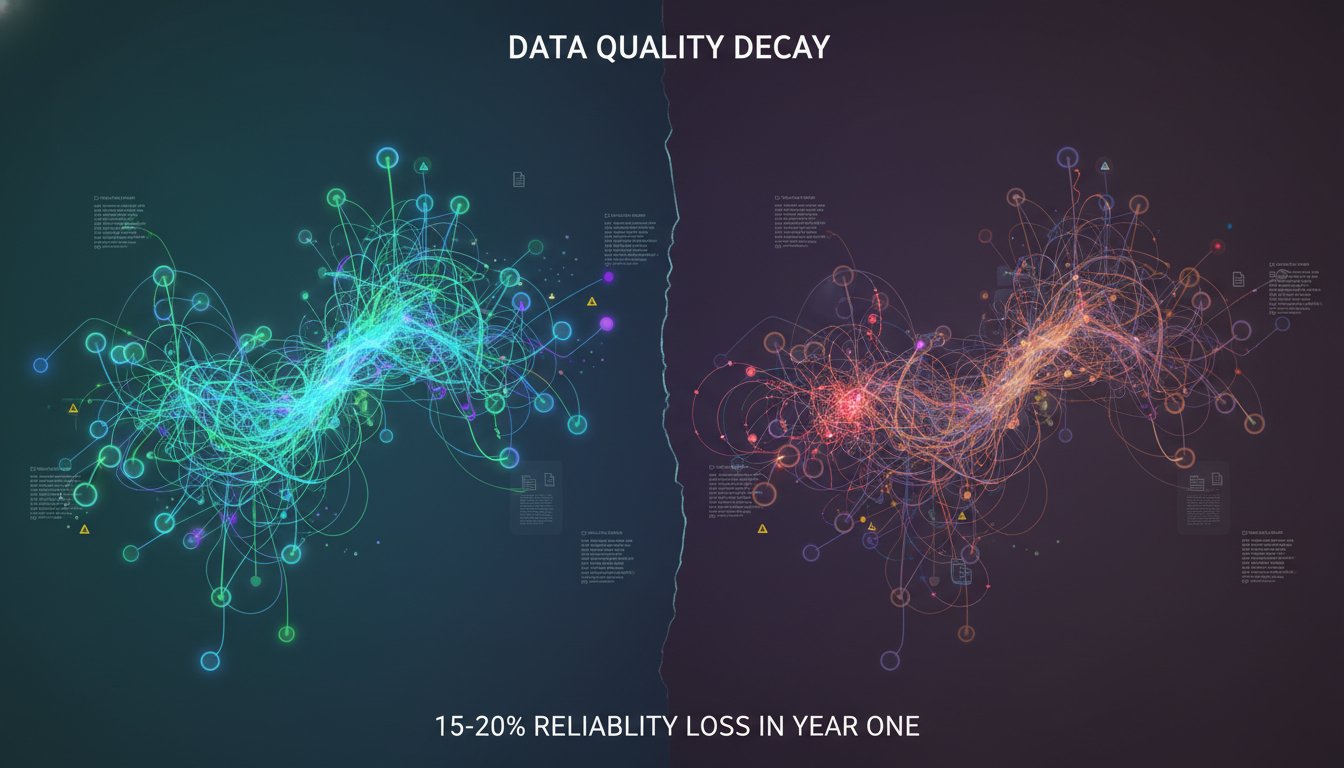
The challenge isn’t whether your data degrades—it always does. The challenge is that most enterprise teams build RAG systems as if the information layer is permanent. It isn’t. The average enterprise knowledge base loses approximately 15-20% reliability within the first year of RAG deployment without active maintenance protocols. That’s not speculation; that’s the pattern across financial services, healthcare, and SaaS organizations managing 500+ document knowledge bases.
This post reveals the specific data quality failure patterns that destroy RAG performance from the inside, and more importantly, the detection and remediation frameworks that prevent silent degradation before it impacts your users. You’ll understand why your existing monitoring dashboards miss this problem, what data metrics actually predict RAG failure, and the automated systems that catch decay before it compounds.
The Five Data Quality Failure Patterns That Kill RAG Systems
Pattern 1: Reference Rot and Link Decay
Your RAG system retrieves a document containing a link to “https://internal.company.com/policy/compliance-2024.pdf.” The retrieval worked perfectly. The document ranked high. The response was generated. But when the user clicks that link three days later, they get a 404. Or worse—they get redirected to an outdated version.
This is reference rot, and it compounds silently. A single broken link might not tank your system. But when 5% of your documents contain dead external references, and 8-12% contain outdated internal links, users lose trust in your RAG outputs faster than the system appears to be failing. They can’t tell if the information is wrong or just broken.
The mechanics: As your organization updates internal systems, URLs change. Compliance documents move to new repositories. Product documentation gets restructured. Your RAG knowledge base was built with snapshots of these links at launch time. Nobody is actively verifying that they still work. By month six, 15-20% of embedded references are broken or misdirected.
Enterprise impact: In a financial services client managing regulatory compliance documentation, broken compliance references caused a single support case to cascade into a 6-week audit when the user couldn’t access the referenced policy. The RAG system had retrieved the correct document; the user had followed the broken link and found outdated guidance instead.
Detection method: Implement link crawling and verification on a rolling basis. For external links, verify monthly. For internal links, verify on the same cadence as your internal system updates (usually weekly for enterprise environments). Flag documents with more than 5% broken references for review.
Pattern 2: Information Staleness Without Triggering Alerts
Your HR knowledge base contains a section on “2024 Benefits Election Deadlines.” The document is well-structured, ranks high for relevant queries, and gets retrieved frequently. Then 2024 ends. The document doesn’t disappear from your system—it’s still there, still retrievable, still being used. But it’s now directing employees to deadlines that have passed. The RAG system returns it because it matches the query semantically. The user reads information they believe is current and acts on it incorrectly.
This is information staleness, and it’s radically different from a completely incorrect document. The information was correct when it was written. It became incorrect when time passed. Your static knowledge base has no concept of temporal validity.
The mechanics: Documents become stale through multiple pathways. Seasonal information (benefits, budgets, compliance periods) expires predictably but nobody builds expiration logic into the knowledge base. Process changes happen; the old documents are archived but not removed from RAG indexing. Metrics and statistics age without being marked as “historical only.” Policy documents are updated, but the old versions remain indexed alongside the new ones, causing conflicting guidance.
Enterprise impact: A healthcare organization’s RAG system continued retrieving outdated clinical guidelines for 14 weeks after they were superseded. The new guidelines recommended different diagnostic approaches for a specific condition. The system had both versions indexed and was retrieving whichever ranked higher semantically. Fortunately, clinicians caught the discrepancy before patient impact, but the close call revealed a blind spot in their quality framework.
Detection method: Implement metadata tracking for document “validity windows.” For documents with temporal relevance (policies, guidelines, seasonal information), tag the expected validity end date and confidence decline rate. Query your system quarterly asking questions that specifically test outdated information. Measure how often old versions of updated documents are retrieved alongside new versions.
Pattern 3: Cumulative Metadata Inconsistency
Your documents have metadata tags: author, creation date, last updated, department, sensitivity level, category. When your RAG system was launched, metadata was clean and consistent. Six months of document additions later, consistency has degraded. Some documents have author fields; others don’t. Some have precise update dates; others show only the year. Sensitivity levels are marked inconsistently across departments (“confidential” vs “restricted” vs “private” when they mean similar things). Categories have drifted from your original taxonomy.
Individually, these inconsistencies seem minor. Collectively, they break the filtering and categorization logic that your RAG system depends on. A query for “public safety information” might retrieve confidential internal risk assessments because the sensitivity metadata wasn’t filled in. A search for “2025 updates” might miss critical documents because they’re tagged with only the year.
The mechanics: Metadata inconsistency accumulates through normal organizational processes. Different teams add documents using different templates. People who uploaded documents months ago used field conventions that don’t match current standards. External documents brought into your knowledge base have different metadata structures. Nobody has been enforcing metadata standards because the system seemed to work without them—until it didn’t.
Enterprise impact: A legal department using RAG for contract retrieval experienced a data privacy incident when metadata inconsistency caused privileged attorney-client communication documents to be retrieved in a general query. The documents were tagged with conflicting privilege levels because different teams had added them using different conventions. The system had no consistent way to filter privileged content.
Detection method: Audit metadata completeness and consistency monthly. Create a metadata quality score for each field: percentage of documents with populated values, percentage adhering to standard formats, percentage using consistent terminology. Set targets (e.g., 100% for sensitivity level, 95% for update dates) and track degradation. Build metadata validation into your document ingestion pipeline, not as a post-process cleanup.
Pattern 4: Duplicate Information Pollution
Your knowledge base contains two documents that cover essentially the same information. Maybe one is a newer version and the old one wasn’t removed. Maybe they’re documents from different departments covering the same topic with slightly different framing. Maybe they’re internal and external versions of the same guidance.
When your RAG system retrieves both, it presents conflicting information to the same query. The user receives contradictory guidance. The system appears to be hallucinating, but it’s not—it’s accurately retrieving inaccurate deduplicated content. The hallucination is a symptom of your knowledge base containing fundamentally conflicting information.
The mechanics: Duplicates accumulate through organizational consolidation (when teams merge, their knowledge bases often remain), through versioning (old and new documents coexist), and through incomplete document lifecycle management. Nobody has a process for identifying and consolidating redundant information. Embedding systems can find semantic similarity, but most enterprises don’t implement duplicate detection as part of their monitoring framework.
Enterprise impact: A customer support team’s RAG system began generating contradictory responses to refund policy questions. Investigation revealed that the knowledge base contained five different versions of the refund policy, each with slight variations. Customers were getting different information depending on which version the retrieval system ranked highest. The system wasn’t broken—the knowledge base was.
Detection method: Implement semantic duplicate detection quarterly. Use embedding similarity scores to identify documents with high semantic overlap (>0.85 similarity on random sample queries). Manually review candidates flagged by automated detection. Create a process for consolidating duplicates and maintaining a single source of truth. Track the percentage of queries returning semantically similar duplicates as a quality metric.
Pattern 5: The Schema Drift Problem
When you launched RAG, your documents had consistent structure: title, summary, content body, metadata fields in predictable locations. Over time, new documents arrive with different structures. Some have expanded metadata. Some eliminate fields you considered essential. Some have additional sections your original parsing logic didn’t expect. Your retrieval pipeline was built assuming consistent document structure. As structure drifts, extraction accuracy degrades silently.
Your embeddings might be capturing the full content or might be capturing malformed extractions. Your metadata filtering might work on 95% of documents but fail quietly on the rest. The system continues functioning, but the quality of what it’s retrieving shifts gradually beyond your detection threshold.
The mechanics: Document schema drift happens when you have multiple teams contributing documents without strong governance, when you integrate documents from external sources, or when you update your document templates without retrofitting existing documents. Unlike a complete format failure, gradual schema drift is invisible until you specifically look for it.
Enterprise impact: A financial services firm’s RAG system began returning lower-quality customer risk assessments. Investigation found that newer documents from an acquired company were using a different risk scoring schema than the original template. The retrieval system was capturing both, but the risk scores weren’t comparable. Users were seeing inconsistent risk ratings for similar customer profiles.
Detection method: Implement schema validation on document ingestion. Log schema exceptions and track their frequency. Quarterly, analyze the actual structure of documents in your system to see how much it has drifted from your defined schema. Set tolerance thresholds (e.g., “95% of documents must match primary schema”) and alert when drift exceeds them.
Building the Detection Framework: The Five-Layer Monitoring Stack
Now that you understand the failure patterns, here’s how enterprises prevent data quality decay from silencing RAG performance. This is the framework successful organizations use:
Layer 1: Ingestion-Time Quality Validation
Don’t wait for degradation to appear in production. Catch data quality issues when documents enter your system.
Implement pre-ingestion validation that checks:
– Metadata completeness (all required fields populated)
– Metadata format consistency (dates in ISO format, tags from approved taxonomy, sensitivity levels from standard set)
– Reference validity (links are accessible, internal references point to valid systems)
– Schema conformance (document structure matches expected format)
– Duplicate detection (semantic similarity check against existing documents)
Set rejection thresholds. If a document fails more than two validation categories, require manual review before indexing. If it fails critical fields, reject it outright. This seems harsh but is far cheaper than discovering bad data in production.
Layer 2: Temporal Validity Tracking
Build expiration logic into your knowledge base metadata. For every document, track:
– Validity start date (when this information became correct)
– Validity end date (when it becomes outdated or wrong)
– Confidence decay function (how certainty decreases over time)
– Update frequency (how often this type of information is typically refreshed)
For documents without defined end dates, apply category-based defaults. Compliance documents typically refresh annually. Product documentation refreshes quarterly. Clinical guidelines have specific supersession dates. Build this logic into your system.
When retrieving documents, factor temporal validity into ranking. An outdated document should rank lower than a current one covering the same topic. A document past its validity window should be flagged or excluded entirely unless the user specifically requests historical information.
Layer 3: Reference and Link Integrity Verification
Implement automated link checking on a rolling schedule:
– External links: verify monthly
– Internal links: verify weekly (or synced to your system update cadence)
– Cross-references between documents: verify quarterly
When links fail, mark documents for review rather than immediately removing them. An administrator should verify whether the link is truly broken or whether the target moved. Update the link if it moved. Remove the reference if the target no longer exists. Flag the document if more than 5% of its links are broken.
Build a reference health dashboard showing:
– Percentage of documents with verified working references
– Percentage of documents with broken references
– Percentage of documents with unverified references
– Trend line (are links getting more or less reliable?)
Layer 4: Duplicate and Conflict Detection
Run semantic duplicate detection quarterly. Use your embedding model to identify documents with high semantic overlap (>0.85 similarity). For each candidate pair:
– Determine if they’re truly duplicates or legitimately different perspectives
– If duplicates, consolidate to a single source
– If different perspectives, add metadata indicating the alternative viewpoint exists
– If conflicting guidance, escalate to a subject matter expert
Build a query-level conflict detection system. When a query returns multiple documents with contradictory information, flag this in the response metadata. Alert your operations team when conflict rates exceed a threshold (e.g., more than 2% of queries returning conflicting information).
Layer 5: Continuous Quality Scoring and Trending
Create a composite data quality score that combines:
– Metadata completeness (0-100): percentage of required fields populated across all documents
– Metadata consistency (0-100): percentage adhering to format standards
– Reference integrity (0-100): percentage of documents with working references
– Temporal validity (0-100): percentage of documents within current validity window
– Duplicate purity (0-100): 100 minus percentage of documents with semantic duplicates
Calculate this score weekly. Track trends monthly. When any component drops below your threshold, trigger alerts.
For example:
– Metadata completeness target: 98%
– Reference integrity target: 95%
– Temporal validity target: 97%
– Duplicate purity target: 99%
When reference integrity drops to 92%, your monitoring system alerts your team that link verification is needed. When temporal validity drops to 93%, your system flags that documents are aging and need review.
Implementation Roadmap: From Detection to Remediation
Building this framework doesn’t happen overnight. Here’s the realistic phased approach:
Phase 1: Baseline Assessment (Weeks 1-2)
Audit your current knowledge base:
– How many documents are in your system?
– What’s the current state of metadata completeness?
– What percentage of embedded references are actually working?
– How much semantic duplication exists?
– Are there known conflicting information sources?
Don’t try to fix everything. Just measure the baseline. You need this data to set realistic targets and track improvement.
Phase 2: Ingestion Governance (Weeks 3-6)
Implement validation on new document ingestion:
– Define required metadata fields
– Create standard formats for dates, categories, tags
– Build a document template that enforces structure
– Implement automated rejection for documents failing critical validation
Start small. Many teams begin with just metadata completeness checks. As your team gets comfortable, add reference validation, duplicate detection, and schema conformance.
Phase 3: Remediation of Existing Data (Weeks 7-12)
Now address the documents already in your system:
– Clean metadata systematically
– Fix or remove broken references
– Identify and consolidate duplicates
– Flag documents past their validity window
This is labor-intensive. Don’t try to fix everything at once. Start with your top 20% most-retrieved documents (they have the highest impact on user experience). Use automated tools where possible, but accept that some documents need manual review.
Phase 4: Continuous Monitoring (Ongoing)
Implement weekly quality scoring, monthly trend analysis, and quarterly deep-dive audits. Set alert thresholds. Build dashboards showing data quality metrics alongside retrieval performance metrics.
This is where most enterprises fail—they implement detection but then forget to actually monitor it. Assign ownership: someone on your team needs to be accountable for data quality metrics the same way someone is accountable for system uptime.
The ROI of Data Quality Discipline
This sounds like a lot of work. It is. But enterprises that implement these frameworks see measurable results:
Performance Improvements:
– Average retrieval accuracy improves 8-15% after data cleanup
– User satisfaction scores typically increase 12-18% within three months
– False positive rates (retrieving incorrect information) drop by 40-60%
Operational Benefits:
– Reduced incident response time (fewer support tickets about conflicting information)
– Lower total cost of ownership (preventing data rot is cheaper than fixing it)
– Better compliance posture (data governance becomes demonstrable)
Competitive Advantage:
– Enterprise customers trust RAG systems with demonstrable data quality frameworks
– Your team becomes proficient in data governance (a skillset that compounds in value)
– You develop the muscle memory for maintaining AI systems, not just building them
The Path Forward
Your RAG system’s performance doesn’t degrade because your LLM is broken or your infrastructure fails. It degrades because your information layer rots—silently, gradually, invisibly until users stop trusting the system.
The good news: this is completely preventable. By implementing the detection frameworks described here—starting with ingestion validation, moving through metadata governance, and establishing continuous monitoring—you transform data quality from an afterthought into a managed discipline.
Start with your baseline assessment. Understand where your knowledge base stands today. Then implement ingestion governance on new documents so the problem doesn’t get worse. Finally, systematically remediate your existing data, prioritizing your most-used documents.
Your users will notice the difference before your dashboards do. When your RAG system consistently retrieves current, verified, non-contradictory information—when links actually work and metadata actually makes sense—user trust returns. Performance stops degrading silently and starts improving measurably.
The question isn’t whether your knowledge base will decay. It will. The question is whether you’ll catch it before your users do. Start monitoring next week.