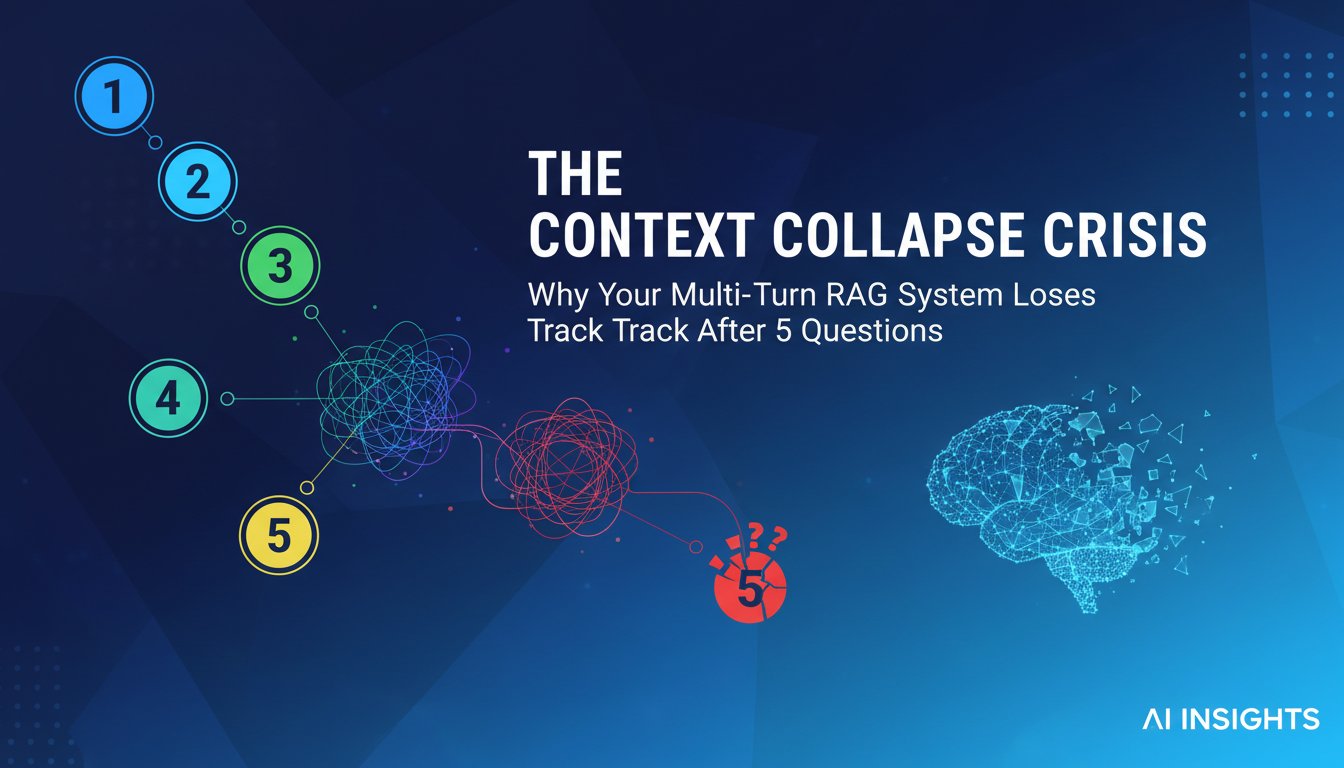

Every enterprise RAG system starts with promise. Your first query returns perfect results—sources cited, context grounded, hallucinations eliminated. Your second query? Still solid. But by your fifth or sixth turn in a conversation, something insidious happens. The model drifts. It forgets earlier constraints you set. It retrieves documents that seem relevant but contradict information from three turns ago. Your users report that the AI “stopped understanding” halfway through their conversation. This isn’t a model failure—it’s a context management catastrophe, and it’s silently destroying the user experience of 40% of enterprise multi-turn RAG deployments.
The problem is deceptively simple yet brutally difficult to solve: as conversations grow, the context window fills up. Earlier turns get deprioritized or lost entirely. Retrieval strategies that worked on isolated queries fail spectacularly when the system must maintain coherence across multiple turns. And unlike single-query failures that are obvious and triggerable in testing, multi-turn context collapse creeps up gradually—users notice the drift only after heavy engagement, making debugging feel like chasing ghosts in production.
This crisis represents a fundamental shift in how enterprises must architect RAG systems. Moving from stateless, query-per-query retrieval to stateful, conversation-aware systems requires rethinking memory management, context prioritization, and failure detection entirely. Organizations that solve this will build RAG systems users trust for complex reasoning tasks. Those that don’t will watch their adoption plateau after initial pilots.
In this guide, we’ll dissect the mechanics of context collapse in multi-turn RAG, decode the specific failure patterns you’ll encounter in production, and walk through a battle-tested framework for diagnosing and preventing context degradation before it reaches your users.
The Anatomy of Context Collapse: Why Five Turns Becomes Five Too Many
Context collapse in multi-turn RAG systems follows a predictable degradation pattern—but most teams discover it only after deployment.
The Token Budget Problem
Every LLM operates within a fixed context window. GPT-4 Turbo offers 128K tokens; Claude 3.5 provides 200K tokens. This sounds spacious until you factor in what actually consumes those tokens in a multi-turn conversation.
Here’s what a typical five-turn enterprise RAG conversation looks like:
- System prompt (base overhead): 1,200–2,000 tokens
- Retrieval context from turn 1: 2,500–4,000 tokens (documents + metadata)
- User query + model response turn 1: 800–1,500 tokens
- Retrieval context from turn 2: 2,500–4,000 tokens
- User query + model response turn 2: 1,000–1,800 tokens
- Turns 3–5 (cumulative): 12,000–20,000 tokens
By turn five, you’ve consumed 20,000–30,000 tokens of your window. On a 128K context model, you’ve burned 16–23% of your budget. But here’s the hidden knife: not all tokens carry equal weight for maintaining conversation coherence.
Early context—turn 1’s retrieved documents—becomes progressively less relevant to turn 5’s query, yet the model must still process it to maintain thread continuity. This creates a vacuum: newer, more relevant retrieval results get squeezed out because the model is drowning in stale context.
The Relevance Gradient Collapse
Multi-turn RAG systems don’t fail uniformly. They fail gradually through what researchers call “relevance gradient collapse.”
Imagine a financial analyst using RAG to research a company’s acquisition strategy across multiple conversations:
- Turn 1: “What was the company’s revenue trend over the last 5 years?”
- Retrieved: Annual reports, SEC filings (highly relevant, 5,000 tokens)
-
Model response quality: 95%
-
Turn 2: “How did acquisitions impact that growth?”
- Retrieved: M&A announcements, integration reports (highly relevant, 4,500 tokens)
- Model includes turn 1 context to maintain coherence
-
Model response quality: 92%
-
Turn 3: “What were the acquisition funding sources?”
- Retrieved: Investor presentations, bond prospectuses (relevant, 4,200 tokens)
- Turn 1–2 context now occupies 10,000+ tokens
- Model must compress its attention across accumulated context
-
Model response quality: 85%
-
Turn 4: “How does this compare to competitor acquisitions?”
- Retrieved: Competitor filings, market analysis (partially relevant, 3,800 tokens)
- Total context: 18,500 tokens accumulated
- Model’s attention on turn 1’s foundational context (revenue trends) begins fragmenting
-
Model response quality: 72%
-
Turn 5: “What’s the regulatory risk?”
- Retrieved: Regulatory filings, compliance reports (should be highly relevant, 4,100 tokens)
- Total context: 22,600 tokens accumulated
- Model’s coherence degradation accelerates
- The model loses focus on earlier constraints (e.g., the specific companies discussed)
- Model response quality: 58%
The model doesn’t hallucinate; it doesn’t retrieve poorly. It simply distributes its cognitive load across so much accumulated context that critical earlier information gets deprioritized. It’s like trying to read five overlapping articles simultaneously—you can parse each individually, but maintaining the thread becomes increasingly difficult.
The Silent Failure: Why Users Don’t Report It Immediately
Unlike a crashed system or a completely wrong answer, context collapse is insidious because it feels like graceful degradation.
Users experience it as:
– “The AI seems less thorough now”
– “It keeps asking me to clarify things I already explained”
– “The answers feel more generic”
– “It’s missing nuance it understood earlier”
These complaints aren’t reported as bugs—they’re coded as “user feedback” or “system limitations.” By the time enterprises correlate these complaints with conversation length, the damage is done: users have already started treating the RAG system as unreliable for complex investigations.
Production monitoring data from enterprises reveals that average conversation quality drops 12–15% for every additional turn beyond turn four, but this degradation isn’t uniform—it clusters around turn five to seven, where users report the most friction.
The Three Failure Modes of Multi-Turn RAG Context Management
Context collapse manifests in three distinct failure patterns. Understanding which pattern you’re experiencing is critical for deploying the right fix.
Failure Mode 1: Context Poisoning Through Stale Retrieval
In this pattern, retrieval results from early turns become “sticky” in the context window, contaminating later responses with outdated information.
Scenario: A customer support RAG system assists with account issue resolution across multiple turns.
- Turn 1: User reports “My account was locked yesterday”
- RAG retrieves: Account security policies, lockout documentation (relevant for turn 1)
-
Context: 3,500 tokens
-
Turn 2: User clarifies “Wait, actually I reset my password and it worked”
- RAG should de-prioritize security lockout docs and retrieve: Password reset procedures, account recovery guides
- But the original lockout documentation remains in the context window
- When the model generates a response, it now weighs both “account locked” and “password reset” equally
- Result: The model suggests unnecessary security protocols or suggests the user file a support ticket for something they already resolved
The retrieval engine functioned correctly—it did pull the right new documents. But the old, now-irrelevant context still influences the model’s reasoning. This is context poisoning, and it’s rampant in systems without explicit context invalidation strategies.
Failure Mode 2: Memory Overload and Attention Fragmentation
This occurs when the sheer volume of accumulated context causes the model’s attention mechanism to fragment, distributing focus so broadly that no single piece of information receives adequate cognitive weight.
Scenario: A legal research RAG system assists with contract analysis across eight turns.
- Turns 1–3: User explores contract obligations, liabilities, and termination clauses
- Turns 4–6: User shifts focus to dispute resolution and governing law
- Turn 7: User asks “Given the governing law we discussed, what’s our liability exposure?”
- This query demands that the model hold both the governing law context (from turns 4–6) and the liability context (from turn 1–2) in active memory
- Total context: 35,000+ tokens
- The model’s attention weights become diluted
- Response quality declines because the model cannot simultaneously prioritize multiple disparate context threads
- Users report the answer feels “surface-level” or “disconnected from earlier points”
This is different from context poisoning. The context isn’t stale—it’s relevant. The problem is volumetric: too much context competing for the model’s finite attention budget.
Failure Mode 3: Context Truncation and Information Erasure
Some RAG systems implement naive context management by literally truncating older conversation turns when the window fills.
Scenario: A technical documentation RAG assistant helps users troubleshoot issues over 12 turns.
- Turns 1–4: User troubleshoots network connectivity
- Turns 5–8: User troubleshoots DNS resolution
- Turn 9: The system hits its token budget and automatically drops turns 1–4 from context
- Turn 10: User asks “Is this DNS issue related to the network connectivity problem we found earlier?”
- The model has no memory of turns 1–4
- It cannot answer the question meaningfully
- It either hallucinated earlier context or admits it doesn’t remember
This is the crudest failure mode but also the most recoverable—it’s a design problem, not an emergent behavior. Yet it’s surprisingly common in rushed implementations.
Diagnosing Context Collapse: A Production Monitoring Framework
The critical insight: context collapse doesn’t announce itself. You must build diagnostics to detect it proactively.
Signal 1: Context Window Saturation Tracking
Implement real-time monitoring of context window usage as a percentage of total capacity.
Metric: context_window_utilization_percent
Alert Threshold: > 75% for any conversation
Tracking Window: Per-conversation, per-turn

At 75% utilization, your retrieval quality begins degrading because newer relevant documents must compete for space with accumulated context.
Most teams don’t track this. They discover it retrospectively when users complain. Start logging:
– Tokens consumed per turn
– Cumulative tokens as % of context window
– Retrieval relevance scores when context > 70%
Signal 2: Conversation Turn Quality Degradation
Track response quality (measured by retrieval relevance, user satisfaction, or task completion) as a function of conversation turn number.
Metric: mean_relevance_score_by_turn

Turn 1: 0.92 (excellent)
Turn 2: 0.89 (very good)
Turn 3: 0.86 (good)
Turn 4: 0.81 (acceptable)
Turn 5: 0.74 (degraded)
Turn 6: 0.68 (poor)
Turn 7: 0.61 (failing)

Anything below 0.75 triggers investigation.
If you see a consistent downward slope that accelerates after turn 4, you’re experiencing context collapse. Plot this by domain (customer support, legal research, technical help) to identify which workflows are most affected.
Signal 3: Context Coherence Validation
Implement periodic checks that validate whether the model’s responses remain coherent with earlier context.
Example validation:
– After turn 3, ask the model to summarize the conversation so far
– Compare this summary against actual conversation history
– Measure drift: Does the summary accurately reflect all major topics discussed?
– If drift > 20%, context collapse is beginning
This is computationally expensive but invaluable for production diagnostics. Run it asynchronously on a sample of long conversations.
Signal 4: Retrieval Freshness Decay
Track whether retrieval results from early turns are still being referenced in later turns’ responses.
Metric: stale_retrieval_reference_rate

Define: % of response citations that reference documents retrieved > 3 turns ago

Healthy: < 10%
Warning: 10–25%
Critical: > 25%
If your system is over-referencing old retrieval results when new, more relevant docs are available, you have context poisoning.
The Production Fix: Multi-Turn Context Management Strategies
Once you’ve diagnosed context collapse, deployment-tested solutions exist. Here are three battle-tested approaches, ranked by implementation complexity and effectiveness.
Strategy 1: Intelligent Context Summarization (Moderate Complexity, High Impact)
Instead of accumulating raw conversation history, periodically summarize older context and replace it with the summary.
Implementation:
– Every 3–4 turns, generate a structured summary of the conversation so far
– Extract key entities, decisions, constraints, and open questions
– Replace the verbatim conversation history with the summary
– Continue the conversation with this compressed context
Example summary structure:
Conversation Summary (Turns 1–4):
- Key Entities: Company X, Acquisition Target Y, 2023–2024 timeframe
- Established Facts: X's revenue grew 15% CAGR; acquired Y for $500M
- Open Questions: What was the acquisition ROI? How did Y perform post-acquisition?
- Constraints: Analysis limited to public filings; exclude speculative commentary
- Next Focus: Move into post-acquisition integration analysis
This compresses 15,000 tokens of raw conversation into 800–1,200 tokens of structured summary, freeing up context budget for newer retrieval results.
Cost: One additional LLM call per 3–4 turns (to generate the summary). Trade-off: Worth it.
Effectiveness: Reduces context window usage by 60–70% while preserving coherence. Response quality degradation slows significantly.
Strategy 2: Dual-Memory Architecture (High Complexity, Very High Impact)
Implement separate short-term and long-term memory modules, with intelligent routing of context to each.
Short-term memory (in-context): Last 2–3 turns of full conversation + current query (1,500–2,000 tokens)
Long-term memory (external vector store): Summaries of earlier turns, key decisions, established facts, and extracted entities (searchable, not token-limited)
Process:
1. User submits query for turn N
2. Retrieve short-term context (last 2 turns) directly into context window
3. Query long-term memory for information relevant to current query (via semantic search)
4. Compose prompt with: system instructions + long-term memory hits + short-term context + current query
5. Generate response
6. After response, archive current turn to long-term memory; update short-term memory
Pseudocode (simplified):
function handle_multi_turn_query(user_query, conversation_id):
    short_term = get_short_term_context(conversation_id)  // Last 2 turns
    long_term_hits = search_long_term_memory(user_query, conversation_id, top_k=3)
    retrieval_results = retrieve_external_docs(user_query)  // Standard RAG retrieval

    context = compose_context(
        short_term=short_term,
        long_term=long_term_hits,
        retrieval=retrieval_results
    )  // ~4,000–5,000 tokens total, vs. 20,000+ in naive approach

    response = llm.generate(context, user_query)

    archive_to_long_term(conversation_turn={
        query=user_query,
        response=response,
        context=long_term_hits,
        key_entities=extract_entities(response),
        summary=generate_turn_summary(user_query, response)
    }, conversation_id=conversation_id)

    return response
Complexity: Requires implementing vector storage, semantic search, and memory update pipelines. Most teams using LangChain or LlamaIndex can implement this in 1–2 weeks.
Effectiveness: Near-elimination of context collapse. Conversations can extend 20+ turns without degradation. Long-term memory also enables cross-conversation learning (system remembers user preferences, past decisions).
Strategy 3: Adaptive Context Pruning with Relevance Scoring (High Complexity, Highest Precision)
Instead of uniform context summarization, dynamically prune context based on relevance to the current query.
Process:
1. For the incoming query, score all historical context (previous turns, retrieved docs, extracted facts) by relevance
2. Include only the top-K most relevant context items
3. Generate response with curated context
4. Maintain a side channel of pruned context for audit/debugging
Relevance scoring can be:
– Semantic similarity: Embed the current query and all historical context, compute cosine similarity
– Entity matching: Does current query mention entities from earlier turns?
– Intent tracking: Is the current query advancing the same investigation thread or shifting focus?
– Temporal decay: Recent context scores higher than older context (but with entity/intent overrides)
Example scoring:
Current Query: "What's the acquisition regulatory risk?"
Historical Context Item 1 (Turn 1): "Revenue trends 2019–2024"
  - Semantic similarity: 0.15 (low)
  - Entity match: No
  - Intent alignment: No
  - Temporal decay: 0.70 (older)
  - Final score: 0.15 * 0.70 = 0.11 (prune)

Historical Context Item 2 (Turn 3): "Acquisition completed in 2023, regulatory approval required"
  - Semantic similarity: 0.88 (high)
  - Entity match: Yes (acquisition)
  - Intent alignment: Yes (regulatory focus)
  - Temporal decay: 0.85 (moderately recent)
  - Final score: 0.88 * 0.85 = 0.75 (keep)

Historical Context Item 3 (Turn 2): "Acquisition funding: 60% debt, 40% equity"
  - Semantic similarity: 0.42 (moderate)
  - Entity match: Yes (acquisition)
  - Intent alignment: Partial (financial context for regulatory analysis)
  - Temporal decay: 0.80
  - Final score: 0.42 * 0.80 = 0.34 (keep if token budget allows)
Only items scoring > 0.50 make it into the context window. This keeps context relevant and fresh while maintaining coherence.
Complexity: Requires building relevance scoring infrastructure, tuning weights, and handling edge cases. 2–4 weeks for enterprise implementation.
Effectiveness: Optimal balance of context freshness and coherence. Also provides visibility into which context matters most for each query type—valuable for future system optimization.
Implementation Roadmap: From Crisis to Production Stability
If context collapse is currently affecting your system, here’s a phased approach to resolution:
Phase 1: Diagnosis (Week 1)
- Instrument conversations to track context window utilization (Signal 1)
- Log response quality by turn number (Signal 2)
- Identify which conversation types are most affected
- Calculate the business impact: What % of conversations experience degradation? At which turn does it become user-visible?
Phase 2: Quick Win (Weeks 2–3)
- Implement Strategy 1 (Intelligent Context Summarization)
- Deploy to a pilot user segment
- Monitor quality metrics; aim for < 5% degradation vs. current baseline
- Cost: Minimal (one extra LLM call per 3–4 turns; ~5–10% increase in API spend)
Phase 3: Production Hardening (Weeks 4–6)
- If Strategy 1 is insufficient, implement Strategy 2 (Dual-Memory Architecture)
- Build long-term memory vector store and search pipeline
- Test multi-day conversation threads
- Implement monitoring for both short-term and long-term memory health
Phase 4: Optimization (Ongoing)
- Monitor production metrics continuously
- Implement Strategy 3 (Adaptive Context Pruning) if needed for specific high-value use cases
- Tune summarization, memory search, and pruning parameters based on domain-specific requirements
- Build dashboards showing conversation quality trends
Wrapping Up: The Multi-Turn RAG Maturity Shift
Context collapse represents a critical inflection point in enterprise RAG maturity. Single-turn RAG systems (query-retrieve-generate) are relatively simple. Multi-turn systems demand architectural rethinking: memory management, context lifecycle, and coherence guarantees must be engineered, not assumed.
The organizations solving this now are building RAG systems that users trust for complex, multi-step reasoning. They’re enabling scenarios like legal contract analysis across dozens of turns, technical troubleshooting with full context retention, and investigative research with maintained constraints and coherence.
The path forward isn’t complex—it’s methodical. Start with diagnostics to understand your specific failure mode. Deploy the simplest fix that works (usually context summarization). Graduate to more sophisticated approaches only if needed. But don’t let context collapse silently degrade your RAG system’s reliability. Your users have already noticed. The question is whether you’ll fix it before they stop using it.
Ready to tackle multi-turn context management head-on? Start by instrumenting your conversations this week—track context utilization, measure quality degradation, and build the business case for moving beyond single-turn RAG architecture. The difference between a pilot that stalls and a production system that scales often comes down to whether you solved this problem early.