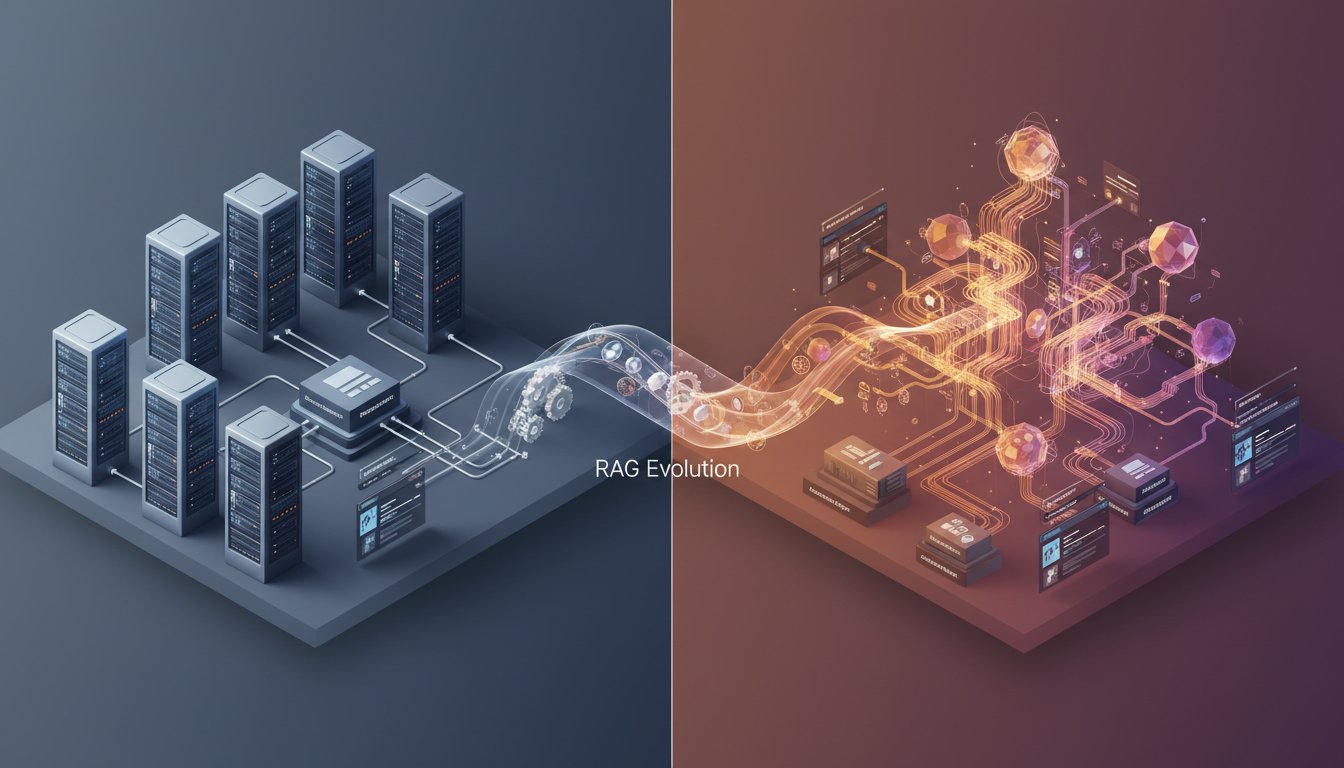

The narrative is everywhere: RAG is dead. Agentic systems are the future. Contextual memory has replaced static retrieval. But this binary framing misses the uncomfortable truth that enterprises are discovering right now—the transition to agentic RAG isn’t a one-way door, and the cost of being wrong about it can break your AI budget.
Over the past two weeks, we’ve watched a fascinating disconnect unfold in the RAG ecosystem. Henon launched what they’re calling a “zero-error RAG system,” IBM positioned agentic RAG as the “AI detective” model for enterprise workflows, and Databricks announced their Instructed Retriever as fundamentally superior to traditional retrieval approaches. Meanwhile, enterprises are asking a question nobody’s really answering: “If we’re migrating to agentic systems, what do we do with our existing RAG infrastructure?”
The honest answer? Most organizations shouldn’t migrate everything at once—and the ones that do are learning that lesson the hard way.
The Real Story Behind the “RAG is Dead” Narrative
When Medium published “RAG is DEAD” on January 10th, it captured something true about the direction of enterprise AI. Traditional static retrieval—where you embed documents, chunk them into predictable sizes, and query them through semantic search—is increasingly showing its limitations at scale. The problem isn’t retrieval itself; it’s that retrieval alone can’t handle the complexity enterprises need.
But here’s what gets lost in the headlines: the vast majority of enterprises deploying traditional RAG today haven’t even solved the foundational problems yet. They’re still wrestling with:
- Silent degradation: Systems performing well in testing but declining in production without triggering alarms
- Context pollution: Irrelevant retrieved documents drowning out signal with noise
- Scaling cliffs: Performance collapsing when vector databases exceed 10 million vectors
- Attribution gaps: No way to trace which source document generated which answer
These aren’t problems you solve by moving to agentic systems. These are problems you solve by understanding why your current RAG architecture is failing.
The Three Architecture Patterns Enterprise Teams Are Actually Using
Instead of a binary choice between traditional and agentic RAG, we’re seeing three distinct architectural patterns emerge in production enterprise environments:
1. The Optimized Traditional RAG (Still the Majority)
Companies like PDIQ (an AWS-based implementation) are proving that properly instrumented traditional RAG can still outperform agentic approaches for specific workloads. Their approach focuses on:
- Metadata-driven chunking: Instead of fixed-size chunks, they’re using domain-specific metadata to create semantically coherent retrieval units
- Instruction-based retrieval: Using Databricks’ Instructed Retriever pattern to add semantic context to queries before retrieval
- Observability-first design: Building monitoring into the retrieval pipeline using Braintrust or LangSmith from day one
The result? Higher resolution rates, reduced hallucinations, and—critically—40% reduction in inference costs compared to their previous agentic experiments.
This pattern works well when you have:
– Well-structured domain knowledge (financial documents, medical records, legal contracts)
– Clear retrieval intent (users know what type of information they need)
– Constrained query patterns (enterprise workflows tend to be repetitive)
2. The Hybrid Context Layer Approach
This is where we’re seeing the real innovation. Companies are adding a contextual memory layer between their traditional RAG and their language model, creating what amounts to a “lightweight agentic” system without the computational cost.
How it works:
– Initial retrieval happens through optimized traditional RAG
– A contextual memory layer (like persistent session state) maintains conversation context and learned patterns
– The LLM still makes final decisions, but with dramatically improved context
– If context degradation is detected, the system can trigger deeper agentic reasoning as needed
VentureBeat’s “Six Data Shifts That Will Shape Enterprise AI in 2026” identified contextual memory as essential, and we’re seeing why: it’s the bridge between traditional static retrieval and full agentic autonomy. It gives you the benefits of adaptive systems without the computational explosion of fully autonomous agents.
3. The Full Agentic Stack (High Complexity, Higher Cost)
When enterprises do go full agentic—with autonomous reasoning loops, multi-step retrieval refinement, and contextual reasoning—they’re seeing both remarkable improvements and significant hidden costs:
Performance gains:
– Complex enterprise queries that traditional RAG fails on (multi-table reasoning, cross-domain synthesis)
– Automatic error correction and refinement cycles
– Real-time adaptation to new information
The cost reality:
– Token usage can increase 3-5x compared to single-pass traditional RAG
– Agentic reasoning loops add 200-500ms latency per query
– Observability becomes dramatically more complex (you’re now tracking agent decision trees, not just retrieval metrics)
IBM’s agentic RAG event and the subsequent industry adoption show this works—but it’s not a drop-in replacement for traditional RAG. It’s a different class of system with different tradeoffs.
The Silent Scaling Crisis Nobody’s Talking About
Here’s where the conversation gets uncomfortable: both traditional and agentic RAG systems hit a hard wall when vector databases scale beyond a certain threshold.
Qdrant’s benchmark data shows significant performance degradation at scale, with 41.47 queries per second (QPS) at 99% recall at 50 million vectors. That sounds fine until you realize that’s the theoretical maximum—most production systems operate at 70-80% recall to maintain acceptable latency.
When enterprises ask, “Should we switch to agentic RAG?” what they’re really asking is, “How do we avoid hitting this scaling cliff?” And the answer isn’t always “go agentic.”
AWS’s recent announcement about 90% cost reduction using S3 Vector Service points to a different solution entirely: rethinking the storage and retrieval architecture rather than making it smarter. By moving from traditional vector databases to object storage with vector indexing, enterprises can:
- Store unlimited vectors without performance degradation
- Pay only for compute resources during queries
- Maintain flexibility to switch retrieval strategies without refactoring
This architectural shift is often overlooked because it’s not as dramatic as “AI detectives” and “autonomous reasoning.” But it’s fixing the actual problem most enterprises face: their data is growing faster than their retrieval systems can handle.
The Observability Gap That Makes All These Choices Harder
Whatever architecture you choose—traditional, hybrid, or agentic—you’ll quickly discover that observability tools haven’t kept pace with architectural complexity.
We’ve highlighted this before, but it bears repeating now: you can’t make informed architectural decisions without visibility into what’s actually happening in production.
The latest generation of observability tools addresses this:
- Braintrust offers production-to-test conversion and CI/CD quality gates, letting you compare architectural approaches using real traffic
- LangSmith provides LLM-specific observability for LangChain workflows, crucial for understanding agentic decision loops
- Arize Phoenix enables framework-agnostic OpenTelemetry-based monitoring, giving you consistent visibility across traditional and agentic systems
- Langfuse adds session replay and trace data, essential for debugging complex retrieval failures
The key insight: don’t choose your architecture based on marketing narratives. Choose it based on instrumented comparisons of how different approaches perform on your actual workloads.
The Decision Framework Enterprise Teams Are Actually Using
After analyzing dozens of enterprise RAG implementations, a clear decision pattern has emerged. Teams should ask themselves these questions in order:
Question 1: Do you have foundational retrieval problems?
If your traditional RAG is failing because of poor chunking, weak embeddings, or missing metadata—fix that first. Most teams spend 3-6 months solving foundational problems and discover their original architecture is suddenly sufficient.
Question 2: Are your retrieval patterns complex?
Do users need multi-step reasoning? Cross-domain synthesis? Iterative refinement? If yes, a hybrid context layer might be sufficient. If you have true autonomous decision-making requirements, then consider full agentic systems.
Question 3: What’s your retrieval scale?
Beyond 10-20 million vectors, traditional vector databases start showing performance degradation. At that point, consider architectural alternatives (object storage, specialized databases) before assuming agentic systems are the answer.
Question 4: What’s your observability maturity?
If you don’t have production monitoring in place, don’t migrate to agentic systems. The complexity multiplies, and you’ll be flying blind.
Following this framework, most enterprises end up in one of two camps:
1. Deeply optimized traditional RAG with metadata-driven retrieval and observability (60-70% of enterprise teams)
2. Hybrid context layers for specific high-complexity workloads (25-30%)
3. Full agentic systems for autonomous decision-making requirements (5-10%)
Notice what this distribution says: the market narrative about RAG being “dead” and agentic systems being inevitable doesn’t match the reality of what’s working in production.
What This Means for Your Architecture Roadmap
The uncomfortable truth is that the “RAG is dead” narrative is partially right—but not in the way it’s being presented. Traditional static retrieval is becoming less sufficient for enterprise workloads. But the solution isn’t one-size-fits-all. It’s architectural clarity.
Henon’s zero-error RAG system, Databricks’ Instructed Retriever, and IBM’s agentic RAG event all point to the same direction: retrieval strategies are becoming more sophisticated, more context-aware, and more integrated with reasoning systems.
But they’re not all arriving at the same destination.
The teams winning with RAG in 2026 aren’t the ones adopting the latest architecture. They’re the ones who:
- Measure before migrating: Using observability tools to compare approaches on real workloads
- Evolve strategically: Moving from traditional → hybrid → agentic only when justified by data
- Optimize ruthlessly: Focusing on retrieval quality, metadata richness, and chunking strategy before assuming more complexity is the answer
- Plan for scale: Considering vector database limitations and alternative storage approaches in their roadmap
The RAG landscape in 2026 isn’t about choosing the “right” architecture. It’s about choosing the architecture that’s right for your enterprise’s specific retrieval challenges—and having the observability to know when to evolve it.
If you’re currently running traditional RAG and hearing the “RAG is dead” narrative, the question isn’t whether to move to agentic systems. It’s whether your current system is actually optimized, whether you have visibility into its production performance, and whether the complexity of agentic reasoning is justified by your actual use cases.
For most enterprises, the answer to that last question is still no. But the architectural tools to evolve when the answer becomes yes are now available. Use them strategically, and you’ll avoid the costly migrations that other teams are learning from the hard way.