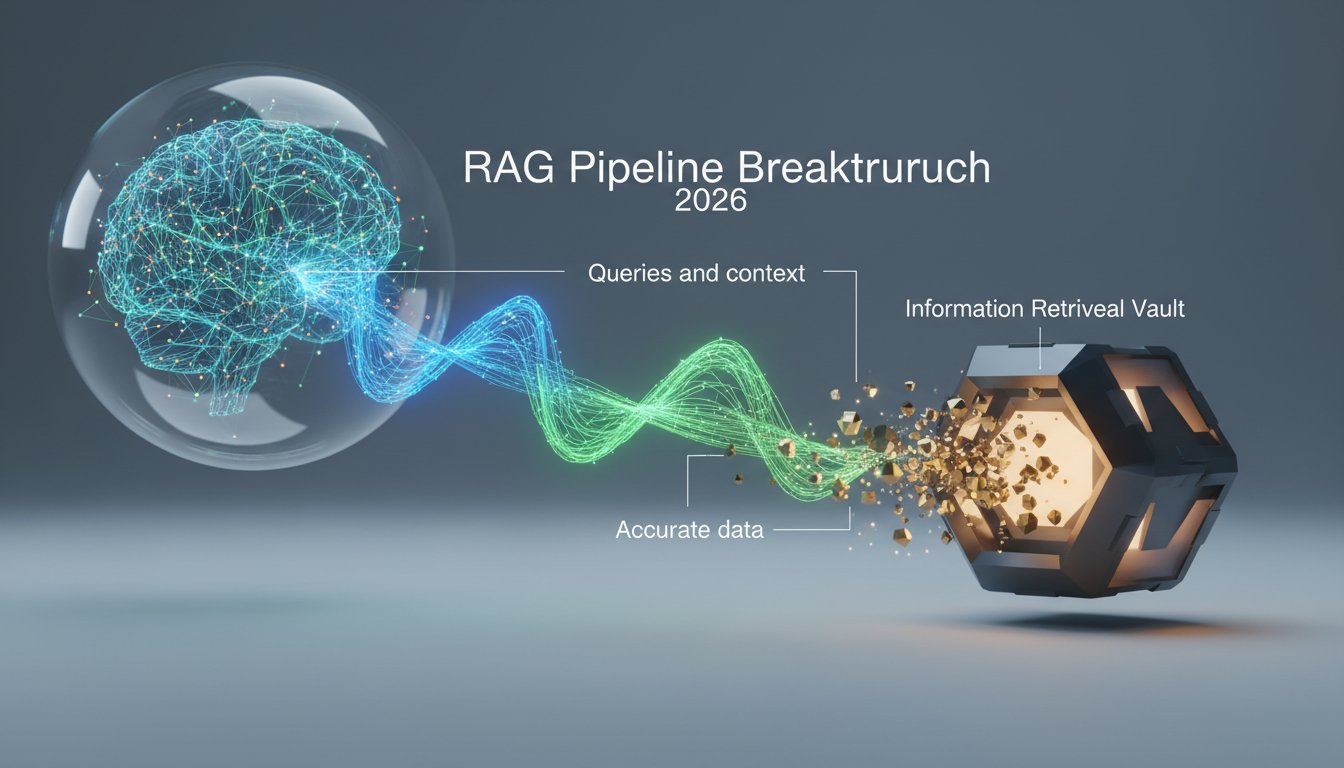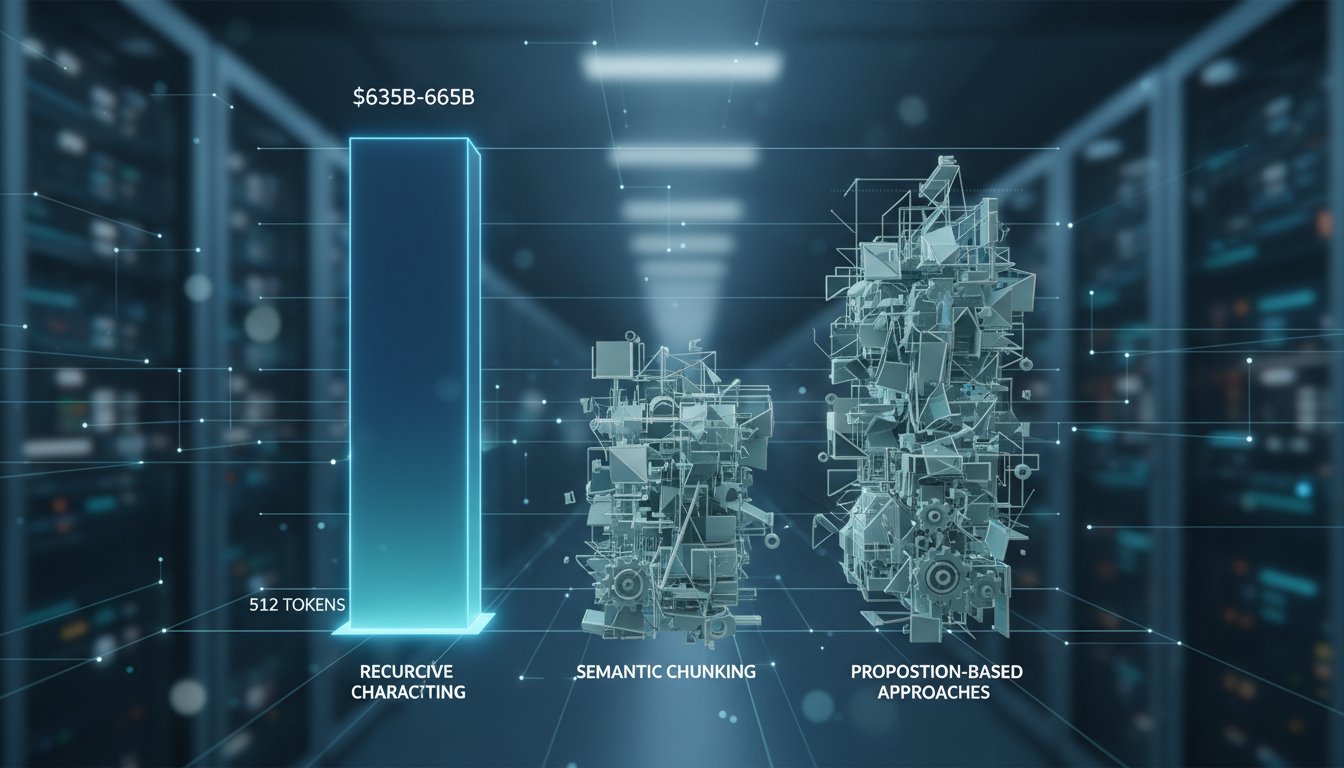

When FloTorch released their comprehensive RAG benchmark study in February 2026, the results sent shockwaves through the enterprise AI community. After testing seven different chunking strategies across thousands of academic papers, the winner wasn’t the sophisticated semantic chunking method powered by advanced embeddings. It wasn’t the proposition-based approach using LLMs to create atomic fragments. The champion was something far simpler: recursive character splitting at 512 tokens.
This finding arrives at a critical moment. With Microsoft, Google, Meta, and Amazon committing a staggering $635-665 billion to AI infrastructure in 2026—the largest technology investment in history—enterprises are rushing to deploy production-grade RAG systems. Yet the gap between infrastructure spending and actual system performance has never been wider. While cloud providers race to build GPU clusters and expand data centers, the most impactful performance gains are coming from fundamental architectural decisions that cost nothing to implement.
The implications extend far beyond chunking strategies. As the vector database market grows at 22.3% CAGR toward a projected $15.1 billion by 2034, enterprises face a paradox: more sophisticated tools don’t always deliver better results. Understanding which complexity adds value—and which creates expensive overhead—has become the defining challenge of enterprise RAG deployments in 2026.
The Benchmark That Changed Everything
FloTorch’s February 2026 study compared seven chunking strategies using a rigorous methodology: equal context budgets, consistent retrieval methods, and standardized evaluation metrics across academic papers. The results revealed a clear performance hierarchy that contradicts conventional wisdom about AI-driven optimization.
Recursive character splitting at 512 tokens achieved the highest answer accuracy and retrieval F1 scores, closely followed by fixed-size 512-token chunks. These straightforward methods outperformed semantic chunking—which uses embedding models to identify natural boundaries—by significant margins. Most surprisingly, proposition-based chunking, which employs LLMs to decompose documents into atomic facts, ranked among the worst performers.
The reason illuminates a fundamental truth about RAG architectures: smaller fragments created by semantic and proposition methods dilute accuracy and waste retrieval focus. When your system retrieves 20 tiny propositions instead of 5 coherent 512-token chunks, you’re not improving context quality—you’re fragmenting it. Each proposition carries less contextual information, forcing the LLM to reconstruct meaning from scattered pieces rather than working with substantive passages.
This matters because chunking represents one of the earliest decision points in RAG pipeline design, yet it’s often treated as a solved problem. Teams default to semantic chunking because it sounds sophisticated, or they implement proposition-based methods because research papers suggest theoretical advantages. The FloTorch benchmark proves that simpler approaches not only perform better—they’re also dramatically cheaper to implement and maintain.
The Hidden Cost Structure of RAG Complexity
The performance paradox extends directly into cost economics. According to LinkedIn infrastructure analysis published in early 2026, the most significant cost driver in RAG deployments isn’t the LLM API calls or the vector database storage—it’s maintaining memory indices in RAM to achieve sub-50ms query times. This infrastructure requirement scales with the number of vectors, not their sophistication.
Semantic and proposition-based chunking create 3-5x more vectors than recursive splitting for the same corpus. A 10,000-document knowledge base that generates 50,000 chunks with 512-token recursive splitting might produce 250,000 proposition fragments. Each fragment requires embedding (tokenization costs), storage (vector database fees), and indexing (RAM infrastructure). The cost multiplier compounds at every layer.
Progress Software’s cost efficiency analysis reveals that model selection creates similar multipliers. Amazon Nova offerings delivered 65.26% lower costs than GPT-4o with only marginal accuracy differences in RAG applications. Yet many enterprises default to flagship models because they assume higher capability equals better RAG performance. The benchmark data tells a different story: retrieval quality and re-ranking methods matter far more than incremental LLM improvements.
The vector database decision amplifies these dynamics. Pinecone’s serverless offering charges $0.33/GB/month for storage plus per-operation fees. Weaviate Cloud runs $0.095 per 1M vector dimensions. Milvus through Zilliz Cloud costs $0.15/CU/hour. For a system with 250,000 proposition-based chunks versus 50,000 recursive chunks, the 5x vector count translates directly to 5x storage and indexing costs before you consider query volume.
Self-hosting introduces different economics. A Qdrant deployment on AWS using r6g.xlarge instances costs approximately $150/month for compute, $10/month for EBS storage, plus an estimated $500/month in DevOps time for maintenance. These fixed costs favor self-hosting at scale—industry analysis suggests the breakeven point arrives around 80-100 million queries monthly. Below that threshold, managed services remain more cost-effective despite higher per-query fees.
Where Complexity Delivers Value: The Re-Ranking Revolution
If chunking strategies favor simplicity, re-ranking represents the opposite pattern: investment in sophisticated methods delivers outsized returns. The FloTorch study identified re-ranking as the single largest accuracy improvement opportunity, with cross-encoder approaches boosting precision by 18-42%. This isn’t marginal optimization—it’s the difference between a RAG system that occasionally hallucinates and one that consistently delivers trustworthy results.
Re-ranking works by taking the initial retrieval results—say, 20 chunks returned by vector similarity search—and applying a more computationally expensive model to reorder them by true relevance. Cross-encoders evaluate query-chunk pairs jointly rather than independently, capturing nuances that embedding similarity misses. The cost is higher inference time and additional API calls, but the accuracy gains justify the investment.
Hybrid retrieval methods show similar value-for-complexity returns. Integrating dense embeddings with keyword matching (BM25) produced 20-40% higher retrieval recall compared to dense search alone in enterprise deployments. The implementation requires maintaining both vector indices and inverted indices, adding infrastructure complexity. Yet the performance improvement—especially for precise terminology, acronyms, and domain-specific jargon—makes hybrid retrieval nearly mandatory for enterprise knowledge bases.
Semantic chunking enhanced with metadata filtering demonstrated 60% accuracy in specialized contexts, significantly outperforming semantic chunking alone. The pattern is clear: complexity adds value when it enhances retrieval precision and re-ranking, not when it fragments documents into smaller pieces. The architecture should invest computational resources where they improve the signal-to-noise ratio of retrieved context, not in creating more vectors to search through.
The Infrastructure Spending Paradox
The $635-665 billion AI infrastructure commitment from tech giants creates a strange dynamic for enterprise RAG builders. On one hand, this spending will improve infrastructure accessibility—more GPU availability, better vector database performance, lower latency for embedding models. Cloud providers are competing to offer RAG-optimized services, which should drive down costs and improve developer experience.
On the other hand, the spending reveals the true complexity and cost of production AI systems at scale. When Amazon commits $200 billion primarily to AWS infrastructure buildout, when Alphabet doubles its 2025 spending to reach $185 billion, when Meta increases capex to $115-135 billion—these aren’t investments in making AI cheaper for end users. They’re investments in capturing market share in an infrastructure war.
For enterprise RAG teams, this creates pressure from both directions. Leadership sees massive infrastructure spending and assumes RAG deployment should be straightforward—after all, the tech giants are building all this capacity. Meanwhile, the actual cost of production RAG systems runs 3x initial budgets according to developer reports on Reddit, driven by hidden tokenization expenses, vector database synchronization overhead, and the DevOps burden of maintaining complex pipelines.
The talent dimension amplifies the challenge. When Meta acquires individual AI researchers with compensation packages reportedly reaching $1.5 billion (as with Thinking Machines Lab co-founder Andrew Tulloch), it signals an AI talent war that trickles down to every enterprise team. Building internal RAG expertise becomes more expensive as cloud providers and AI vendors compete for the same specialist pool. The build-versus-buy decision tilts toward managed services and platforms, even when self-hosting might offer better economics at scale.
The Gartner Warning: Why 30% of GenAI Projects Will Be Abandoned
Gartner’s prediction that 30% of generative AI projects will be abandoned by end of 2025 provides crucial context for the performance paradox. The primary culprits aren’t technical limitations—they’re cost overruns and data quality issues. Separately, Gartner warns that 60% of AI projects are at risk by 2026 due to lack of AI-ready data. These statistics frame the chunking benchmark results in strategic terms.
Projects fail when complexity exceeds the team’s ability to manage it effectively. Proposition-based chunking sounds appealing in architecture reviews, but implementing it requires LLM calls for every document, creating immediate cost and latency overhead. Maintaining the resulting 5x larger vector database requires infrastructure expertise many teams lack. When the system underperforms simpler alternatives—as FloTorch’s benchmark demonstrates—the project loses credibility with stakeholders.
Data quality issues compound when chunking strategies fragment context. If your source documents contain outdated information, inconsistent terminology, or structural problems, semantic chunking won’t fix them—it will amplify them by creating more vectors carrying the same flaws. The 60% of projects at risk from data readiness problems aren’t struggling because they chose the wrong vector database. They’re struggling because they deployed complex RAG architectures on top of data foundations that weren’t prepared for retrieval-based systems.
The path to the surviving 70% runs through architectural decisions that match complexity to capability. Start with recursive character splitting at 512 tokens. Implement hybrid retrieval with BM25 keyword matching alongside dense vectors. Invest in cross-encoder re-ranking to boost precision. Choose cost-effective base models like Amazon Nova unless specific use cases demand GPT-4-class capabilities. These decisions won’t generate impressive architecture diagrams, but they’ll generate working systems that stay within budget and deliver measurable value.
Decision Framework: Matching RAG Complexity to Enterprise Reality
Enterprise RAG teams in 2026 need a framework for evaluating where to invest in sophisticated methods and where to choose simplicity. The benchmark data and cost analysis point to clear principles.
Favor simplicity in document processing. Use recursive character splitting or fixed-size chunking at 512 tokens unless you have specific evidence that your corpus benefits from semantic boundaries. The performance data doesn’t support the complexity overhead of embedding-based chunking for most applications. Save the sophisticated processing for later pipeline stages.
Invest in retrieval quality. Hybrid search combining dense and sparse methods should be standard, not optional. The 20-40% recall improvement justifies the additional infrastructure complexity. Metadata filtering and structured data integration enhance precision without fragmenting context. These investments improve the quality of what reaches the LLM, which directly impacts output reliability.
Make re-ranking non-negotiable. The 18-42% precision improvement from cross-encoder re-ranking represents the highest-leverage optimization in the entire RAG pipeline. This is where computational investment delivers measurable returns. Budget for re-ranking infrastructure and API costs from day one—retrofitting it later becomes exponentially harder.
Choose models based on total cost of ownership. Amazon Nova’s 65% cost reduction compared to GPT-4o matters more than marginal capability differences for most RAG applications. The retrieval pipeline determines output quality far more than incremental LLM improvements. Reserve expensive flagship models for tasks that genuinely require their capabilities, not as defaults.
Evaluate vector databases against actual usage patterns. Self-hosting makes economic sense around 80-100 million queries monthly, but only if you have DevOps capacity to maintain the infrastructure. Below that threshold, managed services like Pinecone, Weaviate, or Zilliz Cloud offer better economics despite higher per-query costs. Above it, Qdrant or Milvus self-hosted deployments can reduce expenses significantly.
Plan for data quality before deployment. The Gartner warnings about data readiness aren’t theoretical—they’re the primary reason RAG projects fail. Invest in data cleanup, standardization, and metadata enrichment before optimizing chunking strategies. No architectural sophistication compensates for poor source data quality.
The 2026 Reality: Infrastructure Abundance Meets Architectural Discipline
The vector database market’s 22.3% CAGR growth through 2034 signals increasing enterprise adoption of RAG systems. The $665 billion infrastructure spending by tech giants will make advanced tools more accessible. Yet the FloTorch benchmark reveals that success in 2026 depends less on accessing sophisticated capabilities and more on deploying them strategically.
Recursive character splitting outperforming semantic chunking isn’t a call to abandon AI-driven optimization—it’s evidence that optimization must target the right pipeline stages. Complexity in document fragmentation reduces performance and increases costs. Complexity in retrieval precision and re-ranking delivers measurable value. The winning architecture invests computational resources where they improve signal quality, not where they multiply infrastructure overhead.
For enterprise teams navigating the gap between infrastructure hype and production reality, the message is clear: simpler chunking strategies, hybrid retrieval methods, aggressive re-ranking, and cost-effective model selection form the foundation of successful RAG deployments. These aren’t compromises forced by budget constraints—they’re architectures validated by benchmark data and real-world cost analysis.
As the AI infrastructure buildout continues through 2026 and beyond, the enterprises that thrive will be those that match architectural complexity to actual performance gains. The tools are becoming more powerful and more accessible. The challenge is knowing which tools to use, where to use them, and—perhaps most importantly—when simpler approaches deliver better results. The FloTorch benchmark provides a roadmap: start simple, invest in retrieval quality, make re-ranking non-negotiable, and let performance data guide your complexity decisions.
The $665 billion infrastructure investment creates opportunity, but opportunity without architectural discipline leads to the 30% abandonment rate Gartner predicts. The enterprises that survive and thrive will be those that recognize the performance paradox: in 2026’s RAG landscape, sophistication without strategy is just expensive noise. The winning move is matching the right complexity to the right problems, informed by benchmark data rather than architectural aesthetics. That’s the path from experimental RAG to production systems that deliver measurable value within sustainable budgets.