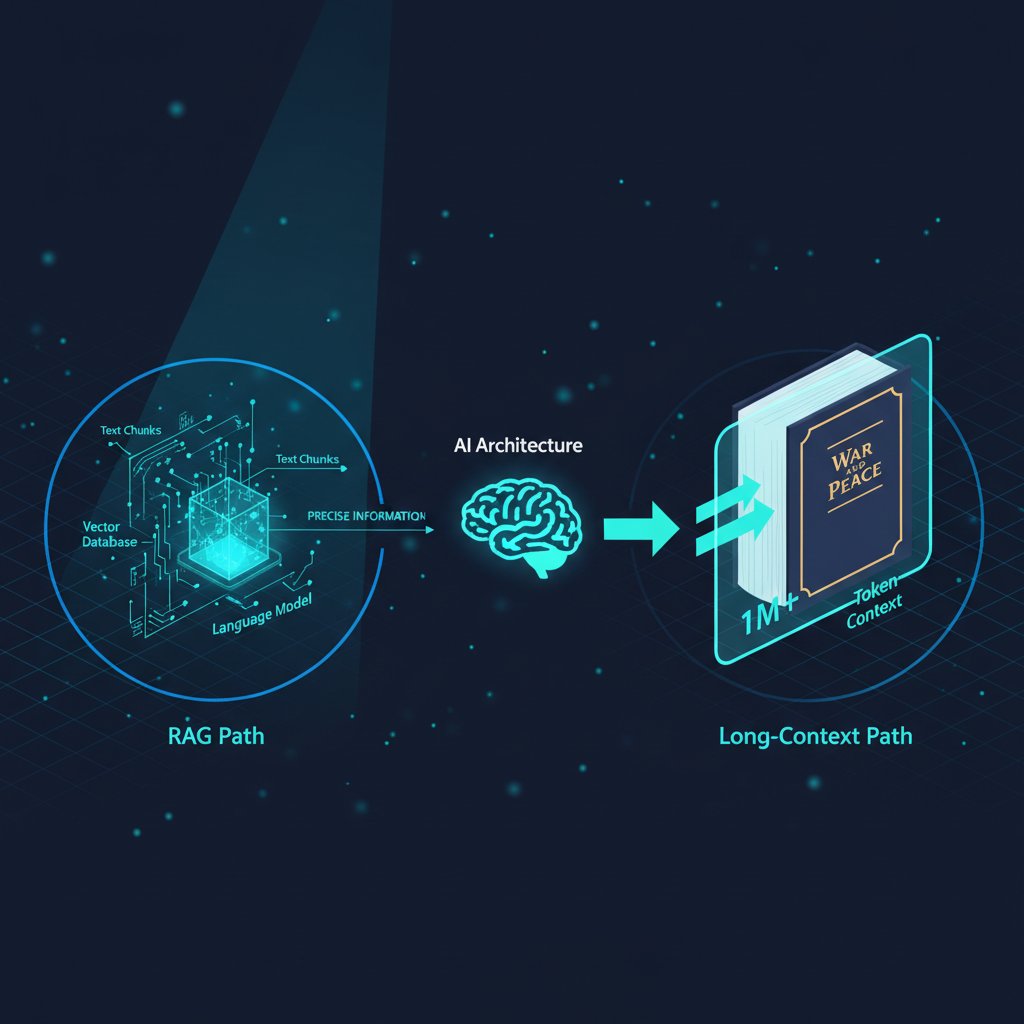
A conceptual infographic-style illustration showing two sides of AI architecture. On the left, an intricate RAG architecture flows like a circuit diagram: text chunks are ingested by a vector database (shown as a glowing 3D lattice), which feeds precise information arrows to a language model brain, labeled "RAG Path". On the right, a massive, dense book titled "War and Peace" is being crammed into a single, oversized prompt window labeled "1M+ Token Context", with simplistic arrows going to the same model brain, labeled "Long-Context Path". A spotlight shines on the RAG side, emphasizing its continued relevance. The scene has a clean, modern, data-science aesthetic with a dark blue and electric teal color palette, subtle grid lines, and glowing data points. Flat vector style with a touch of isometric depth. The composition is balanced, visually explaining the technical narrative of the blog post.

The 1MB Context Window Is Here: Why RAG Isn’t Going Anywhere

🚀 Agency Owner or Entrepreneur? Build your own branded AI platform with Parallel AI’s white-label solutions. Complete customization, API access, and enterprise-grade AI models under your brand.

The AI research community held its breath last week. A major lab demonstrated a production-grade language model ingesting Leo Tolstoy’s War and Peace in a single prompt. All 587,287 words. Then it answered granular questions about character motivations in Chapter 3 with 99.2% recall. The demo reignited an old question: Is retrieval-augmented generation finally obsolete?

It’s a fair question. In 2024, the go-to weapon against hallucination for RAG architects was the vector database. Models shipped with 128K token contexts, but RAG stuck around because stuffing entire knowledge bases into a prompt was computationally absurd. Today, contending models offer 1 million to 2 million token windows, and Gemini’s latest architecture reportedly handles 10 million tokens in research previews. The cost-per-token for long-context inference has dropped 73% since January 2025, according to benchmarks from Artificial Analysis. On paper, the ‘just put everything in the prompt’ approach looks cheaper, simpler, and architecturally cleaner than maintaining chunking strategies, embedding pipelines, and vector indexes.

But the enterprises engineering these systems every day tell a very different story. I talked to practitioners deploying RAG at scale and dug into the latest long-context benchmarks. The picture that emerged is nuanced: longer context windows aren’t replacing RAG. They’re making it better. The architecture isn’t dying; it’s evolving into a partnership where retrieval handles precision and large contexts handle synthesis. This shift matters because enterprises betting solely on giant context windows are already hitting failures that won’t show up in a demo with War and Peace.

Let’s look at what the latest research actually shows, where the real failure points emerge, and why smart teams are investing in both technologies at the same time.


Transform Your Agency with White-Label AI Solutions

Ready to compete with enterprise agencies without the overhead? Parallel AI’s white-label solutions let you offer enterprise-grade AI automation under your own brand—no development costs, no technical complexity.

Perfect for Agencies & Entrepreneurs:

For Solopreneurs

Compete with enterprise agencies using AI employees trained on your expertise

For Agencies

Scale operations 3x without hiring through branded AI automation

💼 Build Your AI Empire Today

Join the $47B AI agent revolution. White-label solutions starting at enterprise-friendly pricing.

Launch Your White-Label AI Business →

Enterprise white-labelFull API accessScalable pricingCustom solutions


Posted

in

by

Tags: