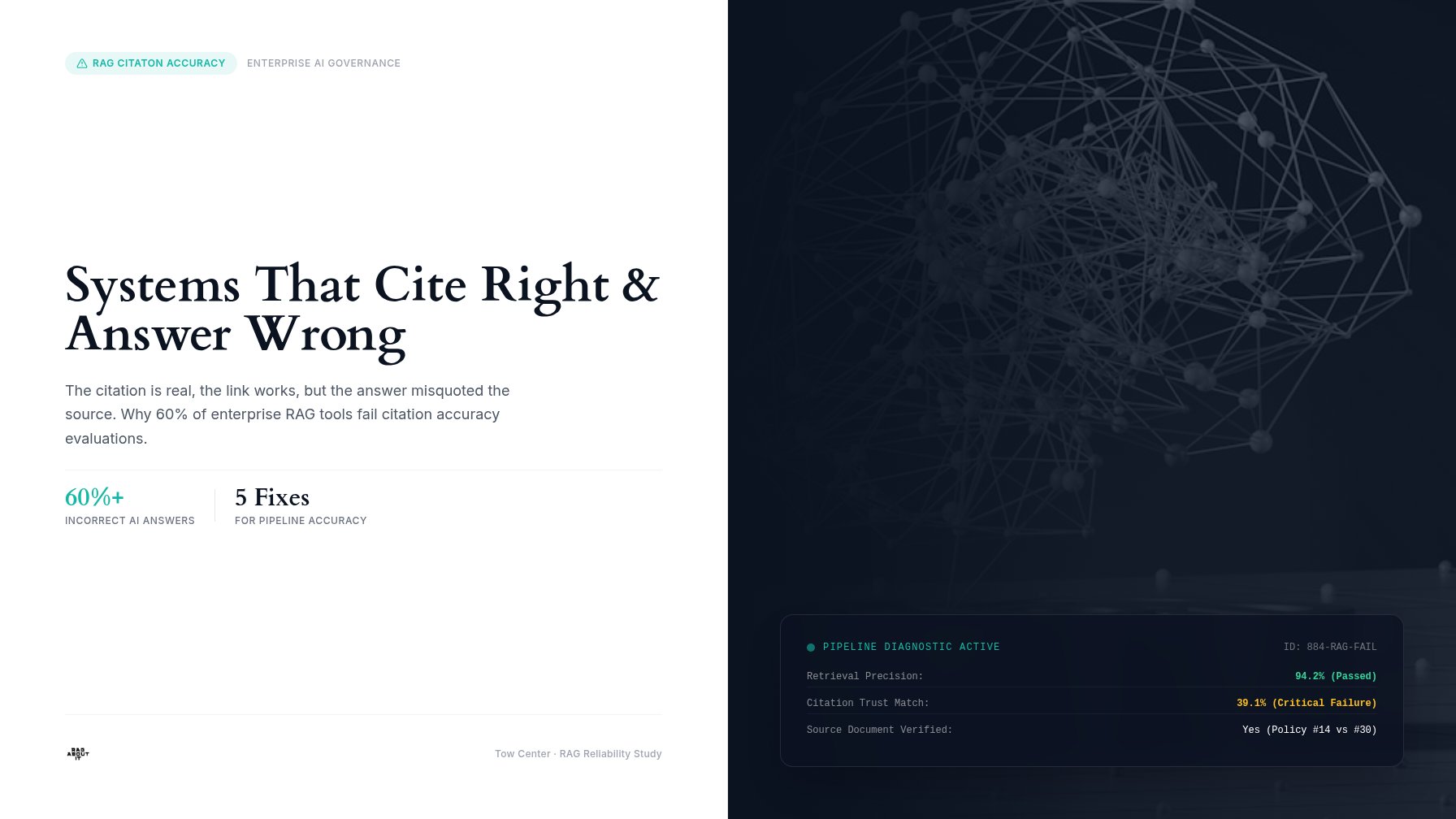

Picture the demo that sank a team’s confidence in its own eval suite. The dashboard was green everywhere. Recall@10 sat at 94%, precision at 88%, every retrieval check passed. Then someone asked the new support assistant about the refund window. The system pulled the correct policy document, linked it neatly under its answer, and told the customer they get 30 days.
The document says 14.
The citation was real and the link worked. The answer was wrong. That’s a RAG citation accuracy failure in one sentence: the right source, linked correctly, summarized wrong. Nobody would have caught it, except the customer opened the source out of curiosity, because the dashboard insisted the system was healthy.
Systems that cite correctly and answer incorrectly are dominating this week’s AI news cycle, and Columbia University’s Tow Center for Digital Journalism has the best data on why it matters. The center tested 8 AI search tools against 200 articles from 20 publishers. More than 60% of the answers came back incorrect or problematic, and most carried citations pointing at the right sources. The tools found the documents. They just didn’t say what the documents said. The BBC has already taken formal action against Perplexity over the same pattern.
If you build RAG systems, that sentence should sting. Every standard eval measures whether the right chunk landed in the context window. None of them measure RAG citation accuracy, which is whether the answer actually matches the chunk it cites. A pipeline can win every retrieval benchmark and still ship an assistant that misquotes its own sources with total confidence. For small teams without a dedicated eval engineer, that gap goes unmeasured for months.
The fix doesn’t require re-architecting anything. This post covers the four places a pipeline breaks between retrieval and answer, 5 fixes that catch wrong answers before users see them, and a 30-minute check you can run on production logs this afternoon.
The Citation Confidence Trap
A correct citation makes a wrong answer more dangerous, not less. People don’t verify. That’s where every RAG citation accuracy failure hides.
A wrong answer with no source gets read with suspicion. A wrong answer with a working link gets read as verified, because the user assumes the machine actually read the thing it linked. The citation transfers trust from the source to the answer, whether or not the answer matches the source.
The BBC ran into exactly this. In October 2025 it filed a formal complaint against Perplexity, citing at least 15 cases where the product misrepresented BBC journalism while linking back to BBC pages. The complaint wasn’t that Perplexity forgot to cite. It cited. The problem was what the answers said.
Your internal RAG assistant never gets a formal complaint. When it misquotes your pricing page or your security policy, users don’t file grievances. They quietly stop asking it things, and you find out months later when the usage graphs sag. By then the trust is gone. Trust in these systems turns out to be binary in practice. One confident misquote about a refund window and users treat every future answer as suspect, including the 95% that were right.
The cost scales with where you deploy the answer, too. In a support bot, a confident wrong answer becomes a ticket escalation. In a sales assistant quoting contract terms, it becomes a conversation with legal. Correct citation with wrong content is the most expensive failure shape in RAG because it doesn’t look like a failure. It looks like a source.
Where RAG Citation Accuracy Breaks After Retrieval
Retrieval quality is not answer quality. Four gaps sit between your retriever returning the right chunk and your model saying something true about it, and RAG citation accuracy breaks in all four.
Extraction errors
The model reads the chunk and grabs the wrong detail. Conditional policies are the worst case. A chunk that says “refunds within 14 days for monthly plans and 60 days for annual contracts” becomes “refunds within 14 days,” with the condition silently dropped. The number is real. The citation points at a sentence that contradicts the answer if anyone reads it.
Numbers, dates, units, and version numbers are the usual casualties. Models drop qualifiers under generation pressure, especially when the question sounds like it wants a one-line answer.
Lost in the middle
Nelson Liu and colleagues at Stanford documented this in 2023: language models use information at the start and end of a context window far better than information in the middle. When your retriever returns 10 chunks and the correct one sits at position 6, the answer can get built from chunk 2 because it came earlier, while the citation machinery still credits chunk 6. Retrieval ranking and generation attention are two separate systems, and this is where they disagree. The result is an answer and a citation that don’t match each other.
Extractive answers posing as synthesis
The Tow Center found that nearly half the answers it audited included some form of extractive summarization, copied phrases presented as original analysis. Stitched fragments read like the source, so users lower their guard. But stitching changes meaning. Five verbatim sentences lifted out of order can add up to a claim the source never made.
Evals that stop at retrieval
Recall@k, MRR, and NDCG all answer one question: did the right chunk make it into the context? None of them ask what happened next. If your dashboard is entirely retrieval metrics, the dashboard is part of the problem. It reports perfect health while the generation stage quietly contradicts the sources you paid to index. RAG citation accuracy never shows up on that screen.
5 Fixes That Catch Wrong Answers Before Users Do
None of these require replacing your stack. They bolt onto the generation side, which is where the RAG citation accuracy gap lives.
1. Cite at the sentence level
Bottom-of-answer source lists are where trust goes to hide. Make each factual claim carry its own citation span instead. The claim “refunds within 14 days” should map to the exact sentence in the source that says it, and that sentence should ship with the answer where the user can see it.
The implementation is a post-processing pass: split the draft answer into claims, match each claim to a quote in the retrieved chunks, attach the quote. Claims with no matching quote get flagged or dropped. LlamaIndex ships a citation query engine that handles most of this wiring, and comparable modules exist in the other major frameworks. The tooling matters less than the constraint. A citation now has to survive a direct comparison against the text it points at.
2. Extract before you generate
Split generation into two steps. First pass: a narrow extraction prompt pulls the exact sentences relevant to the question from the retrieved chunks, nothing else. Second pass: the answer is written using only those sentences.
This forces the model to quote before it talks. For answers that hinge on dates, limits, prices, and policy conditions, quote-first templates work even better, where the answer is literally “Per the refund policy: [verbatim quote].” There’s nothing to paraphrase wrong. The tradeoff is conversational tone, and for policy and support use cases, boring and exact beats fluent and wrong.
3. Add a faithfulness verification pass
Before an answer ships, a second model checks it against the retrieved context. The check is easy to state: every claim in the draft must appear in or directly follow from the context. RAGAS implements this as its faithfulness metric, decomposing answers into individual claims and verifying each against the source chunks. An entailment model keeps the check fast. An LLM as judge catches more nuance.
It costs roughly one extra model call per answer, so start with high-stakes answer types. A pricing answer that fails verification should never reach a user. A changelog summary can skip the check.
4. Evaluate answers, not just retrieval
Build a golden set of 50 to 100 real questions from your logs, each with the known correct answer from your docs. Run it on every deploy and track three generation-side numbers:
- Faithfulness, the share of answer claims the context actually supports
- Citation precision, the share of citations that back the claim they’re attached to
- Answer correctness, whether the final answer matches the known right answer, conditions and all
If you add only one metric this quarter, make it faithfulness. It’s the closest single number to RAG citation accuracy, and it measures exactly the gap this post is about, where retrieval won and the answer lost.
5. Let the system abstain
Some questions deserve the answer “I can’t find that in the docs.” Build an abstention path. If retrieval scores come back below your threshold, or the verifier can’t confirm the key claims, return a hedged answer with links instead of a confident one.
Track the abstention rate as a health metric. A climbing rate usually points to chunking or retrieval problems. A flat zero is worse, because it means the system never admits uncertainty, and a system that never abstains will eventually answer with total confidence about the wrong thing. Set a target band and treat excursions as incidents.
A 30-Minute RAG Citation Accuracy Check You Can Run Today
You don’t need new tooling to find out whether you have a RAG citation accuracy problem. Pull 20 recent answers from production logs. Open each cited source and check every factual claim against it, one claim at a time.
Zero mismatches means your generation side is in better shape than most. A handful of mismatches means your retrieval dashboard is lying to you by omission. The pattern tells you where to aim, too. Failures concentrated in numbers, dates, and conditions point at extraction, so fixes 2 and 3 hit them directly. Failures where the cited chunk doesn’t match the claim at all point at attention across a long context, so fixes 1 and 3 apply.
Repeat weekly with a rotating sample. The Tow Center study worked exactly this way, humans checking claims against sources, and it surfaced what the tools’ own metrics never showed.
The Dashboard Was Never the Whole Story
The refund demo failed with every light green because every metric measured retrieval and nothing measured the answer. The news stories and the study data follow the same shape, and so do the logs you haven’t audited yet.
The five fixes share one principle: make every claim prove itself against the text it cites. Sentence-level spans and extraction do it at generation time. Faithfulness checks and golden sets do it at eval time. Abstention does it at the door. A citation should be a test the answer has to pass, not a decoration it gets to wear. That’s RAG citation accuracy in practice, and no retrieval metric will hand it to you.
Run the 20-answer spot check this week. It’s 30 minutes, and it’s the only eval that measures what your users actually read.
Want more teardowns like this? Rag About It publishes weekly breakdowns of RAG tools, evaluation methods, and failure patterns, so subscribe to the newsletter to get them in your inbox. And if your team is building a RAG system while the documentation drifts behind the pipeline, that’s our day job. Rag About It writes technical docs for AI teams, from architecture overviews to evaluation guides, and the hard problems are the ones we want to hear about.