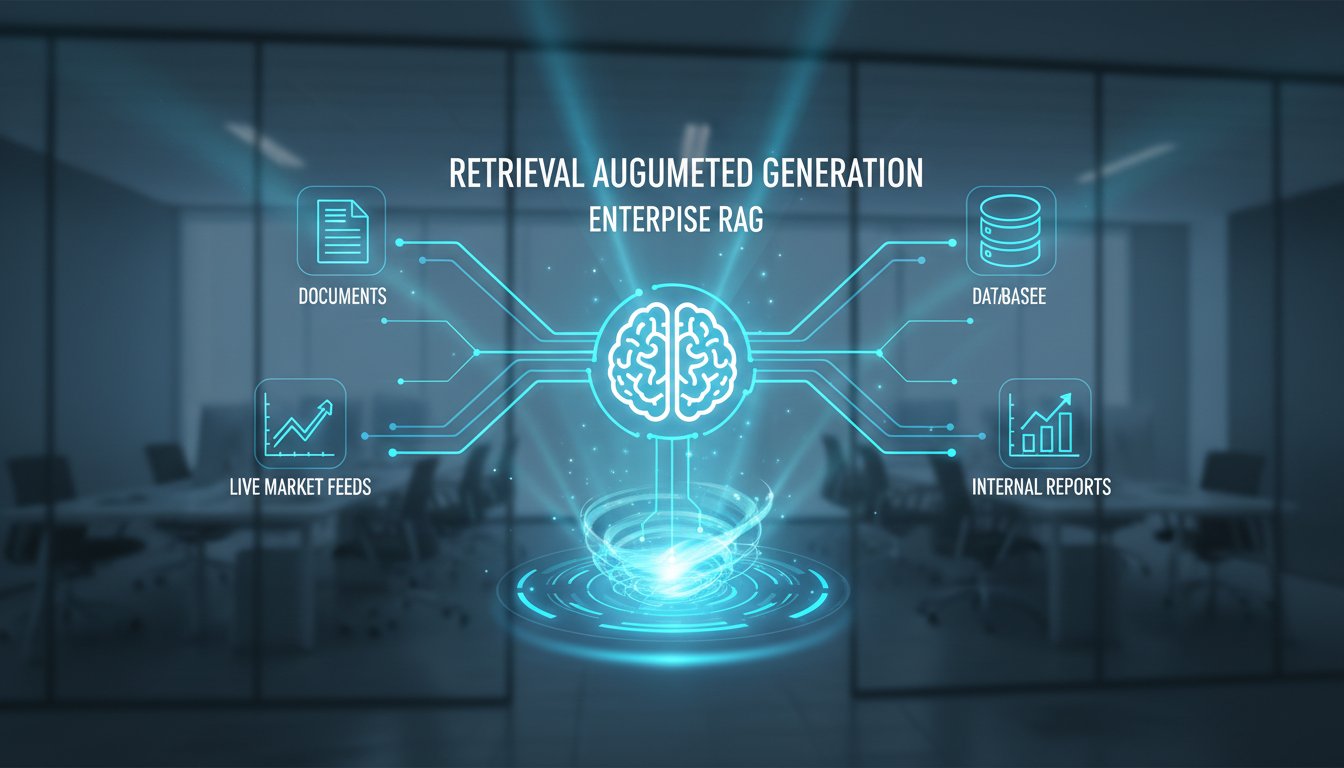

Your enterprise just invested millions in a production RAG system. Your retrieval accuracy hit 94%. Your hallucination rates dropped below 3%. Your executive dashboard shows green across the board.
But while you’re celebrating those metrics, attackers are studying something else entirely: how to turn your AI agents into weapons. They’re not trying to break into your RAG system—they’re learning to live inside it.
This isn’t theoretical. Security researchers are tracking a fundamental shift in attacker tradecraft for 2026, and it’s happening right now, underneath the observability layer most enterprise RAG teams are watching.
The Attack Surface You Didn’t Know You Built
When you deployed your RAG system, you created something powerful: autonomous agents with credentials, API access, and the ability to retrieve and act on sensitive enterprise data. You built guardrails around hallucinations and retrieval accuracy. You implemented monitoring for performance degradation.
But here’s what you probably didn’t account for: every agentic component in your RAG architecture is now a potential persistence mechanism for attackers.
SecurityWeek’s latest research reveals that adversaries are evolving beyond traditional infrastructure attacks. Instead of compromising servers or stealing credentials, they’re targeting AI agents themselves—using them as “living off the AI” platforms that blend into legitimate traffic, evade traditional security controls, and leverage the same tools your organization trusts.
The implications for enterprise RAG are staggering. Your retrieval agents, orchestration layers, and tool-calling capabilities aren’t just productivity enhancers anymore. They’re potential command-and-control channels.
How RAG Systems Become Attack Vectors
Enterprise RAG architectures create three critical vulnerability surfaces that traditional security models weren’t designed to protect:
Agent Identity Sprawl
Your RAG system doesn’t run as a single service with one set of credentials. It’s a constellation of agents: retrieval agents querying vector databases, orchestration agents managing workflows, tool-calling agents executing actions, and monitoring agents tracking performance.
Each agent needs identity and access. Each identity is a potential compromise point.
CyberArk’s 2026 security research highlights that AI agents function as autonomous entities with their own credentials and privileges. When an attacker compromises one agent’s session token or API key, they don’t just get access to data—they get access to agency. The ability to retrieve, reason, and act.
Unlike traditional session hijacking, compromised AI agents can operate for extended periods without detection because their behavior patterns—retrieval requests, API calls, token consumption—look identical to legitimate operations.
Tool Misuse at Scale
RAG systems are increasingly agentic, with tool-calling capabilities that allow AI to execute functions, query databases, update records, and trigger workflows. This is precisely what makes them powerful for enterprise use cases.
It’s also what makes them dangerous when compromised.
The “tool misuse” attack vector exploits an AI agent’s legitimate access to perform harmful actions. An attacker who gains control of a RAG agent doesn’t need to exploit a vulnerability in your vector database or bypass authentication on your knowledge repositories. They simply use the agent’s existing permissions.
Real-world scenario: Your customer support RAG agent has read access to customer records and write access to support tickets. A compromised agent could exfiltrate sensitive customer data by encoding it in support ticket metadata, retrieve competitive intelligence by querying internal knowledge bases, or manipulate responses to damage customer trust.
The attack looks like normal RAG operations because it is normal RAG operations—just with malicious intent.
Retrieval as Reconnaissance
Every retrieval query your RAG system processes reveals something about your data architecture: what information exists, how it’s organized, what’s considered relevant, and what retrieval patterns trigger which downstream actions.
Attackers are learning to use RAG systems as reconnaissance tools. By crafting specific queries and observing retrieval patterns, they can map your knowledge graph, identify high-value documents, and understand your data relationships without ever accessing the underlying databases directly.
This is particularly insidious because retrieval queries are supposed to explore your data. Your monitoring systems are tuned to detect anomalous access patterns, but an attacker using your RAG system’s own retrieval logic can blend reconnaissance into legitimate query traffic.
The Identity Crisis in Agentic RAG
The shift to agentic AI fundamentally changes what “identity” means in enterprise systems. Traditional security models assume identities belong to humans or services with relatively static permissions and predictable behavior patterns.
AI agents break both assumptions.
According to CyberArk’s analysis, the attack surface expands dramatically because:
- AI agents have dynamic privileges: They don’t just read or write—they reason about what to access based on context
- Session boundaries blur: A compromised agent session might persist across multiple user interactions
- Tool access is contextual: Agents gain access to tools based on reasoning chains, not static role assignments
For enterprise RAG teams, this creates a painful reality: your existing identity and access management (IAM) infrastructure wasn’t designed for entities that autonomously decide what data to retrieve and what actions to take.
You can’t simply assign a RAG agent “read access” to your knowledge base and call it secure. The agent’s reasoning process determines what it retrieves, and if that reasoning is compromised, your access controls become irrelevant.
What Enterprise RAG Teams Are Missing
Most enterprise RAG security strategies focus on three areas: data privacy (what goes into embeddings), model safety (preventing harmful outputs), and access control (who can query the system).
These are necessary but insufficient.
The emerging threat model requires visibility into agent behavior, not just agent access. Traditional security questions don’t capture the risk:
- “Does this agent have permission to retrieve this document?” ← Wrong question
- “Is this agent’s retrieval pattern consistent with legitimate reasoning chains?” ← Right question
The gap shows up in monitoring strategies. Enterprise RAG teams track:
– Retrieval accuracy
– Response latency
– Token consumption
– Hallucination rates
But they’re not tracking:
– Retrieval pattern anomalies
– Tool-calling sequence deviations
– Agent session duration outliers
– Cross-agent communication patterns
This monitoring gap is where “living off the AI” attacks thrive. They operate inside the bounds of normal system behavior, exploiting the fact that RAG teams are optimizing for performance, not defending against adversarial agent manipulation.
The Developer Privilege Problem
There’s a second-order risk that enterprises are drastically underestimating: the humans who build and maintain RAG systems are now prime targets.
CyberArk’s research identifies developers and AI agent creators as highly vulnerable due to elevated access levels. The person who can modify agent behavior, update retrieval logic, or change tool-calling permissions has effectively god-mode access to your RAG system’s decision-making process.
A compromised developer account doesn’t just expose code—it exposes the ability to reprogram how your AI agents think, retrieve, and act.
This risk amplifies with low-code/no-code RAG platforms that democratize agent creation. When you empower more users to build retrieval workflows and configure agent behavior without deep security expertise, you expand the attack surface exponentially.
Every citizen developer who creates a custom RAG workflow becomes a potential pivot point for attackers targeting your AI infrastructure.
Building Defense-in-Depth for Agentic RAG
The solution isn’t to abandon agentic RAG—the productivity gains are too significant, and the competitive pressure too intense. Instead, enterprise teams need to extend their security models to account for AI-native threats.
Implement Zero Standing Privileges for Agents
Just as Zero Trust redefined network security, Zero Standing Privileges (ZSP) should redefine AI agent security. Agents shouldn’t have persistent access to tools and data—they should request just-in-time permissions based on specific reasoning chains.
This means your RAG orchestration layer needs to:
– Evaluate each tool-calling request independently
– Grant minimal necessary access for specific actions
– Revoke permissions immediately after use
– Log the reasoning chain that triggered the access request
Implementing ZSP for RAG agents is technically complex—it requires tight integration between your orchestration layer, IAM systems, and reasoning chains—but it fundamentally limits blast radius when an agent is compromised.
Monitor Reasoning Chains, Not Just Outcomes
Traditional RAG monitoring focuses on whether the system produced accurate, relevant responses. Security-aware monitoring must track how the system arrived at those responses.
Your observability stack should capture:
– Retrieval sequences: What documents were accessed and in what order?
– Tool-calling patterns: What functions were invoked and why?
– Cross-agent communication: How are different agents coordinating?
– Reasoning chain deviations: When do agent decisions diverge from expected patterns?
This requires storing and analyzing reasoning chain metadata, not just input/output pairs. When an anomaly appears—an agent retrieves an unusual combination of documents, calls tools in an unexpected sequence, or exhibits reasoning patterns that deviate from baseline—your security team needs alerts, not just your performance team.
Secure the Agent Creation Pipeline
Defending enterprise RAG means defending the process of building and modifying agents. This includes:
- Code review for agent logic: Every change to retrieval strategies, tool-calling permissions, or orchestration workflows should undergo security review
- Privileged access management for developers: Developers who can modify agent behavior need enhanced security controls, including MFA, session monitoring, and access justification
- Agent behavior testing in isolation: Before deploying agent updates, test them in sandboxed environments to detect unexpected behavior patterns
- Immutable agent audit logs: Maintain tamper-proof records of who created, modified, or deployed each agent component
The low-code/no-code challenge requires additional controls: workflow approval processes, automated security scanning of agent configurations, and restricted access to production data for citizen-developer-created agents.
Implement In-Session Security Controls
Compromised agent sessions are particularly dangerous because they can persist and operate with legitimate credentials. In-session controls add a layer of runtime protection:
- Behavioral biometrics for agents: Establish baseline behavior patterns for each agent and flag deviations
- Session timeout policies: Limit how long agent sessions can remain active
- Anomaly-triggered re-authentication: When suspicious patterns emerge, require re-validation before proceeding
- Cross-session correlation: Detect when the same agent identity exhibits different behavior patterns across sessions
These controls don’t prevent initial compromise, but they limit how long and how effectively an attacker can operate within a compromised agent session.
The Convergence of Performance and Security
Here’s the strategic insight most enterprise RAG teams are missing: security and performance optimization are converging for agentic systems.
The same observability infrastructure that helps you optimize retrieval accuracy and reduce latency can detect adversarial behavior—if you instrument it correctly. The reasoning chain logs you need for debugging agent decisions are the same logs you need for security forensics.
This means building security into your RAG architecture isn’t a separate workstream that slows down innovation. It’s an extension of the observability and monitoring capabilities you’re already building for performance optimization.
The teams that recognize this convergence will build more robust, more trustworthy, and ultimately more valuable RAG systems. The teams that treat security as a compliance checkbox will discover—too late—that their AI agents have become someone else’s infrastructure.
What This Means for Your RAG Roadmap
If you’re running enterprise RAG in production, or planning deployment in 2026, the “living off the AI” threat model should reshape three aspects of your roadmap:
1. Architecture decisions: Evaluate RAG frameworks and orchestration platforms based on their security primitives, not just their performance benchmarks. Can they implement ZSP for agents? Do they provide reasoning chain observability? Can they integrate with your existing IAM infrastructure?
2. Team composition: Your RAG team needs security expertise, not just ML engineering and data science. Someone needs to think adversarially about how your agents could be manipulated or misused.
3. Success metrics: Expand beyond accuracy, latency, and cost. Track agent behavior consistency, privilege escalation attempts, anomalous retrieval patterns, and reasoning chain deviations.
The enterprises that thrive with agentic RAG won’t be the ones with the most sophisticated models or the largest knowledge bases. They’ll be the ones who recognized that AI agents are both productivity multipliers and security surfaces—and built accordingly.
The attackers are already studying your RAG system. The question is whether you’re studying it through their eyes.
Moving Forward: Security as a Competitive Advantage
There’s a counterintuitive opportunity in this threat landscape: enterprises that solve agentic AI security first will move faster, not slower.
When your security model can accommodate autonomous agents making dynamic retrieval and tool-calling decisions, you can deploy more sophisticated agentic workflows with confidence. When your monitoring can detect adversarial behavior, you can grant agents broader permissions because you’ll catch misuse quickly.
Security becomes the enabler of agentic capability, not the barrier.
The enterprises struggling with RAG deployment in late 2026 won’t be the ones who couldn’t build accurate retrieval systems. They’ll be the ones who built powerful systems, suffered a security incident, and had to roll back their agentic capabilities because they lacked the security infrastructure to operate safely.
Your RAG system is probably already more capable than you’re allowing it to be. The question is whether you can build the security foundation to unleash that capability without creating the attack surface that gets you breached.
The “living off the AI” era is here. Your RAG architecture either adapts to defend against it—or becomes the infrastructure attackers live off of. Start building the security instrumentation now, before your first incident forces you to build it under pressure. The research is clear, the threats are documented, and the window to get ahead of this is closing.
Your move.