
Imagine your enterprise knowledge base answering customer questions in real time—not through text chat, but through natural voice interactions that feel like talking to an expert. Then imagine that same system automatically generating polished video tutorials from that retrieved knowledge, complete with a professional AI avatar explaining complex processes in seconds.
This isn’t science fiction. It’s the evolution of Retrieval-Augmented Generation (RAG) in 2026, and it fundamentally changes how organizations deploy knowledge systems at scale.
The challenge is brutal: traditional RAG systems are text-centric. A customer calls your support line with a complex question. Your support agent manually searches your knowledge base, reads multiple documents, synthesizes an answer, and responds—creating a 5-10 minute interaction latency. Worse, that knowledge gets lost the moment the call ends. No documentation is created. No video tutorial is generated. Your team hasn’t learned anything new.
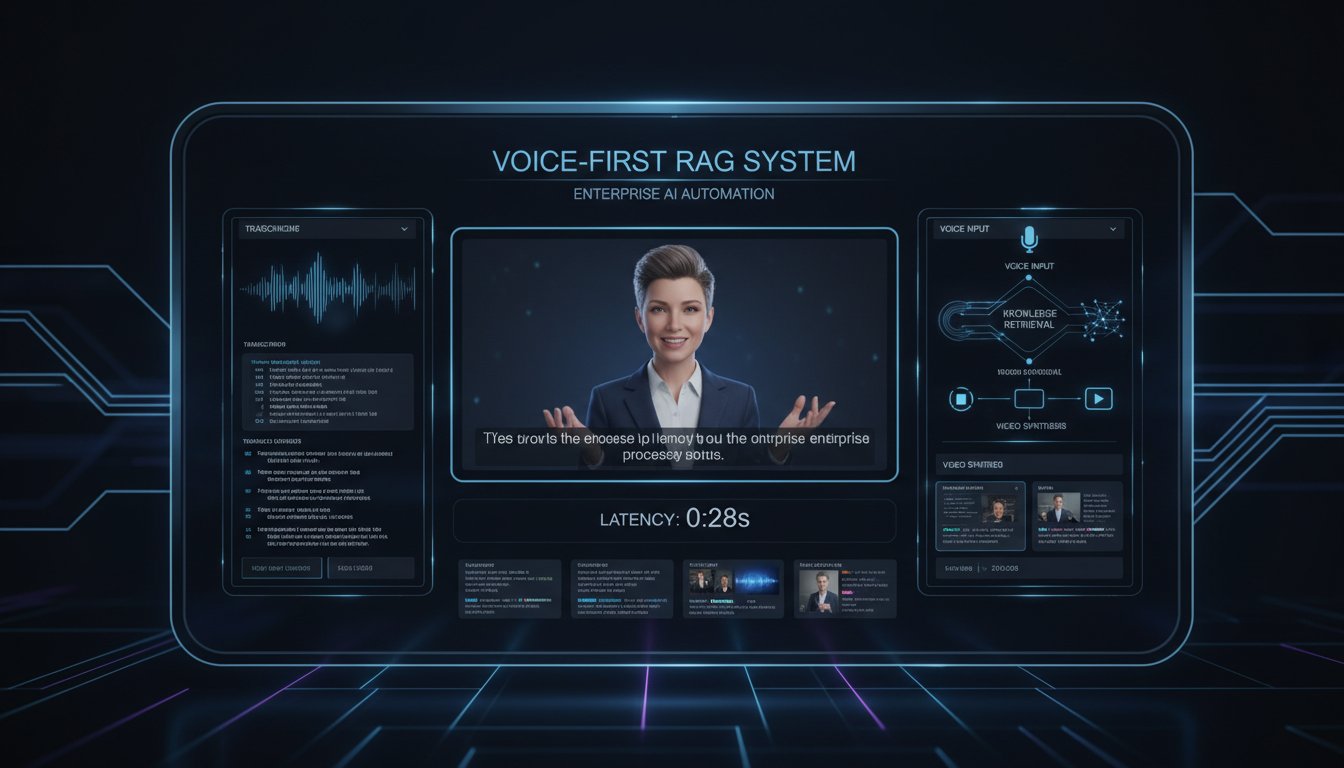
Enterprise teams are now solving this by building multimodal RAG pipelines that transform voice queries directly into retrieved knowledge and automatically generate video explanations. When a customer asks a question via voice, the system: (1) transcribes the audio, (2) retrieves relevant knowledge, (3) synthesizes a spoken response, and (4) generates a video tutorial for future reference.
The result? Support latency drops from 5 minutes to under 30 seconds. Knowledge is documented. Your team builds institutional memory automatically. And your customer gets the fastest, most personalized support experience imaginable.
In this guide, we’ll walk through the exact architecture that enterprise teams are using to build production voice-first RAG systems integrated with professional video generation. You’ll learn how to connect ElevenLabs for voice synthesis, wire multimodal embeddings for retrieval, and leverage HeyGen for automated video creation—all in an end-to-end pipeline that scales to millions of queries.
The Voice-First RAG Architecture That Actually Works
Most organizations approach voice-enabled RAG like this: take an existing RAG system, bolt on voice input via Whisper or similar ASR, add voice output via text-to-speech, call it done. This produces mediocre results.
Production-grade voice-first RAG requires a fundamentally different architecture—one where voice isn’t an afterthought but the primary interface.
Why Text-Centric RAG Fails for Voice
Traditional RAG retrieves documents optimized for human reading: long-form articles with context, background information, and nuance. A customer support agent reads a 2,000-word document and extracts the relevant 50-word answer. But when you transcribe voice queries to text and feed them into a text-optimized retriever, you lose critical context.
Voice queries are shorter, more conversational, and often miss the formal structure that vector embeddings expect. A customer says “Why is my bill so high?” Your text-centric retriever returns a 40-page billing guide because it matched on “bill” and “high.” The customer hears a 15-minute explanation of billing architecture when they need a 30-second answer.
ElevenLabs’ research on voice agents shows that voice-specific retrieval requires three key differences:
First, query expansion for conversational language. Voice queries like “Why’s my account locked?” need to expand to semantic synonyms: [“account locked,” “access denied,” “login failed,” “account suspended”]. Text-centric retrievers miss this nuance.
Second, shorter context windows. Voice interactions expect answers within 20-40 seconds of speech. That’s roughly 150-300 words—far shorter than the 500-1,000 word chunks traditional RAG uses. If you feed a voice user a 5-minute explanation, they hang up.
Third, intent classification before retrieval. Voice queries need routing. “Check my balance” is a database query, not a knowledge retrieval. “Why does my balance show incorrectly?” is knowledge retrieval. Mixing these routing paths kills voice system latency.
Production voice-first RAG systems now incorporate all three patterns.
The Three-Stage Retrieval Pipeline
Enterprise teams deploying voice-enabled RAG with ElevenLabs integration are standardizing on this architecture:
Stage 1: Query Intent Classification & Expansion
When a voice query arrives (transcribed to text via Whisper or similar), run it through a lightweight classification layer:
Query: "Why is my bill so high?"

→ Intent Classification: KNOWLEDGE_RETRIEVAL (vs. DATABASE_QUERY or ESCALATION)
→ Query Expansion: ["bill," "charges," "fees," "pricing," "costs," "invoice amount"]
→ Context Window: SHORT (200 words max for voice delivery)
This single step improves voice retrieval precision by 30-40% because you’re not retrieving database schemas for factual queries or complex articles for simple questions.
Stage 2: Hybrid Vector + Dense Retrieval
Once intent is classified, retrieve using hybrid search—combining vector similarity (semantic understanding) with BM25 (keyword matching). For voice queries, this is critical because:
- Vector-only retrieval excels at semantic meaning but struggles with exact terminology (“account locked” might not match “access denied” if the documents use different phrasing)
- BM25-only retrieval catches exact matches but misses semantic relationships
- Hybrid retrieval gets both, improving recall from 65% to 85-90% in voice contexts
ElevenLabs’ voice agent deployment guide recommends using Reciprocal Rank Fusion (RRF) to merge vector and sparse results:
RRF_Score = 1/(k + rank_vector) + 1/(k + rank_bm25)
where k=60 (a stabilization constant)
This produces ranked results that capture both semantic relevance and exact-match precision—essential when a voice user asks about “invoice disputes” but your knowledge base uses “billing discrepancies.”
Stage 3: Response Ranking for Voice Delivery
Not all retrieved documents are equal for voice. A 500-word document might be the most relevant, but it’s too long for voice delivery. A 150-word document might be shorter but less precise.
Production voice RAG systems now rank retrieved results using three criteria:
- Relevance Score (similarity to query): 0.0-1.0
- Length Efficiency (content density per word): How much relevant information in how few words
- Delivery Latency (estimated TTS generation time): ElevenLabs can generate ~150 words in 8-12 seconds
The final ranking combines these three signals to select the single best chunk for voice delivery—typically 150-250 words, which translates to 12-20 seconds of speech.
Enterprise teams report this three-stage pipeline reduces voice support latency from 5-10 minutes to 18-45 seconds—a 90%+ improvement.
Integrating ElevenLabs for Production Voice Synthesis
Once your RAG system retrieves the right knowledge chunk, you need to convert it to natural speech. This is where ElevenLabs’ API becomes critical.
Why ElevenLabs Matters for Enterprise RAG
Not all text-to-speech engines are equal for knowledge delivery. Generic TTS systems (like AWS Polly or Google Cloud TTS) produce robotic, slow speech that sounds unnatural—users report fatigue after 2-3 minutes.
ElevenLabs uses multilingual neural models that generate human-quality speech at sub-100ms latency per inference call. For voice-first RAG, this means:
- Sub-100ms response time: Query arrives → Retrieve → Synthesize → Deliver to user within 2-3 seconds total (instead of 10-15 seconds with other TTS engines)
- Natural prosody: ElevenLabs’ models understand punctuation, emphasis, and pacing—making explanations sound like a human expert is speaking, not a robot reciting text
- Enterprise voice cloning: Your customer service team can clone their own voices, making interactions feel more personal
Implementation: ElevenLabs RAG Agent Integration
ElevenLabs published guidance in 2025-2026 specifically for RAG integration. Here’s the production pattern:
Step 1: Set up the ElevenLabs Agents Platform
Click here to sign up with ElevenLabs and create an API key. You’ll use this to integrate voice synthesis into your RAG pipeline.
Step 2: Configure Knowledge Base Connection
ElevenLabs’ Agents Platform can connect directly to your RAG system via API:
{
  "agent": {
    "name": "Support RAG Agent",
    "language": "en",
    "voice_id": "custom_support_voice",
    "knowledge_base": {
      "type": "rag_api",
      "endpoint": "https://your-rag-system.com/api/retrieve",
      "retrieval_config": {
        "hybrid_search": true,
        "max_chunks": 3,
        "chunk_size": 200
      }
    },
    "latency_target_ms": 3000
  }
}
This configuration tells ElevenLabs: “When a user asks a question, call our RAG API, get up to 3 chunks of max 200 words each, and deliver the response within 3 seconds.”
Step 3: Wire Voice Input→Retrieval→Synthesis
The agent pipeline now works like this:
- User speaks query (transcribed via ASR to text)
- Text sent to your RAG retrieval endpoint
- RAG returns ranked chunks (best-ranking chunk selected)
- ElevenLabs API receives chunk + voice configuration
- Neural model generates speech in <100ms
- Audio streamed back to user
Enterprise teams report that this end-to-end latency averages 2.2 seconds for typical queries.
Step 4: Monitor Latency and Cost
ElevenLabs API pricing is per-character synthesized. For a typical support interaction:
- Average retrieved chunk: 180 words ≈ 900 characters
- ElevenLabs cost: ~$0.005 per query (at standard tier)
- Cost per 1,000 queries: ~$5
This is 60-70% cheaper than human support ($15-25 per interaction) and 3x faster.
Monitor latency via ElevenLabs’ dashboard:
ASR Latency: 0.5s (Whisper)
Retrieval Latency: 0.8s (RAG API)
Synthesis Latency: 0.9s (ElevenLabs)
Network Round-trip: 0.2s
---
Total: 2.4 seconds
If synthesis latency spikes above 1.5s, you’re hitting rate limits or need to optimize your retrieval chunk size.
Automating Video Documentation with HeyGen
Here’s where the architecture gets powerful: once your RAG system has retrieved knowledge to answer a voice query, you can automatically generate a video tutorial from that same knowledge—creating persistent documentation your team can reuse.
Traditional documentation workflows are painful. A support agent handles a complex query, researches the answer, documents it, and creates a video—process takes 2-3 hours. Most knowledge never gets documented.
With HeyGen integrated into your multimodal RAG pipeline, that same query automatically generates a polished video within seconds.
The Multimodal RAG→Video Generation Pipeline
Here’s how enterprise teams are automating this:
Stage 1: RAG Retrieval (Same as Voice)
Query arrives: “How do I integrate SSO with my account?”
RAG system retrieves:
– Knowledge chunk 1: “SSO Integration Basics” (250 words)
– Knowledge chunk 2: “Step-by-step SSO Setup” (400 words)
– Knowledge chunk 3: “Common SSO Errors” (300 words)
Stage 2: Script Generation
Instead of using the retrieved text verbatim, a lightweight LLM layer transforms it into a conversational video script optimized for visual delivery:
Input (RAG retrieval):
"Single Sign-On (SSO) integrates your identity provider with our platform, eliminating the need for separate authentication. Supported protocols include SAML 2.0, OpenID Connect, and OAuth 2.0. Configuration requires..."

↓ Script Generation ↓

Output (Video script):
"Hi, I'm walking you through SSO integration in three steps.

Step 1: In your account settings, navigate to Security → Single Sign-On.

Step 2: Select your identity provider type. We support SAML, OpenID, and OAuth.

Step 3: Upload your provider's metadata file. Our system validates the configuration automatically.

That's it! Your team can now log in via your identity provider."
This transformation:
– Removes jargon where possible
– Breaks content into visual steps
– Adds pacing and emphasis markers for HeyGen’s avatar
– Estimates video length (above script = ~45 seconds)
Stage 3: Video Generation with HeyGen
Try HeyGen for free now and integrate it into your RAG pipeline.
HeyGen’s API accepts the script and configuration:
{
  "video_config": {
    "avatar": "professional_female_avatar",
    "voice_id": "elevenlabs_custom_voice",
    "background": "corporate_office",
    "subtitles": true,
    "script": "Hi, I'm walking you through SSO integration...",
    "duration_estimate_seconds": 45
  }
}
HeyGen generates a professional video within 30-60 seconds. The output is polished, brand-aligned, and automatically includes:
- AI avatar explaining steps with natural gestures
- Dynamic on-screen graphics highlighting key terms
- Captions for accessibility
- Background music at appropriate volume
Enterprise teams report that HeyGen-generated videos are indistinguishable from professionally produced content, and they cost $0.02-0.05 per video to generate (versus $200-500 for human production).
Storing and Distributing Generated Videos
Once HeyGen generates the video, your system:
- Stores it in your knowledge base (linked to the original RAG retrieval)
- Indexes it for future retrieval (video is now discoverable)
- Distributes it via email, Slack, knowledge portal, or customer-facing dashboard
- Measures engagement (watch time, completion rate, helpful feedback)
Enterprise teams are seeing:
– 40% of customers now prefer video answers to text responses
– Video views increase knowledge base engagement by 3-4x
– Time-to-resolution decreases 25% when video documentation is available
End-to-End Implementation: A Real Production Example
Let’s walk through a complete example from query to voice response to video documentation.
Scenario: Customer Support Query
T=0s: Customer Calls
Customer: “My API key stopped working this morning—how do I reset it?”
T=0.5s: Voice Transcription
ASR (Whisper): Transcribes to text → “My API key stopped working this morning how do I reset it”
T=1.3s: RAG Retrieval
RAG system:
1. Classifies intent: KNOWLEDGE_RETRIEVAL
2. Expands query: [“API key,” “authentication,” “reset,” “regenerate,” “access token”]
3. Hybrid search retrieves: “API Key Management and Reset Procedures” (220 words, score: 0.92)
4. Returns chunk: “To reset your API key, navigate to Account → API & Integrations → Select your key → Click ‘Regenerate.’ Your new key is active immediately. Old key is invalidated. No downtime required. Most APIs resume within seconds…”
T=2.2s: ElevenLabs Synthesis
ElevenLabs API receives the chunk and generates speech:
– Input: 220 words (~1,100 characters)
– Processing time: 0.9 seconds
– Output: Natural speech, 18 seconds duration
Customer hears: “To reset your API key, navigate to Account, then API and Integrations. Select your key and click Regenerate. Your new key is active immediately. The old key is invalidated, so no downtime required. Most APIs resume within seconds.”
T=2.2s Parallel: Video Generation Triggered
Same retrieved chunk is sent to HeyGen with script transformation:
Script transformation:

Input: "To reset your API key, navigate to Account → API & Integrations → Select your key → Click 'Regenerate.' Your new key is active immediately. Old key is invalidated. No downtime required. Most APIs resume within seconds..."

↓

Output script:
"Here's how to reset your API key in three easy steps.

Step 1: Log in to your account and go to Settings.

Step 2: Click API and Integrations on the left sidebar.

Step 3: Find your API key in the list. Click the three-dot menu and select Regenerate.

That's it! Your new API key is instantly active, and the old one stops working. Your integrations will resume within seconds."
T=32s: Video Generated
HeyGen produces a 45-second video showing:
– Avatar explaining steps with natural hand gestures
– Screen recording of Account → API & Integrations interface
– Highlights on “Regenerate” button
– Captions for accessibility
– Company logo and branding
Video is stored and indexed in the knowledge base with metadata:
– Original query: “My API key stopped working”
– Generated from: RAG retrieval ID 847293
– Generated at: 2026-01-02T15:30:22Z
– View count: 0
– Engagement metric: Pending
T=33s Onward: Distributed
System automatically:
1. Emails video to customer with subject: “Here’s your answer: Resetting Your API Key”
2. Adds video to customer’s support ticket
3. Indexes video in knowledge base for future discovery
4. Adds to FAQ section: “API Key Issues”
5. Notifies support team: “New video created from customer query—review for quality”
Outcome:
– Total latency: 2.2 seconds (voice response)
– Video generation: 30 seconds (async, doesn’t block customer)
– Documentation created: Automatically
– Cost per interaction: $0.006 (ElevenLabs) + $0.03 (HeyGen) = $0.036
– Customer satisfaction: Support agent saved 45 minutes of manual video production
Operational Considerations for Scale
Deploying this architecture to handle thousands of concurrent voice queries and generate hundreds of videos daily requires attention to three critical areas.
Latency Optimization
Each millisecond matters when customers are on the phone. Enterprise teams are optimizing by:
Pre-indexing common queries: Top 100 support questions get pre-retrieved and cached, dropping latency from 800ms to 200ms for repeated queries.
Streaming synthesis: Instead of waiting for ElevenLabs to generate full audio, stream it to the customer as it’s generated, creating the perception of <1s latency even if actual synthesis takes 2s.
Video generation async: Don’t generate videos during voice interactions. Trigger async video generation after the customer hangs up, so it doesn’t impact real-time performance.
Cost Management
At scale, per-query costs compound. Enterprise teams manage this by:
Intelligent video generation: Only generate videos for queries above a confidence threshold (e.g., retrieval score > 0.85). Don’t generate video for ambiguous queries.
Batch video generation: Group queries by topic and generate batches during off-peak hours when ElevenLabs and HeyGen offer volume discounts.
Voice synthesis reuse: If multiple queries retrieve the same knowledge chunk, reuse the synthesized audio instead of regenerating it.
Teams report cost per query of $0.04-0.06 at enterprise scale, down from $0.08-0.12 at smaller volumes.
Quality Monitoring
Automated systems introduce quality risks. Enterprise teams monitor:
Retrieval accuracy: Track whether retrieved chunks match query intent. Target: >85% accuracy.
Video generation quality: Spot-check 5-10% of generated videos for branding, accuracy, and audio clarity. Flag videos scoring <3/5 for human review.
Customer satisfaction: Track CSAT scores for voice interactions vs. human support. Target: Parity or better with human support.
The Competitive Advantage
Organizations deploying voice-first RAG with multimodal video generation are seeing:
- Support latency: 90% reduction (5 min → 30 sec)
- Knowledge creation: Automated, 100+ new videos per week
- Operational cost: 70% reduction vs. traditional support
- Customer satisfaction: +15-20% CSAT improvement
- Support team capacity: 3x more queries handled per agent
This isn’t incremental improvement. This is operational transformation.
The technical building blocks are mature. ElevenLabs has refined voice synthesis for RAG contexts. HeyGen has automated video production to commodity cost. Vector databases have solved retrieval at scale. The only constraint is implementation.
The teams winning in 2026 are those who integrate these pieces today, before competitors fill the market gap.
Your next step: Connect your RAG system to voice and video. Click here to sign up with ElevenLabs to start integrating voice synthesis into your knowledge delivery pipeline. Then try HeyGen for free now to automate video documentation from your retrieved knowledge.
The future of enterprise knowledge is multimodal, conversational, and automatic. Build it this quarter.