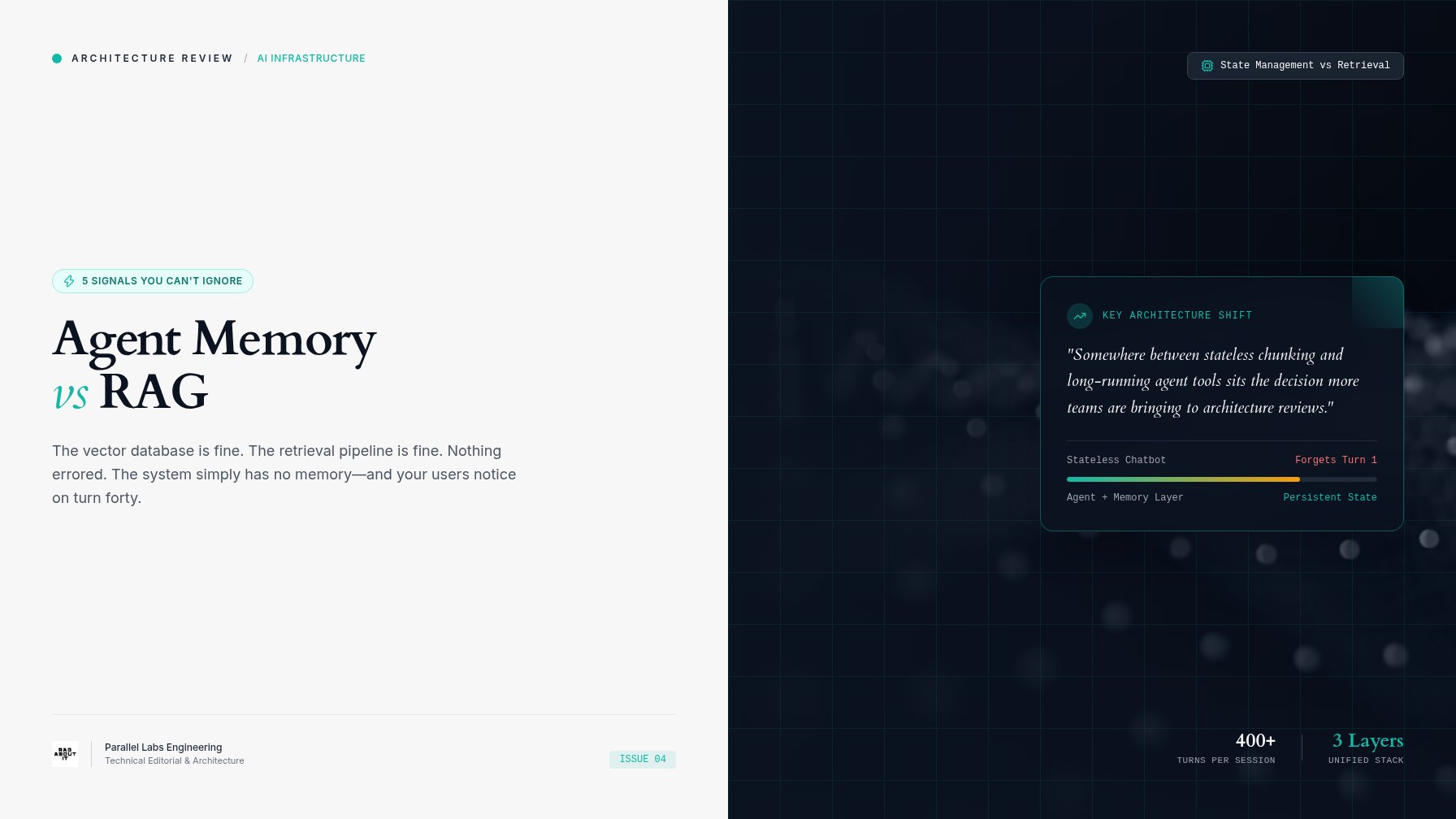

Picture a support agent that has answered the same customer’s questions forty times this quarter. It answers well. Then the customer asks why it keeps forgetting they run everything on AWS, a detail they mentioned in session one. The vector database is fine. The retrieval pipeline is fine. Nothing errored. The system simply has no memory.
For most of the past three years, that was an acceptable trade. Nobody was debating agent memory vs RAG. RAG solved the knowledge problem for stateless models: chunk the documents, embed them, retrieve top-k, stuff the prompt, generate. That contract fit chatbots answering questions against a fixed corpus. It fits poorly now that agents run for hundreds of turns, call tools between turns, and build state worth remembering on turn 400. Somewhere between those two designs sits the decision more teams are bringing to architecture reviews: do we still build RAG, or do we build memory?
The consumer market already voted. ChatGPT shipped memory in 2024, expanded it in 2025 to reference past chats, and Claude followed with its own memory features. Millions of people now use assistants that remember them. So your users open your internal copilot expecting the same behavior and find a blank slate.
The infrastructure market is catching up. Last year the Mem0 team and the Zep team both published benchmark papers treating memory as a first-class system component, and the numbers were not subtle. Letta, born from the MemGPT research line, turned those ideas into shipping products. This is the most interesting story in AI infrastructure right now: retrieval is getting a sibling, and the stacks are merging.
Five signals show where the agent memory vs RAG story goes next, and not all of them favor the memory vendors. I’ll separate the real shift from the hype, show what RAG still does better than any memory layer, and sketch a three-layer architecture that keeps both without doubling your maintenance load. By the end you should know whether your next sprint belongs to your retriever or to a write path you don’t have yet.
Agent Memory vs RAG: Why Agents Broke the Old Retrieval Contract
A chatbot has one job per request. It retrieves, it answers, it forgets. Every turn is independent, so the only state that matters lives in your document store.
Agents broke that. A coding agent runs for hundreds of turns. A support agent handles one customer across months. Between turns, things happen that the model should remember: the user’s stack, decisions already made, bugs already ruled out. In a chatbot, that information evaporates. In an agent, losing it costs money and user patience.
The MemGPT paper from Packer and colleagues at UC Berkeley framed this back in 2023: treat the context window like RAM, treat external storage like disk, and page information between them. That idea, virtual context management, is now the core design of most commercial memory systems.
The important change is subtle. Retrieval used to be a pipeline stage that ran before generation. In a memory architecture, retrieval becomes a policy inside a loop: what to fetch, what to keep, what to write back, what to forget. That policy is where the agent memory vs RAG question turns into an engineering decision.
5 Signals the Stacks Are Merging
None of these signals settles the argument on its own. Together they show which way the stack is moving.
Signal 1: Memory has its own benchmark papers
For years, retrieval had BEIR and MTEB, and memory had nothing. That changed in 2025. The Mem0 paper reported 26% higher accuracy than OpenAI’s memory feature on the LOCOMO benchmark, roughly double the multi-turn accuracy of stuffing the full context, and 91% lower p95 latency. Zep’s paper on Graphiti, its temporal knowledge graph, reported an 18.5% accuracy boost over full-context prompting and a 90% latency reduction on long-horizon tasks.
You can argue with any single number. Vendor-funded benchmarks deserve skepticism, and LOCOMO has known weaknesses. But when a category gets benchmarks, budgets follow. Memory is now measured as a system component, the same way chunking strategies and rerankers were measured in 2023 and 2024.
Signal 2: Consumers learned to expect it
ChatGPT memory is table stakes in consumer AI now, and the expectation transferred straight to enterprise tools. Users who open your internal copilot ask the same question they ask ChatGPT: why doesn’t it remember me? A retrieval-only product answers that badly every time. If your agent re-asks for context the user already gave, that reads as a defect, not an architectural choice. Perception matters in procurement, and “it forgets” is a two-word objection that kills demos.
Signal 3: Memory systems are retrieval systems with better scoring
Here is the uncomfortable part for anyone who built a career on RAG: memory does not replace retrieval. It contains it.
Stanford’s Generative Agents research (Park et al., 2023) described a memory stream where observations get retrieved by scoring three things: recency, importance, and relevance. That’s a retrieval function. The difference from classic RAG is what gets indexed, not how it gets fetched. RAG indexes curated documents. Memory indexes the interaction itself, then writes back what it learned.
So the agent memory vs RAG framing is misleading. Memory is a write-heavy retrieval system over interaction data. RAG is a read-heavy retrieval system over ground truth. Agents need both, and the router between them is becoming a standard layer in its own right.
Signal 4: Facts got timestamps
Static chunks cannot express “this was true until March.” Enterprise knowledge is full of time-bound facts: pricing, policies, org structures, contract terms. Your current stack handles them by re-indexing and hoping stale chunks don’t surface.
Temporal knowledge graphs attack this directly. Zep’s Graphiti stores edges with validity intervals, so a query can honor when a fact was true. HippoRAG, published at NeurIPS 2024, builds a knowledge graph over passages and runs Personalized PageRank across it, with reported gains up to 20% on multi-hop questions over prior retrieval baselines.
For a support agent answering “what did our SLA say when I signed,” timestamped memory is the difference between a correct answer and a confident hallucination.
Signal 5: The token math rewards compression
Long context windows exist, and we have written before about why the 1MB-token window doesn’t kill RAG. The reason is cost: you pay for full context on every call. Memory changes the payment schedule. You pay a small write cost when something worth remembering happens, then a small read cost each time you recall it.
The Mem0 paper put numbers on this, claiming more than 90% token savings against full-context approaches at comparable accuracy. Even at half that saving in your workload, the math compounds. An agent running 40 turns per session across 10,000 sessions a month burns real money re-reading context it already saw.
The honest agent memory vs RAG tradeoff: memory adds a write path you must operate, and write paths fail in ways read paths don’t. If your sessions are short and stateless, skip it. If users come back, the math works.
What RAG Still Wins
Memory is lossy by design. It compresses, summarizes, and decays, because that is the only way interaction data stays affordable. Lossy systems are the wrong place to keep canonical truth.
RAG still wins three jobs:
- Ground truth at scale. Manuals, contracts, codebases, regulatory filings. You want the exact passage, not a summary of a summary.
- Fresh external knowledge. When the source document changes, you re-index. Memory would need to hear about the change, which it can’t.
- Auditability. Regulated industries need citations and provenance. A retrieved chunk with a source URL passes review. “The agent remembers” does not.
The agent memory vs RAG split that emerges in production is clean. Memory holds what is true about this user and this session. RAG holds what is true for everyone. An agent needs both, and the interesting engineering question is the router between them.
How to Merge Them Without Breaking Production
The three-layer split
The agent memory vs RAG merge comes down to three layers. Layer one is working memory: the live context, summarized when it grows past a threshold. Layer two is long-term memory: per-user and per-session state, with a write path, decay, and timestamps. Layer three is ground-truth retrieval: your existing RAG stack, unchanged.
The router can be a plain tool call. Question about the user’s environment? Read memory. Question about the product docs? Retrieve. Question about what the user decided last week? Both, memory first. Tool-calling models handle this routing reasonably well, and it keeps the architecture inspectable in your logs.
Build the write path before the read path
Most teams start by reading, which is backwards. A memory read of an empty store returns nothing, so the feature looks broken and gets cut in the first review. Start with when to write: after task completion, after explicit user corrections, after tool outputs that reveal user state. Write salient facts, not transcripts. The MemGPT insight still holds. Summarize aggressively, store the summary, keep the disk cheap.
Test memory like software, not like prompts
The agent memory vs RAG merge changes how you test, too. Prompt evals are stateless, which makes them useless for memory. You need session replay: recorded multi-turn conversations run against the same write path, with assertions on turn 40 about facts from turn 3. Non-determinism gets worse here, because a slightly different summary at turn 3 changes what turn 40 can know. Pin your eval set. Version your write path. And treat a memory regression like a data migration bug, because that’s what it is.
Two failure modes deserve standing alerts. The first is memory poisoning, where one wrong write compounds across sessions, a risk we covered in our RAG attack series. The second is staleness, where remembered facts outlive their truth. Both fail silently, so both need monitors.
Where This Leaves Your Stack
The agent memory vs RAG story is not about RAG’s death. Retrieval got a sibling. Benchmarks, user expectations, scoring research, temporal graphs, and token economics all point the same direction: state is becoming a first-class part of agent stacks, and the retrieval systems we spent 2023 to 2025 perfecting are becoming one layer of them rather than the whole thing.
So run the audit, because it settles the agent memory vs RAG question for your product: which questions are about the user, and which are about the corpus? If more than a quarter are about the user, you need a write path, and your next sprint is not another reranker. If almost none are, stay lean and let RAG do its job.
We track this shift weekly, the tools shipping for it, and the failure modes that come with it. Subscribe to the newsletter to get the implementation guides as they land, and start with our pieces on agentic failure modes and the 1MB context window if you want the full picture.
That support agent answering its fortieth question? Build it a memory, and it will answer the forty-first like it was there for the first.