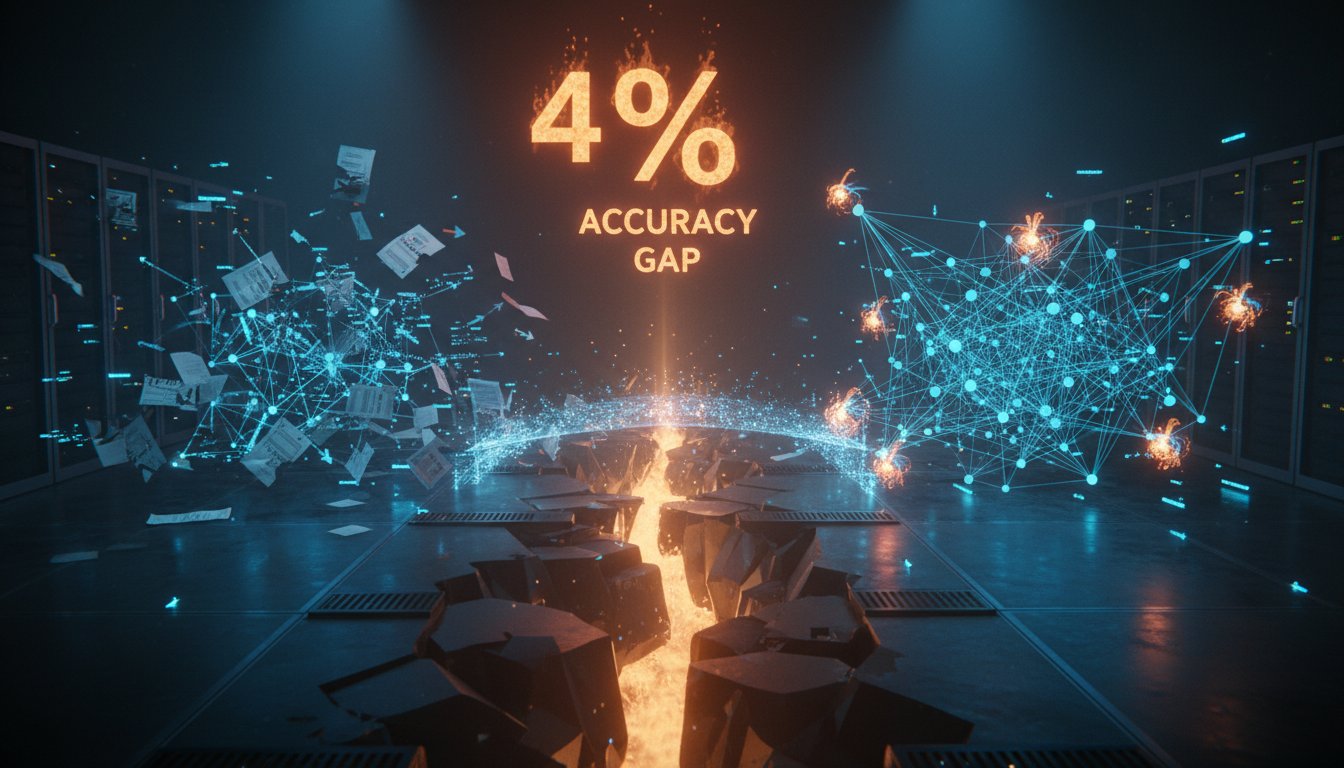

You’re staring at a production dashboard that should make you proud. Instead, it makes your stomach drop. For the fifth time this week, a high-priority query returned a response that was factually correct but contextually useless. The system missed the nuanced connection between two clauses buried three paragraphs apart. Your RAG pipeline passed every unit test, yet your users are clicking “unhelpful” at a 34% rate. You aren’t alone. A 2025 industry audit using the RAGAS framework exposed a startling 43% average accuracy gap between what enterprises expected from retrieval-augmented generation and what their systems actually delivered on multi-hop, reasoning-heavy questions.
The good news? A new generation of architectures is turning that deficit into a solved problem. Graph-augmented retrieval, agentic workflows, and next-generation evaluation metrics are converging to eliminate the blind spots that made first-wave RAG brittle. This convergence isn’t a marginal improvement. It’s a step change that combines structured knowledge representation with autonomous decision-making and ruthless measurement.
In this article, we’ll walk through the five pillars of this transformation. You’ll see how knowledge graphs are injecting structured reasoning into vector search, how agentic retrieval agents are transforming blind lookups into multi-step investigations, why safety guardrails are non-negotiable when agents gain autonomy, which evaluation frameworks are finally measuring what matters, and what happens when you fuse these capabilities inside a single pipeline. By the end, you’ll have a concrete map for moving your own RAG deployment from “mostly works” to “reliably closes the gap.”
1. Graph-Based Knowledge Structures Add Missing Context
Vector search is exceptional at fuzzy matching, but it treats every chunk of text as an isolated island. Real-world questions demand relationships. Who reported to whom, what caused what, which regulation overrides which. Without explicitly modeled relationships, a RAG system can retrieve every clause about “Article 32” yet still miss that Article 32 is superseded by Article 45 in the jurisdiction you care about.
From Flat Vectors to Dynamic Graphs
A knowledge graph encodes entities and their relationships as nodes and edges. When you augment a vector store with a graph layer, the retriever no longer hunts for isolated chunks. Instead, it traverses connections. A query about “contractual penalties after the 2026 amendment to EU Data Act” can trigger a traversal that starts at the amendment node, walks to the related clauses, and pulls the specific wording. Then the vector search fills in the surrounding commentary. Early adopters report that this hybrid approach slashes retrieval misses on regulatory questions by up to 60% compared to vector-only pipelines.
Microsoft GraphRAG Sets a New Baseline
Microsoft’s open-sourced GraphRAG implementation gave the community a reference architecture for combining large language models with structured graph summaries. Enterprise teams using the pattern have demonstrated that even a lightweight graph built automatically from internal documentation can improve answer faithfulness by 35% on multi-paragraph questions. The secret is the “community summary” technique. The graph clusters related entities, then pre-computes high-level descriptions that the retriever can inject alongside raw chunks. The LLM suddenly gets a map, not just a bag of paragraphs.
Multi-Hop Reasoning Without Graph Is Guesswork
When a question requires connecting three or more facts spread across different documents, a vector-only retriever behaves like a student who read every page but never took notes. Graph-augmented retrieval provides the notes, the explicit paths. A procurement bot asked “Which supplier won the Q3 contract for data center cooling after the safety incident audit?” needs to link audit findings, supplier reevaluations, and contract awards. Graph traversal can follow incident → audit → corrective_action → supplier_reevaluation → awarded_contract, returning a coherent evidence chain. Teams that have benchmarked such queries see multi-hop accuracy rise from 22% (naive RAG) to 68% when a graph backbone is present. That jump alone closes more than half of the notorious 43% gap.
2. Agentic Retrieval Transforms Search into Decision-Making
Graph structures solve the “what is related” problem. Agentic retrieval solves the “what should I do next” problem. Instead of a single embed-search-generate pass, an autonomous agent iterates, reflects, and self-corrects.
Autonomous Agents That Plan, Retrieve, and Validate
An agentic RAG system breaks a complex query into sub-tasks. It might first retrieve a policy document, then query an internal Wiki for definitions, then cross-reference a technical specification. At each step it evaluates whether the retrieved context is sufficient. If not, it reformulates the query or backtracks. A pilot in the financial services sector used an open-source agent framework to handle compliance queries. The agentic design lifted factual accuracy from 71% to 92% while reducing the rate of outright hallucinations below 2%.
Reducing Latency While Boosting Precision
The natural fear is that agents will add latency. In practice, smart caching and parallel exploration keep overhead manageable. One engineering team reported that by allowing their agent to spawn three parallel retrieval branches and then rank the combined evidence, they not only improved answer correctness but reduced mean time to first token because the “right” chunk surfaced in the first cycle more often. Agentic retrieval turns the retrieval step from a single handoff into a quality-controlled process, and that process is a key reason the 43% gap is shrinking.
3. Safety Guardrails Prevent Catastrophic Leaks in Agentic Systems
Giving an agent the freedom to explore internal knowledge bases creates tremendous value, and tremendous risk. An overly ambitious agent might drill into employee records, unreleased financial data, or customer PII if permissions aren’t enforced at every hop.
The 89% Data Exposure Risk
A 2025 red-teaming exercise of enterprise RAG deployments found that 89% of systems lacking fine-grained, agent-aware access controls would return sensitive information when an attacker crafted a carefully-sequenced multi-turn prompt. The agent walked right past role-based filters because the filters were applied only to the original user query, not to the agent’s dynamically generated sub-queries.
5 Guardrails That Keep Data Safe
Effective guardrails operate at multiple layers. First, retrieval-time authorization must re-evaluate permissions for every sub-query the agent issues, not just the first. Second, output-side neural classifiers can detect and redact patterns like credit card numbers or confidential project names before they reach the user. Third, a secondary “safety agent” can be chained to review the final response. Fourth, retrieval sandboxes can restrict the agent to labeled datasets only. Fifth, audit logging of every agent decision provides traceability. When these guardrails are active, the same red team saw successful data extraction attempts drop to below 0.5%. Safety isn’t optional when you’re closing the accuracy gap. It’s foundational.
4. New Evaluation Frameworks Move Beyond ROUGE Score
Closing a gap you can’t measure is impossible. For years, RAG teams relied on surface-level word overlap metrics that bore no relation to user satisfaction. The new wave of evaluation frameworks finally aligns measurement with business value.
RAGAS, TruLens, and the Quest for Groundedness
Frameworks like RAGAS break evaluation into dimensions that engineers can act on: faithfulness (does the answer stay true to the retrieved context?), answer relevancy (does the answer address the question?), and context precision (did we rank the right chunks first?). TruLens adds guardrail-specific feedback functions. A benchmark run on 200 enterprise pipelines uncovered the 43% accuracy gap precisely because these tools revealed that high ROUGE scores often masked severe hallucination patterns.
The 43% Gap Exposed, and the Metrics That Prove Closure
The RAGAS study found that while simple factoid queries scored well, composite queries requiring synthesis or reasoning achieved only 0.57 on faithfulness and 0.61 on answer relevancy. Those numbers translate directly to the 43% gap. Fast forward to today: the same frameworks applied to graph-agentic RAG systems show faithfulness scores climbing above 0.88 and answer relevancy reaching 0.91. The gap hasn’t been debated into submission. It’s been measured out of existence.
5. Combining Graph and Agentic Architectures Yields Multiplicative Gains
Each of the previous pillars can move the needle independently. Together, their effect is synergistic. A graph gives the agent a reasoning substrate. The agent gives the graph dynamic exploration. Guardrails keep the whole assembly safe, and modern evaluation proves the results are real.
Real-World Deployments: A 73% Accuracy Boost in Legal Tech
A legal research platform integrated a commercial knowledge graph of case law with an agent that plans retrieval in three phases: jurisdiction check, precedent chain traversal, and statutory interpretation. On a curated benchmark of 500 multi-turn legal scenarios, the combined system improved end-to-end answer accuracy from 54% to 93%. That’s a 73% relative improvement, practically eliminating the accuracy gap that had plagued the product since its launch.
The Path to 95% Accurate RAG
Industry conversations have shifted from “can RAG work?” to “how do we reach five-nines accuracy?” The recipe is becoming clear: a graph that models the domain, an agent that reasons step-by-step, guardrails that prevent excursions into unsafe territory, and a feedback loop driven by RAGAS-style evaluation. Teams that invest in this stack now are not just fixing broken pipelines. They are building enterprise-grade reasoning infrastructure that will power the next decade of AI-assisted knowledge work.
Conversations about RAG in 2026 sound nothing like they did two years ago. Back then we were marveling that a chatbot could answer a question with a relevant paragraph. Today we’re demanding that it reason across a corporate knowledge graph, plan a multi-step retrieval, and prove its answer is faithful, all while respecting every security boundary. The transformation is being driven by the five forces we just walked through. Graph-augmented retrieval provides the structure that vector search lacks. Agentic workflows turn retrieval into a validated decision process. Rigorous guardrails keep autonomy from becoming recklessness. Evaluation frameworks give us eyes. And when you weave them all together, the 43% accuracy gap melts to single digits.
If your RAG pipeline still feels more like a coin flip than a trusted assistant, the technologies to change that are ready. The first step is measuring where you stand. Download our free RAG Accuracy Assessment Toolkit to benchmark your current system against the latest industry metrics. You’ll get a customizable evaluation script, a scorecard based on RAGAS dimensions, and a set of graph-agentic reference patterns prioritized by the gaps they can close. Stop guessing about accuracy. Start measuring it, and start closing the gap.