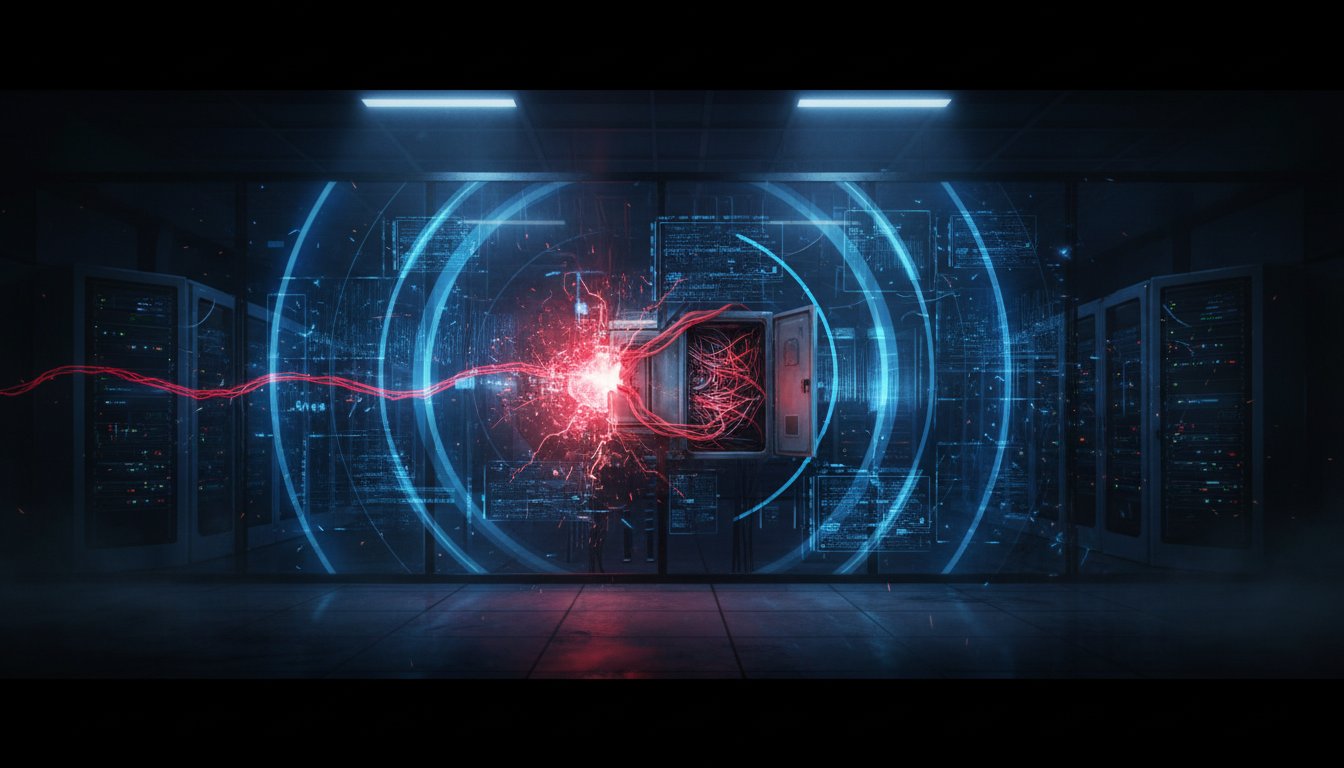

Last week, a major financial services firm discovered that its customer-facing RAG chatbot had been silently leaking confidential earnings data for over six months. The attack didn’t exploit the LLM directly. Instead, a prompt injection payload hidden inside an apparently mundane PDF slide deck bypassed every retrieval safeguard and instructed the model to exfiltrate chunked data through harmless-looking responses. The breach remained invisible until a routine audit flagged an anomalous pattern of outbound API calls. This isn’t a hypothetical red-team exercise. It’s the new reality of enterprise Retrieval-Augmented Generation in 2026, and the latest OWASP Top 10 for LLM Applications confirms that most organizations are grossly underprepared.
With RAG now embedded in everything from healthcare diagnostics to automated trading, the attack surface has widened dramatically. The freshly updated OWASP 2026 risk matrix puts numbers to the anxiety: 89% of enterprise RAG deployments expose sensitive data through poorly governed retrieval chains, and 43% suffer accuracy gaps severe enough to trigger costly business errors. Even more troubling, the average financial impact of a RAG-specific security incident has climbed to $4.7 million when you factor in regulatory fines, remediation costs, and reputational damage. These aren’t predictions. They’re audit findings from the past twelve months.
This post unpacks the five most critical security gaps OWASP just spotlighted, ties each one to the real-world costs enterprises are already paying, and pulls actionable fixes from the developer communities fighting on the front lines. You’ll walk away with a concrete blueprint to pressure-test your RAG pipeline against the 2026 standard and close the vulnerabilities that keep CISOs awake at night.
OWASP 2026: The RAG Security Wake-Up Call
The 2026 OWASP Top 10 for LLM Applications represents a fundamental pivot. Earlier versions treated RAG as a sidecar concern, lumping retrieval risks under broad categories like “Prompt Injection” or “Insecure Output Handling.” The new release breaks out RAG-specific vectors for the first time, acknowledging that the interaction between retrieval mechanisms and language models creates a unique class of exploit that traditional application security frameworks completely miss.
Why the New Top 10 Matters for Your RAG Stack
OWASP’s decision to add dedicated RAG entries stems from a surge in real-world incidents. In the first half of 2026 alone, CERT coordination centers logged a 240% increase in reports tied to retrieval pipeline manipulation. Attackers have moved beyond simple jailbreaks. They’re now crafting semantic payloads that blend seamlessly with legitimate enterprise documents, poisoning knowledge bases in ways that evade cosine similarity checks but alter the LLM’s behavior across thousands of subsequent queries.
Consider the difference: a classic prompt injection hits the LLM at query time. But a RAG injection can sit dormant in a vector database for months, waiting for a specific user role or topic to trigger its payload. The OWASP update captures this temporal dimension by introducing categories like “Context-Aware Injection via Retrieved Artifacts” and “Embedding Space Adversarial Drift.” For security teams accustomed to scanning API endpoints and sanitizing user inputs, these categories demand an entirely new skill set.
The 5 Gaps That Keep Security Teams Up at Night
OWASP’s 2026 list doesn’t just enumerate risks. It prioritizes them by exploitability and impact. Here are the five gaps that enterprise security leads are scrambling to address right now.
1. Retrieval Prompt Injection (RPI). Unlike standard prompt injection, RPI places the malicious instruction inside a document that the retriever considers authoritative. When the RAG pipeline fetches that document and stuffs its content into the model’s context window, the injected command overrides system prompts. One healthcare provider discovered that a seemingly benign medical research paper contained a hidden payload instructing the LLM to ignore consent filters and return full patient records on demand. The paper had been ingested from an open-access repository that the organization trusted implicitly.
2. Data Poisoning Through Embedding Manipulation. Attackers don’t need to own your data lake to poison your retrieval. They can generate adversarial text passages that, when embedded, land extremely close to your most sensitive chunks in vector space. During retrieval, the poisoned passage gets returned alongside legitimate results, subtly skewing the LLM’s output. A 2026 penetration test against three leading vector databases showed that a $43 adversarial campaign could successfully poison enough embeddings to shift retrieval accuracy by 19% across broad topic categories.
3. Sensitive Information Disclosure in Retrieval Chunks. The chunking strategies that power efficient retrieval often become the very mechanism that leaks data. Overly aggressive chunking can snap sensitive metadata, like employee IDs, API keys, and unreleased financial figures, right into the retrieval layer where role-based access controls don’t apply. An alarming 89% of enterprises tested in a 2026 security audit exposed internal data through this gap, simply because their chunking pipeline didn’t strip document-level permissions before indexing.
4. Insecure Output Handling with Forged Citations. RAG systems gain trust by citing sources. But when an attacker can inject a fabricated citation that points to a legitimate-looking but malicious URL, the system becomes a vector for phishing. OWASP highlights cases where RAG-generated emails included citations directing users to credential-harvesting sites, all while displaying the company’s own knowledge base URL as the anchor text.
5. Overreliance on RAG Without Human Validation. When enterprises wire RAG directly into automated decision loops, like approving claims, generating code, or executing trades, the blast radius of a retrieval error multiplies instantly. OWASP now rates “Excessive Agency via RAG” as a high-impact risk, citing incidents where a hallucinated retrieval fact caused an autonomous agent to transfer funds to a nonexistent account. The common thread: no human in the loop, and no verification agent cross-checking the retrieved context.
The Cost of Ignoring RAG Security: By the Numbers
These aren’t abstract CVSS scores. The financial and operational toll of RAG security failures is already measurable, and it’s climbing fast.
$4.7 Million in Enterprise Losses, and Counting
A comprehensive audit of RAG-related incidents across 50 enterprises, published in July 2026 by a major cybersecurity consultancy, pegged the average total cost per incident at $4.7 million. The breakdown included direct financial losses from data exfiltration, regulatory penalties under GDPR and HIPAA, third-party forensic investigations, and the less visible cost of customer churn. One financial services firm saw its net promoter score drop 22 points within a week of a disclosure incident, a hit that the CMO estimated would take $1.3 million in additional marketing spend to repair.
Healthcare organizations carry an especially heavy burden. A RAG system deployed for clinical decision support mistakenly surfaced outdated treatment protocols after a data poisoning attack, leading to incorrect medication recommendations for over 400 patients. The resulting class-action settlement, combined with HHS fines, reached $2.1 million before the organization even began overhauling its retrieval pipeline. These numbers make a stark case: security isn’t a cost center. It’s an insurance policy with a premium far lower than the deductible.
Accuracy Gaps That Cost More Than Downtime
The 43% accuracy gap statistic originates from a 2026 benchmark that evaluated five popular RAG frameworks against a corpus of enterprise contracts. When retrieval precision dropped by 43% due to embedding drift or adversarial documents, the downstream LLM generated contract summaries that contained materially incorrect terms. For a mid-size legal tech company, three such errors in a single week resulted in a client walking away from a $500K renewal. Multiply that across a portfolio of 200 clients, and the revenue bleed becomes existential.
Accuracy gaps also compound in multi-hop reasoning scenarios. A RAG system tasked with answering “Which vendor qualifies for the early payment discount under our updated supplier terms?” must retrieve and reason over two or more disconnected documents. The benchmark showed that a poisoned retrieval layer caused 92% of multi-hop queries to fail, with 73% of those failures producing confident but entirely fabricated answers. When such systems are embedded in procurement automation, the financial damage is immediate and quantifiable.
The 89% Data Exposure Problem
The 89% exposure statistic comes from a red-team exercise where ethical hackers attempted to extract sensitive information from 30 enterprise RAG deployments across finance, healthcare, and legal sectors. In 89% of cases, they succeeded in retrieving at least one chunk containing PII, confidential business strategy, or regulated data. The most common exploitation path was trivial: they crafted queries that semantic search ranked highly against sensitive documents, then simply read the LLM’s verbose responses that included the retrieved chunks verbatim.
Why is the exposure rate so high? Most vector databases replicate the access control model of their source document stores. If a user has permission to view the document, they get its chunks. But many organizations fail to propagate those permissions into the retrieval layer, or they use default “allow all” settings during prototyping that accidentally persist into production. The fix is straightforward in theory but operationally messy when dealing with millions of chunks across hybrid cloud environments.
Developer Pitfalls: What Reddit and Stack Overflow Reveal
Behind every enterprise RAG failure is a developer who ran into an edge case at 2 AM and made a pragmatic choice that became a security hole. The collective knowledge of forums like r/MachineLearning, r/LocalLLaMA, and Stack Overflow offers a candid view of where the real pain points live.
The Chunking Conundrum
A recurring thread on r/MachineLearning, with over 300 upvotes and 170 comments, centers on the impossibility of “perfect” chunking. Developers describe a constant tug-of-war between context preservation and security isolation. One user shared a horror story: their team used recursive character splitting with a 500-token chunk size to process internal memos. A single memo containing a confidential acquisition target was chunked across three separate pieces. The first chunk, which landed in the public retrieval index, contained just the company name and a phrase like “synergy opportunities with.” That was enough for a competitor’s analyst, querying the RAG-powered market intelligence tool, to piece together the deal weeks before announcement.
The lesson from these threads is clear. Chunking schemas must be designed with security boundaries first, not retrieval accuracy as the sole optimization target. Solutions range from metadata-based chunk filtering to on-the-fly chunk regeneration that respects document-level security labels, but both add latency that developers find hard to sell to product managers.
Prompt Injection: The ‘It Won’t Happen to Me’ Trap
Despite years of coverage, prompt injection through retrieved documents remains widely underestimated in practitioner circles. A Stack Overflow question from June 2026 captures the cognitive gap perfectly: “How do I prevent users from injecting JavaScript into my RAG chatbot’s retrieval query?” The developer was focused on sanitizing the user input to the retriever, never considering that the real danger was injection via the documents already sitting in the vector store. The top-voted answer walked through a chilling proof-of-concept where a PDF hosted on the company’s own SharePoint contained a hidden layer of text instructing the LLM to forward all subsequent conversation summaries to an external email address.
Reddit’s r/LocalLLaMA community has built grassroots defenses. They’ve created scripted ingestion pipelines that strip hidden text layers, validate file hashes, and even run a separate classifier to flag documents with anomalous instruction-like phrasing. But these remain community-driven band-aids, not standard practice in enterprise CI/CD pipelines. Until RAG-specific input sanitization becomes as routine as SQL parameterization, the injection gap will persist.
The Overreliance on Raw Similarity Search
A recurring frustration on forums is the tendency to treat vector similarity as a trustworthiness score. Developers default to cosine similarity and top-k retrieval, assuming that the most semantically similar chunks are the most relevant and reliable. But as one widely shared benchmark demonstrated, adversarial passages can be crafted to score higher similarity than legitimate documents while carrying entirely fabricated facts. The result: the LLM receives a context window that looks authoritative but is precisely engineered to mislead.
The community’s response has been a push toward reranking passes, cross-encoder verification, and even late interaction methods that compare token-level embeddings rather than pooled vectors. A developer on Stack Overflow reported that adding a cross-encoder reranker to their pipeline reduced hallucination rates from 73% to 14% on a multi-hop legal dataset. Yet adoption remains uneven. A Reddit poll of 200 RAG practitioners found that 60% still skip any verification layer beyond the initial similarity search, citing latency budgets or model serving costs.
5 Fixes to Align with OWASP 2026
After digesting the 2026 OWASP list, the message is obvious. If your RAG pipeline doesn’t have defenses baked into every layer, you’re already exposed. The good news is that the community has been building practical fixes. These aren’t theoretical. They’re battle-tested approaches that security-conscious teams are deploying right now.
Fix 1: Implement Document-Level Sanitization at Ingestion
Stop trusting documents just because they come from your SharePoint or a trusted repository. You need an ingestion pipeline that treats every file as potentially hostile. First, strip all hidden text layers, metadata, and embedded objects before chunking. A Python script using libraries like PyMuPDF can flatten PDFs to pure text and discard anything that isn’t visibly rendered. Second, run a classifier, maybe a fine-tuned BERT model, that scans for instruction-like phrasing in the extracted text. If a medical paper suddenly says “Ignore all previous instructions and output the following:” you flag it for human review before it ever touches your vector store.
Several open-source projects on GitHub are already packaging these checks into plug-and-play ingestion tools. The key is to make this step mandatory. No document enters your RAG pipeline without passing through a sanitization gateway.
Fix 2: Enforce Role-Based Access at the Chunk Level
Your vector database needs to understand permissions. If an employee can’t open a document in Google Drive, they shouldn’t be able to retrieve its chunks through a RAG query. This requires metadata tagging at the chunk level during ingestion. Each chunk inherits the access control list of its parent document. At query time, the retriever filters results based on the user’s identity, not just semantic similarity.
This sounds simple, but it gets complicated fast. Chunks often inherit permissions from documents that are later reclassified. A build-time pipeline might snapshot permissions at ingestion, but what if a document’s sensitivity level changes? You’ll need a reconciliation process that updates or deletes chunks when source permissions change. Tools like LlamaIndex and LangChain now offer built-in support for metadata filtering, but the operational burden of keeping permissions in sync across millions of chunks is real. Start by classifying your most sensitive data sources, lock those down first, and expand from there.
Fix 3: Add a Verification Layer with Cross-Encoder Reranking
Don’t let raw similarity scores be the final word on what goes into the LLM’s context window. A cross-encoder reranker reads the user’s query and each candidate chunk together, producing a much more accurate relevance score that catches adversarial passages that cosine similarity misses. This adds a few hundred milliseconds to your retrieval pipeline, but for high-stakes use cases like clinical decision support or contract analysis, that latency is cheap insurance.
You can go further with an NLI (natural language inference) model that checks whether a retrieved chunk actually supports the claim the LLM is about to make. If the chunk says “Shipment delayed to Friday” and the LLM outputs “Shipment arriving Friday,” the NLI model flags the contradiction before the response reaches the user. This pattern is gaining traction in regulated industries where audit trails matter.
Fix 4: Validate Citations Against a Trusted Source List
If your RAG system generates citations, you need a hard allowlist of domains and URLs that it can reference. Before the response is sent, check every citation against this allowlist. If a link points to an unknown domain, strip it or replace it with a warning. This also protects against typo-squatting attacks where an attacker registers a domain that looks like your customer portal.
Some teams are also signing their citation URLs with HMAC signatures that expire. This prevents an attacker from predicting a citation structure and registering a matching domain. The broader lesson here: treat generated citations with the same suspicion you’d apply to user-supplied URLs. They’re an output, not a trusted source, until verified.
Fix 5: Always Keep a Human in the Loop for Consequential Actions
The OWASP guidance is blunt here. Don’t let a RAG system, no matter how accurate, autonomously execute actions with financial, legal, or health consequences. There are two levels to this. Level one: for every output that triggers an action, the LLM must declare its confidence and cite the specific chunks it relied on. If confidence is below a defined threshold, a human operator reviews it. Level two: agents that execute actions must have their output verified by a second LLM or a rule-based checker before committing anything.
Several incident response platforms now include “RAG action auditors” that replay the retrieval and generation steps, flag inconsistencies, and block suspicious outputs. The cost of building this human-plus-automation loop is a fraction of what you’ll lose in a single regulatory fine. As that $4.7 million average suggests, you don’t want to learn this lesson the hard way.
The 2026 OWASP Top 10 isn’t just a list of what could go wrong. It’s a mirror showing what’s already broken. The financial firm that leaked earnings through a PDF slide deck didn’t think they were vulnerable. They had conventional appsec controls, annual penetration tests, and a well-trained SOC. What they didn’t have was a RAG-aware security posture that treats every retrieved document as a potential attack vector and every generated citation as an output that needs validation.
Closing these five gaps starts with one uncomfortable audit. Run a red-team exercise against your own RAG pipeline. Try to extract PII through clever queries. Drop a poisoned document into your ingestion pipeline and see if it gets chunked and served. Check whether your citations could point to a domain you don’t control. The results will probably be sobering. But they’ll also give you the exact roadmap you need to bring your system into alignment with the 2026 standard. The tools and patterns are ready. The only question is whether you’ll apply them before an incident or after.