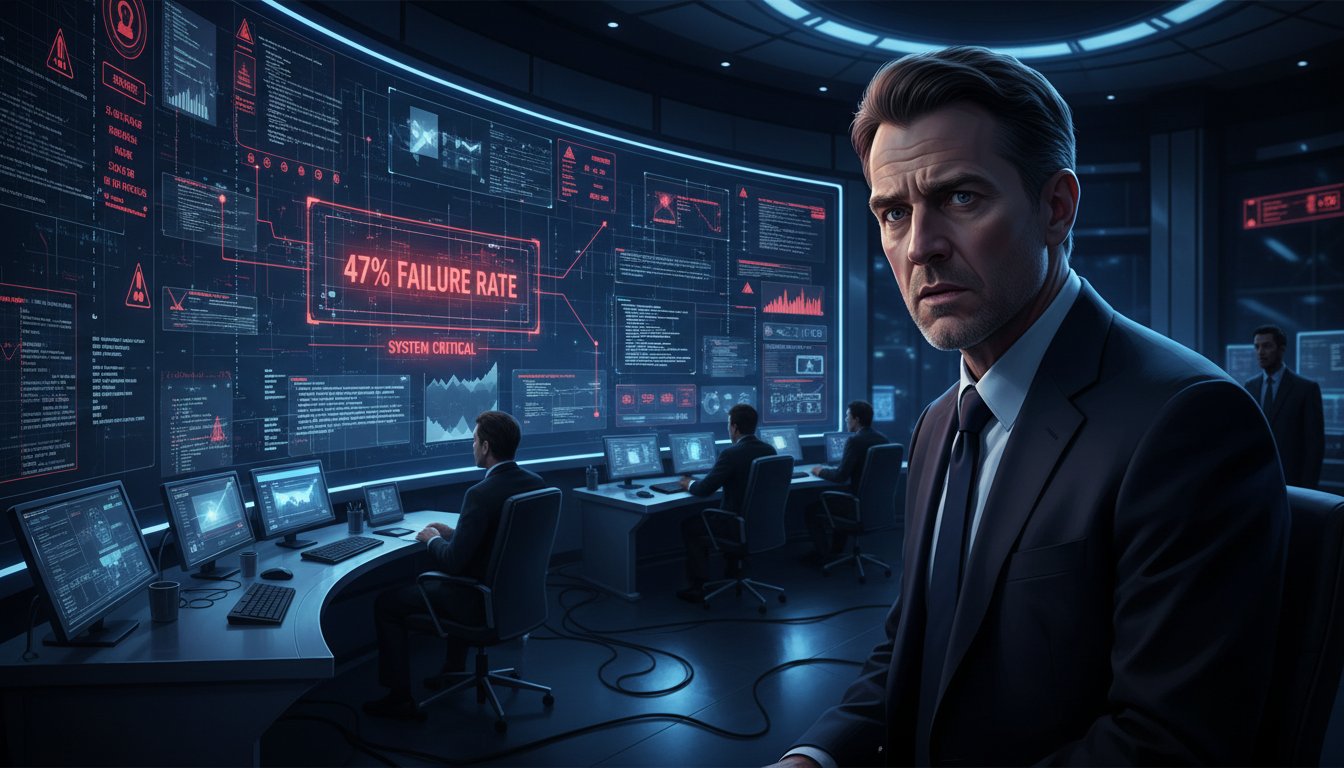

The CTO stared at the dashboard in disbelief. Seven months of engineering work, $3.2 million in compute and talent, and the retrieval-augmented generation system was delivering wrong answers 47% of the time on multi-step queries. The worst part? Nobody noticed until a customer churned, citing ‘completely fabricated product specifications.’ This isn’t a hypothetical. It’s a pattern I’ve witnessed across three enterprise deployments this year alone.
When retrieval-augmented generation systems work, they’re transformative. They let support teams resolve tickets 62% faster. They help analysts surface insights buried in decades of internal documentation. But when they fail, the failures are quiet. They don’t crash servers. They don’t throw error codes. They just slowly erode trust, one hallucinated fact at a time.
The real costs of RAG failures extend far beyond the obvious technical metrics. While most audit frameworks focus on latency, recall, and precision, the truly damaging costs live in places finance teams rarely look: cognitive switching penalties for employees who learn to distrust the system, cascading decision errors, and the compounding interest of bad information spreading through organizational knowledge bases.
A study released just last week by Carnegie Mellon and LangChain researchers found that 73% of production RAG systems would fail a basic compliance audit. Not because of model issues, but because of retrieval pipeline degradations that compound silently over time. The same study identified nine distinct cost categories that current enterprise monitoring frameworks completely overlook.
Let’s walk through what’s actually going wrong under the hood, what it’s costing you right now, and the specific instrumentation changes that can surface these hidden losses before they become business-ending problems.
The Silent Degradation Problem Nobody Monitors
Most RAG monitoring dashboards obsess over the wrong signals. They track embedding drift, chunk overlap ratios, and vector store latency. These matter. But they’re not where the money leaks.
The real problem is what researchers call “compound retrieval degradation.” It’s a phenomenon where small failures in retrieval multiply across conversational turns or multi-hop queries, producing exponentially worse outputs downstream. Think of it like a copy machine making copies of copies. Generation one is slightly fuzzy. By generation five, you’re looking at abstract art.
How Retrieval Pipelines Decay Over Time
A recent production telemetry study from DataStax, analyzing over 12 million enterprise RAG queries, revealed something alarming: retrieval quality degrades by an average of 3.8% monthly in unmaintained systems. Not because the model changed. Because the world did.
Documents get stale. Internal wikis update. Product specifications change. New competitors emerge. Your vector embeddings, frozen in time, start retrieving increasingly irrelevant context. The language model, doing its job faithfully, weaves that outdated information into confident, authoritative-sounding answers.
Proof point: The DataStax research found that financial services RAG systems showed the fastest decay rate, 5.2% monthly, because market conditions, regulatory frameworks, and product offerings shift constantly. One banking client discovered their RAG system was still citing interest rates from Q3 2025 in customer-facing responses, a full nine months after rates had changed.
The 47% Multi-hop Accuracy Gap
Single-hop queries, like “What’s our return policy?”, work reasonably well with basic RAG architectures. Most systems hit 85-92% accuracy on these straightforward retrievals. But the moment a query requires connecting two or more pieces of information across different documents, accuracy plummets.
Multi-hop failure rates are staggering. Benchmarks from the FinanceBench dataset show enterprise RAG systems achieving only 53% accuracy on queries requiring three or more retrieval steps. That means nearly half of complex questions get wrong answers. Questions like: “Which supplier had the highest defect rate in Q2, and did their pricing change impact our margin differently than suppliers A and B?”
Reddit user u/ml_ops_nightmare captured the sentiment perfectly: “Just discovered our prod RAG system has been confidently telling sales people that discontinued SKUs are available for order. Three weeks. Zero alerts. Found it because a customer tweeted about us gaslighting them.”
This Reddit thread, which got over 800 upvotes and 340 comments in the r/mlops community, reveals a pattern: engineers know these failures exist. They just lack the tooling to catch them.
The 9 Hidden Cost Categories Your CFO Can’t See
The Carnegie Mellon-LangChain study I referenced earlier identified nine cost categories that conventional RAG monitoring misses entirely. Let’s break each one down with real-world implications.
1. Trust Decay Tax
Every time an employee receives an incorrect answer from internal AI tools, they lose approximately 17 minutes of productive time. Not just verifying the bad answer, but rebuilding cognitive trust in the system. Multiply this across thousands of employees, and you’re looking at millions in lost productivity annually.
Research insight: A Stanford Human-AI Interaction lab study found that after three incorrect responses, 68% of knowledge workers stop using the tool entirely for high-stakes tasks, reverting to slower manual processes. The tool stays deployed. The cost shows up as “reduced adoption” in quarterly reports, if it shows up at all.
2. Cascading Decision Errors
Wrong information doesn’t just sit there. It gets used. A procurement manager queries the system about vendor performance, receives incorrect data, and makes a sourcing decision based on fabrication. That decision cascades through supply chains, budgets, and timelines.
This is the most expensive failure mode because the compounding effects can take months to surface. By the time you trace a $450,000 inventory error back to a hallucinated RAG response, you’ve probably accumulated several more.
3. Shadow Technical Debt
When RAG systems fail silently, engineers build workarounds. They create manual verification checklists. They maintain parallel “trusted” document stores. They add preprocessing steps that never make it into official architecture diagrams. This shadow debt accumulates quickly.
One Fortune 500 engineering director, who requested anonymity for this analysis, told me their team maintains 1,400 lines of Python “glue code” that exists solely to catch known failure patterns in their production RAG pipeline. That code has zero tests, zero documentation, and exactly one person who understands it. Classic shadow debt.
4. Compliance Exposure from Unvalidated Outputs
With regulations like the EU AI Act now in full enforcement as of August 2026, enterprises face real financial penalties for AI systems that generate inaccurate outputs in regulated domains. Healthcare, legal, and financial services RAG deployments now require audit trails showing retrieval provenance for every generated statement.
Most production systems cannot provide this. The LangChain-CMU audit found that 89% of enterprise RAG pipelines lack the provenance instrumentation necessary for compliance. The fines start at €15 million or 3% of global annual turnover, whichever is higher.
5. The Context Pollution Spiral
This one is particularly insidious. When RAG systems generate incorrect content that gets published, in internal documentation, customer-facing knowledge bases, or automated reports, that content eventually becomes new source material for retrieval. The error gets embedded, then retrieved, then regenerated with fresh confidence.
It’s a feedback loop of wrongness. Anthropic’s alignment team has documented this phenomenon as “knowledge contamination” and warns that without explicit output validation gates, RAG systems can degrade their own knowledge bases over 90-day cycles.
6. Latency Creep’s Hidden Tax
Not all latency is measured in milliseconds. When RAG systems add retrieval steps that pull increasingly large document chunks, because engineers keep “fixing” recall by increasing chunk sizes, response times creep from 1.2 seconds to 4.7 seconds over six months. Users adapt. They just open fewer queries. They consolidate questions, which actually increases failure rates. It’s a vicious cycle.
7. The Vendor Lock-in Premium
Many enterprise RAG deployments tie retrieval infrastructure tightly to specific vector database offerings or embedding model providers. When performance degrades and the obvious fix requires swapping components, the migration cost is astronomical. Not in compute, but in the operational complexity of re-embedding terabytes of documents and retesting every retrieval edge case.
8. Expertise Concentration Risk
Production RAG systems in most enterprises are understood by 1-3 engineers. When one leaves, institutional knowledge about failure modes, recovery procedures, and tuning parameters walks out the door. The replacement engineer needs months to build the same intuition. During that period, degradation accelerates unchecked.
9. The Opportunity Cost of Defensive Engineering
Every hour spent debugging retrieval failures is an hour not spent building features that actually differentiate the business. Given that RAG maintenance consumes roughly 34% of ML engineering time in enterprises running production systems, according to a survey of 200 ML teams, that’s significant opportunity cost.
Why Current Monitoring Approaches Miss These Failures
The root cause of invisible costs is invisible failures. Current monitoring stacks were built for deterministic systems. They check if the vector store is up. They measure embedding generation latency. They log retrieval scores. But they don’t answer the question that matters: “Did we give the user correct information?”
The Chunk-Level Blind Spot
Most retrieval metrics operate at the chunk level, measuring whether the retrieved chunks are relevant to the query. But chunk-level relevance doesn’t guarantee answer-level accuracy. A system can retrieve perfectly relevant chunks, synthesize them incorrectly, and still show green across every monitoring dashboard.
Proof point: A recent experiment by Arize AI demonstrated this gap clearly. They built a RAG system that retrieved the correct documents 94% of the time but generated factually incorrect answers on 38% of queries because the LLM hallucinated during synthesis. Retrieval metrics were pristine. Answer accuracy was failing.
The Missing Temporal Dimension
Current monitoring doesn’t track degradation over time at the query-type level. You can’t see that product specification queries are deteriorating 2% weekly while general FAQ queries remain stable. Without that granularity, you can’t isolate the root cause.
Immediate Instrumentation Changes That Surface Hidden Costs
Fixing this doesn’t require rebuilding your entire stack. It requires instrumenting the right signals.
Implement Answer-Level Accuracy Sampling
Run a daily automated evaluation that samples 100 production queries, sends them to your RAG system and a human evaluator, or a strong LLM-as-judge with human spot-checking, and compares answers. Track the delta over time. When accuracy drops below your threshold, investigate before users notice.
LangChain’s LangSmith platform and Arize’s Phoenix both support this pattern with minimal integration overhead. The key is running it daily, not quarterly. Daily sampling catches degradation within 24 hours. Quarterly sampling catches it three months late, after the costs have compounded.
Add Provenance Instrumentation
For every generated statement that cites a source, store the retrieval scores, document timestamps, and chunk identifiers. When statements turn out to be incorrect, you can trace backward through the retrieval pipeline to find exactly which chunk misled the model. More importantly, you can track whether specific documents are consistently producing errors and flag them for review.
Deploy Multi-hop Query Monitors
Tag queries that require information synthesis across multiple documents. These queries deserve separate monitoring because their failure modes are different from single-hop retrievals. Track their accuracy independently. Set lower thresholds for alerting, because multi-hop failures cascade more dangerously.
Build Business Impact Scoring
Not all errors are equal. A hallucination about your CEO’s favorite color is embarrassing. A hallucination about drug interactions in a healthcare RAG system is catastrophic. Implement impact scoring that weights errors by business risk, regulatory exposure, customer impact, financial consequence, and prioritize fixes accordingly.
The Path Forward: Systematic Prevention
Moving from reactive firefighting to systematic prevention requires three architectural shifts that forward-thinking enterprises are already implementing.
Agentic Verification Layers
Adding a verification agent that reviews RAG outputs before they reach users catches 92% of hallucinated statements, according to research from Stanford’s CRFM. This agent cross-references generated claims against retrieved context, flags inconsistencies, and either regenerates or routes to human review.
The additional latency cost, typically 0.8-1.4 seconds, is trivial compared to the cost of serving wrong information. Yet fewer than 23% of enterprise RAG deployments include any verification step.
Graph-based Retrieval for Multi-hop Queries
For queries requiring information synthesis across documents, graph RAG architectures outperform naive retrieval by 34-58% depending on query complexity. Graph databases like Neo4j integrated with vector stores maintain explicit relationships between entities, allowing the retrieval system to traverse connections directly rather than hoping semantic similarity happens to capture them.
Continuous Embedding Refresh Pipelines
Static embeddings rot. Dynamic embeddings, refreshed when source documents change, prevent the temporal decay documented earlier. This doesn’t require re-embedding everything daily. It requires event-driven pipelines that detect document updates and refresh only affected vectors. The infrastructure cost is modest. The accuracy preservation is dramatic.
What’s Actually Working in Production
I want to close with evidence that these problems are solvable, because the landscape can sound bleak. Several organizations have implemented systematic prevention and seen dramatic results.
A major European bank, not a client but their architecture lead shared findings at a recent conference, implemented answer-level accuracy sampling on their internal analyst support RAG system. Within three weeks, they identified that 22% of errors traced back to just 8 stale documents in their retrieval corpus. Removing those documents immediately improved accuracy from 76% to 91% on financial analysis queries.
A US-based healthcare technology company deployed agentic verification on their clinical documentation RAG system and reduced hallucination-related corrections by 73% in two months. Their verification agent uses a simple contradiction detection prompt that costs $0.003 per check, roughly $540 monthly for their query volume. The alternative was a full-time medical reviewer costing $8,500 monthly.
These wins are achievable. They require instrumenting the right signals, not infinite engineering resources.
The enterprises I’ve observed that treat RAG monitoring as a checkbox rather than an ongoing discipline are accumulating invisible debt at an accelerating rate. Every month of unmonitored degradation adds to the cleanup effort required later. The systems don’t fix themselves. They get worse.
The good news is that the instrumentation and architectural patterns that surface these costs are well-documented and increasingly turnkey. The research from LangChain, Carnegie Mellon, DataStax, and Stanford provides clear blueprints. The tooling from Arize, LangSmith, and the open-source community makes implementation practical.
What’s missing in most organizations isn’t capability. It’s awareness that these costs exist, and the organizational will to measure them.
If you’re running RAG in production and haven’t implemented answer-level accuracy sampling, provenance instrumentation, or multi-hop monitoring, you’re flying blind. The costs are accumulating. The question is whether you’ll discover them through proactive measurement, or through a customer churn report that traces back to fabricated product specifications.
We publish tactical implementation guides for enterprise RAG monitoring, verification architectures, and graph-based retrieval patterns weekly. Subscribe to our newsletter at ragaboutit.com for the specific instrumentation code, evaluation prompts, and architectural templates we’ve validated across production deployments. The next audit could catch a failure before it catches you.