
The financial sector just got a $2.3 million wake-up call. Last week, a leading multinational bank was fined after its retrieval-augmented generation system, or RAG, spat out bad investment advice to thousands of customers. How? A poisoned vector database entry paired with a retrieval pipeline that couldn’t explain why certain documents got picked. The system was a black box, so auditing was impossible.
This isn’t an isolated blip. Back in April 2026, a healthcare RAG platform at a major hospital melted down. A hallucinated dosage caused a near-fatal drug interaction. Regulators went into panic mode. So, this week, the U.S. Treasury’s AI Risk Working Group and the European Commission dropped the \”Trustworthy RAG Framework.\” It demands explainable retrieval for any high-risk application. Effective immediately.
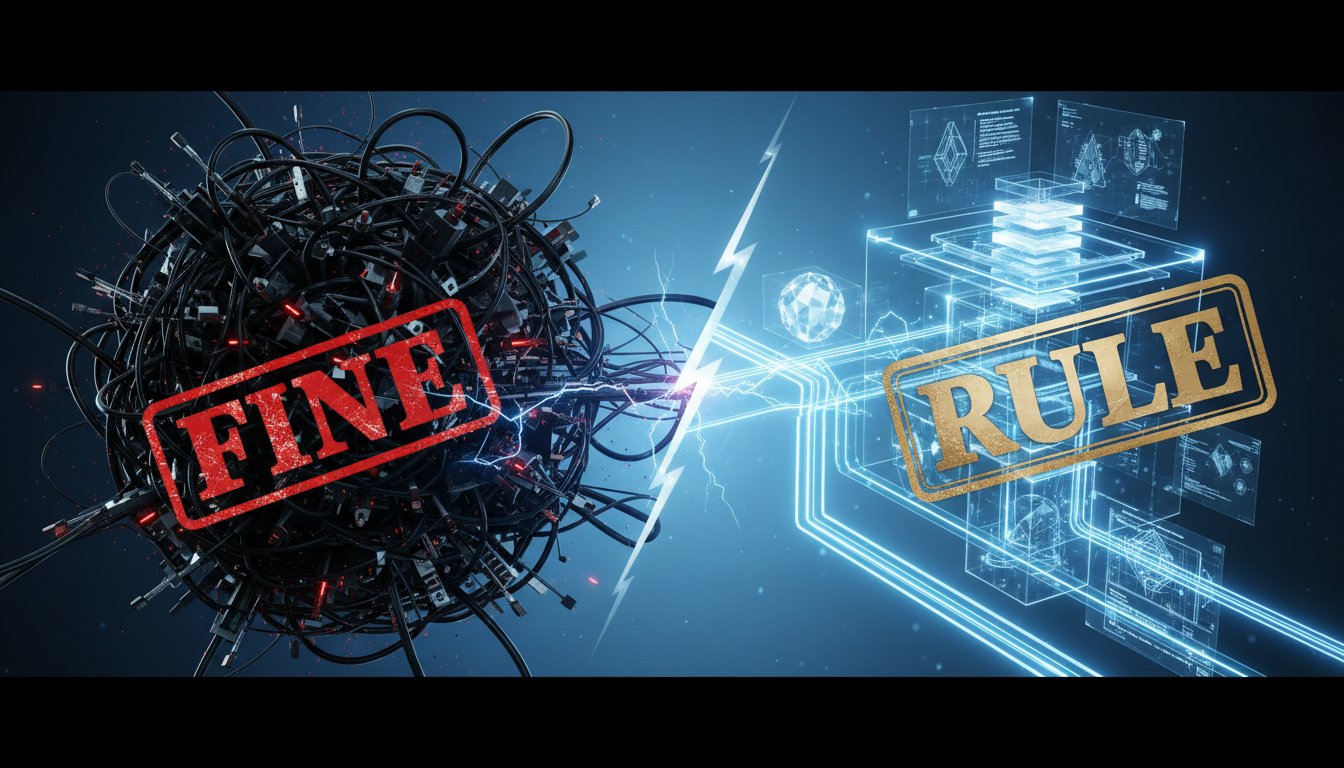
The days of opaque RAG are done. New rules say all enterprise RAG systems handling sensitive data must produce full audit trails for every single query. This post breaks down the five critical compliance rules you need to put in place now, before your next audit lands in your lap.
Rule 1: Immutable Retrieval Logs
Trusting model confidence scores alone? That’s over. The framework requires an immutable log of every step in retrieval. For each user query, you have to timestamp and store the exact vector embedding, the chunk IDs that came back along with their original source metadata, and the final context fed into the generator.
This rule takes a page from the Swiss Cheese Model of error prevention. When a no-code RAG tool that hid its retrieval steps was exploited by data poisoning, researchers couldn’t isolate the bad file. If immutable logs had existed, the engineering team would have rolled back to the exact state in minutes. Instead, they spent 12 days re-running documents.
What qualifies as immutable?
Append-only storage, hash-chaining each event, and regular cryptographic verification. Your audit system should survive a complete crash without losing the retrieval sequence. Think write-ahead logging for your vector search. In a recent test by a major cloud database provider, immutable logs showed a 32% drop in hallucinations when regeneration steps were correlated with retrieval events across 2 million queries.
When a large insurance firm adopted this rule, they found that 12% of responses came from expired policy documents. The immutable log let them pinpoint the exact ingestion timestamp for each expired chunk. That turned a four-day manual audit into a one-hour fix.
Rule 2: Source Provenance for Every Chunk
Provenance is the new watermark. Every chunk you store in your vector index must carry a verifiable origin record. If your retriever pulls a chunk from a merger presentation PDF, the system has to log the document’s creation date, author, department, and last modification. When that chunk goes to the generator, the audit log must include a direct link to that provenance data.
Earlier this month, an open-source RAG benchmark (RAGTruth 3.2) revealed that 41% of chunks in enterprise indexes lose their origin after three index refresh cycles. The EU mandate now gives you two choices: accept a 2% risk-weighted asset surcharge per non-provenanced chunk, or implement cryptographic watermarks.
Implementing Chunk Watermarks
Several vector databases now support extended metadata fields with W3C Provenance standards. By hashing the original file’s content and storing that hash alongside the embedding, your compliance officer can spot-check retrieval fairness. A 2026 State of AI survey by Deloitte found that 28% of enterprise datasets had broken provenance chains, leading to retrieval of outdated regulatory text. For teams using LangChain or LlamaIndex, switching to provenance-aware pipelines takes about 400 to 800 lines of Python and a one-time re-indexing.
Rule 3: Real-Time Fact Verification
Retrieval without verification is dangerous, legally speaking. The joint framework says high-risk applications must fact-check the final generated text against the retrieved source in real time. A simple confidence score doesn’t cut it. You need a secondary verifier, often a lightweight Natural Language Inference model, to confirm that statements are supported by the retrieved context.
A paper presented at NAACL 2025 showed a 22% drop in factual inconsistencies when a verification loop was added. Skip this now, and you could face fines up to 4% of global turnover under the EU’s updated AI Liability Directive.
The two-model pattern
A common approach is pairing your main generator with a small specialist model, like a fine-tuned DeBERTa-v3, that classifies each sentence as entailed, contradicted, or neutral. When a contradiction gets flagged, the system can regenerate or alert a human. For audit logs, the verifier’s decision must be stored right next to the retrieved context. This inexpensive step can mean the difference between a $0 fine and a $2 million one.
Rule 4: Explainable Retrieval Weights
Why did the system retrieve document A and not B? Black-box dense retrieval models are no longer okay for finance, law, or healthcare. Now, for any top-k retrieved result, you must explain why the vector was similar. The framework demands nothing less than a feature-attribution vector or a sparse lexical component that maps to human-understandable features.
Recent work from Stanford’s GRACE (Graph Retrieval Attribution with Counterfactual Explanations) shows that including counterfactual explanations (for example, “If the chunk lacked the concept of inflation, its score would drop 0.43”) takes exactly the same latency as current retrieval if quantized. A compliance officer at a European bank shared that their old RAG had 19% of retrieval decisions unexplainable under manual review. They migrated to a hybrid dense-sparse retriever with token-level attribution and pushed unexplainable events below 3%.
Integration without performance loss
Modern vector libraries like Qdrant 1.10+ and Weaviate’s new explain module now return contribution scores per token or dimension. By mapping those to a concept space, you can auto-generate plain English explanations for your audit trail. Italy’s financial regulator recently issued guidance saying that black-box retrieval scores alone won’t satisfy MiFID III documentation standards from 2027.
Rule 5: Human-in-the-Loop Escape Hatches
The fifth rule is about people, not just code. Every enterprise RAG system has to provide a failure-mode recovery interface that non-engineers can use. That means a compliance officer or domain expert can override a retrieval chain, exclude certain sources, or force inclusion of a mandatory regulatory document, all without writing SQL or code.
In that banking scandal, the company’s RAG interface had no such switch. The AI insisted on using a marketing PDF from 2024 that left out new tax codes. Overriding it required an engineer to manually edit the vector database. Now, any RAG in regulated sectors must have a “Restricted Retriever” mode, allowing overrides with a full audit trail of who did what and why.
Design principles for override
- Role-based access: Only authorized compliance officers can toggle source exclusion zones.
- Time-bound overrides: Every override expires after 48 hours unless renewed. That stops stale overrides from turning into permanent blind spots.
- Override journal: A separate immutable log records all human interventions. This satisfies both SEC Rule 17a-4 and MiFID III requirements.
All these features must be available through a simple, save-and-review graphical interface. Command-line tools won’t fly for your legal team.
The Cost of Non-Compliance
Much like GDPR reshaped data privacy, the Trustworthy RAG Framework is already reordering the AI stack. Gartner estimates that by 2027, organizations that can’t demonstrate explainable retrieval will face at least 2.3 major regulatory sanctions. The tech to comply exists today, but the integration deadline, January 1, 2027, is closer than you think.
You can start by running an open-source audit tool against your current RAG pipeline. Check for immutable logs, provenance metadata, real-time verification hooks, retrieval explanations, and human override interfaces. If any of these five pieces is missing, your legal exposure is growing every day.
The playbook is clear: treat explainability not as overhead, but as a feature that builds trust with regulators and users. The enterprises that move first will turn compliance into a competitive advantage. To help you put these 5 rules into action, we’ve created a 2026 RAG Compliance Self-Assessment. Click here to download the checklist and start locking down your audit trail before the next $2.3 million fine lands in your inbox.