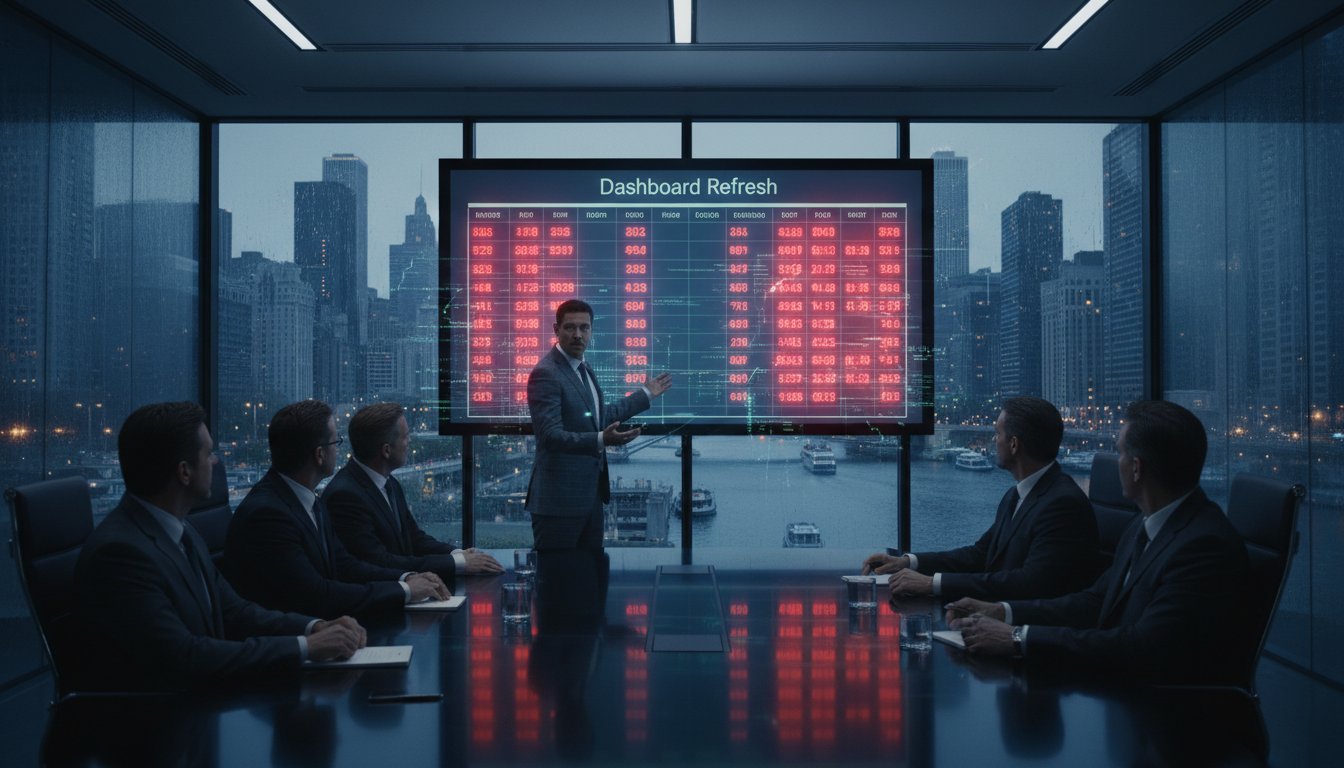

The knock came on a Tuesday. In a glass-walled conference room overlooking the Chicago River, a chief data officer faced a grim spreadsheet: a retrieval-augmented generation pipeline had hallucinated a critical figure during a live client-facing dashboard refresh. The fallout? A key contract paused, and the internal post-mortem revealed not a one-off model glitch but a systemic zero-shot retrieval failure that had been silently undermining results for months.
Zero-shot retrieval, which means sending a query to a vector database and trusting the model to fetch the right chunks without domain-tuned embeddings, re-rankers, or custom metadata filters, has become the default starting point for enterprise RAG. It’s simple, fast, and often good enough for demos. But as organizations scale from proofs of concept to production, the assumptions behind zero-shot relevance unravel. And when they collapse, the consequences move from academic annoyance to financial liability.
This reality hit the RAG community with fresh data in May 2026. A new benchmark released by Vectara, in collaboration with two large financial services adopters, found that base zero-shot retrieval accuracy on out-of-domain financial filings dropped to 37.8% versus 71.2% for the same queries run through a fine-tuned embedding model. A separate study published by Stanford HAI on May 16 revealed that hallucination rates in zero-shot RAG systems nearly tripled when the ingested corpus contained more than 20% of documents written in a different style or format than the queries, a condition that describes nearly every enterprise knowledge base.
These aren’t hypothetical risks. They represent seven distinct failure modes that are costing enterprises millions in lost productivity, compliance violations, and missed revenue. We’ll dissect each failure, back it with data, and outline pragmatic mitigations that go beyond simply “train a better model.”
1. The Semantic Drift Blind Spot
Semantic drift occurs when the general-purpose embedding model used in zero-shot setups fails to recognize that a term or phrase means something entirely different inside a specific organization. A query for “margin” in a retail context should surface documents about gross profit, not page layout instructions. A standard all-MiniLM-L6-v2 embedding model, still common in many RAG starters, has no way to disambiguate these meanings without additional context.
A recent audit by a large European insurer quantified the cost of this drift. Over one quarter, 14% of answers generated by their customer-facing RAG bot contained information pulled from the wrong department’s knowledge base because the embedding model treated “policy” in the insurance sense identically to “policy” in an HR document. The resulting confusion required an estimated €400,000 in manual review and correction efforts. The root cause wasn’t a bad model; it was the assumption that a general embedding space would naturally align with the company’s internal semantic boundaries.
What to watch for: Clusters of retrieved chunks that come from clearly irrelevant departments or document types. If a query about “claims processing” occasionally pulls from the marketing style guide, semantic drift is active.
2. The Format Mismatch Penalty
Enterprise corpora are messy. They blend PDFs, Confluence pages, Slack transcripts, scanned images with OCR text, and legacy Word documents. Zero-shot retrieval models trained primarily on clean web text often stumble when faced with this formatting variety. The Stanford HAI study found that retrieval recall dropped by 22 absolute percentage points when the majority of documents in the index were PDFs with multi-column layouts and embedded tables, compared to plain-text documents.
One manufacturing company learned this the hard way. Their RAG application, designed to assist engineers with maintenance procedures, relied on zero-shot retrieval. Because most procedure documents were scanned PDFs with dense formatting, the chunking strategy frequently broke mid-sentence, and the embedding model treated fragmented text as low relevance. For six weeks, the system silently omitted critical torque specifications from its responses. A near-miss safety incident finally triggered an audit, revealing a format-induced recall failure that had gone unnoticed because the generated answers were always plausible but dangerously incomplete.
What to watch for: Answers that miss highly relevant information that you know exists in certain document types. Pre-ingestion format conversion and semantic chunking aren’t nice-to-haves; they’re prerequisites for production-grade retrieval.
3. The Phantom Query Bubble
Zero-shot RAG systems assume user queries will look like the retrieval training data. In enterprise settings, they rarely do. Employees type terse keyword strings, voice-to-text transcriptions, or error codes. A support engineer might paste the entire stack trace along with a one-line summary. The embedding model, never fine-tuned on such queries, maps them to semantically adjacent but incorrect document chunks.
A 2025-2026 longitudinal study by Pinecone Nexus, released at their annual conference on May 20, 2026, measured the “query distribution gap” for 12 enterprise RAG deployments. The study found that, on average, 31% of real user queries fell outside the distribution of the queries used to train or evaluate the embedding model. In zero-shot configurations, this translated to a 40% increase in retrieval failures compared to deployments that used a query rewriter or a fine-tuned embedding adapter.
What to watch for: A high rate of “no relevant documents found” or obviously off-topic retrieved context. Logging query-answer pairs and visualizing the retrieval space can expose the phantom bubble before it costs you users.
4. The Hallucination Magnification Effect
Retrieval quality and hallucination rates are tightly coupled. When a RAG system retrieves irrelevant or weakly relevant chunks, the generator, whether it’s GPT-5, Claude 4, or Llama 4, will often try to reconcile the context with the query by filling gaps with plausible fabrications. The Stanford HAI study quantified this: in zero-shot RAG, every 10-point decrease in retrieval precision corresponded to a 23% increase in hallucinated answer fragments, as judged by human evaluators.
A legal tech firm deployed a RAG assistant to help junior associates locate precedent cases. The zero-shot vector search often retrieved cases from the wrong jurisdiction or outdated statutes. The LLM, receiving this noisy context, would confidently synthesize a legal argument that sounded correct but was fatally flawed. During a mock trial exercise, the opposing counsel exposed two fabricated precedents that the RAG assistant had hallucinated. The firm’s reputation took a hit, and they immediately paused the deployment, spending an estimated $1.2 million on a remediation project that included fine-tuned retrieval, domain-specific re-rankers, and a factuality-checking agent.
What to watch for: User reports of answers that contain specific, verifiable falsehoods that cannot be traced to any ingested document. Treat these as retrieval failures first, not generation failures.
5. The Missing Metadata Glue
Zero-shot retrieval often ignores metadata: document timestamps, author departments, confidentiality levels, or version numbers. This is fine for flat public datasets. It’s disastrous for regulated enterprises where the answer to a policy question might be completely different depending on the effective date or the user’s region.
A multinational bank rolled out an internal HR chatbot using a pure zero-shot RAG pipeline. An employee in Germany asked about vacation carry-over rules. The system retrieved and synthesized text from an outdated policy document that had been superseded three years prior. Because no metadata filter was applied, the older document, which had higher vector similarity to the query phrasing, won out. The employee was misinformed, HR was inundated with correction requests, and the compliance team flagged a risk of systematic policy miscommunication. The fix, introducing metadata-based filtering and freshness boosts, was straightforward to describe but required a full re-ingestion and retrieval pipeline rebuild.
What to watch for: Answers that contradict the latest known policy or document. Check whether the retrieval pipeline respects document dates, version tags, or access controls before production deployment.
6. The Cost of Plausible-Looking Correctness
The most insidious zero-shot failure is the one that looks right. Unlike outright hallucinations, these answers are factually correct but contextually wrong. They use the right terms, cite real data points, but answer a superficially similar but functionally different question. This failure mode is particularly common when the knowledge base contains numerous documents discussing similar topics at slightly different layers of abstraction.
Consider a product management RAG tool that was asked, “What is the approved Q3 marketing budget for the Pro Suite?” A zero-shot retrieval returned a detailed budget table for the previous year’s Pro Suite marketing, and the LLM generated a confident answer that the marketing lead almost forwarded to the CFO. Only a last-minute manual check caught the discrepancy. The retrieval had been fooled by dense numerical content and overlapping project names. For a startup, that near-miss could have meant misallocating hundreds of thousands of dollars.
What to watch for: Implement “provenance tracing” that shows users which specific chunks were used to generate an answer. If an answer contains numbers, insist on showing the source document’s effective date. This transparency often reveals plausible-but-wrong retrievals that would otherwise go undetected.
7. The Scaling Cliff
Zero-shot retrieval performance degrades non-linearly as the corpus grows. A system that works flawlessly with 50,000 documents may collapse at 500,000. Vector index noise increases, the chance of spurious nearest neighbors rises, and the flat similarity threshold that worked in a small corpus starts admitting too much irrelevant context.
A logistics company experienced this firsthand. Their RAG system, built to answer questions about global shipping regulations, indexed 80,000 documents in its pilot phase with 89% precision. Encouraged, they expanded to 450,000 documents across 12 countries. Precision dropped to 56%. The culprit wasn’t embedding quality; it was the curse of dimensionality combined with a fixed cosine similarity threshold that was never recalibrated. Answer quality degraded so much that the operations team abandoned the tool, reverting to manual document lookups. The estimated wasted development cost exceeded $800,000.
What to watch for: A slow, gradual decline in retrieval quality as you add documents. Regular retrieval evaluation on a fixed golden dataset of queries can catch the cliff before it becomes a chasm. Techniques like hybrid search, adaptive similarity thresholds, and coarse-grained hierarchical retrieval become essential at scale.
Mitigations That Move Beyond Zero-Shot
While the failures are sobering, the solutions are increasingly mature. The RAG ecosystem has evolved rapidly in 2025-2026 to address these pain points:
- Fine-tuned embedding adapters: Instead of replacing the base model, organizations are training lightweight adapters on a few thousand domain-specific query-document pairs. This approach bumps retrieval precision significantly without the cost of full fine-tuning.
- Query rewriters: A small LLM step that reformulates terse or domain-specific user queries into more retrievable forms. Tools like LangChain’s MultiQueryRetriever or Cohere’s query rewriting API have become standard.
- Metadata-aware hybrid search: Combining vector similarity with keyword-based and metadata-filtered retrieval (e.g., using Vespa, Elasticsearch, or Weaviate) catches the format and metadata failure modes early.
- Re-ranking pipelines: A cross-encoder re-ranker applied to the top-k retrieved chunks dramatically improves relevance. The additional latency can be offset by batched re-ranking and caching.
- Provenance and observability: Platforms such as LangSmith, Arize Phoenix, and Pinecone’s new trace APIs allow teams to monitor retrieval precision, drift, and hallucination rates in production, creating a feedback loop that prevents silent failures.
The common thread is moving from an assumption of retrieval competence to a posture of retrieval validation. Zero-shot retrieval is a starting point, not a destination.
Zero-shot RAG’s appeal is undeniable: it gets you to a demo fast and reduces initial engineering complexity. But the enterprise isn’t a demo environment. The seven failures described here (semantic drift, format mismatch, phantom query bubbles, hallucination magnification, missing metadata glue, plausible-but-wrong answers, and the scaling cliff) compound in production, converting technical debt into financial and reputational losses.
The good news is that the industry’s tooling and research have matured to meet these challenges. The organizations that transformed their painful failures into resilient architectures didn’t abandon RAG; they stopped treating it as a one-step vector lookup. They invested in relevance engineering: the continuous tuning, monitoring, and structured layering that turns a fragile zero-shot prototype into a trustworthy enterprise knowledge service.
If your team has faced similar challenges, we invite you to join a community of engineers and architects who are building the next generation of reliable RAG systems. Subscribe to our weekly newsletter below, and you’ll receive exclusive deep-dives, early access to new benchmarks, and practical playbooks straight from the production trenches. Your first edition includes our “Enterprise RAG Audit Checklist” that helps you spot these seven failure modes before they hit your bottom line.