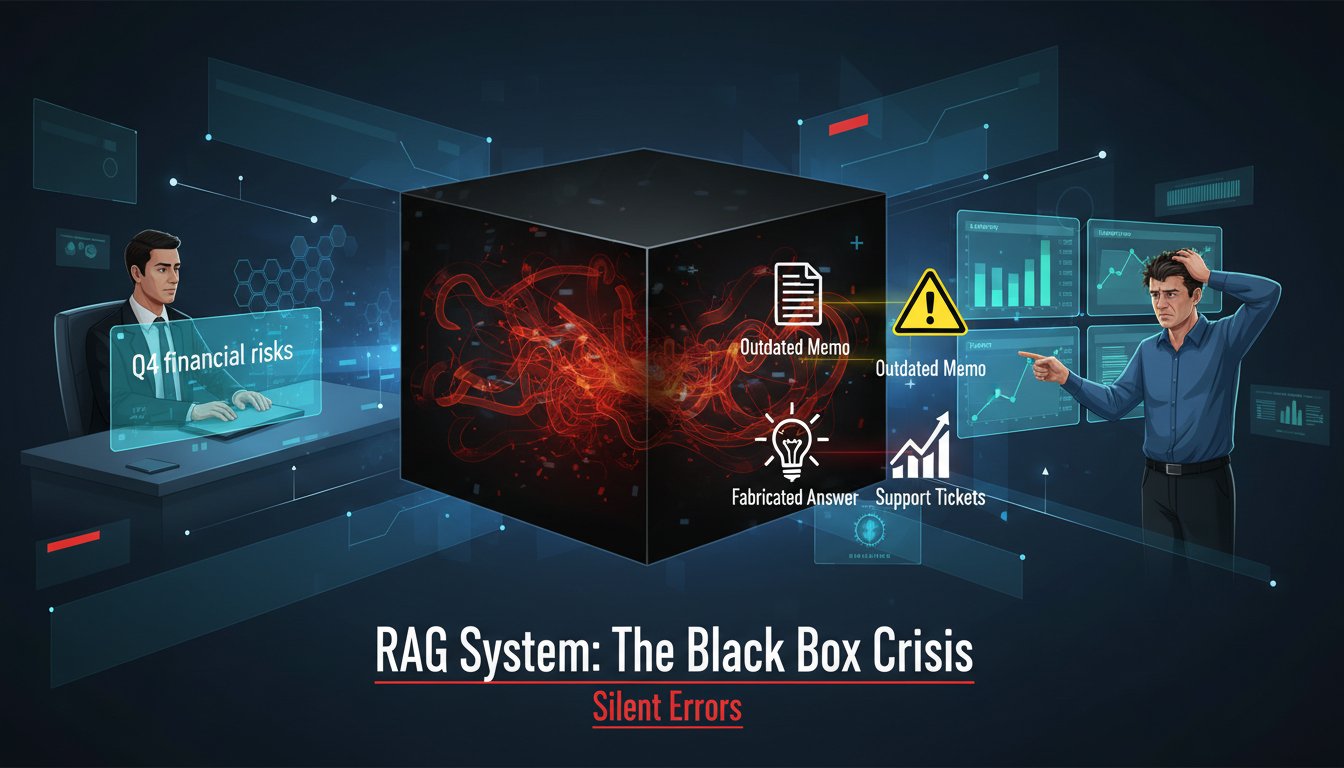

An enterprise AI team at a major financial services firm deployed their new RAG system with high hopes. Early tests looked promising. Retrieval scores were solid, and the answers seemed coherent. But three months into production, support tickets started flooding in. A risk analyst asked about exposure limits in a specific European market and received a confident but entirely fabricated answer. A compliance officer’s query about new SEC regulations pulled from an outdated internal memo. When the engineering team dug into their monitoring dashboards, they saw the usual metrics: token counts, latency graphs, and vague “confidence scores.” They had observability data, but it told them nothing about why the system was failing. The bottleneck wasn’t the model. It was the complete black box between the user’s question and the final answer. This is the silent crisis of modern RAG: systems that appear healthy while delivering dangerously inconsistent results.
Most enterprise RAG deployments today rely on probabilistic monitoring, tracking what might be happening based on aggregate signals like latency or token usage. This approach fails because it doesn’t capture the deterministic relationship between input, retrieval, and generation. Without deterministic observability, teams can’t guarantee that a query about “Q4 financial risks” will reliably retrieve the correct risk assessment documents, nor can they prove that the generated answer faithfully represents those documents. The result is what one AI architect calls “stochastic reliability”: systems that work until they don’t, with no clear explanation or path to correction.
The solution is shifting from probabilistic dashboards to deterministic tracing. This means instrumenting every step of the RAG pipeline, from query parsing and embedding to retrieval, reranking, context construction, and final generation, with traceable, verifiable data. When a problematic answer surfaces, teams should be able to replay the exact pipeline execution, see which chunks were retrieved (and which were missed), understand why the reranker scored them that way, and pinpoint where in the prompt template the context was misinterpreted. This level of transparency transforms RAG from an unpredictable black box into a debuggable, improvable system. What follows are seven proven strategies to implement deterministic observability, moving beyond surface-level metrics to achieve true production-grade reliability in enterprise AI.
Building Your Deterministic Observability Foundation
Before you can trace failures, you need a foundation that captures every decision your RAG pipeline makes. This requires moving beyond simple logging to structured event tracing that preserves causality.
Implement Comprehensive Pipeline Tracing
The core of deterministic observability is a trace: a complete record of a single query’s journey through your system. Each trace should capture:
– The Original Query: With all parameters and metadata (user ID, session, timestamp).
– Query Transformations: Any rewriting, keyword extraction, or hypothetical document embedding (HyDE) applied.
– Retrieval Events: The exact embedding vector used, the similarity search performed against the vector database (including the index configuration), and every candidate chunk returned with its similarity score.
– Reranking Decisions: If applicable, the input to your reranker and the new scored list of chunks.
– Context Assembly: The final set of chunks selected for the prompt, in the exact order they were presented to the LLM.
– Generation Input/Output: The full prompt sent to the LLM (including system instructions and context) and the complete, raw response.
Tools like OpenTelemetry for LLMs (OTel for LLMs) or vendor-specific tracing SDKs can automate this instrumentation. The key is making sure these traces are stored with high fidelity and can be queried efficiently, not just sampled. As a Lead ML Engineer at a healthcare AI company puts it, “We moved from 1% trace sampling to 100% for all production queries. The storage cost increased, but the ability to instantly diagnose any hallucination paid for itself in reduced engineer hours and prevented compliance incidents.”
Define and Track Ground Truth Metrics
Deterministic observability requires moving beyond vague “accuracy” to specific, measurable metrics that compare system output against a known truth. You’ll want to run automated evaluation against a golden dataset of questions and validated answers. Critical metrics include:
– Retrieval Precision/Recall: What percentage of retrieved chunks are relevant? What percentage of all relevant chunks were retrieved?
– Answer Faithfulness: Does the generated answer contain any statements not supported by the retrieved context? (Measured via LLM-as-a-judge or rule-based checks.)
– Answer Relevance: Does the generated answer directly address the original query?
These metrics must be tracked per trace and aggregated. By correlating low faithfulness scores with their corresponding traces, you can identify patterns. For instance, you might find that hallucinations spike when more than 12 chunks are in the context, pointing to context window saturation.
Three Strategies for Proactive Failure Detection
With tracing in place, you can move from reactive debugging to catching failures before users notice them.
Establish Semantic Drift Baselines
RAG systems degrade subtly. The embedding model’s perception of semantic similarity can drift from your data. New documents get added, changing the density and relationships within your vector space. To detect this, establish weekly or monthly baseline evaluations using your golden dataset. Track:
– Mean Reciprocal Rank (MRR) Trend: Is the average ranking position of the first relevant chunk getting worse?
– Embedding Cluster Density: As you add documents, do similar concepts stay clustered tightly in the vector space, or do they scatter?
– Query Intent Distribution: Are users asking new types of questions that your query understanding layer wasn’t designed for?
A financial technology firm implemented this and discovered a 15% gradual decline in MRR over six months, traced back to their embedding model becoming less effective on numerical tabular data as their knowledge base grew. They switched to a specialist embedding model before performance crossed an error threshold.
Implement Deterministic Canary Tests
Deploying a new embedding model, reranker, or chunking strategy is risky. Probabilistic A/B testing can show an average improvement while hiding catastrophic failures for specific query types. Instead, use deterministic canary tests. Before a full rollout, run the new component on a fixed set of critical production queries (your “canaries”) and compare the trace output against the old component, result by result.
Check for deterministic equivalence: Did the new pipeline retrieve the exact same set of relevant chunks? Did it generate the same answer? If not, you need to analyze the difference. This prevents scenarios where a new embedding model improves average cosine similarity but fails on all queries containing specific jargon vital to your business. “Canary testing forced us to be precise,” says an AI Platform Director. “We couldn’t just say ‘looks good.’ We had to prove it behaved identically or explain exactly how it was different and why that was better.”
Create Alerting on Trace Anomalies
Alerts shouldn’t just fire on high latency. Configure them on deterministic signals within traces:
– Empty Retrieval Alerts: A query that returns zero chunks from the vector database (after reranking) is a guaranteed failure. This often points to a vocabulary mismatch or embedding failure.
– Low Max Similarity Alerts: If the highest similarity score for any retrieved chunk falls below a threshold (e.g., 0.7), the system is retrieving weak candidates and will likely hallucinate.
– Context Window Saturation Alerts: When the total token count of assembled chunks exceeds 80% of your LLM’s context window, answer quality can drop sharply due to lost information in the middle.
– Faithfulness Violation Alerts: Use a lightweight, fast LLM-as-a-judge to spot-check a sample of answers for faithfulness and alert if violations spike.
These trace-level alerts give engineers a specific starting point for investigation, unlike a generic “high error rate” alert that tells you nothing actionable.
Two Strategies for Root Cause Analysis and Improvement
When a failure is detected, deterministic traces turn a days-long investigation into a minutes-long diagnosis.
Enable Trace Comparison and Replay
Your observability platform needs to allow side-by-side comparison of two traces. This is invaluable for:
– Diagnosing Regressions: Compare a failing trace from today with a successful trace for the same query from last week. Did a different chunk get retrieved? Did the embedding similarity change?
– Testing Fixes: After hypothesizing that increasing chunk overlap will help, run the same failing query through a test pipeline with the new configuration and compare the traces.
– Understanding User Reports: A user reports a “bad answer.” Find the trace for their session, replay it step-by-step, and see precisely where the pipeline diverged from expectation.
The ability to replay a trace, re-running the exact same pipeline steps in a debug environment, is the ultimate deterministic tool. It isolates the problem to a specific component, cutting out environmental variables entirely.
Correlate Traces with Data Lineage
A retrieved chunk is only as good as its source. Your traces should link each chunk back to its origin document and the exact ingestion job that created it. This enables powerful root-cause analysis:
– Identify Poisoned Data: If multiple failing traces all retrieved chunks from the same source document, that document may have been incorrectly processed (poor OCR, wrong encoding) or may contain outdated information.
– Tune Ingestion Parameters: Discover that chunks from a specific type of PDF (scanned reports with two-column layouts, for example) consistently have low retrieval scores. That’s a clear signal you need better preprocessing or a different chunking strategy for that document type.
– Audit and Compliance: Prove exactly which version of a policy document was used to generate an answer for a regulatory audit.
By combining pipeline traces with data lineage, you create a closed-loop system where failures in generation directly inform improvements in data ingestion and preparation.
Integrating Observability into Your Development Workflow
Deterministic observability shouldn’t be a separate operations concern. It needs to be built into the development lifecycle from the start.
Treat Traces as Test Fixtures
When you fix a bug identified via trace analysis, convert the failing trace into a permanent test fixture. Save the query, the expected retrieved chunks, and the expected answer. Add this to your integration test suite. This ensures the specific failure never regresses and that your evaluation dataset grows organically from real production issues, making it far more representative than static, artificial benchmarks.
Build a Feedback Loop from Production to Retrieval Tuning
The ultimate goal of observability is continuous improvement. Use data from your traces to automatically identify weak spots:
– Find Hard Queries: Automatically flag queries with low retrieval precision or low faithfulness scores. These become candidates for adding to your golden dataset or for targeted investigation.
– Discover Missing Knowledge: If users repeatedly ask about a concept that triggers empty retrieval or very low similarity scores, it’s a signal that this knowledge is missing from your corpus and needs to be added.
– Fine-tune Chunking and Embeddings: Analyze the similarity scores of retrieved chunks for successful vs. failed queries. This data can train a model to predict optimal chunk sizes or inform the selection of a better embedding model for your domain.
One enterprise software company used this feedback loop to discover that their product’s internal acronyms weren’t well-represented in general-purpose embedding models. They fine-tuned their embedder on a set of query-chunk pairs pulled from their traces, boosting retrieval precision for internal jargon by over 40%.
For too long, enterprise RAG teams have flown blind, relying on hope and averages rather than proof and precision. The financial services team from the opening story implemented these deterministic strategies. They can now click on any support ticket, see the complete trace of the failed query, and understand within minutes whether the culprit was a missed chunk, a mis-scored reranker, or a confusing prompt template. Their system is no longer a black box. It’s a transparent, explainable engine. More importantly, they can improve it proactively, using traces as a compass to guide every optimization.
The shift from probabilistic to deterministic observability isn’t just about debugging. It’s about building a foundation of trust: trust that your AI system will perform reliably, trust that you can explain its behavior, and trust that you can continuously make it better. Start by instrumenting one critical RAG pipeline with full tracing. The clarity you gain will redefine what you consider possible for production AI. Download our Deterministic RAG Observability Checklist to map these seven strategies to your specific architecture and start closing the reliability gap today.