
At a Fortune 500 manufacturing company, a $50 million product launch got delayed by three weeks. The marketing team’s AI assistant, built on a basic RAG framework, was confidently generating sales copy based on outdated supplier specifications. The retrieval system pulled data from a deprecated procurement database, and the generation engine spun it into polished, incorrect content. The human review process caught the error, but the scramble to fix it cost time, trust, and real revenue.
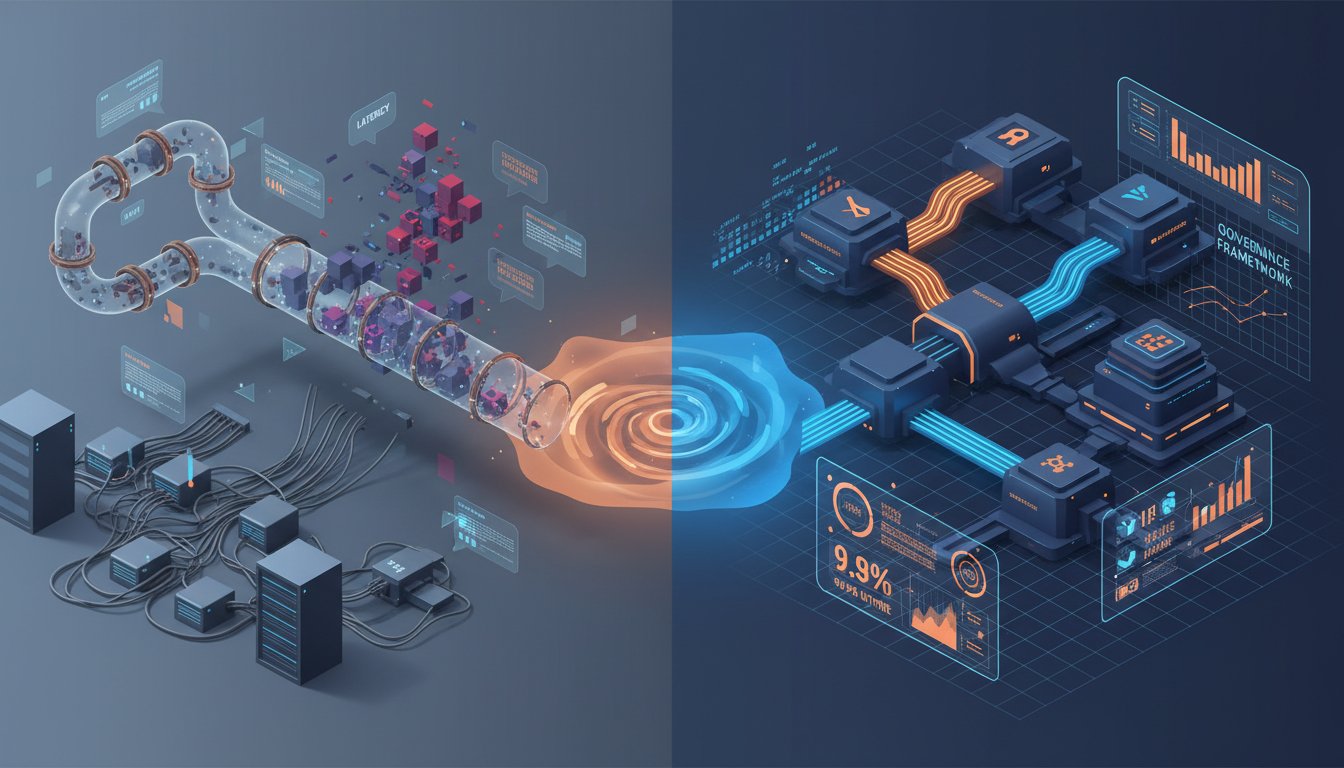
This isn’t an anomaly. It’s a symptom of a widespread enterprise problem. Organizations have rushed to implement RAG systems to put their proprietary data to work, but they’ve often built on foundations designed for experimentation, not production-grade reliability. The gap between the promise of context-aware AI and the reality of fragile, opaque pipelines is costing businesses in accuracy, compliance, and operational speed.
The fix isn’t a single magic tool. It’s a strategic selection from a new generation of frameworks and platforms built for the demands of scale, security, and observability. These tools are moving beyond simple retrieval and generation to offer orchestrated workflows, governed data access, and built-in performance monitoring. They represent a shift from treating RAG systems as projects to managing them as critical infrastructure.
What follows is a breakdown of the key frameworks and commercial platforms defining the enterprise RAG space right now. We’ll look at their core capabilities, their distinct approaches to the enterprise problem, and proof points from recent deployments. The goal is a clear map for technical leaders working through a crowded tool market, helping them match their choice to their organization’s specific needs for durability, control, and integration.
The Orchestration Layer: LangChain and Semantic Kernel
For enterprises building complex, agent-driven workflows, orchestration frameworks provide the necessary glue. They don’t replace retrieval or generation engines, but they manage how those components interact with data sources, business logic, and other systems.
LangChain’s Rise to Enterprise Reliability
LangChain started out known for its flexibility in prototyping. It’s matured considerably since then. Its 2026 focus, as noted by industry analysts, is on “building scalable and durable RAG pipelines.” That translates to a few concrete capabilities:
- Declarative Pipelines: Engineers can define multi-step retrieval and generation processes as configurable chains, cutting down on custom code for common patterns like query rewriting, multi-database lookup, and answer synthesis.
- Integrated Observability: New modules offer tracing and logging hooks within chains, so teams can monitor where a retrieval came from, how it was processed, and what context was finally passed to the LLM. This is critical for debugging and auditing.
- Agent Framework Enhancements: For scenarios requiring dynamic tool use, like checking a CRM after a retrieval, LangChain’s agent system provides a structured way to integrate actions, making RAG systems more interactive and capable.
A practical example: a customer service bot built on LangChain. The chain might first retrieve product manuals, then decide based on the query to also pull recent support tickets from a separate database, synthesize the information, and format the answer. The framework manages this sequence and logs every step.
Semantic Kernel’s Deep Microsoft Integration
Born from Microsoft’s research, Semantic Kernel offers solid orchestration with a natural fit for enterprises already invested in the Azure ecosystem.
- Native Azure AI Services Connectors: It simplifies plugging in Azure OpenAI models, Azure Cognitive Search for retrieval, and other cloud services. This cuts integration friction and takes advantage of Azure’s security and compliance postures.
- Planner Abstraction: It introduces a higher-level “planner” concept that can automatically generate a sequence of steps (retrieval, processing, generation) based on a high-level goal, potentially reducing pipeline design complexity.
- Enterprise Governance Features: It aligns with Microsoft’s enterprise tooling for access control, secret management, and deployment pipelines, which appeals to organizations with strict IT policies.
For a company running its data estate and AI services on Azure, Semantic Kernel can act as the control layer that securely bridges Azure OpenAI, company data in Azure SQL or Cosmos DB, and downstream applications.
The Retrieval Engine Specialists: LlamaIndex and Haystack
While orchestration frameworks manage the process, these tools specialize in the often-underestimated retrieval phase: finding the right data from vast, messy corporate repositories.
LlamaIndex’s Focus on Intelligent Data Structuring
LlamaIndex operates on the principle that retrieval quality depends heavily on how data is indexed and organized beforehand. Its core strength is transforming raw enterprise documents (PDFs, Word files, SQL tables) into optimized, queryable knowledge structures.
- Sophisticated Indexing Strategies: It goes well beyond simple text chunking. It can create hierarchical indexes where a top-level summary node points to detailed child nodes, allowing the system to retrieve a summary first, then drill down if needed. This mirrors how humans actually access documents.
- Embedding Management: It provides tools to generate, cache, and update the vector embeddings that power semantic search. For large, changing document sets, this management is essential to keep retrieval performance high.
- Query Transformation: It includes modules that can rewrite a user’s natural language query into a form more likely to hit the right index entries, improving accuracy without touching the underlying data.
Consider a legal department with thousands of case files. LlamaIndex can build an index where each case has a high-level “outcome” node and child nodes for “arguments,” “cited precedents,” and “judge’s notes.” A query about “successful negligence defenses” retrieves from the outcome index first, efficiently narrowing the search.
Haystack’s End-to-End Pipeline for Production
Haystack is designed as a cohesive framework covering retrieval, generation, and the pipeline itself, with a strong emphasis on production readiness.
- Pre-built, Configurable Components: It offers ready-to-use “retrievers” (for databases, search engines), “readers” (for document parsing), and “generators” (for answer synthesis) that can be wired together with minimal code. This speeds up development for common use cases.
- Focus on Scalability and Monitoring: Its architecture handles high query volumes and includes built-in metrics for tracking retrieval latency, hit rates, and generation quality. That operational focus matters for systems serving external customers or large internal teams.
- Enterprise Document Handling: It has solid connectors for enterprise content sources like SharePoint, Confluence, and various databases, with an understanding of their specific security models and data formats.
An e-commerce company building a product FAQ bot might use Haystack. Its retriever connects directly to the product catalog database and the CMS holding FAQ articles. The pipeline is configured, deployed, and its performance dashboard shows that 95% of queries find a relevant document in under 200ms.
The Commercial Platforms: NVIDIA’s AI Enterprise and Oracle’s Cloud Infrastructure
For enterprises that want a fully managed, integrated stack rather than assembling open-source tools, major cloud and hardware providers are offering tailored RAG platforms.
NVIDIA AI Enterprise: Hardware-Optimized RAG Workflows
NVIDIA’s approach takes advantage of its deep expertise in GPU acceleration to make every step of the RAG pipeline faster.
- Accelerated Embedding Generation: Creating vector embeddings for millions of documents is computationally intensive. NVIDIA’s libraries and optimized models on their GPUs can dramatically speed up this indexing phase, turning a days-long process into hours.
- High-Performance Retrieval Search: Once indexed, searching through billions of vectors to find the closest matches is another heavy lift. NVIDIA’s technology accelerates this similarity search, keeping response times low even on massive knowledge bases.
- Collaboration with LangChain: NVIDIA is working with LangChain to develop “deep agents for enterprise search.” This points to a future where the orchestration logic (LangChain) runs efficiently on optimized hardware (NVIDIA), combining flexibility with performance.
A financial institution analyzing millions of historical reports needs near-instant retrieval. Building on NVIDIA’s platform lets them create and query a massive embedding index in real time, so analysts can ask complex questions across the entire archive without delay.
Oracle Cloud Infrastructure (OCI) for AI: Integrated Data and AI Services
Oracle’s strength is its unified cloud environment, where enterprise data often already lives.
- RAG on Your Operational Data: Many companies run their ERP, HR, and supply chain systems on Oracle databases. OCI’s AI services can perform RAG directly on this live, transactional data without complex extraction or copying, providing context from the most current business state.
- Security and Governance by Default: Data never leaves Oracle’s secured cloud environment during the RAG process. This satisfies strict compliance requirements for industries like healthcare and finance, where data residency is a hard requirement.
- Scalable Supercomputing for AI: Oracle’s investments in high-performance compute clusters, highlighted in their recent expansion announcements, support the training of large models and the running of intensive RAG workloads across global datasets.
A global logistics company using Oracle Transportation Management can build a RAG assistant for planners. The system retrieves real-time data from the live OTM database, including current shipment locations, capacity constraints, and weather delays, and generates suggestions based on the actual operational picture, not a stale data dump.
The Emerging Alternative: The LLM Knowledge Base Concept
A discussion from last week, highlighted by AI researcher Andrej Karpathy, presents a potential shift in direction that enterprises should keep an eye on.
The LLM Knowledge Base architecture proposes that instead of constantly retrieving from external databases, the core LLM itself could maintain and update an internal, structured knowledge store. The model would be trained or fine-tuned to hold specific corporate knowledge, and mechanisms would allow it to “learn” new information over time without full retraining.
- Potential to Reduce Latency and Complexity: If it works at scale, this could bypass the entire retrieval infrastructure, making systems simpler and responses faster.
- Current Limitations and Enterprise Concerns: The approach raises real questions about knowledge freshness, the scope of what can be internalized, and the governance of what the model “knows.” For enterprises with constantly updating, proprietary data, a pure internal knowledge base may not yet be practical.
- Hybrid Future: The most likely near-term path for enterprises is a hybrid model: an LLM with a core knowledge base of stable company information (values, policies, product lines) combined with RAG for dynamic, transactional data (sales figures, customer tickets, inventory levels).
This concept is a good reminder that the tool space isn’t static. The frameworks and platforms you choose today need to be adaptable enough to incorporate ideas like this tomorrow.
The story of the delayed product launch makes one thing clear: choosing RAG infrastructure isn’t just a technical decision. It’s a business risk mitigation strategy. The frameworks and platforms gaining traction right now, LangChain and Semantic Kernel for orchestration, LlamaIndex and Haystack for solid retrieval, NVIDIA and Oracle for integrated, performant stacks, are responding directly to the enterprise need for reliability, observability, and scale.
They move us from fragile prototypes to durable systems. They provide the logs to trace errors, the connectors to access live data, and the performance to serve global teams. For technical leaders, the task is matching these capabilities to your organization’s specific data environment, compliance requirements, and performance demands.
The evolution isn’t stopping. As concepts like the LLM Knowledge Base suggest, the very architecture of knowledge-powered AI may change. The most strategic choice, then, is a toolset that offers strength today and the flexibility to adapt tomorrow. Start your evaluation by mapping your highest-priority failure scenarios, whether that’s data staleness, retrieval latency, or audit complexity, and see which of these tools offers the most direct path to solving it.