
Your enterprise spent six months implementing a RAG system for your customer support knowledge base. It retrieves with 94% precision, handles thousands of queries daily, and your engineering team is proud of the architecture. Then a competitor launches the same capability with 40x faster response times and 80% lower per-query costs. They’re not using RAG. They’re using Context-Augmented Generation (CAG), and your carefully constructed retrieval pipeline just became obsolete.
This isn’t a theoretical scenario. In February 2026, enterprise AI architecture fractured into two distinct paths, and the choice between them determines whether your AI systems deliver sub-3-second responses or frustrate users with 90+ second wait times. The technical community has been quietly migrating away from retrieval-based architectures for static knowledge bases, and the performance gap is so dramatic that it’s forcing a fundamental rethink of how we build enterprise AI systems.
The shift isn’t about incremental improvements—it’s about recognizing that retrieval-augmented generation solved a problem that no longer exists for a significant portion of enterprise use cases. Modern AI models can hold 1-2 million tokens in their context windows, which means entire knowledge bases can be pre-loaded rather than retrieved piece by piece. The implications reshape everything from architecture decisions to cost projections to user experience expectations.
The Retrieval Tax: What RAG Costs You Per Query
Traditional RAG systems impose a multi-step overhead on every single query. A user asks a question. Your system converts it to embeddings. Vector databases search for relevant chunks. The system ranks results, retrieves documents, and finally feeds context to the language model. Each step adds latency, computational cost, and potential failure points.
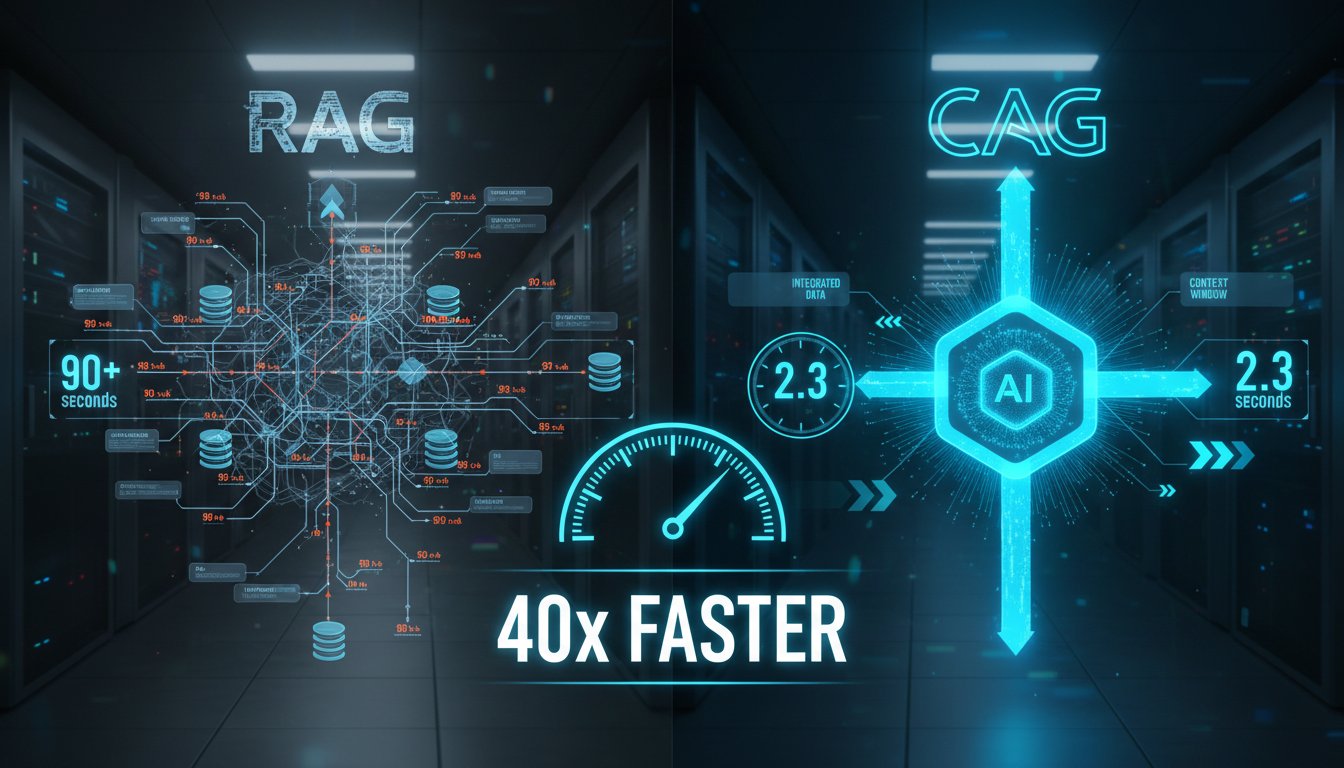
For a typical enterprise RAG implementation handling static knowledge bases, benchmark testing shows query completion times averaging 94.35 seconds. That’s not a typo—over 90 seconds for responses that users expect in under 5 seconds. The culprit isn’t slow hardware or poor optimization. It’s the fundamental architecture requiring repeated retrieval operations for information that rarely changes.
The cost structure compounds the problem. Every query triggers vector search operations, database reads, embedding computations, and context assembly. For high-volume workloads processing thousands of queries daily, these per-query costs accumulate into substantial operational expenses. Organizations running RAG systems for customer support, internal documentation, or product information pay this retrieval tax repeatedly for the same static information.
The reliability challenge emerges from dependency chains. RAG systems require vector databases, embedding models, retrieval services, and language models to all function correctly. A failure in any component breaks the entire pipeline. Monitoring becomes complex, debugging spans multiple systems, and maintaining consistent performance requires coordinating updates across the entire stack.
Context-Augmented Generation: The Pre-Load Alternative
CAG takes a fundamentally different approach: pre-load the entire knowledge base into the model’s context window once, cache it, and serve queries directly without retrieval. For corpora under 1-2 million tokens—which covers most enterprise knowledge bases, product documentation, support articles, and internal wikis—the entire dataset fits comfortably in modern context windows.
The technical implementation is elegantly simple. Instead of chunking documents into retrievable segments, CAG loads the complete knowledge base at initialization. The model caches this context, enabling instant access without vector searches or embedding lookups. When users submit queries, the model references the cached context directly, eliminating the retrieval bottleneck entirely.
Benchmark results demonstrate the performance transformation. The same workloads that required 94.35 seconds in RAG architecture complete in 2.33 seconds with CAG—a 40.5x improvement. This isn’t marginal optimization; it’s a categorical shift in user experience. Responses that felt broken now feel instantaneous. Systems that frustrated users now delight them.
The cost structure inverts from per-query to upfront. CAG incurs higher initialization costs loading the full knowledge base, but subsequent queries run at dramatically lower expense. For high-volume scenarios, the amortized cost per query drops by approximately 80% compared to retrieval-based approaches. Organizations processing thousands of daily queries see immediate ROI from eliminating repeated retrieval overhead.
When Static Knowledge Bases Don’t Need Retrieval
The CAG advantage concentrates in specific enterprise scenarios where knowledge bases remain relatively stable. Customer support documentation that updates monthly or quarterly doesn’t require real-time retrieval. Product information, compliance guidelines, employee handbooks, and technical specifications change infrequently enough that pre-loading makes architectural sense.
Consider an enterprise customer support use case with 500,000 tokens of documentation covering product features, troubleshooting guides, and policy information. Traditional RAG chunks this into retrievable segments, maintains vector embeddings, and searches for relevant passages per query. CAG loads all 500,000 tokens once and serves every subsequent query from cache. The performance difference reshapes what’s possible.
Organizations using CAG for internal knowledge bases report response times under 3 seconds even for complex multi-part queries. The same queries in RAG architectures averaged 60-90 seconds due to multiple retrieval rounds. The user experience gap is so significant that it affects adoption rates—employees actually use the CAG-powered systems while RAG implementations gathered dust despite similar accuracy.
The accuracy benefits emerge from complete context availability. RAG systems risk missing relevant information if retrieval algorithms fail to surface the right chunks. CAG provides the model with the entire knowledge base, eliminating retrieval blind spots. For questions requiring synthesis across multiple document sections, CAG’s comprehensive context consistently outperforms RAG’s fragmented retrieval.
The Architecture Split: CAG vs. Agentic RAG
The February 2026 enterprise AI architecture landscape settled into a clear bifurcation. For static, cacheable knowledge bases under 1-2 million tokens, CAG dominates due to superior speed, lower costs, and simpler infrastructure. For dynamic, complex reasoning tasks requiring multi-step analysis and tool execution, Agentic RAG emerged as the preferred approach.
Agentic RAG extends traditional retrieval with autonomous planning, tool use, and adaptive reasoning. These systems handle complex financial analysis, legal research requiring current case law, or strategic decision-making where knowledge constantly evolves. The per-query costs are higher and latency remains a challenge, but the capability to navigate complex reasoning chains justifies the overhead for high-value decisions.
The critical distinction centers on data dynamics and task complexity. If your knowledge base updates weekly or less frequently and fits within context windows, CAG delivers better performance at lower cost with simpler architecture. If your use case requires real-time information, multi-step reasoning across constantly changing data, or autonomous tool execution, Agentic RAG provides capabilities CAG cannot match.
Some organizations attempt hybrid approaches, routing queries to CAG or Agentic RAG based on classification. The implementation complexity proves substantial—routing logic, maintaining two parallel systems, debugging cross-architecture issues, and managing divergent cost structures. Most successful deployments choose one primary architecture based on their dominant use case rather than attempting hybrids.
Implementation Reality: The Migration Challenge
Organizations with existing RAG implementations face a strategic decision: continue optimizing retrieval pipelines or migrate static knowledge bases to CAG. The technical migration is straightforward—consolidate document chunks, load full context, implement caching—but the strategic implications run deeper.
Teams invested in vector database infrastructure, embedding models, and retrieval optimization must evaluate sunk costs against performance gains. The 40x speed improvement and 80% cost reduction make compelling cases, but organizational inertia, technical debt, and expertise gaps slow adoption. Engineering teams who spent months building RAG expertise face learning curves in CAG implementation patterns.
The vendor landscape is adapting rapidly. Databricks positioned its Instructed Retriever as superior to traditional RAG, while multiple platforms launched CAG-optimized services. The market signal is clear: retrieval-based approaches for static knowledge bases are losing mindshare to context pre-loading architectures. Organizations planning new AI implementations increasingly default to CAG for applicable use cases.
The monitoring and observability requirements shift fundamentally. CAG systems require cache invalidation strategies, context refresh monitoring, and performance tracking for cached queries. RAG’s retrieval metrics—precision, recall, chunk relevance—become irrelevant. Teams need new instrumentation focusing on cache hit rates, context staleness, and query latency distributions.
The Static-Dynamic Boundary: Choosing Your Architecture
The architecture decision hinges on answering one critical question: how frequently does your knowledge base change, and does it fit in modern context windows? If updates happen daily or hourly, and retrieval provides necessary freshness, RAG or Agentic RAG remain appropriate. If your knowledge base updates weekly or less and sits under 1-2 million tokens, CAG offers superior performance.
Consider knowledge base size realistically. Many organizations overestimate their content volume. A comprehensive product documentation set might total 300,000 tokens. An internal HR policy wiki might reach 150,000 tokens. Customer support articles across all products could total 800,000 tokens. These all fit comfortably in context windows, making CAG viable where teams assumed retrieval was necessary.
The freshness requirement varies by use case. Legal research demands current case law, making retrieval essential. Customer support for stable product features tolerates documentation that’s days or weeks old, making CAG appropriate. Financial analysis needs real-time market data, favoring Agentic RAG. Internal IT troubleshooting references systems that change monthly, fitting CAG perfectly.
Cost sensitivity affects the calculation. Organizations with limited query volumes might not see sufficient ROI from CAG’s upfront loading costs. High-volume deployments serving thousands of daily queries amortize initialization expenses quickly and benefit most from per-query cost reductions. The breakeven point typically occurs around 1,000-2,000 queries per knowledge base refresh cycle.
The Path Forward: Redefining Enterprise AI Architecture
The CAG emergence forces enterprises to audit their AI architectures with fresh perspectives. Systems implemented in 2024-2025 when retrieval seemed necessary may now benefit from CAG migration. The performance and cost improvements are substantial enough to justify re-architecture for static knowledge base use cases.
The strategic implication extends beyond individual systems. Organizations building AI strategies should segment use cases into static-cacheable versus dynamic-retrieval categories before choosing architectures. The default assumption that enterprise AI requires retrieval no longer holds. For significant portions of enterprise knowledge, context pre-loading delivers better results at lower cost with simpler infrastructure.
The vendor ecosystem will accelerate this transition. As CAG-optimized platforms mature and case studies demonstrate ROI, adoption pressure increases. Organizations clinging to retrieval-based approaches for static knowledge bases risk competitive disadvantage from slower response times and higher operational costs. The 40x speed gap is too significant to ignore.
The February 2026 architecture split marks a maturation point for enterprise AI. The field moved beyond one-size-fits-all retrieval approaches to nuanced architecture selection based on data dynamics and use case requirements. Understanding when to pre-load context versus when to retrieve dynamically separates sophisticated AI implementations from those following outdated patterns.
Next Steps: Evaluating Your RAG Architecture
If you’re running RAG systems for static knowledge bases, start by measuring your actual query latency and per-query costs. Compare these against CAG benchmarks—2-3 seconds response time and 80% cost reduction for high-volume workloads. The performance gap might be larger than you expect.
Audit your knowledge base size and update frequency. If you’re under 1 million tokens and updating weekly or less, you’re in CAG’s sweet spot. Calculate your query volume to determine if amortized costs favor pre-loading versus per-query retrieval expenses. For many enterprises, the numbers strongly favor migration.
The retrieval-first era is ending for a large class of enterprise AI applications. Context-augmented generation isn’t a future possibility—it’s delivering 40x performance improvements today for organizations willing to rethink their architectures. The question isn’t whether CAG will displace RAG for static knowledge bases. It’s how quickly your organization adapts before competitors leverage the speed and cost advantages to pull ahead.