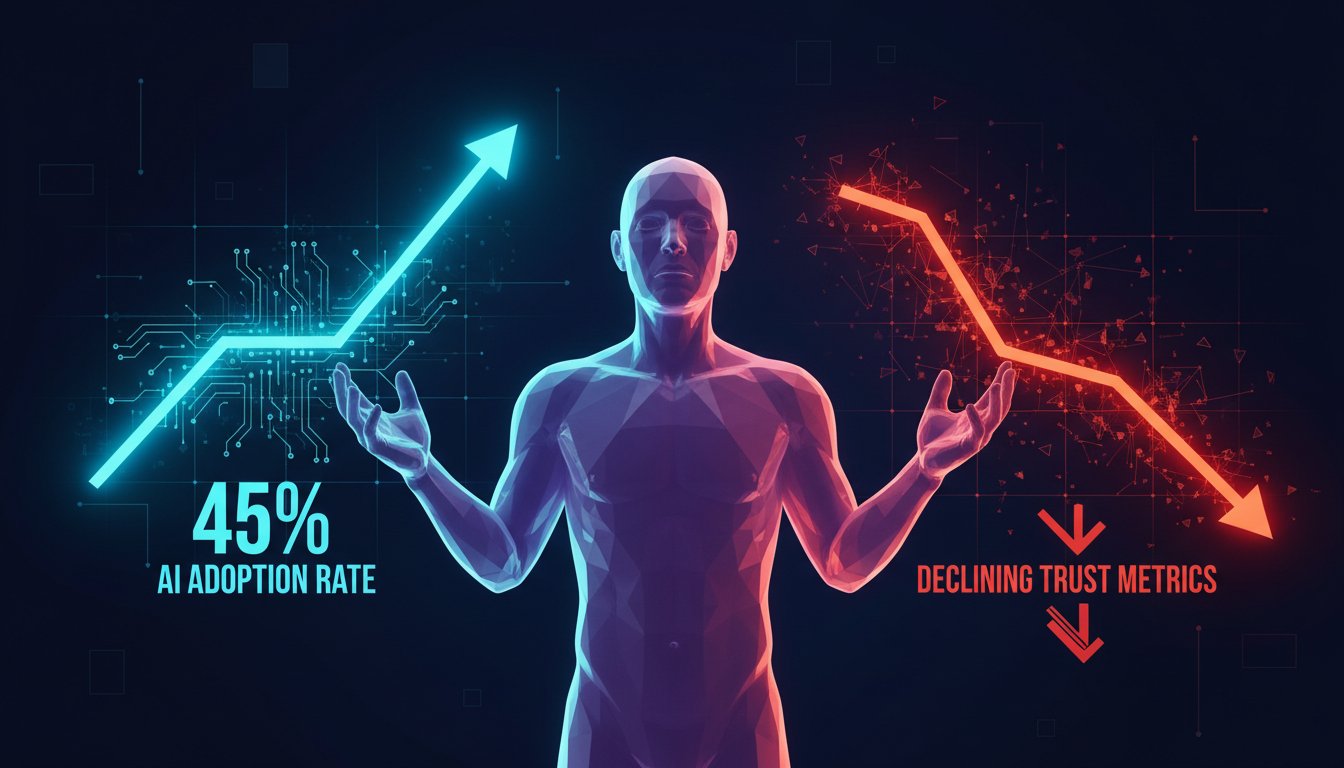

The numbers tell a troubling story. According to Gallup’s latest workplace research, 45% of U.S. employees now use AI at least a few times per year—up from 40% just one quarter earlier. Daily AI usage has plateaued at 10%, but frequent use (several times per week) has jumped from 19% to 23%. On paper, these are the adoption curves every enterprise AI leader dreams about.
But dig deeper into the January 2026 data, and a different narrative emerges. As Fortune reported on January 21st, worker trust in AI is collapsing at the exact moment adoption accelerates. Baby boomer confidence has dropped 35%, Gen X trust has fallen 25%, and over half of all U.S. workers express serious concerns about AI’s impact on their jobs. This isn’t just a perception problem—it’s a fundamental crisis in how we’re building and deploying AI systems.
For enterprise RAG architects, this paradox demands immediate attention. Your retrieval-augmented generation system isn’t just a technical achievement—it’s a trust interface between your organization and its workforce. When employees use your RAG-powered tools several times per week but fundamentally distrust the technology, you’re not building productivity infrastructure. You’re building resentment infrastructure. The question isn’t whether your RAG system can retrieve accurate information. The question is whether your workers believe it can—and whether they understand how it reaches its conclusions.
Why Traditional RAG Architectures Accelerate the Trust Crisis
The trust collapse isn’t happening in a vacuum. It’s happening because most enterprise RAG systems operate as sophisticated black boxes, retrieving information and generating responses without providing the transparency workers need to build confidence in the technology.
Consider the typical RAG workflow: a user submits a query, your system retrieves relevant chunks from your vector database, passes context to a large language model, and returns a synthesized response. Fast, efficient, and completely opaque to the end user. They see an answer. They don’t see why that answer is trustworthy, which documents informed it, what got excluded from consideration, or how confident the system is in its response.
The Hallucination Anxiety Factor
According to research from IBM and Red Hat, RAG systems can suffer from hallucinations where models generate false information despite having access to accurate source material. When workers encounter a single hallucination—a confident-sounding answer that’s demonstrably wrong—trust doesn’t just decrease incrementally. It collapses entirely.
The problem intensifies because workers rarely have the tools to verify RAG outputs efficiently. They’re expected to trust the system, but they’re also implicitly responsible for the accuracy of work products that incorporate AI-generated content. This creates a psychological double-bind: use the AI tool to keep pace with productivity expectations, but remain perpetually anxious about whether the output is reliable.
The Explainability Gap in Enterprise Contexts
As AI governance frameworks mature globally, explainability requirements are becoming more stringent. The EU AI Act and similar regulations emphasize transparent decision-making in AI systems. But most enterprise RAG implementations lag far behind these standards.
Your system might retrieve the correct information 95% of the time, but if workers can’t understand how it retrieves information, that 95% accuracy rate becomes irrelevant to trust-building. Workers don’t think probabilistically about AI systems. They think in absolutes: “Can I trust this?” or “Should I verify everything manually?”
The Trust Architecture: Five RAG Design Principles for 2026
Building RAG systems that workers actually trust requires rethinking your architecture around transparency, verifiability, and human agency. These aren’t nice-to-have features—they’re fundamental to preventing the trust collapse that’s already undermining AI adoption across industries.
1. Transparent Retrieval Paths
Every RAG response should surface its provenance. When your system generates an answer, show users exactly which documents, sections, or data sources informed that response. Implement citation systems that link back to original sources with specific page numbers or timestamps.
This isn’t just about building trust—it’s about enabling verification. According to IBM’s human-in-the-loop tutorials, workers need the ability to quickly validate AI outputs against source material. When your RAG system says “According to the Q4 financial report,” that phrase should be a clickable link that takes users directly to the relevant section of the actual report.
Tools like LangGraph and watsonx.ai are making it easier to build these transparent retrieval paths into RAG architectures. The technical implementation matters less than the user experience: can someone verify your system’s work in under 30 seconds?
2. Confidence Scoring and Uncertainty Communication
Your RAG system knows when it’s uncertain. The semantic similarity scores, the relevance rankings, the model’s confidence levels—all of this information exists internally. The question is whether you’re surfacing it to users.
Implement visible confidence indicators that help workers calibrate their trust appropriately. A response with 95% confidence deserves different treatment than one with 60% confidence. Workers can handle uncertainty—what they can’t handle is false confidence in unreliable outputs.
Datadog and other observability platforms are developing RAG-specific monitoring that tracks confidence scores over time. Use these metrics not just for system monitoring, but as user-facing trust signals. When your system is uncertain, say so explicitly and suggest manual verification steps.
3. Human-in-the-Loop Integration Points
According to research from Techment and IBM, human oversight is crucial for maintaining control and trust in automated processes. But “human-in-the-loop” doesn’t mean humans review every single output—that defeats the purpose of automation.
Instead, design intelligent intervention points where human review adds maximum value. This might include:
- High-stakes decisions (financial approvals, compliance determinations)
- Low-confidence responses (below your defined threshold)
- Contradictory source material (when retrieved documents disagree)
- Novel queries (questions your system hasn’t encountered before)
Implement approval loops in multi-agent systems where agents propose actions and humans review at critical points. This preserves automation benefits while building the oversight infrastructure workers need to trust the system.
4. Graceful Failure Modes and Fallback Logic
As outlined in enterprise RAG implementation guides from AWS and Medium, reliability requires structured system responses with retry logic and fallbacks. But reliability isn’t just a technical concern—it’s a trust concern.
When your RAG system encounters a query it can’t handle confidently, how does it fail? The worst possible approach is generating a plausible-sounding answer with no indication of uncertainty. The best approach is explicit acknowledgment: “I couldn’t find sufficient information in our knowledge base to answer this question confidently. Here are the closest relevant documents I found.”
This kind of graceful failure actually builds trust. It demonstrates that your system knows its limitations and won’t mislead users. Over time, workers learn that when the system does provide a confident answer, that confidence is earned.
5. Audit Trails and Decision Provenance
For regulated industries and compliance-heavy contexts, audit trails aren’t optional—they’re mandatory. But even in less regulated environments, decision provenance builds trust by making AI decision-making transparent and reviewable.
Implement logging that captures:
- What query was submitted
- What documents were retrieved and in what order
- What chunks were passed to the LLM
- What response was generated
- What confidence scores were calculated
- Whether human review was triggered
This creates a complete audit trail that can be reviewed when questions arise. More importantly, knowing that this audit trail exists changes how workers perceive the system. It’s no longer a black box—it’s a documented, reviewable process.
From Metrics to Trust: Rethinking RAG Evaluation
Most enterprise RAG evaluation focuses on technical metrics: retrieval precision, answer accuracy, latency, cost per query. These metrics matter, but they’re incomplete if you’re trying to build systems that workers actually trust.
Add trust metrics to your evaluation framework:
- Verification rate: How often do users click through to source documents? (Higher rates may indicate lower trust)
- Override frequency: How often do users discard RAG outputs and find information manually?
- Adoption consistency: Are users engaging with the system regularly, or does usage drop off after initial experimentation?
- Confidence calibration: Do your system’s confidence scores correlate with actual accuracy?
- Failure transparency: When your system fails, do users understand why?
According to Gallup’s research, leaders are substantially more likely to use AI than other employees. If you’re seeing this pattern in your RAG adoption data, it’s a red flag. It suggests that workers don’t trust the system enough to rely on it for their daily work, even while leadership champions it.
The Implementation Reality: Trust Takes Time
Building trust in enterprise RAG systems isn’t a launch day achievement—it’s a continuous process that extends months beyond deployment. The Fortune article highlighting collapsing worker confidence noted that trust issues intensify without adequate training and support.
Your rollout strategy should prioritize trust-building:
Phase 1: Transparency First
Launch with maximum transparency features enabled. Show all sources, display all confidence scores, flag all uncertainties. Yes, this creates more complex interfaces. But workers need to see how the system works before they’ll trust it.
Phase 2: Feedback Loops
Implement mechanisms for workers to flag incorrect outputs, suggest better sources, and rate response quality. Use this feedback not just to improve the system, but to demonstrate that human input shapes AI behavior.
Phase 3: Confidence Calibration
As you gather usage data, calibrate your confidence thresholds and human-in-the-loop triggers. The goal is reducing false confidence while maintaining automation benefits.
Phase 4: Progressive Automation
Only after trust metrics stabilize should you consider reducing transparency features or automation guardrails. And even then, maintain the option for users to access detailed provenance when needed.
The Future Is Trust-First, Not Efficiency-First
The 45% adoption paradox reveals a fundamental truth about enterprise AI in 2026: technical capability has outpaced organizational trust-building. We can build RAG systems that retrieve information with remarkable accuracy, but accuracy alone doesn’t drive adoption or change worker behavior.
According to recent research, agentic RAG with human oversight is becoming standard practice, while traditional black-box RAG is increasingly seen as baseline technology. This shift reflects growing recognition that enterprise AI success depends on human-AI collaboration, not human displacement.
Your RAG system architecture should reflect this reality. Every design decision—from how you surface source citations to how you handle uncertain queries—either builds trust or erodes it. In an environment where worker confidence is collapsing even as adoption rises, trust-building isn’t a secondary concern. It’s the primary success factor.
The organizations that thrive with enterprise RAG in 2026 won’t be those with the fastest retrieval times or the lowest cost per query. They’ll be the organizations that built systems workers actually trust—systems that transparently show their work, gracefully acknowledge limitations, and preserve human agency in high-stakes decisions.
The data is clear: your workers are using AI more than ever, and trusting it less than ever. Your RAG architecture needs to solve both sides of that paradox. Build for trust first, and efficiency will follow. Build for efficiency alone, and you’ll join the growing list of enterprise AI projects that achieved impressive technical metrics while failing to change how work actually gets done.
The choice isn’t between transparency and performance. It’s between sustainable AI adoption built on worker trust, or short-term efficiency gains that collapse under the weight of organizational skepticism. Choose wisely.