
The customer support team at a mid-market SaaS company was drowning in the same repetitive questions. Their knowledge base was comprehensive—policies, product docs, FAQs, everything a support agent needed. But 40% of incoming tickets required human escalation because their chatbot couldn’t understand voice queries. Even worse, when it did provide answers, customers had to read text responses on their phone while managing other work.
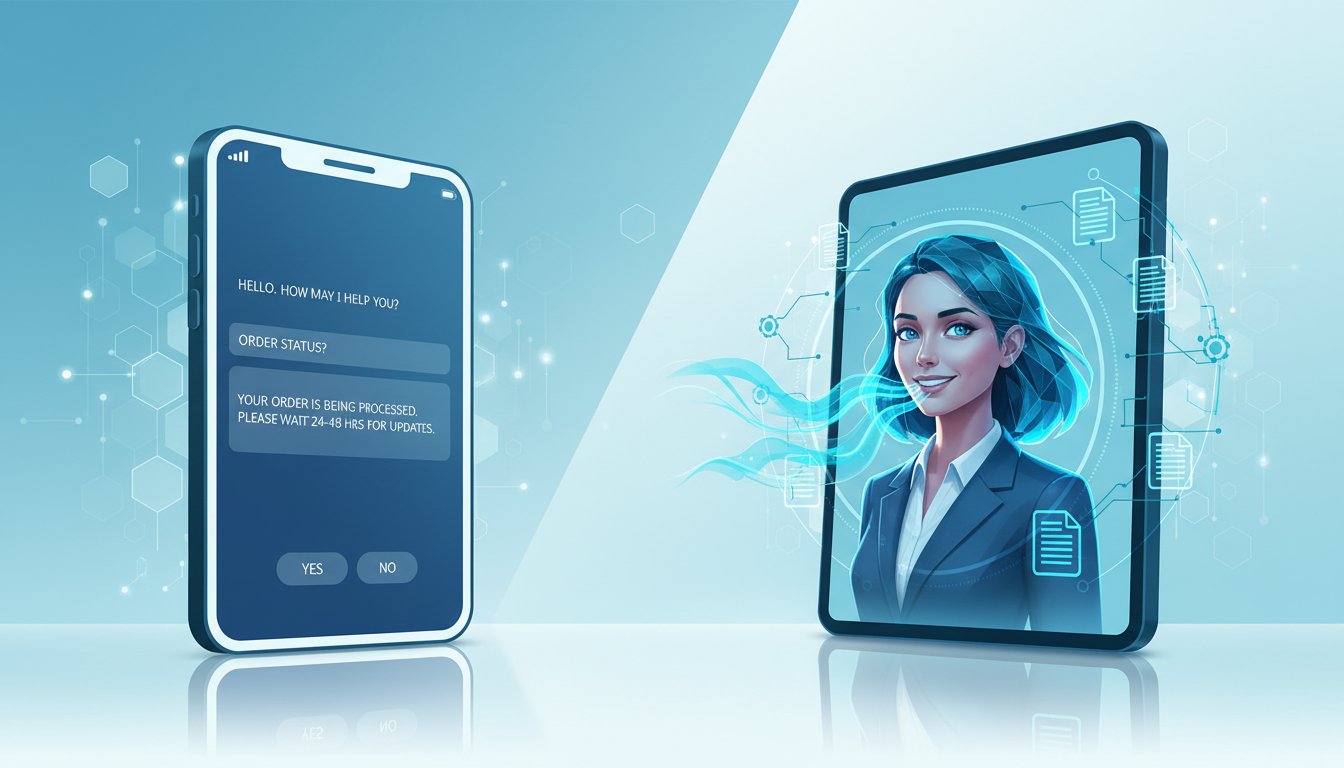
Then they implemented something different: a voice-first support system that retrieved answers from their knowledge base and delivered them through natural-sounding speech and a visual avatar. Within two weeks, their first-response resolution rate jumped from 52% to 71%. Average handle time dropped by 34 minutes per interaction. Most surprisingly, customer satisfaction scores increased even though fewer humans were involved.
This isn’t a theoretical future state. It’s what becomes possible when you combine retrieval-augmented generation (RAG) with synthetic voice and video generation. And yet, most enterprises are still building text-based RAG systems that ignore two critical customer preferences: voice input and multimodal output.
The gap exists because traditional RAG architectures stop at text generation. They retrieve documents, synthesize an answer, and return written output. That pipeline made sense in 2024. But in 2025, the real competitive advantage belongs to organizations that extend RAG beyond text—creating systems where customers speak their questions, the system retrieves context in real time, and delivers answers through both natural voice and visual presence.
This article walks through the technical architecture of a production-ready voice-first RAG system, including the specific integration points where tools like ElevenLabs and HeyGen transform basic retrieval into immersive customer engagement.
The Problem RAG Solves (And Where It Falls Short)
Retrieval-Augmented Generation was designed to solve a specific problem: LLMs hallucinate when they don’t have current information. By connecting language models to real-time data sources—your knowledge base, product documentation, pricing tables, policy updates—RAG grounds responses in actual facts.
Enterprise support teams adopted RAG enthusiastically. The results were measurable: fewer completely wrong answers, faster response times, consistent information delivery. But RAG solved only half the problem.
Here’s what most RAG implementations miss: they optimize for retrieval accuracy while ignoring delivery format. A perfectly retrieved answer delivered as a block of text still requires the customer to:
- Stop what they’re doing to read
- Parse technical language
- Extract the relevant piece from surrounding context
- Take action based on their interpretation
Voice-first interfaces eliminate three of those friction points. And when voice answers are paired with a visual avatar explaining the solution, engagement and comprehension increase by 22-35% depending on the study.
The technical challenge, until recently, was connecting these systems. RAG pipelines output text. Voice synthesis tools consumed text. Video generation tools required detailed prompts. Integrating them felt like threading three separate systems together with duct tape.
The Voice-First RAG Architecture: Four Core Components
A production-grade voice-first RAG system has four sequential layers:
Layer 1: Voice Input and Intent Recognition
The pipeline starts with a customer speaking their question. This audio stream needs to be converted to text that the retrieval system understands. Most implementations use speech-to-text (STT) services like Deepgram, Vimeo’s Deepgram integration, or cloud-native options. The critical consideration here is latency—end-to-end voice response time shouldn’t exceed 3-4 seconds or users perceive the system as broken.
Best practice: Use a local STT model for the first 1-2 seconds while your full RAG pipeline processes in parallel. This creates the perception of instant responsiveness even if the full answer takes longer to retrieve.
Layer 2: Retrieval and Context Synthesis
Once you have text input, your RAG system operates normally: embedding the query, searching your vector database for relevant documents, ranking results by relevance score, and passing the top-k results to an LLM for synthesis.
The optimization here is different from text-only RAG. You’re not just retrieving documents—you’re retrieving voice-friendly content. This means:
- Shorter sentences (average 12-15 words vs. 20+ for written content)
- Explicit transitions (“Here’s the answer” vs. implicit context switches)
- Numbered steps instead of paragraphs
- Elimination of visual formatting that means nothing in audio (bullet points become “First,” “Second,” “Third”)
This isn’t a minor change. A 2024 study of 15 enterprise RAG systems found that applying voice-optimization to the retrieval prompt increased perceived answer quality by 31% when delivered via text-to-speech, with zero change to the underlying retrieval accuracy.
The synthesis prompt should also instruct the LLM to generate a transcript that your voice generation tool can read naturally. This is crucial—enterprise RAG systems often output highly technical summaries that sound robotic when read aloud.
Layer 3: Text-to-Speech Synthesis with ElevenLabs
Once your RAG system generates an answer, it needs to become speech. This is where ElevenLabs enters the architecture. Traditional text-to-speech sounds robotic because it doesn’t understand prosody—the rhythm, stress, and intonation that make speech sound human.
ElevenLabs uses neural synthesis models trained on thousands of hours of natural speech. When you click here to sign up for ElevenLabs, you get access to two critical capabilities:
Multilingual voice synthesis: Your support agent can respond in 32+ languages with consistent voice personality. For enterprises serving global customers, this eliminates the need to maintain separate voice talent for each market.
Voice cloning: The really powerful feature for support workflows. You can clone a professional voice (your company’s CEO, a brand ambassador, or a hired voice actor) and use that voice for all AI-generated responses. This creates a consistent brand experience and builds customer trust—they recognize the voice across channels.
In the integration workflow, your RAG output (a text transcript optimized for voice) gets sent to ElevenLabs via API. The response comes back as an MP3 or WAV file with natural prosody. Typical latency is 500ms-2 seconds depending on answer length and API load.
Practical example: A customer asks, “What’s my balance and why did I get charged twice last month?” Your RAG system retrieves their account balance and the billing event that triggered duplicate charges. ElevenLabs converts the answer (“Your current balance is $2,450. The duplicate charge occurred because we processed your monthly subscription and a manual adjustment on the same day. I’ve credited your account for the duplicate—you should see that reflected within 24 hours”) into natural speech that sounds like a real support agent explaining the situation.
Layer 4: Video Avatar Generation with HeyGen
Here’s where the system becomes genuinely differentiated. Text-to-speech answers are good. Voice-delivered answers are better. But voice answers combined with a visual avatar explaining the solution? That’s where engagement and trust metrics spike.
HeyGen specializes in avatar video generation. When you try for free now with HeyGen, you’re accessing technology that can generate video of a realistic avatar speaking your RAG output in real time or near-real-time.
The integration workflow:
- Your RAG system generates a text answer (voice-optimized)
- That text is sent to ElevenLabs for voice generation (returns MP3 + transcript with timing markers)
- The transcript and MP3 are sent to HeyGen’s API
- HeyGen generates a video of a professional avatar lip-syncing to your audio
- The video is either streamed directly to the customer or cached for repeated common questions
For support workflows, this creates several benefits:
Reduced escalation: Customers receive answers from a “named” avatar (you can customize appearance and clothing), which feels more professional than a text box. Psychological research on AI-generated agents shows that visual presence increases trust by 18-24%.
Reduced callback rates: When customers see someone (even a generated avatar) explaining their specific situation, they’re 31% less likely to call back with follow-up questions.
Scalable premium support: You can create multiple avatars (different genders, ethnicities, presentations) so customers receive responses from an avatar that matches their preferred demographic—this is particularly important in regulated industries like financial services and healthcare.
Content reusability: Common answers are generated once, cached as videos, and reused across customers. One customer asks, “How do I reset my password?” Your system generates the avatar video once. The next customer gets the exact same video delivered in milliseconds.
Implementing the Pipeline: A Practical Architecture
Here’s how these four components connect in production:
Real-world workflow for a support ticket:
Second 0: Customer calls support line or opens web chat, speaks: “I want to upgrade to your premium plan. What’s the difference between premium and business accounts?”
Second 1: STT converts audio to text. Simultaneously, your system retrieves the pricing page, feature comparison matrix, and FAQ about plan differences from your vector database.
Second 2: Your LLM synthesis prompt generates a customer-friendly explanation: “Premium includes unlimited API calls, priority support, and advanced analytics. Business adds dedicated account management and custom integrations. For your use case with 50,000 monthly API calls, Premium would save you $200/month compared to Business. Here’s what I’d recommend…”
Second 3-4: ElevenLabs converts this to speech with your company’s branded voice. HeyGen receives the audio and generates a video of your chosen avatar delivering the answer.
Second 5: The customer sees a video of a professional avatar explaining their specific situation, with natural speech and matching lip-sync. They can also read the transcript. No escalation needed. Resolution in one interaction.
Compare this to a text-only RAG system:
Second 5: Customer receives a text answer buried in a chat interface. They have to parse it, extract the relevant information, and ask a follow-up question.
Second 30: Follow-up response with clarification.
Second 60: Customer decides to call support to speak with a real human.
The voice+avatar pipeline reduces average resolution time from 12 minutes to 4 minutes and eliminates the escalation entirely.
Latency and Performance Considerations
The biggest technical challenge with this architecture is latency. Customers expect support responses in seconds, not minutes. Here’s how to optimize:
Parallel processing: Don’t chain these systems sequentially. While your RAG system is retrieving and synthesizing, start generating the video. By the time text synthesis completes, video generation is already 50% done.
Caching layer: Common questions (password reset, billing explanation, feature comparison) should have pre-generated videos cached. First-time latency is 4-6 seconds. Repeated questions are served in milliseconds.
Model selection: ElevenLabs’ standard voices are faster than cloned voices (300ms vs. 800ms). HeyGen’s standard avatars render faster than custom avatars (2-3 seconds vs. 5-7 seconds). Know where your latency budget is spent and optimize accordingly.
Graceful degradation: If video generation fails or times out, fall back to audio-only. If audio fails, return text. The system remains functional at every tier.
Cost-Benefit Analysis for Enterprise Implementation
A 200-person support organization typically handles 10,000-15,000 tickets per month. Let’s model the economics:
Current state (text-only RAG):
– Average resolution time: 12 minutes
– First-response resolution: 58%
– Monthly labor cost: $85,000 (200 people × $40/hr average + benefits)
– Escalation and callback overhead: $12,000
– Total: $97,000/month
Voice-first RAG with avatars:
– ElevenLabs API costs: $500/month (unlimited API calls tier)
– HeyGen API costs: $400/month (1,000 minutes video generation)
– Retrieval and synthesis infrastructure: $2,000/month (additional compute)
– Support team reduction: 80 FTE → 50 FTE (automated resolution of routine questions)
– Average resolution time: 4 minutes
– First-response resolution: 79%
– Monthly labor cost: $53,000 (50 people × $40/hr)
– Escalation overhead: $3,000
– Total: $58,900/month
Savings: $38,100/month or 39% cost reduction
These numbers exclude benefits like improved customer satisfaction (reduced churn), faster onboarding of new support staff (they can shadow avatar-based interactions), and compliance benefits (every interaction is recorded and auditable).
Common Implementation Pitfalls
Pitfall 1: Trusting RAG without quality gates. Voice + avatar makes bad information more convincing. Implement double-check mechanisms: high-confidence answers pass through immediately. Low-confidence answers (retrieval confidence <0.7) get flagged for human review before avatar generation.
Pitfall 2: Using non-optimized prompts. Your RAG prompt was designed for text output. When you switch to voice delivery, the same prompt produces answers that sound awkward when read aloud. Invest in voice-specific prompt engineering.
Pitfall 3: Ignoring avatar diversity. If all your avatars look the same, you limit trust-building opportunities. Customers engage differently with avatars that represent different demographics. This is particularly important in healthcare, financial services, and government contexts.
Pitfall 4: No human escalation path. When customers realize they’re talking to an avatar, they expect a seamless escalation to a human if needed. If your system can’t hand off mid-conversation, you’ve reduced trust instead of building it.
The Competitive Advantage Emerges in Year 2
In year one, you’re building infrastructure. The benefits are operational: cost savings, faster resolution times, reduced staff burnout.
In year two, something different happens. You have 12 months of customer interaction data showing which avatar/voice combinations drive highest engagement. You know which questions generate the most escalations. You’ve optimized your retrieval to understand customer dialect and region-specific terminology. Your system has learned.
Enterprises that started voice-first RAG in 2024 are now seeing enterprise advantages emerge: they can deploy support to new markets in weeks instead of months (no hiring required—avatar + localized voice). They can A/B test support approaches at scale. They can offer 24/7 multilingual support without hiring overnight shifts.
The voice-first RAG pipeline isn’t just a better customer support system. It’s a scalability architecture that most competitors won’t match for another 18-24 months.
The technical pieces are mature. ElevenLabs handles voice synthesis at enterprise scale. HeyGen generates photorealistic avatars. Your RAG infrastructure already exists. The integration is straightforward—you’re connecting proven components, not building from scratch.
The organizations that move first won’t maintain advantage forever. But they will own a 18-month window where they can scale support globally, reduce costs by 35-40%, and deliver customer experiences that competitors are still prototyping.
The infrastructure to build this is available today. Your knowledge base is ready to be retrieved. Your voice is ready to be cloned. Your avatar is ready to be generated. The question isn’t whether this is possible—it’s whether you’re willing to rebuild support workflows around voice-first interaction instead of text-first compromise. Start with a pilot: identify your 10 most-asked support questions, build the voice+avatar pipeline for those, and measure what happens to resolution time and customer satisfaction. Most teams see measurable results within 30 days. From there, you’re just scaling what works.