
Every enterprise RAG deployment starts the same way: a finance stakeholder asks, “How much is this actually going to cost?” And every technical team gives the same answer: “It depends.” The problem isn’t that they’re wrong—it’s that nobody has built a reliable framework to separate RAG cost assumptions from RAG cost reality.
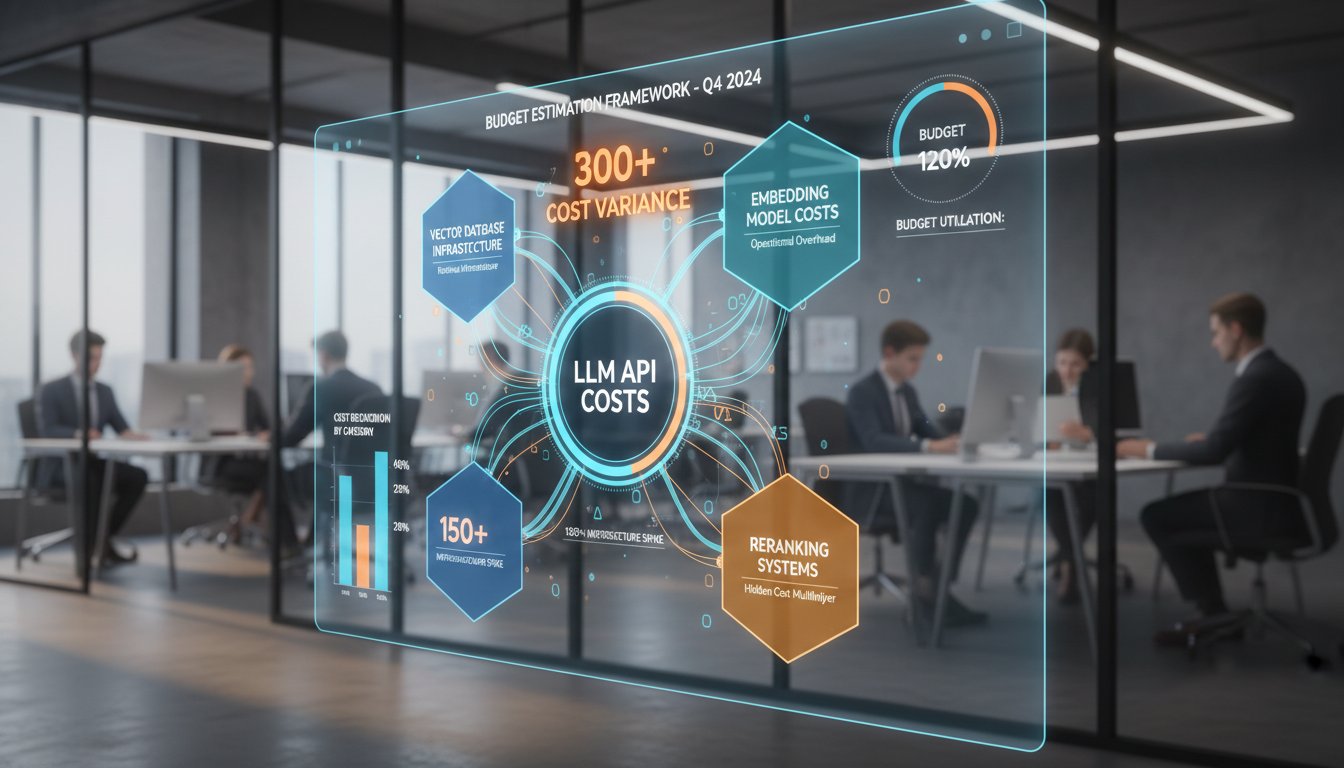
The market has exploded. The enterprise RAG adoption rate crossed 70% this year, with the market itself ballooning from $1.85 billion to a projected $67 billion by 2034 at a 49% CAGR. But that growth has created a dangerous blind spot. Teams are deploying RAG systems with budget estimates that miss actual costs by 300% or more, leading to either false greenlight decisions or mid-project budget standdowns that kill deployments entirely.
This isn’t a technical problem—it’s an estimation problem. And it’s solvable.
The issue stems from three fundamental mistakes enterprise teams make when budgeting for RAG. First, they treat retrieval infrastructure costs as a simple add-on to their LLM API spend, when in reality, vector databases, embedding models, and reranking systems create a separate cost layer that often exceeds the LLM token bill. Second, they anchor their estimates to academic benchmarks (“embeddings cost $0.0001 per 1K tokens”) without accounting for the operational overhead of production systems: retry logic, fallback paths, continuous re-indexing, and observability infrastructure. Third, they neglect the “hidden” cost multiplier—query volume scaling. A RAG system that works at 1,000 queries per day might cost $500 monthly; the same system at 100,000 queries per day becomes a $50,000 monthly operation with diminishing optimization returns.
This article deconstructs the real cost structure of enterprise RAG systems, provides a practical estimation framework, and shows you exactly where to find cost optimization wins without sacrificing performance.
The Three Cost Layers of Enterprise RAG
Most teams think of RAG costs as a single line item. In practice, there are three distinct cost layers, each with different scaling characteristics and optimization levers.
Layer 1: Embedding and Retrieval Infrastructure
This is where 40-50% of typical enterprise RAG budgets go, and it’s where estimation goes wrong most often.
Embedding costs vary dramatically by model choice. Using OpenAI’s text-embedding-3-small at $0.02 per 1 million tokens, embedding a 10,000-document knowledge base (average 500 tokens per document) costs roughly $100 upfront. But here’s where teams stumble: they only budget the initial indexing cost. Production RAG systems continuously re-index, update embeddings for new documents, and regenerate embeddings as models improve. A team with a 10,000-document base growing by 500 documents monthly will spend $600 annually just on embedding refreshes—not counting disaster recovery re-indexing or A/B testing embedding model changes.
Vector database costs depend entirely on scale and architecture choice. Pinecone’s starter tier runs $1 per day (around $30/month) with 100K vectors. Weaviate self-hosted on AWS costs roughly $0.05 per day in compute but requires engineering time (estimate 10-20 hours monthly for maintenance, updates, and scaling). Milvus adds complexity but offers control. For an enterprise deploying 5-10 million vectors, expect $500-$2,000 monthly for managed solutions, or 60-120 engineering hours monthly for self-hosted optimization.
Reranking systems—increasingly critical for 80%+ RAG accuracy—add another cost layer. Using an open-source reranker (bge-reranker-large) on your own compute costs infrastructure money but zero API fees. Using a paid reranking API (Cohere Reranker at $0.02 per 1K queries) for 100K monthly queries adds $2,000 to the tab. This layer is optional in theory but mandatory in practice for production accuracy.
Realistic Layer 1 estimate for mid-market enterprise: $2,500-$8,000 monthly, scaling to $15,000-$40,000 as query volume reaches 1M+/month.
Layer 2: LLM Token Consumption
This is the layer teams budget best—because it’s the most visible—but it’s also where they miss the multiplication effect.
A single RAG query doesn’t consume tokens only for the final LLM response. It consumes tokens for:
– Retrieval query expansion (re-writing the user question): 50-150 tokens
– Context embedding in the LLM prompt: 2,000-8,000 tokens (depending on context window and document count)
– Final response generation: 500-2,000 tokens
– Retry/fallback paths when retrieval fails: 1,000-4,000 additional tokens per failed attempt
A team assuming “5,000 tokens per query” and estimating 100K monthly queries might budget $25 (using GPT-4 at $0.03 per 1K input tokens). Reality: 100K × 7,500 tokens (accounting for expansion + context + generation + occasional retries) × $0.03 = $22,500 monthly.
There’s also the question of model choice. Using GPT-4 Turbo at $0.03/1K input tokens versus Claude 3.5 Sonnet at $0.003/1K input tokens creates a 10x cost difference. For a high-volume RAG system (500K queries/month), that’s the difference between $112,500 and $11,250 monthly. The cheaper model might have lower accuracy, creating a trade-off, but many teams never test this variable.
Realistic Layer 2 estimate for mid-market enterprise: $5,000-$30,000 monthly at 100K-500K queries, scaling non-linearly with volume and model choice.
Layer 3: Operations, Observability, and Maintenance
This is the cost layer most teams skip entirely—and it’s where actual deployments often exceed budget by the greatest margin.
Observability infrastructure (logging failed retrievals, tracking latency, monitoring hallucination rates) requires tooling. Using Datadog, New Relic, or similar platforms adds $500-$3,000 monthly depending on log volume. Building custom observability on Elasticsearch/Prometheus adds 40-80 engineering hours quarterly. A production RAG system generating 1 million queries monthly produces roughly 50-100GB of logs and traces—that’s not free to store or query.
Engineering time for ongoing optimization is the hidden multiplier. A mature RAG deployment requires:
– Weekly dashboard reviews and alert triage: 5-10 hours/week = 250-500 hours annually
– Monthly prompt tuning and retrieval strategy optimization: 40-80 hours/month = 480-960 hours annually
– Quarterly reranker model updates and ablation testing: 100-200 hours per cycle
– Emergency incident response and system scaling: unpredictable but budget 10-15% overhead
At a $150K annual fully-loaded engineer salary, that’s $75,000-$150,000 annually in personnel costs for a single mid-market RAG system.
Infrastructure costs for compute (if self-hosting components) add another $1,000-$5,000 monthly. Compliance and governance tooling (audit logging, access controls, data residency) adds $2,000-$10,000 monthly for enterprises in regulated industries.
Realistic Layer 3 estimate for mid-market enterprise: $8,000-$15,000 monthly in platform costs + $6,000-$12,000 monthly in allocated engineering time.
The Complete Cost Picture: Four Real Scenarios
Let’s walk through how these layers stack for four realistic enterprise deployments, all deployed today.
Scenario 1: Content Search (Low-Risk Pilot)
Use case: Customers search internal knowledge base of 5,000 articles. 50K queries/month. Accuracy matters but not as critically.
Infrastructure: Pinecone starter, text-embedding-3-small, GPT-4 Turbo (lower cost due to lower volume)
– Embedding refreshes: $50/month
– Vector DB: $30/month (Pinecone starter)
– Reranking: Self-hosted with existing compute, $0/month
– LLM tokens: 50K queries × 5,500 tokens × $0.03/1K = $8,250/month
– Observability: $300/month (basic Datadog)
– Engineering time: 10 hours/week = $10,000/month allocated
Total: ~$18,630/month ($223,560 annually)
What teams budget: Usually $5,000-$8,000/month (off by 250%)
Scenario 2: Customer Support (Medium Risk, High Volume)
Use case: AI agent handles 70% of support tickets using RAG over 20K documents + historical tickets. 500K queries/month. Accuracy critical (misrouting harms customers).
- Embedding refreshes: $400/month
- Vector DB: Weaviate self-hosted on EKS: $2,000/month compute + 60 hours/month engineering
- Reranking: Cohere API (paid for accuracy): $10,000/month (500K queries × $0.02/1K)
- LLM tokens: 500K queries × 8,000 tokens × $0.015/1K (Claude 3.5 for cost) = $60,000/month
- Observability: Datadog with high log volume: $2,500/month
- Engineering time: 20 hours/week optimization + incident response = $30,000/month allocated
- Compliance tooling (audit, data residency): $3,000/month
Total: ~$107,900/month ($1,294,800 annually)
What teams budget: Usually $40,000-$60,000/month (off by 180%)
Scenario 3: Compliance and Legal Document Analysis (High Risk, Regulatory)
Use case: Legal team uses RAG to synthesize case law and regulatory documents. 50K queries/month. Accuracy and auditability are non-negotiable.
- Embedding refreshes: $200/month (legal documents update frequently)
- Vector DB: Managed Weaviate Cloud (highest reliability): $5,000/month
- Reranking: Specialized legal reranker model (Jina or Voyage AI): $3,000/month
- LLM tokens: 50K queries × 10,000 tokens (longer legal documents) × $0.02/1K (GPT-4 for precision) = $10,000/month
- Observability: Enterprise-grade with 6-month audit retention: $5,000/month
- Engineering time: 25 hours/week compliance management + optimization = $37,500/month allocated
- Compliance and governance infrastructure: $8,000/month (access controls, encryption, audit)
Total: ~$68,700/month ($824,400 annually)
What teams budget: Usually $15,000-$25,000/month (off by 275-450%)
Scenario 4: Manufacturing Quality Control (Complex Multimodal)
Use case: RAG system analyzes defect photos + technical documents to identify root causes. 200K queries/month. Speed and accuracy both critical.
- Embedding refreshes (text + image): $800/month
- Vector DB: Multi-index setup with separate text/image stores: $8,000/month
- Multimodal reranking: Proprietary or fine-tuned model: $15,000/month
- LLM tokens: 200K queries × 9,000 tokens (multimodal context is larger) × $0.03/1K = $54,000/month
- Image processing (separate from LLM): $8,000/month (cloud vision APIs)
- Observability: Real-time monitoring for latency-critical system: $4,000/month
- Engineering time: 30 hours/week (multimodal complexity): $45,000/month allocated
- Infrastructure for on-premises deployment (security requirement): $12,000/month
Total: ~$146,800/month ($1,761,600 annually)
What teams budget: Usually $50,000-$80,000/month (off by 84-194%)
The Cost Estimation Framework Your Enterprise Can Use
Here’s a practical framework to estimate your RAG deployment accurately.
Step 1: Define Your Query Profile
Start by answering five questions:
– How many queries per month will your system handle? (Start with 6-month projection, not Year 1)
– What’s your acceptable latency SLA? (Sub-200ms requires reranking; 200-500ms allows flexibility)
– How critical is accuracy vs. cost? (This drives embedding model and reranker choices)
– Are you in a regulated industry? (Compliance tooling adds 15-30% overhead)
– Will your system need multimodal capabilities (text + image/PDF)? (Adds 30-50% to infrastructure costs)
Step 2: Build Your Infrastructure Budget
For each component, use these benchmarks:
Embedding Model:
– Open-source (BGE, ONNX): $0 API, 30-60 hours setup/maintenance annually
– text-embedding-3-small: $0.02 per 1M tokens
– text-embedding-3-large: $0.13 per 1M tokens (only if accuracy demands it)
Vector Database:
– Managed SaaS: $30-$5,000/month (scales with vector count and query volume)
– Self-hosted: $500-$15,000/month compute + 40-120 hours engineering/month
– Hybrid (managed with self-hosted fallback): $3,000-$8,000/month
Reranking:
– Self-hosted: $100-$500/month compute (negligible)
– API-based: $0.01-$0.05 per reranking query
– Specialized models (legal, medical): $5,000-$15,000/month
Step 3: Calculate Token Consumption
For each query, estimate:
– Query expansion tokens: 100 tokens
– Retrieved context tokens: (number of documents × avg tokens/doc) + 1,000 (formatting)
– Response tokens: 1,000 tokens (conservative)
– Retry overhead: multiply by 1.15 (assumes 15% failure rate with retries)
Formula: (Query expansion + Context + Response) × Retry overhead × Monthly queries × (LLM price per 1K tokens / 1,000)
Step 4: Add Operations Overhead
Allocate:
– Observability: $300/month (basic) to $5,000/month (enterprise)
– Engineering time: 10 hours/week minimum (assume $200/hour fully-loaded): $8,000/month
– Compliance/governance: $0/month (non-regulated) to $10,000/month (highly regulated)
Step 5: Apply Scaling and Contingency
Multiply your estimate by:
– Query volume uncertainty: ×1.25 (25% buffer for higher-than-expected volume)
– Seasonal peaks: ×1.15 (holiday/campaign periods spike queries)
– Model price increases: ×1.10 (LLM APIs have increased 3-4% annually)
– Optimization overhead: ×1.05 (unforeseen tuning costs)
Final estimate = (Infrastructure + Tokens + Operations) × (1.25 × 1.15 × 1.10 × 1.05)
Where to Find Cost Optimization Without Sacrificing Performance
Once you have a realistic budget, here’s where you can actually reduce costs:
Optimization 1: Hybrid Retrieval for Query Efficiency
Kernel-based hybrid retrieval (keyword + vector search) reduces the number of documents you need to rerank and send to the LLM. By filtering to top-50 hybrid results before vector reranking, you reduce context tokens by 30-40%, directly cutting LLM token spend by 15-25%. Cost impact: $5,000-$15,000 monthly savings at scale with no accuracy penalty.
Optimization 2: Query Routing and Caching
Identifying which queries should hit RAG vs. which should use simple rule-based logic reduces unnecessary retrieval overhead. Implementing semantic caching (storing results for similar queries) cuts retrieval costs by 20-30% for repeated question patterns. Cost impact: $2,000-$8,000 monthly savings depending on query diversity.
Optimization 3: Batch Indexing and Off-Peak Processing
Running embedding and reranking jobs during off-peak hours (if using reserved capacity pricing) or batching embeddings in weekly jobs instead of real-time updates reduces per-unit costs by 25-35%. Cost impact: $1,000-$5,000 monthly savings.
Optimization 4: Model Downsampling for Non-Critical Queries
Using a cheaper LLM (Claude 3.5 Sonnet vs. GPT-4) for low-stakes queries while reserving expensive models for high-accuracy use cases cuts overall token spend by 30-50%. Cost impact: $10,000-$30,000 monthly savings at scale.
Optimization 5: Self-Hosting Vector DB and Reranking
For enterprises comfortable with engineering overhead, self-hosting Weaviate or Milvus + using open-source rerankers (bge-reranker) cuts infrastructure costs by 40-60% compared to fully managed solutions. Cost impact: $5,000-$20,000 monthly savings, offset by 60-100 hours monthly engineering time.
Building Your Cost Accountability System
The final piece isn’t just estimation—it’s tracking. Set up weekly cost dashboards that break down:
– Per-query cost by source (support, content search, compliance, etc.)
– Cost per LLM call vs. cost per retrieval operation
– Embedding refresh costs vs. inference costs
– Engineering allocation (hours spent on optimization vs. maintenance vs. incident response)
Without this visibility, cost creep is inevitable. With it, you can identify which queries are expensive and which optimizations actually move the needle.
The RAG deployments that succeed financially aren’t the ones with the best technology—they’re the ones with the best cost accounting. Start with a realistic estimate using the framework above, build observability from day one, and optimize with data rather than intuition. Your CFO will appreciate it, and your RAG system will actually deliver the 45% cost reduction and 3× faster resolution times the market promises.