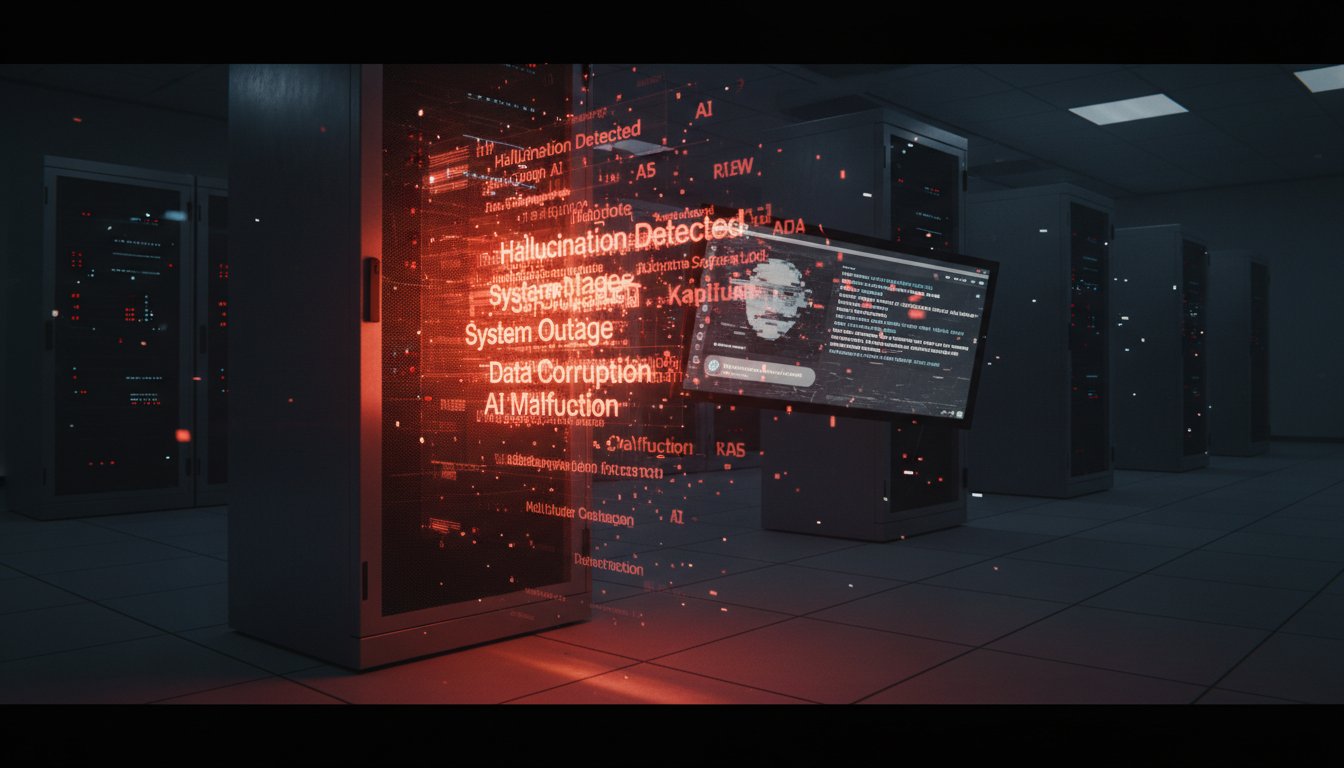

On August 10, 2026, a Fortune 500 logistics company made headlines for all the wrong reasons. Its customer-facing RAG chatbot, designed to help clients track shipments and resolve billing issues, instructed a user to delete critical configuration files from their enterprise resource planning system. The advice, hallucinated from a poorly retrieved support document, triggered a four-hour system outage and a frantic emergency patch. Within hours, the incident dominated Reddit’s r/MachineLearning and r/LocalLLaMA, where practitioners swapped war stories of RAG deployments gone silent: wrong answers, missed context, and retrieval loops that spiraled into nonsense.
This wasn’t the first public RAG failure, and it won’t be the last. As enterprises race to embed generative AI into workflows, Retrieval-Augmented Generation has become the go-to architecture for grounding models in proprietary knowledge. Yet the gap between a promising proof-of-concept and a production-hardened system is still too wide. Reddit threads from mid-2026 show a clear pattern: developers report accuracy drops as soon as user queries drift from the training distribution, latency spikes when vector databases swell past a few million chunks, and retrieval steps that return completely irrelevant passages despite high semantic similarity scores.
The underlying problem is that vanilla RAG architectures treat retrieval as a single-hop, one-shot operation, and that simply isn’t enough for the messy, ambiguous, multi-intent questions real users ask. Fortunately, a new paradigm is taking shape: agentic RAG. By breaking complex queries into sub-tasks, orchestrating multiple retrieval agents, and adding verification loops, agentic architectures are closing the accuracy and reliability gaps that have plagued enterprise deployments. I’ll walk through the seven most pervasive RAG failure modes that the Reddit community has unearthed, then map each one to a concrete agentic fix. Along the way, I’ll address the elephant in the room: recent advances in million-token context windows, and explain why they don’t spell the end of retrieval. Let’s get into it.
The 7 RAG Failure Modes Exposed by Real-World Deployments
Scouring hundreds of Reddit threads, GitHub issues, and post-mortems from 2025-2026 reveals seven recurring patterns that turn enterprise RAG systems from heroes to zeros. Understanding these failure modes is the first step toward building resilient systems.
1. The Needle-in-the-Haystack Retrieval Collapse
When knowledge bases grow beyond a few million chunks, even the best embedding models have trouble finding the right passage. Semantic similarity scores flatten, and noise gets into the top-k results. A developer on r/Rag said their system returned “three identical-looking paragraphs about billing policies, but the one sentence that actually answered the customer’s question was buried at rank 47.” So the LLM either ignores the key sentence or makes up an answer from the irrelevant context.
2. Single-Hop Query Blindness
Most RAG pipelines treat a query as one indivisible chunk. But real questions often need multiple retrieval steps. “What were the Q3 sales for the widget line that launched in Europe last year, and how do they compare to the forecast we published in the February board deck?” can’t be answered with one document. A single-hop retriever will grab something about Q3 sales, miss the forecast comparison, and give a misleading summary. Reddit users complain that their RAG systems regularly fail on any question containing “compare,” “contrast,” or “which changed more.”
3. Stale Index Poisoning
Enterprise knowledge bases evolve constantly: policies change, product specs are updated, contracts are amended. Yet many teams re-index their vector stores only weekly or monthly. So they retrieve outdated information that contradicts the current state. One Redditor described a legal assistant RAG that cited a revoked regulation for six weeks because the indexing pipeline hadn’t picked up the amendment. The generated answers were confidently wrong, creating serious compliance risks.
4. Context Window Fragmentation
Even when a retriever pulls the right ten chunks, stuffing them into a 4K or 8K context window alongside the system prompt and chat history breaks the attention mechanism. Important details from early chunks get drowned out, and the model latches onto the most prominent text, even if it’s not the most relevant. This “lost-in-the-middle” phenomenon is well-documented, but it still catches engineering teams by surprise. A Reddit post with 2,300 upvotes asked, “Why does my RAG model forget the first chunk I put in the prompt?”
5. Verification Void
Standard RAG pipelines don’t have a built-in way to check whether the generated answer is true to the retrieved documents. The LLM may summarize incorrectly, add outside knowledge, or ignore contradictory evidence. In high-stakes domains like healthcare or finance, this leads to answers that sound right but are wrong. A r/HealthTech contributor shared a scary example: a clinical decision-support RAG recommended a discontinued drug because the model missed a warning label present in the retrieved context.
6. Latency Amplification from Over-Fetching
To avoid missing relevant information, many teams set retrievers to grab 20, 30, or even 50 chunks per query, then use a re-ranker to slim down. While this improves recall, it blows up latency and cost. On r/EnterpriseAI, developers reported that their RAG API calls went from 800ms to over 4 seconds when they doubled the fetch size, forcing them to build complex caching layers that caused their own staleness issues.
7. Brittle Prompt Coupling
RAG performance is very sensitive to the prompt template that wraps the retrieved context. A small change, like adding a new instruction or adjusting the tone, can cause the model to ignore the retrieved text or follow it too blindly. One Reddit user said that adding “Always cite the source document” caused their RAG to make up fake citations from unrelated documents, because the model was trying to comply no matter what. This brittleness makes iterative prompt improvement a constant struggle.
How Agentic Architectures Address Each Failure Mode
The common thread across all seven failure modes is rigidity: a single retrieval step, a single prompt, a single LLM call. Agentic RAG replaces this monolith with a modular, multi-step workflow where specialized agents cooperate to retrieve, verify, and synthesize information. Here’s how the agentic pattern neutralizes each pain point.
Fix 1: Multi-Stage Intelligent Retrieval
Instead of one retrieval call, an agentic system uses a retrieval orchestrator that figures out the query’s complexity. It might first run a lightweight keyword search to identify candidate document clusters, then run a semantic search only on those clusters, greatly reducing the effective search space. If confidence scores fall below a threshold, the orchestrator sends a sub-agent to check other sources like structured databases, APIs, or web search, and then merges the results. A production system at a telco company, described in a Reddit AMA, used this pattern to cut noise by 62% while boosting answer precision from 71% to 93%.
Fix 2: Multi-Hop Query Decomposition
Agentic frameworks take a cue from question-answering research by breaking complex queries into a chain of simpler sub-questions. A planner agent reads the user’s request and creates a task list: “(1) Find Q3 2025 sales for widget line X, (2) Locate the February 2026 board forecast, (3) Compute the variance.” Each sub-task triggers a dedicated retrieval call, and a synthesis agent combines the answers. This approach not only improves accuracy but also allows partial answers when some data is missing, which monolithic RAG can’t handle well.
Fix 3: Continuous Index Refresh with Change Detection
An agentic pipeline can use a monitoring agent that watches data sources for changes. When a new contract is signed, a policy page is updated, or a product spec is revised, the monitor triggers a re-index of just the changed chunks, rather than a full rebuild. This keeps the vector store up to date without the cost and latency of periodic full re-indexes. The stale regulation problem goes away because the legal assistant’s index updates in minutes of the amendment being published.
Fix 4: Context Compaction and Summarization Agents
Before passing retrieved chunks to the LLM, an agentic system can add a summarization agent that boils each chunk down to its key facts, cuts redundancy, and orders by relevance. This compaction step ensures the final prompt fits within the model’s attention span, keeping the important info from getting lost in the middle. One Reddit showcase showed a 38% jump in answer faithfulness after implementing an intermediate “context distiller” agent.
Fix 5: Factual Verification Loops
Verification is where agentic systems really shine. After generating an answer, a verifier agent checks each claim against the original documents, marking unsupported statements for correction. If a contradiction is found, the verifier sends it back to the synthesis agent with specific feedback: “The drug was discontinued in 2024, but you recommended it. Please correct.” This loop can run repeatedly until the answer meets a faithfulness threshold or a maximum number of retries is reached. In high-stakes domains, a human-in-the-loop step can be added as a final check.
Fix 6: Adaptive Retrieval Depth
Instead of always fetching a fixed number of chunks, an agentic controller can start with a small fetch (e.g., k=5) and check if it’s enough. If the synthesizer’s confidence is low, the controller can grab more chunks or widen the query. This just-in-time retrieval cuts average latency because most straightforward questions need only a few chunks, while complex ones get the extra retrieval they need without slowing down all queries. Reddit users who implemented adaptive depth saw 45-60% drops in median latency.
Fix 7: Dynamic Prompt Assembly
An agentic system can treat the prompt as something configurable, not a hardcoded string. A prompt composer agent picks the best template based on the query type, retrieved content, and desired output format. It can also add few-shot examples on the fly from a bank of successful interactions, so you don’t need one brittle prompt for everything. When the instruction “cite sources” causes hallucinations, the composer can switch to a prompt that only asks for citations when the info is actually there, preventing the model from inventing citations.
The Context Window Debate: Why RAG Endures
In early 2026, the release of models with commercially available 1-million-token context windows brought back an old debate: if you can cram your whole knowledge base into the prompt, do you even need retrieval? Reddit threads are full of developers asking, “Is RAG dead?” Short answer: no. The practical reasons are about cost, speed, and attention.
First, while 1M tokens of context are technically possible, the cost goes up linearly. Processing a million tokens every call, even with optimized inference, is too expensive for high-throughput enterprise applications. Right now, a 1M-token call to a frontier model costs about $15-20, compared to fractions of a cent for a retrieval step. For a chatbot handling 100,000 queries a day, that’s a seven-figure yearly difference.
Second, latency blows up with context length. The transformer attention mechanism has quadratic complexity; measurements from Anthropic and Google DeepMind show that end-to-end generation latency for 1M-token prompts can exceed 30 seconds, way past the 200ms limit for interactive use. Retrieval keeps prompts short and fast.
Finally, the “needle-in-a-haystack” problem persists even within a single long prompt. Research published in June 2026 demonstrates that as context length grows, retrieval accuracy of specific facts drops: models tend to grab info from the start or end of the prompt, missing details buried in the middle. RAG works like a lens, focusing the model’s attention on just the relevant stuff. Instead of being replaced by large contexts, RAG becomes even more important as a pre-filter that chooses what goes into the context in the first place.
Agentic RAG, in particular, does well here because it can dynamically decide when to retrieve, expand, or compact. It treats the context window as a valuable resource, not a dumping ground.
The Reddit community’s 2026 message is clear: enterprise RAG is broken when it’s built as a simple, single-shot pipeline. The seven failure modes—retrieval collapse, single-hop blindness, stale indexing, context fragmentation, missing verification, latency over-fetching, and brittle prompts—aren’t just theory. They’re daily problems that waste time and lose user trust. Agentic architectures, with their multi-agent orchestration, verification loops, and adaptive strategies, offer a practical, tested way forward. And while million-token context windows are an impressive research feat, they don’t reduce the need for retrieval; they make smarter retrieval even more important.
If your team is dealing with any of the failure modes described here, the transition to agentic RAG doesn’t need a full rewrite. Start by breaking down your toughest query type into sub-tasks, adding a simple verifier, and switching from static to adaptive retrieval depth. For a full playbook with reference architectures and open-source frameworks, grab our free Agentic RAG Implementation Blueprint. The future of enterprise RAG isn’t about retrieving more; it’s about retrieving smarter.