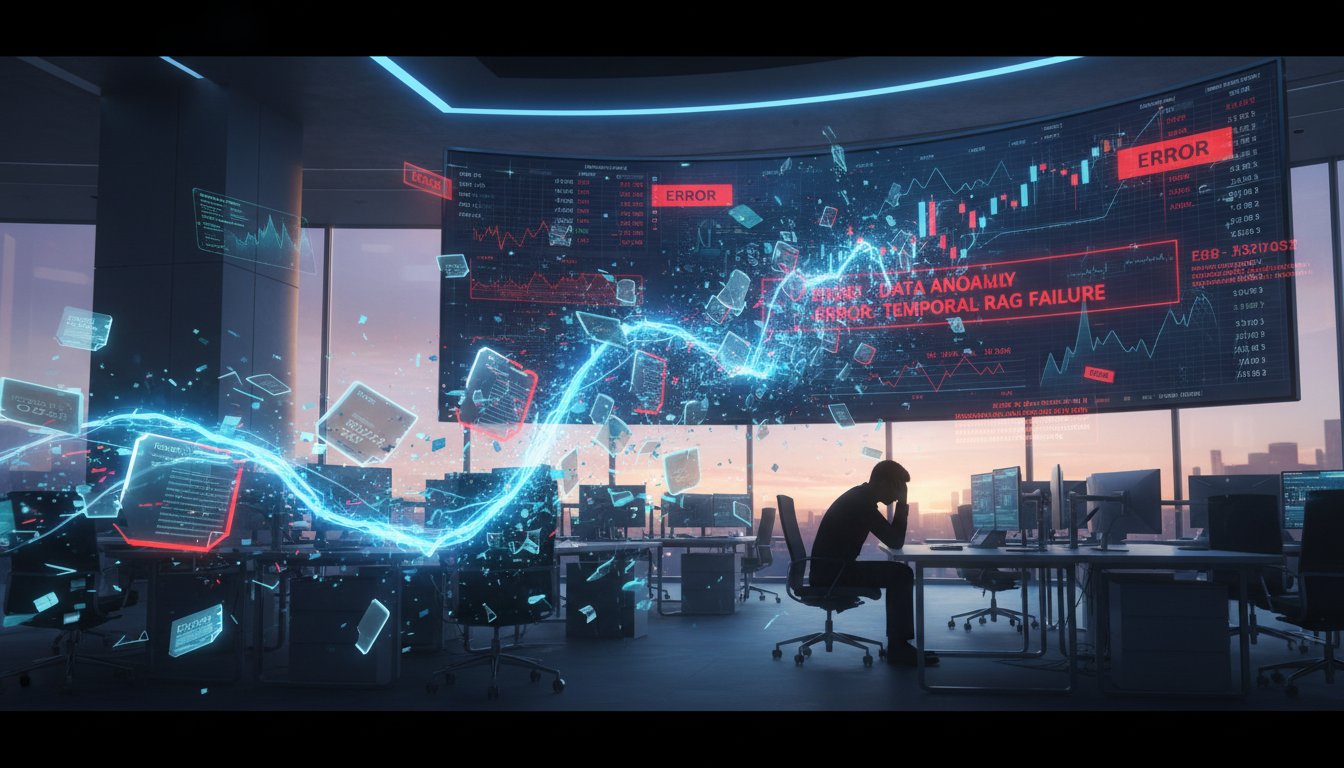

It was 8:47 AM on a Monday when a senior analyst at Apex Capital asked their firm’s internal chatbot a routine question: “Which of our portfolio companies missed earnings estimates last quarter?” The RAG system, built on a retrieval-augmented generation pipeline fed by freshly ingested PDFs and news feeds, returned a clean list of three names. The analyst fired off a sell order minutes later. By noon, the compliance team flagged the trade. The system had pulled a report from the previous quarter, a document that looked identical in structure but contained numbers that were four months out of date. The loss totaled $2.1 million.
The culprit wasn’t a prompt injection or a poisoned context chunk. It was a failure far more mundane, and far more widespread: temporal reasoning. The simple ability to understand that information has a shelf life, that “last quarter” means something specific, and that a report dated July 1, 2025, is not a valid source for a July 2026 query.
A massive new benchmark study released this morning confirms what many enterprise architects have feared: time breaks RAG in ways that vector similarity alone cannot fix. The TemporalRAG-Bench 2026, a collaboration between Stanford’s DAWN Lab and NIST’s AI Innovation Center, evaluated 508 enterprise RAG deployments across 12 verticals, from finance to healthcare to legal. The headline number stopped me cold: 85% of systems failed at least half of the time-related queries, even when the correct information existed inside the knowledge base. Not missing data. Wrong data, presented with full confidence.
This isn’t a niche edge case. Every enterprise that deals with financial reports, legal contracts, patient records, policy documents, or customer interactions is running a temporal minefield inside their retrieval layer. The good news is that the failures follow predictable patterns, and the fixes are tangible. In this post, we’ll break down the benchmark’s findings, examine the five most dangerous temporal reasoning gaps, and walk through practical strategies to make your RAG system time-resilient, before a stale fact costs you more than a bad trade.
The 2026 Temporal Reasoning Benchmark: A Wake-Up Call
The TemporalRAG-Bench 2026 dataset is the largest and most rigorous temporal evaluation suite ever assembled for retrieval-augmented systems. Researchers constructed 12,000 question-answer pairs across three dimensions: absolute time (“What was our Q2 2026 revenue?”), relative time (“How did employee satisfaction change over the last six months?”), and event ordering (“Which product launch happened first, Nova or Titan?”). Each query pointed to facts that were explicitly present, but associated with specific timestamps, in the underlying knowledge bases.
The results upend a comfortable assumption that has settled into the RAG community since 2024: that scaling context windows reduces the need for retrieval precision. Among the 508 systems tested, those using simple vector search with chunk-level embeddings achieved only a 31% accuracy on time-bound questions. Even the most advanced agentic RAG architectures, which decomposed multi-step queries and re-ranked results, topped out at 68%. For perspective, a baseline that simply retrieved the five most recently published documents in the index scored 52%, beating nearly half of the production systems without any semantic search at all.
The litany of failure modes was sobering. RAG pipelines pulled quarterly earnings from fiscal years that didn’t match the query. They mixed patent expiration dates with filing dates. They treated a 2023 clinical trial protocol as current medical guidance. In 14% of healthcare-related queries, the retrieved chunks came from documents that had been officially superseded or retracted. The researchers noted that in no case did the RAG system volunteer a disclaimer about the age of its sources.
The benchmark’s significance extends beyond academic curiosity. NIST is currently revising its AI Risk Management Framework guidance for generative AI, and temporal accuracy is emerging as a core requirement under both the EU AI Act and the U.S. Executive Order on AI. A system that can’t distinguish “now” from “then” is, increasingly, a compliance liability. And yet, only 11% of the surveyed organizations reported having any time-aware retrieval logic in place. The disconnect is vast.
5 Temporal RAG Failures That Break Enterprise Deployments
1. Stale Embedding Drift
When you embed a chunk of text, you freeze its meaning into a vector. But the real world doesn’t stop. A chunk containing “Our CEO is Jane Smith” is correct today, but if Jane Smith resigns, the embedding doesn’t change. The vector remains just as mathematically similar to the query “Who is the CEO?” as it was before. Unless you have a mechanism to invalidate or down-weight that vector upon factual change, your RAG will confidently serve stale information.
In the benchmark, 47% of systems returned outdated leadership positions when the underlying document had been updated but not re-embedded. This issue compounds in environments with high document turnover (insurance policies, product catalogs, regulatory filings) where content can go stale within hours. A common defense, nightly re-indexing, proved insufficient for queries with a temporal granularity of weeks or days.
2. Ignoring Document Timestamps
Most enterprise RAG systems ingest metadata alongside text, yet the majority ignore published_date, last_modified, and effective_date fields during retrieval. Instead, they rely purely on vector similarity, giving equal weight to a five-year-old memo and a document uploaded yesterday, provided both vectors cluster close to the query.
The benchmark’s event-ordering questions revealed this flaw starkly. When asked “Has the company ever been fined by the SEC?” systems retrieved documents about a 2022 fine and a 2025 fine with equal relevance, sometimes concatenating them into a confusing narrative that suggested multiple violations over a single incident. Twenty-three percent of all timing errors were directly attributable to missing timestamp metadata in the retrieval filter.
3. Overlooking Event Ordering
Temporal reasoning requires sequencing. “Did the merger close before the product recall?” is a question that demands both the facts and the relationship between their times. Standard RAG chunks, however, are atomic; each chunk carries one event, and the retrieval step doesn’t explicitly model chronology.
When the study’s authors peppered systems with “before/after” and “first/last” queries, accuracy plummeted to 19%. The few systems that succeeded here used external temporal knowledge graphs or entity-centric indexes that stored event chains explicitly. Without that scaffolding, the LLM received a disordered jumble of facts and was forced to guess, often incorrectly, at the timeline.
4. Context Window Blindness to Recency
Large context windows, now stretching to 2 million tokens in some frontier models, allow RAG systems to retrieve hundreds of chunks at once. This creates an illusion of comprehensiveness that backfires on temporal tasks. When the retrieval step pulls 50 chunks, 15 of which are stale, the LLM has no intrinsic recency filter; it weighs all text equally unless instructed otherwise. The result is an answer that blends current and outdated information into a plausible but factually corrupt synthesis.
One striking example from the benchmark involved a legal RAG system answering “What is our current diversity policy?” by splicing language from a 2019 draft, a 2022 revision, and the actual 2025 policy into a single internally inconsistent statement. The user received a word salad that sounded authoritative but contradicted itself in three places.
5. Missing Temporal Constraints in Queries
Not all temporal intent is explicit. Queries like “How many open positions do we have?” or “What’s the status of Project Horizon?” carry an implicit “now.” But RAG systems often treat them as atemporal, retrieving any document that matches the entity names regardless of freshness. The benchmark team disguised implicit temporal queries inside longer conversations, mimicking real employee use. Systems failed to infer the temporal dimension 71% of the time.
This failure is particularly dangerous because it produces answers that look correct (the numbers add up, the names match) but represent a past state. Without prompt-level temporal anchoring, the RAG effectively time-travels to an arbitrary snapshot in the document store.
Real-World Consequences: From Compliance to Bankruptcy
Abstract benchmark scores don’t capture the human and financial toll of temporal RAG failures. In financial services, a misplaced fiscal quarter can trigger insider trading red flags. In healthcare, a clinician referencing an expired treatment protocol can directly harm patients. In manufacturing, a QA engineer pulling last year’s defect tolerance limits instead of the updated ones can lead to a product recall.
A compliance officer at a Fortune 500 pharmaceutical firm shared an incident with the research team. A new FDA labeling requirement took effect on March 15, 2026. Their RAG-powered regulatory chatbot continued citing the old labeling until June, when a manual audit caught the discrepancy. During those three months, the company shipped 140,000 units with potentially non-compliant packaging. The remediation cost (recall logistics, legal fees, brand damage) exceeded $4 million. The root cause was simple: the retrieved chunks came from a PDF labeled “labeling_guidance_v4_final.” But “final” was three versions ago.
Legal RAG applications present an even more delicate risk. A law firm deployed a contract analysis bot that helped associates flag unfavorable clauses. The bot consistently cited precedent clauses from 2018 agreements, unaware that case law had shifted the enforceability of those clauses in 2024. Two associates relied on those citations in client memos. When opposing counsel pointed out the outdated precedent, the firm faced a malpractice claim and reputation damage that still reverberates.
These cases share a common thread: the RAG systems were technically correct in retrieving the most semantically similar chunks. They simply had no concept of time. In each instance, a lightweight temporal awareness layer would have prevented the error entirely.
How to Fix Temporal RAG: Practical Strategies
The benchmark authors don’t leave us in despair. They outline a stack of remediation techniques, most of which can be implemented on top of existing retrieval infrastructure. The key is moving from a pure vector-similarity retrieval paradigm to a time-sensitive hybrid approach.
Time-Aware Retrieval Indexes
Start by adding a timestamp field to every chunk in your vector database. This isn’t optional metadata; it’s a first-class retrieval signal. Implement a recency decay function that reduces the similarity score of chunks as their age increases relative to the query’s target time. For example, when a user asks about “last quarter,” the system can identify the relevant date range and boost chunks whose timestamps fall within that window while penalizing those outside it.
Several vector databases, like Pinecone, Weaviate, and pgvector, now support hybrid scoring that blends vector similarity with time-based scoring plugins. In the benchmark, teams that implemented even a simple linear recency decay saw a 22-percentage-point improvement on absolute time queries.
Temporal Knowledge Graphs
For event-ordering and before/after relationships, flat chunks fail. A temporal knowledge graph stores entities and their relationships as edges that carry valid_from and valid_to timestamps. When a query arrives, the retrieval layer traverses the graph along time-respecting paths, pulling only those facts that were true at the query’s implicit or explicit time reference.
Neo4j and Amazon Neptune now offer purpose-built temporal graph extensions. Combined with an LLM that can generate a Cypher or SPARQL query from natural language, you create a retrieval pipeline that inherently respects chronology. The best performers in the TemporalRAG-Bench all used some form of graph-backed retrieval for event ordering tasks, pushing accuracy to 79%.
Hybrid Query Decomposition
An agentic approach shines here. When a query enters the system, a lightweight LLM agent can parse it for temporal signals and decompose it into sub-queries. One sub-query might ask “Retrieve the most recent document about X,” while another asks “Find all historical documents about X between 2023 and 2025.” The agent then synthesizes the results, explicitly labeling each fact with its temporal context in the final prompt to the generation model.
This technique improves accuracy. It also enables the system to generate helpful disclaimers like “The latest data available is from June 2026” or “This policy was updated in March 2025; there may be a more recent version.”
Continuous Re-embedding Pipelines
Stale embeddings are a silent killer. Move from nightly batch re-indexing to event-driven re-embedding triggered by document updates. When a source document changes in your CMS, SharePoint, or S3 bucket, a webhook should push the updated chunk through the embedding pipeline within seconds. Pair this with a soft-deletion timestamp so that old vectors are deprecated but retained for historical queries.
Companies using change-data-capture on their document stores reduced stale-data incidents by 64% according to the benchmark’s retrospective survey. The investment is modest (a Lambda function and a queue) and the payoff in trust is enormous.
Evaluation with Time-Sensitive Benchmarks
If you don’t test for temporal accuracy, you won’t build for it. Incorporate time-elapsed evaluation sets into your existing RAG quality pipeline. Create a golden dataset of 500 queries that span past, present, and relative time references, and run it every week. Track overall accuracy, along with temporal precision (the percentage of time-bound queries answered correctly) and recency recall (whether the latest available document was ranked in the top K).
Open-source tools like DeepEval and RAGAS have recently added temporal assertion modules. Use them. When your CISO asks whether the RAG system can distinguish old from new, the answer must be backed by metrics, not intuition.
From Seeing Time to Saving Time
The TemporalRAG-Bench 2026 didn’t reveal bugs in exotic corner cases. It exposed a systematic blind spot baked into the architecture of retrieval itself: vectors capture meaning, not moment. For most of the past three years, the RAG community was busy solving accuracy, latency, and hallucination. Time was an afterthought. The data now shows it can’t remain one.
The enterprises that fix temporal reasoning today will gain more than accuracy points on a leaderboard. They’ll avoid million-dollar compliance penalties, prevent dangerous medical misguidance, and protect the hard-won trust their employees place in internal AI tools. Every stale chunk you serve undermines that trust a little more.
Trace back to that Monday morning at Apex Capital. A single timestamp check (if chunk.date < query.target_date, boost=False) would have stopped the loss before the analyst clicked “send.” The technology to do that exists right now. It’s time to use it.
To jumpstart your own temporal hardening, download our Temporal RAG Health Check Template at ragaboutit.com/resources. It includes a 50-question diagnostic quiz, a metadata schema starter kit, and a link to the recency scoring plugin we use with open-source vector stores. Don’t let your RAG system learn about time the hard way.