
Your enterprise RAG system works perfectly in demos. It answers questions accurately with 10,000 documents. Your leadership is impressed. Your team celebrates.
Then you scale to production.
At 100,000 documents, retrieval precision drops. At 1 million, response quality gets inconsistent. At 30 million documents, your RAG system doesn’t just slow down. It fundamentally breaks. Embedding spaces collapse. Retrieval precision plummets. What worked brilliantly in testing becomes unreliable in production.
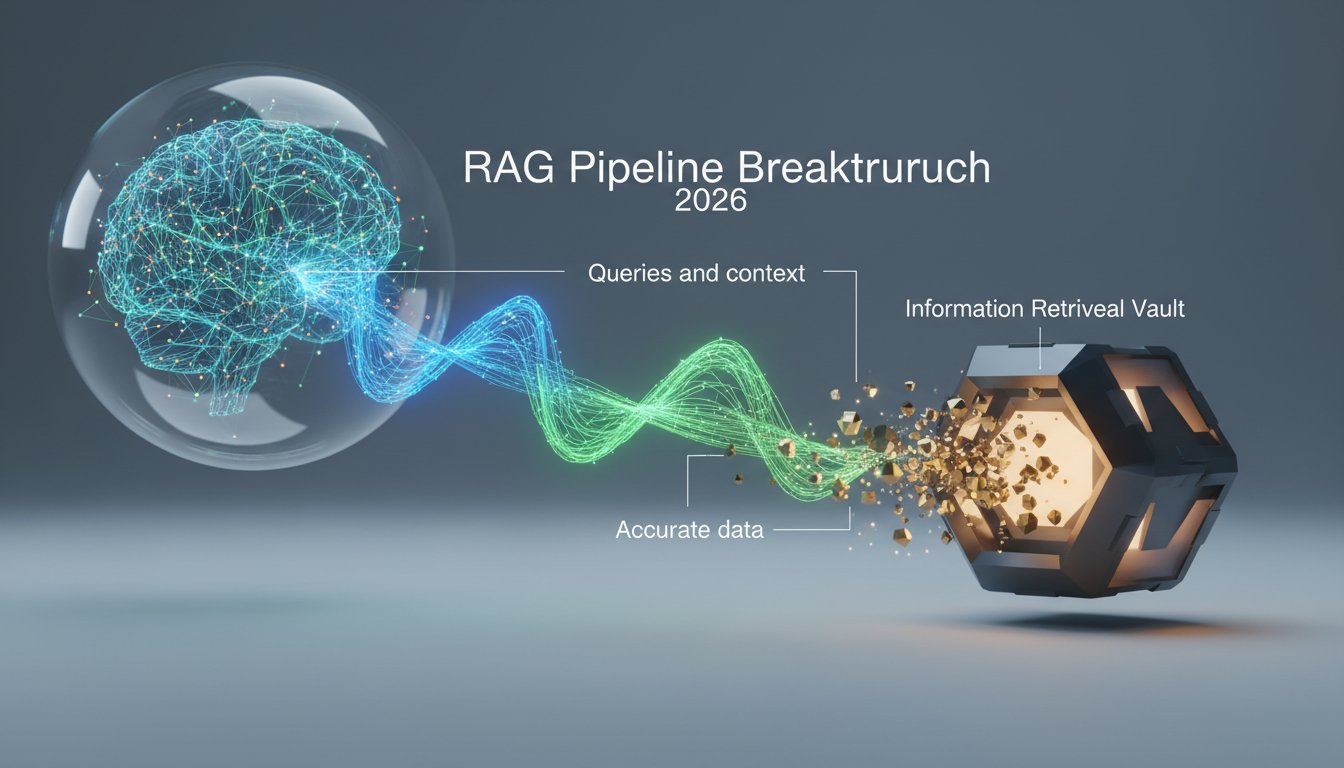
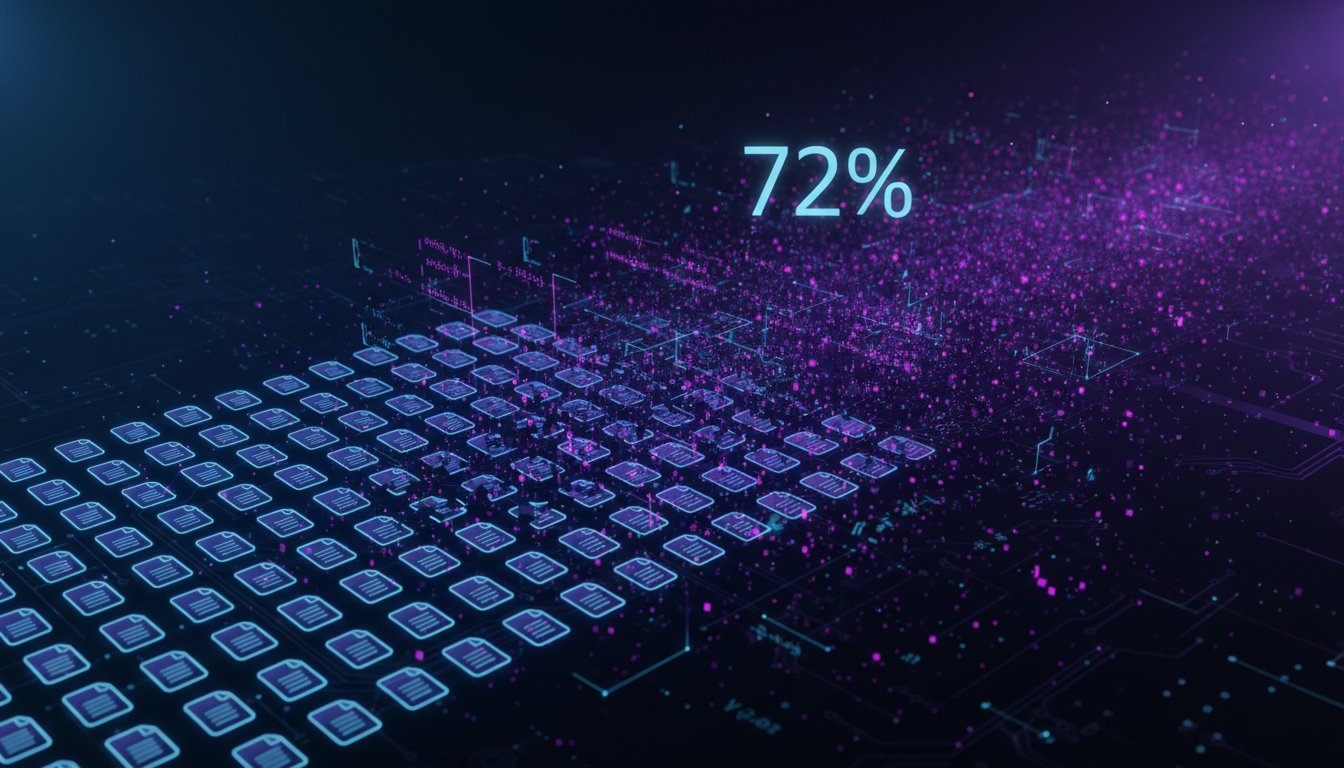
This isn’t a configuration problem. It’s not a tuning issue either. Standard RAG has architectural limitations that no amount of optimization can fix at enterprise scale. And in 2026, the breaking point is no longer theoretical. 72% of enterprise RAG systems fail in their first year, with 80% experiencing critical failures that require complete architectural redesigns.
The companies succeeding at scale aren’t running better versions of Standard RAG. They’ve moved to entirely different architectures. Here’s why Standard RAG fails, and what’s replacing it in production environments right now.
The Five Fatal Flaws of Standard RAG
1. The Embedding Space Collapse
Standard RAG relies on vector similarity to retrieve relevant chunks. This works when your vector space has clear boundaries between concepts. With 10,000 documents, embeddings cluster naturally. Financial concepts separate from legal concepts. Product documentation separates from support tickets.
But as you scale to millions of documents, the curse of dimensionality kicks in. Your embedding space becomes increasingly dense. Distances between semantically different chunks compress. What should be distinct clusters blur together.
The result? Your RAG system retrieves chunks that are vaguely similar but contextually wrong. A query about Q4 revenue projections returns information about Q3 actuals. A question about compliance requirements pulls sections from operational procedures. The cosine similarity scores look fine, 0.87, 0.85, 0.83, but the semantic relevance is broken.
This isn’t fixable by switching embedding models. It’s a mathematical limitation of high-dimensional vector spaces at scale.
2. The Chunking Strategy Paradox
Every RAG implementation starts with the same question: What’s the optimal chunk size?
The answer enterprises discover after deployment: There isn’t one.
Legal contracts need semantic chunking that preserves clause relationships. Source code requires syntax-aware chunking that maintains function context. Financial documents demand section-based chunking that keeps tables with their explanatory text. Customer support tickets work best with conversation-thread chunking.
Standard RAG uses fixed-size chunking, 512 tokens, 1024 tokens, maybe with 10% overlap. This one-size-fits-all approach guarantees you’re chunking incorrectly for most of your documents. Critical context gets split across chunks. Related information gets separated. Document structure gets destroyed.
When retrieval pulls a chunk that starts mid-sentence and ends mid-thought, your LLM hallucinates to fill the gaps. The 97% accuracy you saw in testing becomes 73% in production because your chunking strategy fundamentally mismatches your data topology.
3. The Multi-Hop Reasoning Failure
Consider this enterprise query: “What were the compliance violations in Q3, and how do they relate to our current vendor contracts?”
This requires:
– Retrieving Q3 compliance reports
– Identifying specific violations
– Accessing vendor contract terms
– Mapping violations to contractual obligations
– Synthesizing cross-document relationships
Standard RAG retrieves the top-k chunks by vector similarity. It might pull relevant compliance documents. It might pull vendor contracts. But it can’t traverse the relationships between them. It can’t perform multi-hop reasoning across connected entities.
Your RAG system returns information about compliance and information about contracts, but fails to answer the actual question about their relationship. Users get frustrated. Adoption drops. Your carefully tuned RAG system gets labeled “unreliable” because it simply cannot handle relational queries.
4. The Query Decomposition Inconsistency
Some RAG implementations try to solve complex queries through decomposition, breaking “What were Q3 violations and how do they relate to vendor contracts?” into sub-queries.
In theory, this works. In practice, it introduces new failure modes.
Query decomposition depends on the LLM correctly understanding intent and creating consistent sub-queries. But LLM outputs are probabilistic. Run the same query twice, get different decompositions. One might focus on violation severity, another on violation timing. One might prioritize active contracts, another historical contracts.
This inconsistency compounds when you’re retrieving based on decomposed queries. Different sub-queries retrieve different chunks. Different chunks lead to different synthesized answers. Your users ask the same question Monday and Friday and get contradictory responses.
The accuracy of your end-to-end RAG pipeline is multiplicative: Retrieval accuracy × Re-ranking accuracy × Generation accuracy × Query decomposition consistency. Each component below 95% accuracy drops your total system reliability dramatically.
5. The Real-Time Data Blind Spot
Standard RAG works with static documents in a vector database. But enterprise decisions require real-time data, current inventory levels, live financial metrics, updated customer status, active system states.
A question like “What’s our current burn rate given yesterday’s expenses?” requires:
– Querying live financial databases
– Calculating based on recent transactions
– Comparing against budget projections
– Synthesizing numerical results with contextual understanding
Standard RAG can’t do this. It retrieves documents about burn rate calculations, but can’t execute queries against live data. It provides outdated information from the last vector database update, which might be hours or days old.
Enterprises need RAG systems that can both retrieve documents and compute over live data. Standard RAG’s architecture has no mechanism for this.
What’s Replacing Standard RAG in 2026
The enterprises succeeding at scale aren’t fixing Standard RAG. They’re deploying fundamentally different architectures built for production realities.
Graph-Enhanced RAG: For Relational Knowledge Domains
Graph-Enhanced RAG pairs vector retrieval with knowledge graphs that capture entity relationships. Instead of just retrieving similar chunks, it traverses connected entities to perform multi-hop reasoning.
When to use it:
– Financial services (tracking entities across compliance, contracts, transactions)
– Legal tech (connecting cases, statutes, precedents)
– Healthcare (relating patients, treatments, outcomes, research)
How it works:
LLMs extract entities and relationships from documents to build a knowledge graph. Queries traverse this graph to synthesize information across connected nodes. A question about compliance violations and vendor contracts can move from violation entities to related contract entities, pulling relevant context at each hop.
The tradeoff:
Graph construction and maintenance are computationally expensive. Initial setup requires significant engineering effort. But for relational queries, the accuracy improvement is real. Enterprises report 30-40% better performance on complex multi-hop questions.
Agentic RAG: For Complex Analytical Tasks
Agentic RAG puts an LLM inside the retrieval loop, allowing iterative planning, reasoning, and retrieval refinement. Instead of a single retrieve-and-generate cycle, the agent can:
– Analyze the query to determine retrieval strategy
– Retrieve initial information
– Assess gaps and retrieve additional context
– Reason over retrieved information
– Decide what else is needed
When to use it:
– Strategic analysis requiring synthesis across diverse sources
– Research tasks with evolving information needs
– Scenarios where initial context reveals the need for additional retrieval
How it works:
The LLM acts as a reasoning agent that controls retrieval. It might start with a broad query, analyze results, then issue more specific follow-up retrievals. This iterative process continues until the agent determines it has enough information to answer accurately.
The tradeoff:
Higher latency due to multiple retrieval rounds, and increased LLM costs from reasoning at each iteration. But for complex analytical queries, this architecture delivers accuracy that Standard RAG simply can’t match. Some enterprises report a 50% reduction in hallucinations on multi-step reasoning tasks.
Hierarchical and Contextual Chunking: For Document Structure Preservation
Instead of fixed-size chunks, hierarchical chunking intelligently parses documents to preserve structural elements, sections, subsections, tables, code blocks, lists.
When to use it:
– Technical documentation with nested structure
– Legal documents with clause hierarchies
– Financial reports with section-table relationships
How it works:
Document parsers identify structural elements and create chunks that respect semantic boundaries. A legal contract gets chunked by clause. A technical spec gets chunked by section and subsection. Financial reports keep tables with their explanatory paragraphs.
Retrieval can happen at multiple granularity levels. Retrieve a top-level section, then drill down to specific subsections based on query requirements.
The tradeoff:
This requires more sophisticated parsing for different document types. You can’t use one-size-fits-all chunking. But retrieval precision improves significantly because chunks maintain semantic coherence and structural context.
Hybrid Retrieval with Re-Ranking: For Precision at Scale
This approach combines dense vector search (semantic similarity) with sparse keyword search (exact matching) and machine learning re-ranking.
When to use it:
– Large-scale document repositories where precision is critical
– Domains with technical terminology where exact keyword matching matters
– Enterprise search where users expect both semantic and exact-match capabilities
How it works:
Parallel retrieval runs using both dense embeddings and sparse BM25/keyword search. Initial candidates from both methods get passed to a re-ranking model trained on domain-specific relevance. This two-stage retrieval dramatically improves precision.
The tradeoff:
Increased infrastructure complexity from maintaining both vector and keyword indices, plus higher computational cost for re-ranking. But retrieval precision can improve by 25-35%, especially for queries with specific technical terms or proper nouns that embeddings handle poorly.
Talk to Data Interfaces: For Live Data Integration
This approach gives LLMs the ability to generate and execute queries against structured databases, APIs, and live data streams.
When to use it:
– Financial analysis requiring current metrics
– Operational dashboards combining static documentation with live system state
– Customer support needing both knowledge base retrieval and account status queries
How it works:
The LLM analyzes the query, determines what requires database queries vs. document retrieval, generates appropriate SQL or API calls, executes them, and synthesizes results with retrieved documentation.
A query about current burn rate triggers a database query for recent expenses, a calculation based on retrieved results, and synthesis with budget documentation from the vector database.
The tradeoff:
This requires secure query execution sandboxes, careful permission management, and validation of LLM-generated queries. But it enables RAG systems to answer questions that require real-time computation, not just document retrieval.
Making the Transition: A Practical Implementation Strategy
Migrating from Standard RAG to advanced architectures isn’t a simple swap. Here’s the framework enterprises are using.
1. Audit Your Current Pipeline
Before choosing a replacement architecture, understand where your Standard RAG actually fails:
– Track queries by type (factual lookup vs. relational vs. analytical)
– Measure retrieval precision by query category
– Identify failure modes (wrong chunks retrieved, correct chunks retrieved but answer wrong, multi-hop reasoning failures)
– Document user complaints and support tickets about RAG accuracy
This audit reveals which architectural limitations affect you most.
2. Match Architecture to Query Distribution
Different enterprises have different query profiles:
– Financial services with heavy compliance/contract queries: Graph-Enhanced RAG
– Research and analytical use cases: Agentic RAG
– Technical documentation with complex structure: Hierarchical Chunking
– Large-scale search requiring high precision: Hybrid Retrieval with Re-Ranking
– Operational queries mixing static docs and live data: Talk to Data Interfaces
You may need multiple architectures for different use cases. That’s normal. Standard RAG’s one-size-fits-all approach is exactly what doesn’t work at scale.
3. Start with the Highest-Impact Use Case
Don’t try to migrate your entire RAG system at once. Find the use case where Standard RAG fails most often and causes the most user frustration. Implement an advanced architecture for just that use case.
Then measure the impact:
– Retrieval precision improvement
– Answer accuracy improvement
– User satisfaction scores
– Reduction in “I don’t know” or hallucinated responses
Use those metrics to justify broader migration.
4. Build Evaluation Frameworks Before Deploying
Standard RAG’s failures often go undetected because enterprises lack proper evaluation frameworks. Before deploying advanced architectures, put these in place:
– Retrieval precision metrics: Are you retrieving the right chunks?
– Answer accuracy metrics: Given retrieved chunks, is the generated answer correct?
– End-to-end accuracy: Is the final answer users receive correct?
– Hallucination detection: Are answers unsupported by retrieved context?
– Latency monitoring: How long do queries take?
Advanced architectures are more complex. Without solid evaluation, you won’t know if they’re actually improving performance.
5. Invest in Observability
One reason Standard RAG fails silently is lack of visibility. Build observability for:
– Query patterns and distributions
– Retrieval results and relevance scores
– Re-ranking decisions
– Generated answers and confidence scores
– User feedback, both explicit and implicit
This data feeds continuous improvement and helps you catch degradation before users start complaining.
The Path Forward
Standard RAG served its purpose. It proved that retrieval-augmented generation works for enterprise use cases. But its architectural limitations make it unsuitable for production scale.
The enterprises succeeding in 2026 recognize that RAG isn’t one architecture. It’s a category of approaches. They’re deploying Graph-Enhanced RAG for relational reasoning, Agentic RAG for complex analysis, hierarchical chunking for document structure, hybrid retrieval for precision at scale, and Talk to Data interfaces for live information. Often in the same organization, for different use cases.
This shift isn’t theoretical. It’s happening right now. The question isn’t whether to move beyond Standard RAG. It’s which advanced architecture matches your specific failure modes and query distributions.
At 30 million documents, Standard RAG doesn’t just slow down. It breaks. And the cost of that breakage, in user trust, operational efficiency, and competitive advantage, far exceeds the engineering investment in better architectures.
Your Standard RAG worked beautifully in the demo. Now it’s time to build something that actually works in production. If you’re ready to assess which architecture fits your scale, start with a query audit of your current system. The failure patterns will tell you exactly where to go next.